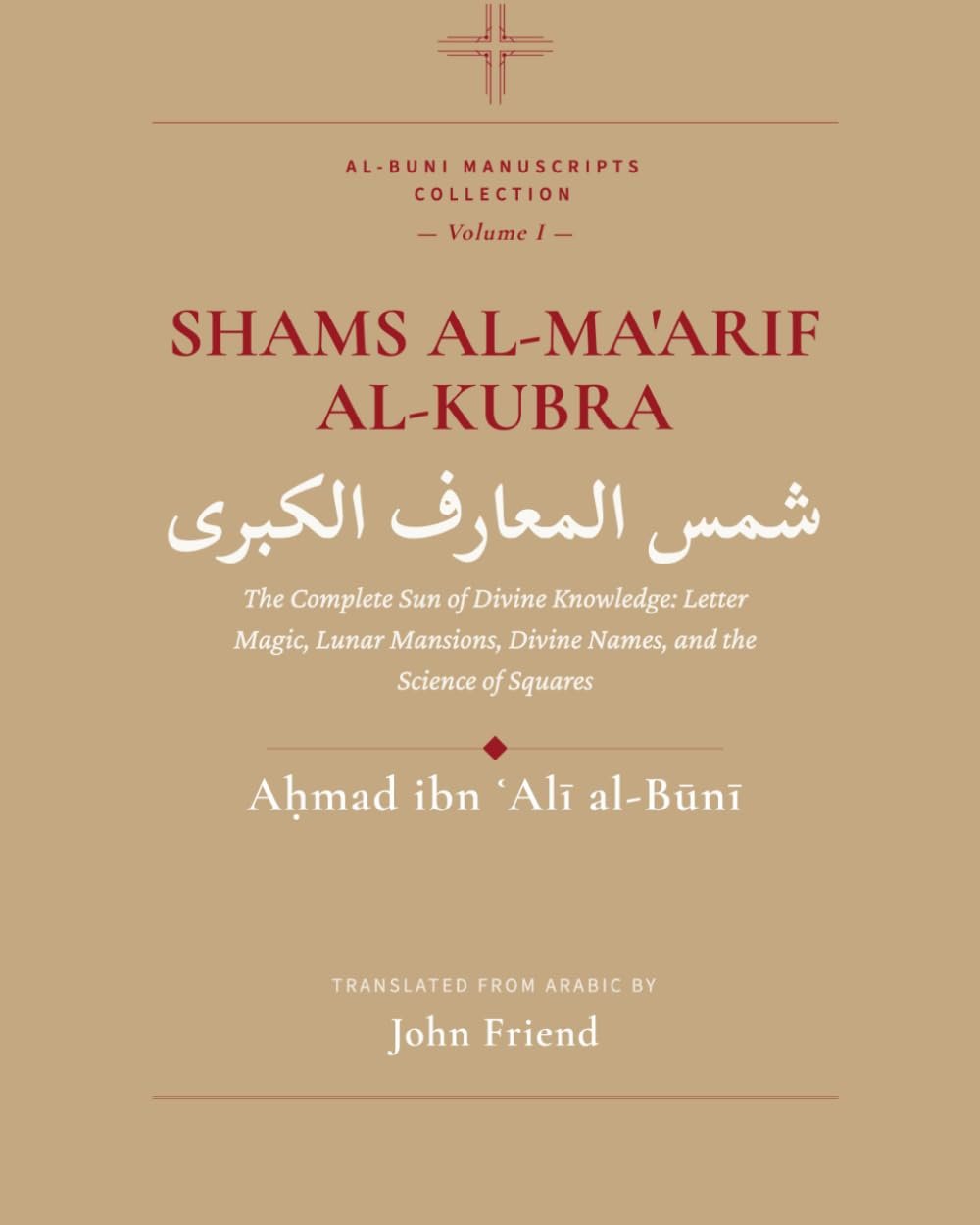
When a Western mathematician encounters a magic square, she sees a number puzzle — a grid in which every row, column, and diagonal sums to the same constant. It is elegant. It is interesting. It is a curiosity for recreational mathematics journals and the backs of cereal boxes. When a practitioner in the Arabic magical tradition encounters the same grid, he sees something entirely different: a precision-engineered talisman, a mathematical engine designed to capture, concentrate, and direct a specific planetary force into the physical world. The grid is not a puzzle. It is a machine. And the numbers inside it are not arbitrary integers — they are the numerical values of divine names, computed through the Abjad system and arranged according to rules that have nothing to do with mathematics for its own sake and everything to do with making things happen.
The Arabic term is wafq (plural: awfaq). It is usually translated as “magic square,” but that translation is misleading in exactly the way that matters most. It strips the object of its function. A wafq is not “magic” in the vague, decorative sense. It is an instrument of applied cosmology — a device that exploits the correspondence between numbers, letters, divine names, and celestial bodies to produce measurable effects in the world. Ahmad al-Buni’s Shams al-Ma’arif provides the theoretical framework. Ibn al-Hajj al-Tilmsani’s Shams al-Anwar wa Kunuz al-Asrar al-Kubra provides the operational procedures — the step-by-step instructions for actually building and activating these grids. The difference between the two texts is the difference between a physics textbook and an engineering manual.
One Planet, One Grid: The Seven Arabic Talismanic Squares
The foundational principle of the awfaq system is that each grid size corresponds to a specific planet, and therefore to a specific domain of influence. This is not a metaphor. It is a precise assignment, as rigid as the periodic table:
| Grid | Planet | Day | Example Divine Name |
|---|---|---|---|
| 3 × 3 | Saturn (Zuhal) | Saturday | Al-Badi’ (The Originator) |
| 4 × 4 | Jupiter (Mushtari) | Thursday | Al-Basit (The Expander) |
| 5 × 5 | Mars (Mirrikh) | Tuesday | Al-Qahhar (The Subduer) |
| 6 × 6 | Sun (Shams) | Sunday | Al-Malik (The King) |
| 7 × 7 | Venus (Zuhara) | Friday | Al-Wadud (The Loving) |
| 8 × 8 | Mercury (‘Utarid) | Wednesday | Al-Hakim (The Wise) |
| 9 × 9 | Moon (Qamar) | Monday | Al-Mu’izz (The Bestower of Honor) |
A practitioner seeking to attract wealth and good fortune constructs the 4×4 Jupiter square. One seeking authority and public recognition uses the 6×6 solar square. One seeking to inspire love or reconciliation builds the 7×7 Venus square. The grid size is not chosen arbitrarily or aesthetically — it is determined by the nature of the desired outcome, because each planet governs a specific domain of worldly affairs. Choose the wrong grid, and you are tuning the instrument to the wrong frequency. It will produce nothing.
The grimoires state these assignments outright. The Shams al-Anwar names them in order: “the smallest magic square is the three-by-three square, and it is called the square of Saturn” — followed by the four-by-four of Jupiter, the five-by-five of Mars, the six-by-six square of the Sun, the seven-by-seven of Venus, the eight-by-eight of Mercury, and the nine-by-nine of the Moon. It also gives each square a use: carry the square of Jupiter and “you will find favor in the eyes of judges and rulers”; carry the square of Venus and “you will find love and affection from all people.” The magic square of the Sun and the Venus magic square (7x7) each have an article of their own.
The Numbers Are Not Random
This is the point where the Arabic system diverges most sharply from recreational mathematics. In a Western magic square, the numbers are simply integers arranged to satisfy the constant-sum property. In an awfaq, every number in the grid is derived from a divine name through the Abjad numeral system — the ancient system in which each Arabic letter corresponds to a specific numerical value. Alif is 1, ba’ is 2, jim is 3, and so on through ghayn at 1000.
To construct a wafq, the practitioner begins with the divine name appropriate to the operation. He calculates its Abjad value — the sum of all its letters. He then derives from that value a “seed number” that generates the entire grid. The Shams al-Anwar provides the algorithms for this derivation in meticulous detail: how to reduce the seed, how to distribute it across rows and columns, how to adjust for odd and even grid sizes, how to handle remainders. The result is a grid in which every number traces back to the divine name — and therefore to the planetary force that the name invokes.
This means the constant sum of each row, column, and diagonal is not merely a mathematical curiosity. It is the total spiritual “charge” of the name, distributed evenly across the grid. Every path through the square carries the same power. Every direction radiates the same force. The Shams al-Ma’arif describes this as the name being “imprisoned” in the grid — held in a state of mathematical equilibrium that prevents the force from dissipating and instead concentrates it into the physical medium on which the square is inscribed.
Three Kinds of Wafq: Numbers, Letters, or Both
Within the Islamic occult sciences, magic squares come in more than one kind, and not every wafq is a grid of numbers. The Shams al-Anwar distinguishes three kinds of Arabic talismanic square: the simple square (al-wafq al-basit), “in which only numbers are placed”; the lettered square (al-wafq al-harfi), “in which the letters of a divine name are distributed according to their numerical values”; and a combined square of letters and numbers together, which it calls “the most powerful type.” The sum shared by every row, column, and diagonal has its own name, the constant (al-thabit), and the square’s basis (asas) “corresponds to the numerical value of the divine name or word that the square is constructed to embody.”
The same text treats the plain three-by-three, al-muthallath, as “the foundation upon which all other squares are built.” From this natural square (al-wafq al-tabi’i), the harmonized squares (al-awfaq al-muwaffaqah) are derived “through specific operations of transposition and rotation.” This is how the Arabic magic square (wafq) — the Islamic magic square of the grimoires — can carry the value of any divine name: the grid is tuned to the name, not the other way around. Al-Buni’s own construction rules for odd, even, and even-odd grids are covered in how al-Buni built Arabic magic squares.
Activation Is Not Optional
Writing the numbers in a grid is the beginning, not the end. A wafq that has been drawn but not activated is inert — a diagram and nothing more. The Arabic manuscripts are emphatic on this point, and it is the point that every modern book on “magic squares” manages to miss entirely.
Activation requires five conditions, all of which must be satisfied simultaneously:
- Correct planetary hour. The square must be inscribed during the planetary hour governed by the planet of the grid. A Jupiter square inscribed during a Mars hour is at best useless, at worst actively harmful. The al-Jawahir al-Lamma’a provides complete planetary-hour tables and warns that even a few minutes’ miscalculation can void the entire operation.
- Proper fumigation. Each planet has a specific incense. Saturn: myrrh and storax. Jupiter: saffron and aloe-wood. Mars: pepper and sulfur. The smoke carries the inscription from the physical plane into the spiritual plane. The Shams al-Anwar provides the exact recipes, including weights and preparation methods.
- Ritual purity. The practitioner must be in a state of taharah — complete ritual purity, including ablution, fasting, and clean garments. The Tumtum al-Hindi adds that the practitioner must have refrained from sexual contact for a specified number of days prior to the work.
- Facing the qibla. The practitioner must face the direction of Mecca during the entire inscription process. This is not symbolic. The manuscripts treat the qibla as a directional anchor that orients the spiritual forces being invoked.
- Memorized recitation. The divine name whose Abjad value generated the grid must be recited continuously throughout the inscription — a specific number of times, determined by the planet. The recitation must be from memory, not read from a page. The Ghayat al-Hakim (known in the Latin West as the Picatrix) confirms this requirement from the Hermetic side of the tradition: the voice must carry the name into the object without interruption.
Skip any one of these conditions, and the grid remains dead. The Shams al-Ma’arif compares an unactivated wafq to “a lamp with no oil” — the structure is correct, but there is nothing burning inside it.
Why Al-Buni Is Not Enough
Al-Buni’s Shams al-Ma’arif is the most famous Arabic text on magic squares, and it deserves its reputation. Al-Buni explains the theory with a clarity that no other author matches. He establishes the planetary correspondences, the Abjad derivations, the spiritual mechanics of why the squares work. But al-Buni is a theorist. His text is a treatise, not an instruction manual. He tells you what a wafq is and why it functions. He does not always tell you, step by step, how to build one from scratch and activate it for a specific purpose.
That is what the Shams al-Anwar provides. Ibn al-Hajj al-Tilmsani, writing approximately a century after al-Buni in the same North African magical lineage, composed the Shams al-Anwar as an operational companion to the Shams al-Ma’arif. Where al-Buni gives the theory, Tilmsani gives the procedure. Where al-Buni says “construct the square of Jupiter,” Tilmsani says: “Take a sheet of clean paper. Calculate the Abjad value of al-Basit. The value is 72. Divide as follows…” and proceeds through every arithmetic step, every inscription sequence, every recitation count, every fumigation instruction.
The two texts were clearly designed to be read together. The Shams al-Ma’arif without the Shams al-Anwar gives you understanding without capability. The Shams al-Anwar without the Shams al-Ma’arif gives you procedures without comprehension. The Arabic tradition insists on both.
Magic Squares in the Shams al-Ma’arif
None of this means the Shams al-Ma’arif is thin on squares. The Shams al-Ma’arif magic squares run from four angelic awfaq — a triangle for ‘Azra’il, a square for Israfil, a sevenfold form for Jibra’il, and an eightfold form for Mika’il, each with its own day of the week — to squares built on single divine names such as al-Rahman, al-Rahim, al-Salam, and al-Latif, and a wafq of Surat al-Fatihah for love and favor. It is also where the Buduh square appears by name: one operation for a marriage proposal tells the reader to “write Budūḥ in the middle of a square” and tie it beneath the wing of a white dove.
In the English edition of the Shams al-Ma’arif al-Kubra, many of these figures are printed with the manuscript image at left and a transcription at right, so the Arabic grimoire magic squares can be checked against their source. For a second Arabic magic square manuscript, organized around the days of the week, see the Shams al-Anwar.
What the Picatrix Got Right — and What It Left Out
The Ghayat al-Hakim — composed in al-Andalus around the mid-tenth century and later translated into Latin as the Picatrix — contains significant material on planetary talismans, including references to magic squares. The Hermetic framework of the Ghayat al-Hakim overlaps with the Arabic awfaq tradition at several points: the planet-grid correspondences, the timing requirements, the insistence on correct fumigation. The Picatrix is, in this respect, a genuine witness to the same body of knowledge.
But the Picatrix is a philosophical compilation, not an operator’s manual. It discusses magic squares within a broader framework of astral magic and Neoplatonic cosmology. It does not provide the Abjad derivations. It does not provide the step-by-step construction algorithms. It does not provide the activation protocols with the specificity that the Arabic operational grimoires demand. A reader of the Picatrix will understand that magic squares are planetary instruments. That same reader will not be able to construct one correctly from the text alone.
How the planetary squares fared once they crossed into Latin is its own story; the Picatrix magic squares and the talismans built from them are examined separately.
The operational detail lives in the Arabic-language source texts — in the Shams al-Anwar, in the al-Jawahir al-Lamma’a, in the Tumtum al-Hindi, and in the dozens of related manuscripts that have never been translated. Until now, English-language readers have had the theory without the practice. The translations published by John Friend Publishing are intended to close that gap.
The Jinn Connection
There is one further dimension to the awfaq system that no discussion of “magic squares” in Western sources ever mentions: the relationship between the planetary squares and the jinn hierarchies.
Each planet governs not only a day, a metal, an incense, and a domain of influence, but also a specific king of the jinn.
The al-Jawahir al-Lamma’a makes this explicit. The book is published in English as The Radiant Jewels for Summoning the Kings of Jinn, a title that refers precisely to this operational connection between planetary talismans and jinn conjuration. The awfaq are not merely abstract spiritual devices. They are, in practice, calling cards — instruments that identify the practitioner to the appropriate planetary ruler and establish the channel through which communication and command become possible. The Jinn Kings volume provides names, seals, and protocols for the jinn kings it names.
This is why treating magic squares as number puzzles is not merely incomplete — it is a category error. It is like studying a radio schematic as an exercise in geometry. The geometry is real, but it is in service of something else entirely: the transmission and reception of a signal.
Where to Read the Complete System: Awfaq Books in English
The construction algorithms, the Abjad derivation tables, the planetary-hour protocols, the fumigation recipes, the activation procedures, and the jinn-king correspondences for all seven planetary squares are available in English for the first time in the following translations:
- Shams al-Anwar wa Kunuz al-Asrar al-Kubra (Volume III) — the primary operational text for awfaq construction and activation, by Ibn al-Hajj al-Tilmsani.
- al-Jawahir al-Lamma’a: The Radiant Jewels for Summoning the Kings of Jinn (Volume V) — the jinn-king hierarchies and planetary conjuration protocols.
- Tumtum al-Hindi: The Book of the Indian Sage (Volume VI) — supplementary planetary talismanic material, including variant awfaq designs from the Indian esoteric tradition.
If you want one awfaq book to begin with, start with the Shams al-Anwar: its ninth chapter, on the placement of the awfaq, calls itself “the most technical of all the chapters in this book,” and its subtitle announces “Talismanic Squares” alongside the divine names, planetary magic, and the science of letters. For al-Buni’s own construction treatises, add Volume III of the Al-Buni Manuscripts Collection, the Manba’ Usul al-Hikma.
The squares are not puzzles. They are instruments. The manuscripts provide the engineering. All that remains is the discipline to use them correctly.
