Aleister Crowley called it indispensable. The Golden Dawn built their hierarchy of spirits around it. Contemporary practitioners from Chaos Magicians to Thelemites treat it as foundational. The Lesser Key of Solomon — the Lemegeton, and specifically its first book, the Goetia — has been the backbone of Western ceremonial demonology since at least the 17th century. It names 72 spirits. It gives their ranks, their sigils, their powers, and their hierarchies. And it presents itself as an ancient Solomonic text, the preserved wisdom of the great king about the spirits he commanded. What most practitioners who work with the Goetia do not know is that the actual Solomonic tradition — the original, operational, pre-Latin version — was Arabic. And the Arabic source-texts are still available. In English, for the first time.
The Ars Goetia Manuscript: Self-Presentation vs. Actual History
The Lemegeton presents itself as ancient. The name “Lesser Key of Solomon” implies that somewhere there is a Greater Key, and that both keys represent Solomon’s own transmissions about the spiritual beings he governed. The sigils and names of the 72 spirits have an archaic, authoritative look. Everything about the presentation of the text suggests great age and authentic Solomonic pedigree.
The actual manuscript history tells a different story. The Lemegeton as a composite text — pulling together five distinct books including the Goetia, the Theurgia Goetia, the Ars Paulina, the Ars Almadel, and the Ars Notoria — appears to have been assembled in its current form no earlier than the 17th century CE. The earliest reliably datable manuscripts are from the mid-1600s. Aleister Crowley’s 1904 edition, produced with Samuel Liddell MacGregor Mathers, was based on a British Museum manuscript of similarly recent vintage.
None of this means the Goetia is simply invented. The material it compiles has genuine roots reaching back through the medieval Latin magical tradition — grimoires like the Key of Solomon (Clavicula Salomonis), the Liber Juratus (the Sworn Book of Honorius), and a range of other texts that circulated in manuscript form across medieval Europe. And those Latin texts, in turn, have roots that reach back further — to the Arabic tradition, via the translation centers that transmitted Islamic intellectual culture into Latin Europe.
The Translation Corridors: How Arabic Magic Became Latin Magic
The mechanism by which Arabic occult knowledge reached medieval Europe is reasonably well-documented by historians of science and philosophy, even if it remains largely unknown to practitioners working with the resulting texts.
The primary pathways were two. The first and more important was the translation school of Toledo, in the 12th century CE. Toledo had been an Islamic city until its reconquest by Alfonso VI of Castile in 1085 CE, and it retained a population of Arabic-speaking scholars — Muslims, Jews, and Christians — long after the political transfer. Under Archbishop Raymond of Toledo (r. 1125–1151 CE) and his successors, Toledo became the most important center of Arabic-to-Latin translation in Europe. Scholars including Gerard of Cremona, Dominicus Gundissalinus, and John of Seville worked there, producing Latin translations of Arabic texts on astronomy, medicine, philosophy, and — alongside these — astrology and occult science.
The second pathway was Sicily, where Norman rulers governed a trilingual kingdom (Arabic, Latin, Greek) that similarly facilitated translation. Frederick II of Sicily (1194–1250 CE), the Holy Roman Emperor who was simultaneously fascinated by Arabic learning and perpetually at war with the papacy, patronized scholars who worked across all three languages and whose output included occult texts.
What came through these translation corridors was not neutral. Translation is transformation. The Arabic texts that became Latin grimoires were abbreviated, rearranged, interpolated, and adapted to a Latin Christian context. The result was that certain elements of the original Arabic systems — the planetary timing, the fasting and purification protocols, the divine-name authority structure, the specific cosmological framework within which the operations made theological sense — were attenuated or lost entirely, while other elements (the names and sigils of spirits, the basic hierarchical structure) were preserved.
This is, in a single sentence, the story of what the Goetia got wrong: it preserved the names but lost the framework.
That is the short answer to the question of the Goetia’s Arabic origin: not a single lost Arabic Goetia, but a body of Arabic Solomonic practice whose names and hierarchies survived the crossing into Latin while its framework did not.
Names That Overlap: The Arabic and the Goetia
The overlap between the names of spirits in the Goetia and the names of spiritual beings in the Arabic Solomonic tradition is not complete, and any specific claim about direct borrowing requires careful source-by-source comparison. But the overlaps that exist are striking enough to merit attention.
The Arabic tradition of the seven jinn kings — whose names include al-Mudhhab, Murra, al-Ahmar, Barqan, Shamhurash, Zawba’a, and Maymun — does not map directly onto the 72 demons of the Goetia. The two lists are not the same list with different names. But they share a common structural logic: spirits organized into hierarchies with ranks (kings, dukes, marquises, presidents — in the Latin tradition; kings and their subordinates — in the Arabic tradition), each with a specific domain of power, each with specific planetary or elemental correspondences, each accessible only through properly constituted ritual authority.
More specifically, certain names in the Goetia’s list bear resemblances to names that appear in Arabic demonological and jinn literature. The spirit Furcas, for instance, may have connections to Arabic magical traditions through intermediate Latin-Arabic transmission, though the specific etymological chain is disputed. The spirit Murmur in the Goetia has been compared by some researchers to the Arabic demonic figure Murra. These connections remain at the level of scholarly hypothesis rather than established fact, and readers should approach specific name-by-name comparisons with appropriate caution.
What is not in dispute is the structural correspondence: both the Arabic tradition and the Goetia are organizing the same ontological territory — a population of powerful non-human beings, ranked and specialized, accessible through Solomonic authority — by means of similar taxonomic principles inherited from the same general cultural stream.
72 Spirits, Seven Kings: Is There an Arabic List of 72 Jinn Names?
The question usually means an Arabic original of the Goetia’s catalogue of 72 jinn names. None of the Arabic Solomonic texts translated in this series contains such a list. The catalogue belongs to the Ars Goetia. The number itself does appear in the Arabic material: an invocation in the Mujarrabat al-Ruhban calls on “the seventy-two tribes” alongside the seven kings — but it does not name them, and the sources organize their spirits differently.
Their organizing number is seven. The Radiant Jewels (al-Jawahir al-Lamma’a) says that among the spirits who serve the practitioner “the greatest are the seven kings of the jinn, each associated with one of the seven days and one of the seven planets.” Kitab al-Ajnas gives a whole part to “The Planetary Kings and Their Seals,” and the Radiant Jewels also sorts the jinn into four kinds by element, with fire jinn (al-Marid) and air jinn (al-Ifrit) among them. For the jinn names in this system, with the 7 jinn kings taken one by one, see the real Arabic jinn names of the seven kings.
What the Latin Tradition Lost: The Operational Framework
The most significant thing lost in the Arabic-to-Latin transmission is the cosmological and operational framework that gave the Arabic Solomonic tradition its internal coherence.
In the Arabic tradition, every operation involving spiritual beings takes place within a carefully specified temporal and cosmological context. Planetary hours determine when a spirit associated with a particular planet can be effectively contacted. Fasting and purification protocols establish the practitioner’s ritual suitability for the contact. Specific Quranic verses or divine names, recited in specific sequences, provide the authority by which the practitioner demands the spirit’s attendance and compliance.
Crucially, the authority in the Arabic system is never the practitioner’s own. It derives from a chain: from God, to Solomon (to whom God explicitly granted authority over spirits, per the Quran), to the practitioner who invokes Solomon’s authority. This is a theological architecture — a coherent account of why a human being has any right to speak to a jinn king and expect to be obeyed.
The Goetia preserves the forms — the names, the sigils, the circles of protection — but the theological architecture is attenuated. The 17th-century Lemegeton invokes divine names, but they appear more as technical requirements than as the operating principle of the entire system. The deep logic — why these names, why this authority, why this structure — has been separated from its original context.
Crowley’s edition further complicates this by adding a psychological interpretive layer (the spirits as aspects of the magician’s subconscious) that would have been entirely alien to the original Arabic practitioners, who understood themselves as contacting real external entities subject to real divine authority.
Is There a Lesser Key of Solomon in Islam?
Not under that name, and not as a single book. In the Islamic tradition Solomon (Sulaymān) holds his authority over the jinn from God, as the Quran describes, and the operational literature is attributed to his circle — above all to his vizier Āṣaf ibn Barkhiyā, to whom Kitab al-Ajnas is attributed. Its table of contents shows the shape of an Arabic Solomonic book: the subtleties, the seven elevations and the seven heavens, the seal of Mīṭaṭrūn and his seven oaths, the planetary kings and their seals, the twelve names and talismanic operations, and a part of tried and tested remedies.
Some readers look for a Kitab Goetia, an Arabic book by that name. The Arabic texts translated in this series use no such title: goetia is a Greek-derived word that reached this material through the Latin tradition, while the Arabic Solomonic books carry Arabic titles — Kitab al-Ajnas, Sihr Muluk al-Jann, al-Jawahir al-Lamma’a. For the wider literature, including what readers mean by a Kitab Solomon, see the essay on Solomonic magic in the Islamic tradition.
The Ars Notoria: A Partial Survival
The fifth book of the Lemegeton, the Ars Notoria, is in some respects the most interesting from the perspective of Arabic-Latin transmission, because it preserves a practice — the use of specific prayers in combination with geometric figures (notae) for the acquisition of knowledge and memory — that has a clear Arabic parallel in the wafq tradition of al-Buni and his successors.
The Ars Notoria claims that its prayers and figures were revealed to Solomon by an angel and allow the practitioner to acquire mastery of all the liberal arts through ritual practice. This is strikingly similar to the Arabic tradition of da’wa (invocation) operations designed to confer knowledge, spiritual insight, and specific intellectual abilities through the combination of prayer, divine names, and talismanic figures. The parallel is close enough that some historians of magic have argued for a specific Arabic source-text behind the Ars Notoria, though a definitive textual source has not been conclusively identified.
For the Goetia Practitioner Who Wants the Depth
If you have worked with the Goetia — if you have drawn the circles, learned the sigils, studied Crowley’s commentary — and you want to understand the tradition that underlies what you’ve been working with, the Arabic source-texts are the right place to go. For a direct comparison of how the two traditions of Solomonic conjuration differ in their operative theology, see Arabic Solomonic Magic vs. the Goetia.
They are not a replacement for the Goetia. They are its context. They explain why the operations are structured the way they are. They provide the cosmological framework that the Latin transmission stripped away. And they name many of the same players — the kings of spirits, their hierarchies, their domains — in forms that may be more complete and more internally consistent than the version that reached Europe through the medieval translation filters.
The planetary timing systems in the Arabic texts are operational in a way the Goetia barely hints at. The fasting and purification protocols provide a physical and psychological preparation that changes the character of the practice. The divine-name authority structure gives the operations a theological coherence — a clear account of where the practitioner’s authority comes from and why it works — that makes the ritual logic comprehensible rather than merely traditional.
Read the Arabic Sources in English
Kitab al-Ajnas: Solomonic Grimoire of Asif ibn Barkhiya — the foundational Solomonic operational text attributed to Solomon’s own vizier (chapter-by-chapter walkthrough), containing the hierarchies, names, and invocation protocols that form the deep background of the Western Solomonic tradition.
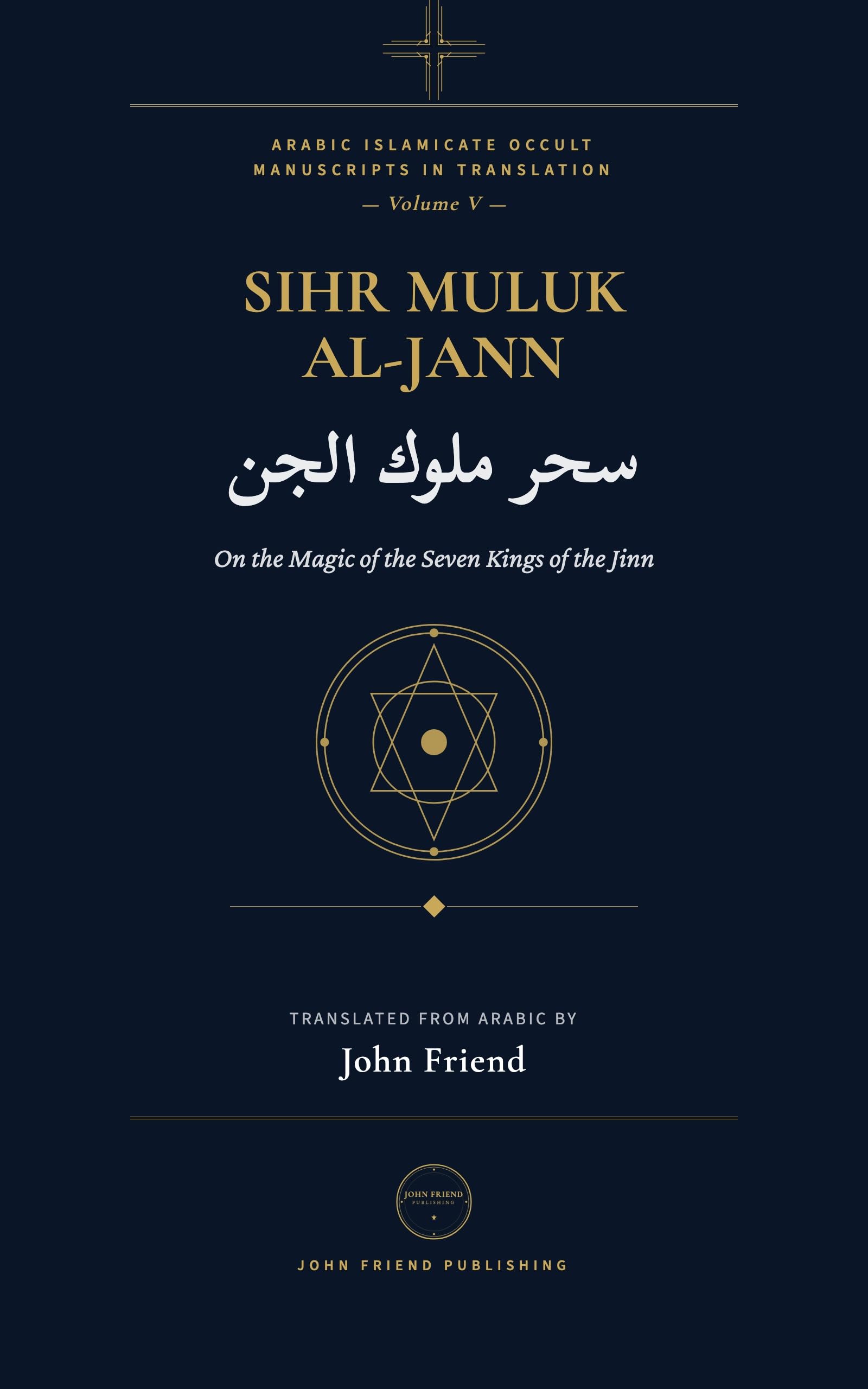
Sihr Muluk al-Jann: Magic of the Jinn Kings — an anonymous book on the magic of the seven kings of the jinn, with the specific protocols that the Arabic tradition preserved and the Latin transmission largely lost. See also Seven Magic Squares for Seven Jinn Kings.
Suns of Lights & Treasures of Secrets — the 1327 CE al-Buni-lineage text that provides the cosmological and letter-magic framework underpinning the divine-name authority structure in Solomonic operations.
For the scholarly background on the transmission of Solomonic literature from antiquity through the medieval period, see Pablo Torijano, Solomon the Esoteric King (2002, Brill). For the Toledo translation school, see Charles Burnett’s extensive work on Arabic-Latin translation. The Wikipedia article on the Lemegeton provides a useful starting point for the manuscript history of the text itself.
