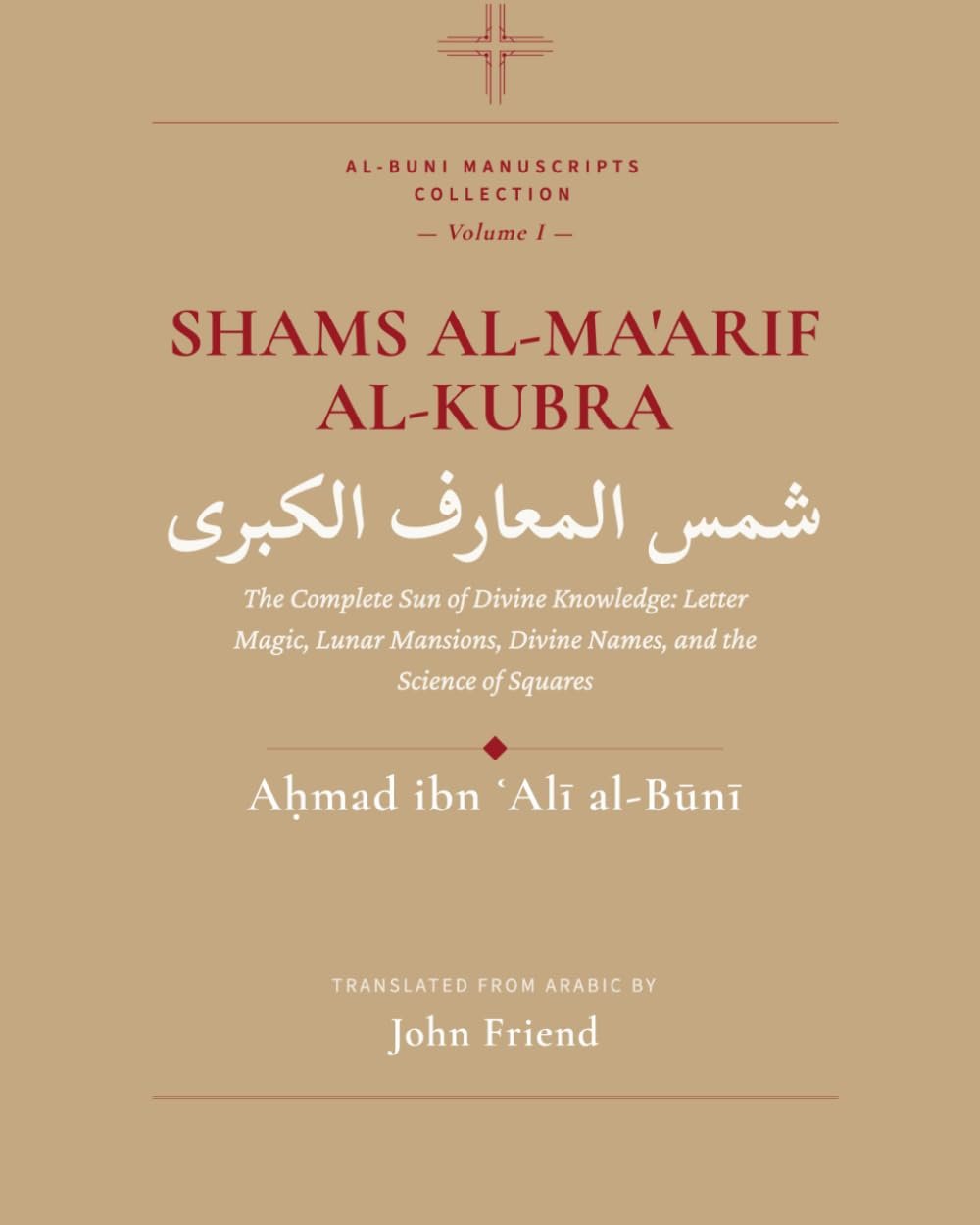
Modern practitioners of ceremonial magic obsess over planetary hours. They consult tables for Saturn and Jupiter and Mars, calculate dawn and dusk, divide the daylight into twelve unequal segments, and believe they have done due diligence on timing. The original Arabic grimoires would regard this as a beginner’s exercise — necessary but radically incomplete. Behind the planetary hours, beneath them, governing them like an operating system running silently under every application, lies a far older and far more comprehensive timing engine: the twenty-eight lunar mansions, the manazil al-qamar. This is the system that determines when magic works and when it does not. It appears in Ahmad al-Buni’s Shams al-Ma’arif, in the Ghayat al-Hakim (the Arabic original of the Latin Picatrix), in Shams al-Anwar wa Kunuz al-Asrar al-Kubra, and in al-Jawahir al-Lamma’a.
If you have performed talismanic work, conjuration, or any form of stellar magic using only the planetary hour and ignored the lunar mansion, the Arabic sources would say you missed the most important variable in the equation.
Why the Moon and Not the Stars
The logic of the lunar mansions rests on a cosmological principle that the Arabic magical texts state plainly: the Moon is the closest celestial body to the earth. It is nearer than Mercury, nearer than Venus, nearer than the Sun itself. Every other planet transmits its influence downward through layers of celestial spheres, each one filtering and attenuating the signal before it reaches the sublunary world. The Moon has no such barrier. It is the final lens — the last sphere between the celestial realm and the terrestrial one — and all planetary influence must pass through it before reaching the practitioner.
Al-Buni makes the point explicitly in the Shams al-Ma’arif: the Moon receives the powers of every planet it aspects and transmits them directly to earth. When the Moon occupies a specific mansion, it is not merely “in” that region of the sky in some abstract astronomical sense. It is actively channelling the qualities of that mansion downward. The mansion is the frequency. The Moon is the antenna. The practitioner who aligns an operation with the correct mansion is tuning into the precise celestial broadcast that corresponds to the intention of the work.
The Ghayat al-Hakim frames this in Neoplatonic terms: the mansions are the “gates” through which spiritual influences descend into matter.
Twenty-Eight Mansions, Twenty-Eight Letters
The Arabic alphabet contains twenty-eight letters. The lunar zodiac contains twenty-eight mansions. This is not a coincidence, and the Arabic magical tradition does not treat it as one. Each mansion corresponds to a specific Arabic letter, and this correspondence is the key that unlocks the entire system of letter magic (ilm al-huruf) that runs through the Arabic occult sciences like a spinal cord.
The correspondence goes deeper. Of the twenty-eight Arabic letters, fourteen are undotted — alif, ha, dal, ra, and so on — letters written without the distinguishing dots that differentiate, say, ba from ta from tha. These fourteen undotted letters are called the “luminous” or “manifest” letters. The remaining fourteen are dotted: ba, ta, tha, jim, and their kin. These are the “dark” or “hidden” letters.
The fourteen luminous letters correspond to the fourteen visible mansions — the mansions above the horizon, through which the Moon passes in the first half of its cycle. These are considered benefic: favorable for constructive operations, attraction, creation, healing, love, and increase. The fourteen dark letters correspond to the fourteen hidden mansions — those below the horizon, through which the Moon transits in the second half of its cycle. These are considered malefic: suited for destruction, separation, binding, banishment, and constraint.
The Shams al-Anwar provides the complete mapping. The system is internally consistent and extraordinarily detailed.
What the Shams al-Ma’arif Says About the Lunar Mansions
For readers looking specifically for the Shams al-Ma’arif lunar mansions, the place to start is the third chapter of the Shams al-Ma’arif al-Kubra, “On the Judgments of the Twenty-Eight Mansions of the Moon and the Celestial Spheres.” It opens not with theory but with a method for finding the Moon’s mansion on a given day. Watch the last day of the Arab lunar month, when Sun and Moon stand in one mansion, and count forward from there. The chapter’s own example: if the crescent appears on the first night in al-Sharatayn and seven days of the month have elapsed, count seven mansions from al-Sharatayn and you arrive at al-Dhira’ — “thus we know that the moon is in al-Dhira’.”
Each mansion then receives a letter, a nature, a list of suitable works and a fumigation — the meeting point of the lunar mansions and ilm al-huruf, the science of letters. Al-Sharatayn has the letter alif and is “fiery and harsh”; al-Butayn has ba’; al-Thurayya has jim. A parallel passage in the book’s second chapter, on ordering works by times and hours, gives al-Sharatayn the planet Mars and a servant it calls simply “the Red One” — al-Ahmar, the name borne by the jinn king examined in Who Is al-Ahmar? Al-Buni also divides the twenty-eight among the four seasons, seven mansions apiece: spring runs from al-Sharatayn to al-Dhira’, summer from al-Nathrah to al-‘Awwa’, autumn from al-Ghafr to al-Baldah, and winter from Sa’d al-Dhabih to al-Risha. The theory of the letters themselves is set out in Usul Ilm al-Huruf, al-Buni’s book of the science of letters.
Mansions of the Moon Talismans: Where al-Buni Says Yes and No
The chapter is precise about when talismans may be made under the mansions of the Moon. Under al-Butayn, “work talismans in it; alchemy succeeds in it, and so does every craft for loosening knots,” and its incense is aloeswood, saffron and mastic. Under al-Thurayya, “talismans are made,” and the mansion suits travelers, kings and marriage; its fumigation is flaxseed and black seed. Under al-Dabaran the instruction reverses: “Do not make a talisman in it” — the mansion is fit only for burying the dead, burying wealth, concealing secrets, digging wells and opening canals, and its fumigation is sweet pomegranate peel and male frankincense. Al-Sharatayn, fiery and harsh, is given to operations “that concern worldly matters, corruption, and the shedding of blood.”
The Shams al-Ma’arif’s astrological timings do not stop at the Moon: the same work orders operations by times and hours in its second chapter and treats the twelve zodiacal signs in its fourth, a combination weighed against the Picatrix in Shams al-Ma’arif vs Picatrix. For a reference table of all twenty-eight Arabic lunar mansions, see Manazil al-Qamar: The Arabic Lunar Mansions Chart.
Five Mansions and Their Operations
To understand how the system works in practice, consider five mansions from across the zodiacal wheel, each with a distinct character and a distinct set of prescribed operations.
Al-Sharatain (The Two Signs) — 1st Mansion
The first mansion of the lunar zodiac falls in the early degrees of Aries. Its nature is martial, hot, and destructive. The Shams al-Ma’arif confirms: talismans made under al-Sharatain are for breaking alliances, scattering enemies, and creating conflict between people who were previously united. It is a mansion of severance. The practitioner who wishes to bind two people together and works under al-Sharatain has not merely chosen the wrong time — he has chosen the opposite time, and the operation will produce the reverse of what was intended.
Al-Butain (The Little Belly) — 2nd Mansion
The second mansion, still in Aries, shifts the register dramatically. Al-Butain governs the discovery of hidden things: buried treasure, concealed knowledge, the secrets of kings and rulers. This is political magic — court magic — and it needs the Moon in exactly this mansion.
Al-Thurayya (The Pleiades) — 3rd Mansion
The third mansion corresponds to the Pleiades star cluster and is one of the most celebrated stations in the entire system. Al-Thurayya governs love, attraction, sexual desire, and the reconciliation of estranged lovers. The Shams al-Ma’arif provides talismanic designs specific to this mansion.
Al-Dabaran (The Follower) — 4th Mansion
Named for the bright red star Aldebaran in Taurus, this mansion reverses the warmth of al-Thurayya. Al-Dabaran is malefic. It governs enmity, obstruction, and the burial of harmful talismans. The Ghayat al-Hakim is characteristically more philosophical about it, noting that al-Dabaran channels the “heavy and fixed” nature of Taurus into operations that require permanence and immovability. But the practical texts are blunt: this is a mansion for harm, and the practitioner uses it when harm is the objective.
Sa’d al-Su’ud (The Luckiest of the Lucky) — 24th Mansion
If al-Dabaran represents the system’s capacity for maleficence, Sa’d al-Su’ud represents its supreme beneficence. The name itself — “the luckiest of the lucky,” or “the felicity of felicities” — signals the station’s nature. This mansion, falling in Aquarius, is the single most auspicious station in the entire lunar zodiac for operations of general good fortune, success, prosperity, and the fulfillment of wishes.
The Operational Difference
What separates the lunar mansion system from the planetary hour system is scope and specificity. Planetary hours tell you which planet governs a given segment of the day. They are useful. They are also crude. They tell you that this is a Venus hour or a Saturn hour, but they do not tell you what kind of Venus operation or Saturn operation is favored at this particular moment.
The lunar mansions provide that specificity. The Moon stays in each mansion for about a day, moving through the entire cycle of twenty-eight mansions in a single lunar month. During each transit, the qualities of that mansion are active — not in a general, ambient sense, but in a precise and operational one. The Arabic texts do not say “this is a good time for love magic.” They say “this is the time for inscribing a silver talisman with the third divine name from the Jawshan al-Kabir, fumigated with mastic and rose water, for the specific purpose of reconciling a husband and wife who have separated due to the interference of a third party.” That level of precision requires the mansion, not just the hour.
The Ghayat al-Hakim acknowledges this hierarchy when it instructs the practitioner to select the mansion first and the planetary hour second. The mansion is the strategic decision. The hour is the tactical one. Getting the hour right under the wrong mansion is like arriving at the correct time for a meeting in the wrong building.
Why This System Was Lost in Translation
The lunar mansions appear in Western astrological texts — they are mentioned in Agrippa, in the Latin Picatrix, in various Renaissance compilations. But they appear as lists: names, degrees, vague descriptions. The operational layer — the specific talismanic recipes, the fumigations, the prayers, the letter correspondences, the benefic/malefic classification tied to the Arabic alphabet — was stripped away during the centuries of transmission from Arabic into Latin and from Latin into the European vernacular languages.
This is not accidental. The letter correspondences only work in Arabic. The prayers are in Arabic. The divine names are Arabic. The entire system is built on the Arabic language in a way that makes it untranslatable without extensive commentary and cultural context. The Latin translators, working in twelfth- and thirteenth-century Toledo and Sicily, had neither the interest nor the competence to preserve these layers. They kept the astronomical skeleton and discarded the magical flesh.
The result is that Western ceremonial magic inherited a timing system with its most important component missing. Practitioners work with planetary hours because that is what survived the translation. They do not work with lunar mansions in any operational sense because the operational material was never translated — until now.
Where the Complete System Survives
For the cosmological framework — the theory of celestial influence that explains why the mansions work — the essential reference is Shams al-Anwar wa Kunuz al-Asrar al-Kubra (Volume III), which integrates the lunar mansions into a complete system of planetary magic, magic squares, and divine name invocation. For the Solomonic conjuration protocols that build on the mansion system — the summoning of planetary spirits during specific lunar transits — see al-Jawahir al-Lamma’a: The Radiant Jewels for Summoning the Kings of Jinn (Volume V).
The Arabic sources are unanimous: timing is not a secondary consideration in magical practice. It is the primary one. The twenty-eight mansions are the clock by which the cosmos operates, and the practitioner who ignores that clock is not practicing magic. He is guessing.
