Medieval Egypt was not a quiet place for religion. The country had been Christian for six centuries when the Arab conquest arrived in 641 CE, and Christianity did not simply vanish. It adapted, survived, and continued — in Coptic monasteries clinging to the desert cliffs, in urban Christian communities navigating the legal status of dhimmi (protected non-Muslims), in the intricate social world where Coptic priests, Muslim scholars, and Jewish merchants lived in proximity close enough to share everything, including their magical traditions. The manuscript called Mujarrabat al-Ruhban — “The Tested Remedies of the Monks” — is a window into what that shared world actually looked like at the practical level.
A Manuscript Genre That Shouldn’t Exist
By the official account of religious history, Muslims, Christians, and Jews in medieval Egypt occupied distinct legal and theological worlds. Sharia governed Muslim practice. Coptic canon law governed Christian practice. The two were not supposed to overlap in their sacred dimensions. Official religious authorities on all sides periodically condemned the use of “foreign” magical practices and emphasized the purity of their own traditions.
The manuscripts tell a different story.
The Mujarrabat genre — “tested remedies” or “tried and proven” formulas — is one of the most widespread in the Arabic manuscript tradition. Collections of practical formulas, medical cures, amulets, and spirit-operations circulated under this label in enormous quantities across the medieval Islamic world. They were not primarily scholarly texts. They were practical handbooks, used by ordinary people and village practitioners, copied and shared without the theological qualifications that characterized formal academic texts.
Mujarrabat al-Ruhban — the version attributed specifically to Christian monks (ruhban) — belongs to this genre while occupying a distinctive place within it. The attribution to monks does multiple things simultaneously: it lends the text an aura of antiquity and spiritual authority (monks were understood to possess knowledge of the spirit world gained through long years of ascetic practice and prayer), and it marks the formulas as belonging to a specific tradition of Christian sacred knowledge adapted for Arabic-speaking use.
Whether the text was actually composed by Christian monks, compiled from material circulating in Christian communities, or attributed to monks for reasons of prestige by a Muslim compiler — the historical record is unclear, and any definitive claim should be treated with caution. What is certain is that the text exists, that it circulated in Arabic, and that its content is unmistakably syncretic.
The Cairo Geniza and the Reality of Magical Syncretism
The most direct archaeological evidence for the kind of religious mixing that Mujarrabat al-Ruhban represents comes not from any single manuscript but from the Cairo Geniza — the repository of discarded documents discovered in the Ben Ezra synagogue in Fustat (Old Cairo) in the late 19th century. Over 300,000 manuscript fragments spanning roughly a thousand years of Jewish life in Egypt were preserved there, including a substantial collection of magical texts.
What those magical texts reveal is remarkable: Jewish practitioners in medieval Egypt used Arabic-language formulas, invoked angels named in both Hebrew and Arabic, incorporated elements from Islamic du’a (supplicatory prayer) into their protective charms, and occasionally drew on Christian traditions as well. The boundaries that official religion policed so carefully were, at the practical level of ordinary people seeking protection and healing, extremely permeable.
Scholars including Gideon Bohak, Peter Schäfer, and Shaul Shaked have documented this extensively. The pattern that emerges from their research is consistent: in any society where multiple religious communities live in close proximity over generations, their magical and protective traditions do not stay neatly within confessional boundaries. Practitioners borrow what seems to work. Formulas migrate across religious lines carrying the prestige of their tradition of origin while being adapted to new contexts.
Mujarrabat al-Ruhban sits squarely in this documented historical pattern. It is not an anomaly or an exotic curiosity. It is a representative example of something that was, in medieval Egypt and the Levant, entirely ordinary.
What the Text Actually Contains
The content of Mujarrabat al-Ruhban — as preserved in the surviving manuscript tradition — is a practical collection of formulas for the same problems that drove people to magical practitioners across every culture: illness, love, enemies, difficult births, protection of households, the evil eye, spirits causing disruption.
The distinctively Christian elements appear in several forms. Prayers and divine names drawn from the Christian tradition are incorporated into the operational formulas: references to al-Masih (the Messiah, Jesus), to the Virgin Mary (Maryam al-‘Adhra), to the apostles, and to specific angels identified in the Christian rather than Islamic tradition. Some formulas invoke a chain of spiritual authority that runs through Christian saints and biblical figures in a way that has no parallel in standard Islamic mujarrabat texts.
The Quranic elements are equally present. Al-Fatiha, the opening chapter of the Quran, appears as a protective formula — as it does in Islamic magical texts of every kind, since it is the most universally recognized and recited chapter in the Islamic world. Specific Quranic verses associated with protection and healing (Ayat al-Kursi, the Throne Verse at 2:255, being the most prominent) appear alongside the Christian prayers without any apparent sense of contradiction.
The talismanic squares — wafq — in the text sometimes combine Christian crosses or symbols with the letter-grid structure characteristic of Arabic talismanic magic. This fusion of visual form (the Arabic wafq grid) with Christian symbolic content is among the most striking features of the manuscript tradition: it suggests not merely borrowing of formulas but a genuine synthesis of operative techniques.
The Coptic Monastic Tradition and Esoteric Knowledge
To understand why Christian monks specifically are credited with this knowledge, it helps to understand the position of Coptic monasticism in medieval Egyptian culture. The great monasteries of the Egyptian desert — Wadi Natrun, the monasteries of St. Anthony and St. Paul on the Red Sea coast, Deir al-Muharraq — were among the oldest continuous religious institutions in the world at the time the Arabic manuscripts were being written. They had their own traditions of spiritual power, including extensive knowledge of protective and healing practices rooted in the late antique Christian magical tradition.
The late antique period — roughly the 3rd through 7th centuries CE — produced an enormous body of Greek and Coptic magical papyri from Egypt, preserved in the dry desert conditions that make Egypt uniquely valuable for manuscript survival. These papyri, now in collections from Berlin to London to Vienna, document a syncretic magical tradition that was already blending Egyptian, Greek, Jewish, and early Christian elements before Islam arrived. The Christian monks of medieval Egypt were the heirs of this tradition.
When Arabic became the dominant administrative and literary language of Egypt — a process essentially complete by the 10th century — the Coptic communities did not lose their traditional knowledge. They adapted it: translating, transcribing, and incorporating Arabic elements while preserving the core of their inherited practice. Mujarrabat al-Ruhban is, on this reading, one stage in a very long process of adaptation and synthesis.
Why the Monks Kept This Quiet
The official positions of medieval Christian authorities on magical practice were not, it must be said, enthusiastic. Church councils from the 4th century onward had periodically condemned the use of amulets, charms, and divination. The Coptic church had its own scholarly tradition of condemning sorcery (sihr) in terms borrowed from both patristic Christianity and, increasingly, from the Islamic legal vocabulary that surrounded it.
The practical situation was more complicated. Monks and priests who possessed reputations for healing or protective power were valuable members of their communities. In a world without effective medicine, where the evil eye was a social reality that required social management, where enemies and illness were constant threats, the person who could provide a protective talisman was performing a genuine service. The tension between official theological condemnation and practical community function is one of the most consistent features of folk religious practice across every tradition.
What Mujarrabat al-Ruhban suggests is that this tension was managed, at least in part, by keeping the relevant knowledge in specialist hands — in this case, monks who combined religious authority with esoteric knowledge — and by avoiding the kind of public visibility that would draw official scrutiny. The mujarrabat genre was itself a literature of practical discretion: not systematic theology, not formal scholarship, but working knowledge passed between practitioners.
Parallel Jewish Traditions: The Shared World
The phenomenon documented in Mujarrabat al-Ruhban is not unique to Christian-Muslim interactions. The Cairo Geniza, mentioned above, provides parallel evidence for Jewish-Muslim magical exchange. Jewish practitioners in medieval Egypt used Quranic phrases in their amulets when they believed those phrases had protective power. Muslim practitioners occasionally incorporated Hebrew divine names — Yah, Adonai, Elohim — into their own formulas, drawing on the perceived power of the older monotheistic tradition.
This was not, in most cases, theological syncretism in the sense of combining doctrines or believing in multiple religious systems simultaneously. It was practical syncretism: the use of formulas and materials from multiple traditions based on a pragmatic assessment of what works, combined with a cosmological framework that could accommodate multiple sources of spiritual power within a single monotheistic understanding. If God is one, and if all protective power ultimately derives from God, then a formula drawn from a different tradition is not necessarily drawing on a different god — it may simply be another way of addressing the same divine power.
This logic is made explicit in some versions of the mujarrabat literature, and it is the intellectual framework that made texts like Mujarrabat al-Ruhban possible to write and use without their authors necessarily experiencing an acute crisis of religious identity.
Why This Matters Now
The historiography of medieval religion has, for most of the modern period, emphasized difference and conflict between the Abrahamic traditions. The manuscript traditions tell a more complicated story — one of intensive cultural contact, practical exchange, and the kind of pragmatic synthesis that official histories tend to suppress.
Mujarrabat al-Ruhban is a minor text by the standards of formal Islamic or Christian scholarship. It will never appear on a theology syllabus. But it is a primary source for something that is actually very important: what ordinary people did when they needed help, and how the boundaries between religious communities looked at the ground level rather than from the heights of official doctrine.
Read the Text in English
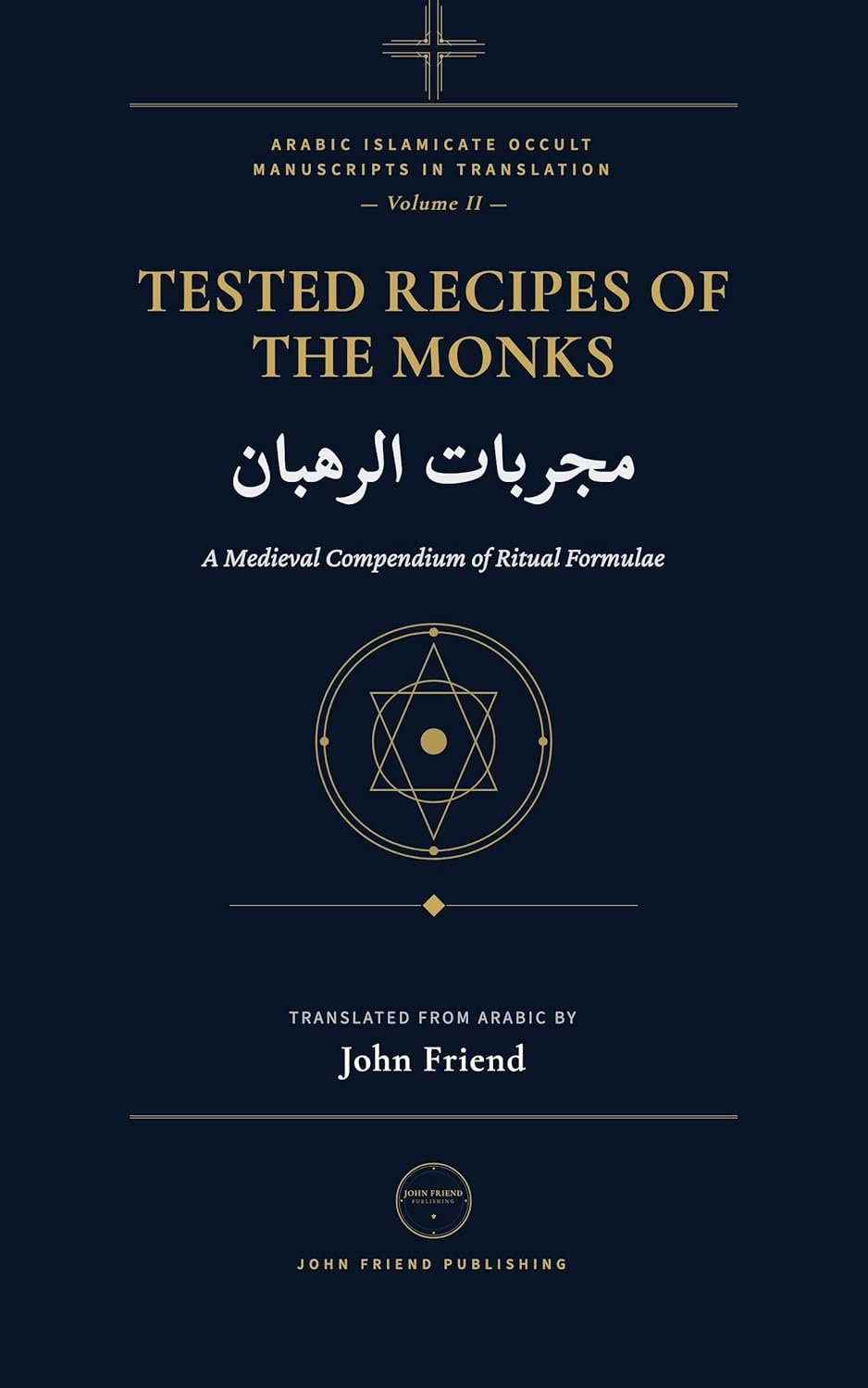
John Friend Publishing has translated Mujarrabat al-Ruhban into English for the first time:
The Tested Remedies of the Monks (Mujarrabat al-Ruhban)
This is the primary source — the actual manuscript content, with the formulas, the prayers, the talismanic instructions, and the textual evidence for the syncretic tradition described here. For a detailed look at the six categories of love spells the monks organized, see Medieval Arabic Love Spells Categorized by Christian Monks. For the scholarly context on how this text combines Christian and Islamic sacred formulas, see The Syncretic Arabic Grimoire.
For related material in the prophetic and divinatory traditions of the Arabic occult, The Book of the Prophet Daniel (Kitab Danyal al-Nabi) provides essential context on how biblical and Islamic prophetic authority intertwined in the Arabic manuscript tradition — see How a Medieval Arabic Manuscript Predicted Earthquakes by Zodiac Sign.
The scholarly literature on the Cairo Geniza magical texts is substantial. Gideon Bohak’s Ancient Jewish Magic (2008, Cambridge University Press) provides the broadest treatment. Peter Schäfer and Shaul Shaked’s Magische Texte aus der Kairoer Geniza (1994–1999) is the foundational critical edition. For the Greek magical papyri from Egypt that form the late antique background, see the Wikipedia article on the Greek Magical Papyri and the Betz edition.