The Quran contains one of the most extraordinary claims in any sacred text: that a man transported an enormous throne across continents — from Yemen to Jerusalem — before Solomon could blink. Not the jinn who volunteered to do it in the time it would take Solomon to rise from his seat. The man. A human being. The feat was accomplished, according to the classical commentators, by means of a single divine Name — al-Ism al-A’zam, the Greatest Name of God. And the Arabic occult tradition spent the next thousand years building operational systems around that Name.
The Quranic Scene: Surat al-Naml, Verses 38–40
The episode appears in the 27th chapter of the Quran, Surat al-Naml (The Ant), at verses 38 through 40. The context: Solomon has received a letter from Bilqis, the Queen of Sheba, and has determined that she should come to him in Jerusalem. The question arises of how to bring her magnificent throne there before she arrives — an act designed, in the classical reading, to demonstrate the power of Solomon’s kingdom and perhaps to test her.
An ifrit (a powerful class of jinn) offers to bring the throne “before you rise from your place” — that is, in hours. Solomon’s response is recorded in verse 38-39, and then in verse 40 comes the event itself:
“Said one who had knowledge of the Scripture: ‘I will bring it to you before your gaze returns to you.’”
And the throne was brought. Instantly. Before Solomon’s gaze — that is, before a single eyeblink completed.
The identity of “one who had knowledge of the Scripture” (alladhī ʿindahu ʿilm min al-kitāb) is not given in the Quran directly. This is precisely the kind of interpretive gap that the classical tafsir (Quranic commentary) tradition was designed to fill, and fill it did.
Who Was Asif ibn Barkhiya?
The dominant identification in classical Islamic scholarship is Asif ibn Barkhiya — Āṣif ibn Barkhiyā in Arabic — who is identified as Solomon’s vizier and secretary, and as the one who possessed sufficient knowledge of the divine names to accomplish the throne-transport.
This identification is not Quranic. It emerges from the hadith and tafsir tradition, particularly from the reports attributed to early authorities like Ibn Abbas, one of the companions of the Prophet Muhammad who is cited extensively in classical Quranic commentary. The medieval commentators — al-Tabari (839–923 CE), al-Zamakhshari (1075–1144 CE), and Ibn Kathir (1301–1373 CE), among others — all engage with this identification and debate what exactly the “knowledge of the Scripture” consisted of.
The majority view settled on: Asif knew al-Ism al-A’zam — the Greatest Name. By uttering it, he was able to accomplish what the most powerful jinn could not accomplish quickly enough to satisfy Solomon.
Asaph ben Berechiah: The Jewish Parallel
The figure of Asif ibn Barkhiya does not appear from nowhere in the Islamic tradition. He has a direct counterpart in the Hebrew Bible and the Jewish textual tradition: Asaph ben Berechiah (Āsāf ben Berekhyāhū), who appears in 1 Chronicles 6:39 as a Levite appointed by David and Solomon as a chief musician and keeper of sacred song. The Psalms associated with Asaph (Psalms 50 and 73–83 in the Hebrew numbering) are among the most theologically sophisticated in the entire Psalter.
In the Jewish mystical tradition — particularly in the Talmud Yerushalmi and later kabbalistic literature — Asaph ben Berechiah acquired a reputation for supernatural knowledge. The parallel with the Islamic Asif is not coincidental: both traditions draw on a shared fund of Solomonic legend that predates both Islam and the rabbinic canonization of the Hebrew Bible. The Solomonic material circulated across the ancient Near East as a kind of common cultural inheritance, and both the Islamic and Jewish traditions shaped their Asif/Asaph figures from this shared substrate.
This is one of the most compelling aspects of the Arabic occult tradition for the historically curious reader: it preserves, in Arabic dress, materials that connect directly to late antique Jewish and Christian textual traditions, and through those traditions, to even older strata of Near Eastern lore.
What al-Ism al-A’zam Actually Is — And Isn’t
Al-Ism al-A’zam — “the Greatest Name of God” — is one of the most contested concepts in the entire history of Islamic esotericism. The tradition holds that God possesses a name of such comprehensive power that whoever invokes it correctly is granted whatever they ask. This is not a marginal folk belief: it appears in authenticated hadith collections, and it is discussed seriously by mainstream scholars from the earliest centuries of Islam.
The disagreement — sustained, unresolved, and genuinely interesting — is about which of God’s names is the Greatest. The theological mainstream holds that the Greatest Name is among the 99 Beautiful Names (al-asma al-husna) but that its specific identity has been hidden from ordinary knowledge. Candidates proposed in the classical literature include Allah itself (as the comprehensive divine name), al-Hayy al-Qayyum (“the Living, the Self-Subsisting”), and al-Rahman (“the All-Merciful”). Different scholarly lineages have argued for different candidates on the basis of Quranic and hadith evidence.
The Arabic occult tradition takes a different approach. Rather than resolving the theological debate, it preserves multiple candidate formulas — extended, compound divine names, sometimes including Quranic phrases, sometimes including names in non-Arabic languages identified as Hebrew or Syriac, sometimes appearing as letter-combinations whose full linguistic meaning is deliberately obscure. The operational texts do not claim certainty about which formula is definitively the Greatest Name. They claim that certain formulas have been transmitted through chains of practitioners going back to Asif himself, and that these formulas are operative.
How the Arabic Grimoire Tradition Built on This Story
The story of Asif and the throne of Bilqis functions as a kind of authorization myth for the entire Arabic Solomonic grimoire tradition. If a human being — not an angel, not a jinn, but a man with knowledge — could accomplish the instantaneous transport of a massive physical object across a thousand miles of geography, then human beings are capable of extraordinary things when they possess and correctly apply the right knowledge.
The operational logic follows: Solomon was the supreme practitioner of this knowledge in his own right, governing jinn and birds and wind by divine gift. But his vizier Asif accessed something even Solomon did not use for the throne-transport — Asif used the Greatest Name, which operates on a different register than Solomon’s prophetic authority over created beings. The grimoire tradition therefore constructs a two-tier system: Solomonic authority over spiritual beings (invoked through names, sigils, and protocols), and beyond that, the direct address to God through the Greatest Name (accessible only to those with genuine spiritual qualification).
The Kitab al-Ajnas — the Solomonic Grimoire of Asif ibn Barkhiya himself — is organized precisely around this framework. Asif is not merely a historical figure in this text; he is the attributed author, the person whose authority legitimizes the operational content. The text claims to transmit, through a chain of tradition, the actual knowledge that Asif possessed.
Bilqis and the Throne: The Deeper Symbolism
The Queen of Sheba — Bilqis in the Arabic tradition, unnamed in the Hebrew Bible — is a figure of considerable symbolic weight in both the Quran and the broader literary tradition. She arrives in Jerusalem expecting to deal with an ordinary king and instead encounters someone operating on an entirely different plane of reality. Her throne has been transported there before she arrives. She is tested; she submits; in the Islamic telling, she ultimately accepts the monotheism of Solomon and his God.
For the Arabic occult tradition, this episode is not simply a miracle story. It is a demonstration of what theurgic knowledge — knowledge of divine names and their application — can accomplish in the hands of someone properly qualified to use it. Asif ibn Barkhiya becomes the model practitioner: a human being who, through the right knowledge applied at the right moment, accomplished something that outstripped the most powerful of the non-human spiritual beings.
The throne itself is significant. In classical Islamic cosmology, the Arsh — the divine Throne — is the supreme symbol of God’s sovereignty over creation. A human throne transported through the application of divine names is a theological statement in narrative form: human knowledge, when properly oriented toward the divine, participates in the divine governance of creation.
The Preserved System: Read It in English
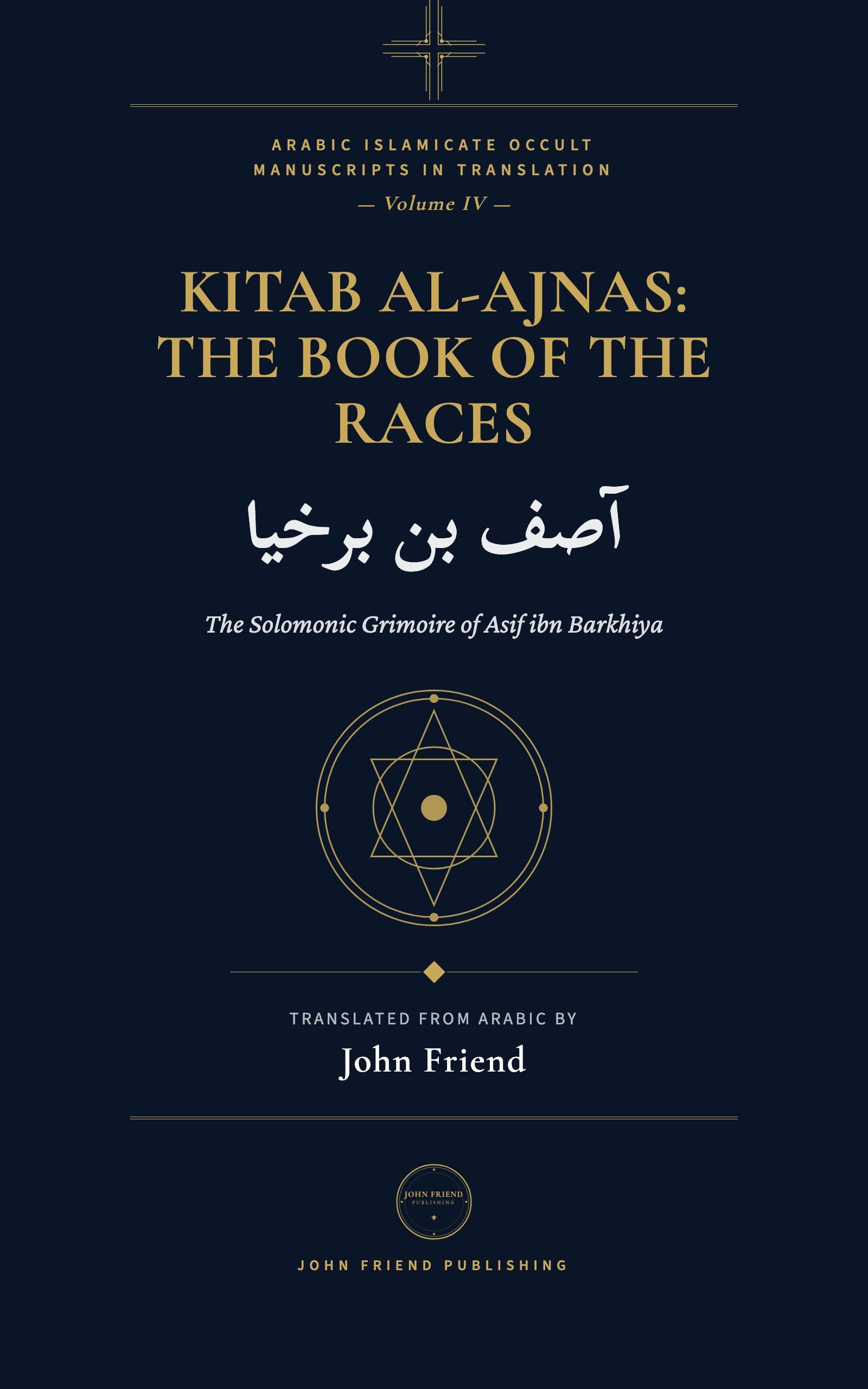
The Kitab al-Ajnas — the text that claims Asif ibn Barkhiya’s own authority and preserves the operational Solomonic system built around his knowledge — is now available in English translation for the first time:
Kitab al-Ajnas: Solomonic Grimoire of Asif ibn Barkhiya
This is the primary text. It contains the names, the protocols, and the cosmological framework that the Arabic tradition attributed to the man who moved a throne across continents before Solomon could blink. For a detailed chapter-by-chapter walkthrough, see Kitab al-Ajnas: A Chapter-by-Chapter Guide. For the broader Solomonic tradition in Islam, see Solomonic Magic in the Islamic Tradition. For a comparison with the Western Goetia, see Arabic Solomonic Magic vs. the Goetia.
For the broader context of how this Solomonic tradition intersects with the planetary and letter-magic systems inherited from al-Buni’s lineage, Suns of Lights & Treasures of Secrets (1327 CE, Ibn al-Hajj al-Tilmsani) provides essential background.
The Quranic passage discussed here is Surat al-Naml (27):38-40. The relevant biblical parallel for Asaph appears in 1 Chronicles 6:39 and the superscriptions of the Asaphite Psalms. For the scholarly treatment of Solomonic literature across the Jewish-Christian-Islamic traditions, see the work of Pablo Torijano on Solomon in Jewish, Christian, and Gnostic tradition, and the relevant entries in the Encyclopaedia of the Quran on Solomon and the jinn.
