Somewhere between theology and folk practice, between the formal cosmology of classical Islamic scholarship and the dusty practicality of people who needed results, a genre of Arabic manuscript emerged that preserves what might be the most operationally detailed tradition of spirit-contact in any medieval culture. These texts do not merely assert that the jinn exist. They name them. They specify which day of the week each king rules, which planet governs him, which divine names compel his appearance, and what happens — in explicit and sometimes alarming terms — if you get the protocol wrong.
What the Manuscripts Actually Say
Before anything else, a necessary caveat: the tradition of the seven jinn kings is not a single fixed text. It is a current running through dozens of manuscripts, and the details shift from one to the next. The names of the seven kings are broadly consistent across the tradition, but their spellings, their planetary assignments, and their particular domains of power vary depending on the manuscript, its period, and its regional origin. What follows is drawn from the tradition as it appears across the genre, including the texts John Friend Publishing has made available in English — the Sihr Muluk al-Jann and the al-Jawahir al-Lamma’a — and the secondary scholarship that has documented this material.
With that established: here is what the manuscripts say.
The Seven Kings: Names, Days, Planets
The seven kings of the jinn are associated with the seven classical planets in an exact correspondence that mirrors the planetary week. This is not coincidental — the Arabic astrological tradition, inherited from Hellenistic sources via the great translation movement of the 8th–10th centuries, organizes time and matter into a seven-fold planetary hierarchy, and the jinn-king tradition slots directly into this framework.
The most commonly attested roster in the manuscript tradition runs as follows:
Al-Mudhhib (also spelled Mudhib, “the Gilder” or “the One Who Makes Golden”) is associated with Sunday and the Sun. He is typically described as a king of great brilliance, governing wealth, honor, and the illumination of hidden things. His color is gold or yellow, and his sigil appears in manuscripts as an elaborate figure sometimes resembling a stylized human form.
Murra al-Abyad (“Murra the White,” sometimes listed as Murra separately from Abyad) is associated with Monday and the Moon. The white color and lunar association connect this king to matters of water, travel, dreams, and the hidden world of the night. Some manuscripts list Murra and Abyad as a single king; others treat them as distinct figures. The textual situation is genuinely ambiguous.
Al-Ahmar (“The Red One”) is associated with Tuesday and Mars. As the martial planet’s regent, al-Ahmar governs warfare, conflict, and the coercion of enemies. He is among the more feared of the seven, and manuscripts that describe the dangers of improper invocation tend to emphasize the consequences of incorrectly summoning the Mars-king.
Burqan is associated with Wednesday and Mercury. Mercury’s quicksilver character in Arabic astrology — governing speech, writing, commerce, and trickery — shapes this king’s domain. Burqan appears in manuscripts concerned with eloquence, with the unlocking of secrets, and with the operation of certain kinds of influence over the minds of others.
Shamhurish (sometimes Shamhurash) is associated with Thursday and Jupiter. The Jupiter-king is among the most prestigious figures in the tradition — Jupiter being the planet of religious authority, scholars, and kings — and Shamhurish appears in texts concerned with the acquisition of spiritual knowledge, the settling of legal disputes, and the gaining of favor from powerful persons.
Abyad (“The White One”) — where this name appears independently — is associated with Friday and Venus. The Venusian domain covers love, beauty, harmony, and the reconciliation of enemies. This is the king most frequently invoked in the genre of mahabbah (love) operations.
Maymun (“The Fortunate” or “The Blessed”) is associated with Saturday and Saturn. Saturn in classical Arabic astrology governs agriculture, slow processes, the dead, and hidden underground things. Maymun is often described as the most difficult king to work with — Saturn’s heavy, cold nature making him resistant to human petition — but also, in some manuscripts, the most powerful when successfully contacted.
A key scholarly caution: these attributions are drawn from the general manuscript tradition, but individual texts vary. Some manuscripts place the kings in a different order; some substitute or add names; some assign different planetary rulers. Anyone working seriously with this material should consult the primary sources rather than any single secondary summary.
The Conditions: What the Practitioner Had to Do
The most striking feature of the jinn-king summoning literature is not the names — it is the protocol. These are not casual operations. The manuscripts specify conditions of preparation that would, by modern standards, constitute a serious ascetic practice.
Ritual purity (tahara) was non-negotiable. The practitioner was required to be in a state of complete bodily purity — the full ablution (ghusl), not merely the partial wudu of ordinary prayer. Some texts specify that this purity had to be maintained for the entire period of the operation, which could extend over several days.
Fasting was standard. The manuscripts specify varying periods — three days, seven days, forty days in the most demanding versions — during which the practitioner abstained from certain foods or from food entirely. Meat was commonly prohibited. Sexual abstinence was required. Some operations specified the avoidance of any contact with women, or with anyone in a state of ritual impurity.
Isolation (khalwa) features prominently. The practitioner retreated to a place of seclusion — ideally a clean room that had not been used for mundane purposes — and remained there for the duration of the working. This isolation served both ritual and practical purposes: it concentrated the practitioner’s intention (niyyah) and removed him from distractions that might break the conditions of purity.
The timing was determined by planetary correspondences. Operations dedicated to al-Mudhhib were begun on Sunday, ideally in the first planetary hour of Sunday — the hour governed by the Sun. The practitioner had to calculate these hours using the traditional system of unequal (seasonal) hours, which varied by latitude and season. Getting the timing wrong was understood to undermine the operation.
The Invocations: What Was Actually Said
The manuscripts preserve specific prayers, divine names, and Quranic verses to be recited during the operation. These were not improvised. They were fixed formulas, transmitted from teacher to student, copied with the care that any sacred text received.
The structure of these invocations typically follows a pattern: opening with Quranic recitation (most commonly al-Fatiha and specific verses chosen for their relevance to the working), proceeding through an address to God invoking the divine names by which the jinn-king was bound, and then the specific petition to the king himself — naming him, stating the purpose of the contact, and specifying what was being requested.
Critically, the authority structure of these operations is always Solomonic. The practitioner does not summon jinn by his own power or in his own name. He summons them by the authority of Solomon (Sulayman), to whom God granted power over the jinn, and ultimately by the authority of the divine names that bind both Solomon and the jinn. This framing is not merely rhetorical — it is the theological mechanism by which practitioners justified the practice as consonant with Islam rather than contrary to it.
What Happened If You Got It Wrong
The manuscripts are not reassuring on this point. Operations conducted without proper preparation, or with impure intention, or with errors in the formulas, are described as producing unpredictable and potentially dangerous results. The jinn-kings, in this tradition, are not malevolent by nature — they are bound by Solomonic authority and by divine decree — but they are also not patient with practitioners who approach them carelessly.
The consequences described range from minor disruption (the operation simply fails, nothing appears) to active harm. Some manuscripts warn that improperly summoned jinn may not leave, or may mislead the practitioner, or may bring harm to the practitioner’s household. The Mars-king, al-Ahmar, appears most frequently in these warnings — the martial spirit being understood as particularly dangerous to those who summon it without adequate preparation. For the specific adjuration formula used to command al-Ahmar, see Al-Ahmar, the Red King of Jinn.
These warnings serve multiple functions in the text. They protect the tradition by raising the bar for casual practitioners. They explain failures without undermining the system (if nothing happened, you did it wrong). And they reflect a genuine theological position: spiritual forces of this magnitude are not toys, and the manuscripts treat them accordingly.
The Solomonic Authority Structure
What distinguishes the Arabic jinn-king tradition from simple demonology is its integration into the broader Solomonic cosmology that runs through the Quran and the classical Islamic interpretive tradition. The Quran explicitly affirms that God subjected the jinn to Solomon’s authority (Quran 38:37-38, 21:82-83) — this is not folklore but scriptural fact within the tradition. The jinn-king manuscripts are, from their own perspective, not magical texts but operational handbooks for working within a divinely ordained order.
This matters for understanding why these texts survived. They were dangerous to the authorities not because they were simply superstitious, but because they made a serious theological claim: that the Solomonic authority over spirits was a real and transmissible power, accessible to properly trained human practitioners. If that claim was correct, then the person who could summon al-Mudhhib on a Sunday morning in the first planetary hour of the Sun was not a sorcerer — he was a practitioner of a legitimate science.
The Actual Source Texts in English
Two of the texts that preserve this tradition in most complete form are now available in English translation for the first time.
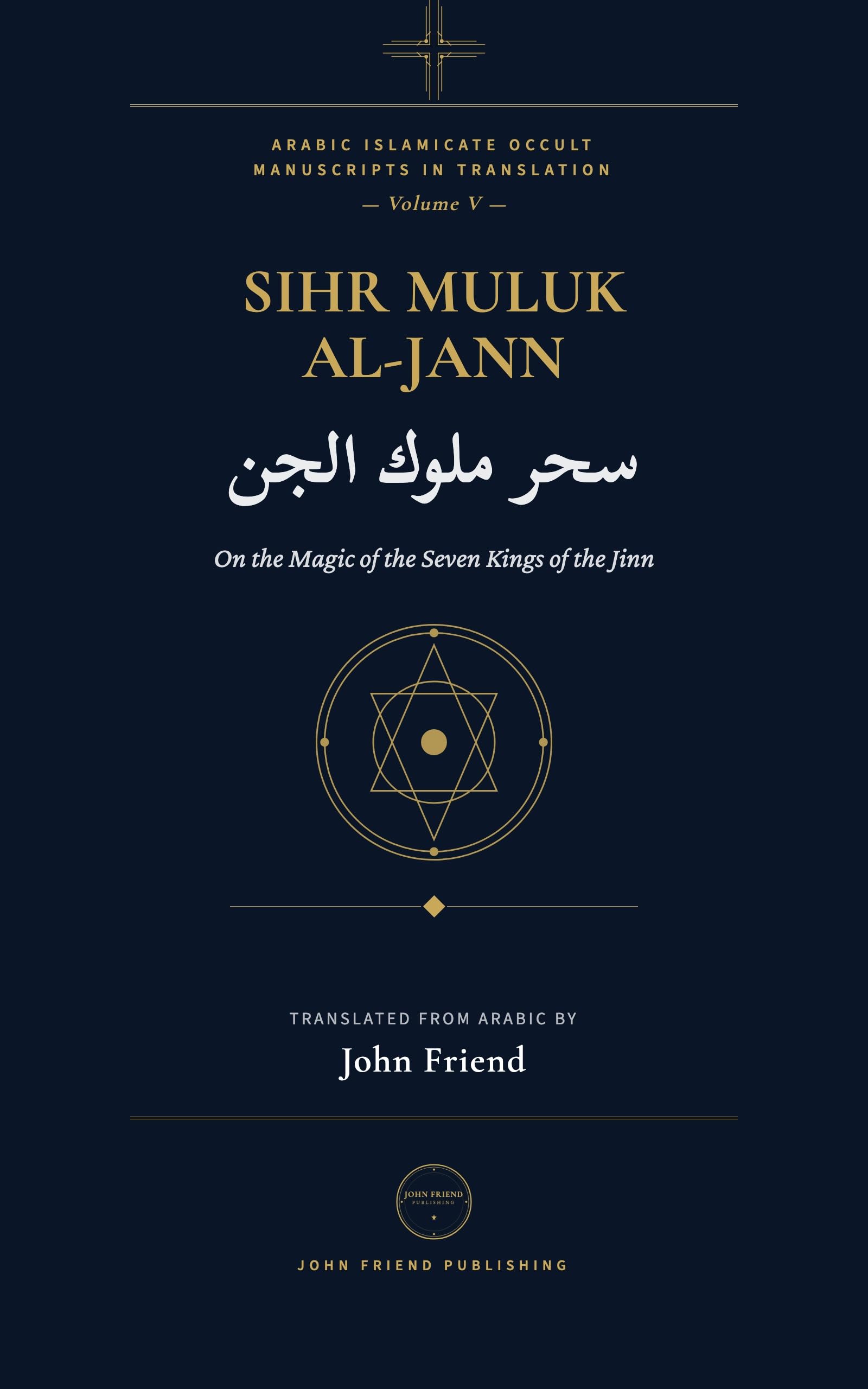
Sihr Muluk al-Jann: Magic of the Jinn Kings — the primary operational text in this genre, containing the detailed protocols, names, and invocations of the seven jinn kings.
al-Jawahir al-Lamma’a: Radiant Jewels for Summoning Kings of Jinn — a companion text focusing on the invocation protocols and the structure of the Solomonic authority framework.
For the magic squares associated with each king, see Seven Magic Squares for Seven Jinn Kings. For the planetary-hour timing system, see Planetary Hours for Jinn Summoning. These are primary sources. They are not modern reconstructions or interpretive guides. They are translations of manuscripts that have been circulating in the Arabic tradition for centuries, made available in English for the first time by John Friend Publishing.
For the scholarly background on the seven jinn kings in Islamic cosmology and their manuscript tradition, see the relevant sections in Matthew Melvin-Koushki’s work on occultism in the medieval Islamic world, and the entries on jinn in the Encyclopaedia of the Quran. The Wikipedia article on Jinn provides a useful entry point into the primary sources.
