Ahmad al-Buni (Abu al-‘Abbas Ahmad ibn ‘Ali al-Buni, also written Ahmed al-Buni) was a Sufi scholar from Buna, present-day Annaba in Algeria, who lived and worked primarily in Cairo. The printed Shams al-Ma’arif gives his death as 622 AH (1225 CE); some sources give 630 AH (1233 CE). He is known above all as the author to whom Shams al-Ma’arif al-Kubra (“the Greater Sun of Knowledge”) is attributed, a book of letter science, magic squares and the Divine Names that religious authorities condemned and tried to suppress.
The condemnation of his book was real but uneven. Scholars issued fatwas against the use of Shams al-Ma’arif al-Kubra, occult manuscripts were burned in periodic reform campaigns, and printed editions were restricted in twentieth-century Egypt. None of it took the book out of circulation: the manuscripts went on being copied, and the Cairo book trade never stopped selling it.
Who Was Ahmad al-Buni? A Short Biography
The historical record on al-Buni is thin. He belonged to the same generation as Ibn Arabi, the great Andalusian mystic, with whom he shares certain cosmological preoccupations.
The printed Shams al-Ma’arif names him “Shaykh Ahmad ibn ‘Ali al-Buni” and adds the prayer “may God sanctify his spirit.” The book stays inside the tradition: it gives whole chapters to the Fatiha, the Throne Verse and Surat Ya Sin, and it cites prophetic hadith. He was not arguing against Islam. He was arguing that Islam contained, within its own scriptural core, a complete and operational science of the unseen world.
That claim — made systematically, in Arabic, with Quranic proof-texts — was exactly what made the authorities furious.
Any biography of Ahmad al-Buni ends up as a biography of the Shams al-Ma’arif, because the details his own books preserve are few but firm. The texts give his full name as Abu al-‘Abbas Ahmad ibn ‘Ali al-Buni — the nisba al-Buni marking his origin in Buna — and a later passage in the Manba’ Usul al-Hikma remembers him as “the great imam, the famous sage.” The Ahmad al-Buni manuscripts now gathered in English in the Al-Buni Manuscripts Collection run from the Shams al-Ma’arif itself to commentaries on the Barhatiyya and the Great Jaljalutiyya attributed to him: a record of what he taught, where the chronicles say little of how he lived.
When Did Ahmad al-Buni Die? Cause of Death and Grave
The question of how and when Ahmad al-Buni died — asked in Arabic as سبب وفاة أحمد بن علي البوني, “the cause of death of Ahmad ibn ‘Ali al-Buni” — has a short answer. The printed Shams al-Ma’arif opens each of its four parts by recording his death in the year 622 — “He died in the year 622,” as the first part puts it — that is, 1225 CE. The English edition adds that the date is disputed, some sources giving 622 AH / 1225 CE and others 630 AH / 1233 CE. The Manba’ Usul al-Hikma repeats 622 AH, and one passage in it says he “was buried in the year 622 AH.”
That is the whole of the record these texts preserve. They give a year, not a cause: none of the manuscripts translated in this series says how al-Buni died, and none names the place of his grave. Any account that supplies a cause of death or a tomb should be read with that silence in mind. What can be said with confidence is the generation — al-Buni died between 1225 and 1233 CE, depending on the source, in the lifetime of Ibn Arabi.
What Shams al-Ma’arif Actually Taught
The Shams al-Ma’arif al-Kubra is not a single book in the modern sense. It exists in multiple recensions of varying length, the longest running to four substantial volumes in manuscript form. The core text, sometimes called the Shams al-Saghira (“Lesser Sun”), may reflect an earlier composition that was expanded by later editors — a common fate for celebrated medieval Arabic texts. Modern scholars, including Liana Saif in her research on al-Buni’s reception, have noted the difficulties of establishing a definitive text from the surviving manuscript tradition.
What is consistent across versions: Shams al-Ma’arif is primarily a systematic treatise on the occult properties of letters, names, and numbers. Al-Buni’s foundational claim is that the Arabic alphabet is not merely a writing system but a cosmological architecture. Each letter corresponds to a divine attribute, an angelic power, a planetary sphere, and a material property. The practitioner who understands these correspondences can, in principle, manipulate reality by constructing the right combinations.
The operational heart of the book is the wafq — the magic square. Al-Buni’s treatment of letter-squares (wafq al-huruf) and number-squares is extraordinarily sophisticated, producing grids in which the numerical values of Arabic letters sum to equal totals along each row, each column and both diagonals. These squares were inscribed on paper, metal, cloth, and ceramic — worn as amulets, buried at thresholds, dissolved in water and drunk. Al-Buni provides squares for healing, for love, for protection from enemies, for acquiring favor from rulers, and for communicating with spiritual beings.
He also provides the divine names — the asma al-husna and their more esoteric variants — with specific protocols for their invocation: how many times to repeat them, at which planetary hours, after which purifications, oriented in which direction. This is not vague mysticism. It is operational instruction.
The Names You Were Not Supposed to Write Down
Among the most controversial elements of Shams al-Ma’arif are al-Buni’s treatments of the Ism al-A’zam — the Greatest Name of God — and his classification of angelic and spiritual beings susceptible to human invocation. Orthodox Islamic theology holds that God is absolutely transcendent and that attempts to coerce or manipulate the divine through ritual formulas constitute shirk (associationism, the gravest of sins) or, at minimum, bid’a (blameworthy innovation).
Al-Buni’s counter-argument was elegant and infuriating in equal measure: he maintained that the power of these operations derived entirely from God, and that the practitioner was not commanding God but rather aligning himself with the divine order already embedded in creation. The letters, names, and squares were, in his framing, not magic but hikma — wisdom, science, the proper understanding of how God’s creation works.
Religious authorities were not convinced. The problem was not merely theological abstraction. Shams al-Ma’arif was being used — copied out by ordinary people, by soldiers seeking battlefield invulnerability, by merchants wanting commercial advantage, by jealous husbands and spurned lovers. The book had escaped al-Buni’s Sufi-scholarly context entirely and was circulating as a practical handbook for anyone literate enough to follow its instructions.
Banned, Burned — and Copied Faster Than It Could Be Destroyed
The suppression of Shams al-Ma’arif across the Mamluk period (1250–1517 CE) and beyond is well-documented in chronicles and legal opinions. Mamluk-era religious scholars issued fatwas against its use, and there are records of public burnings of occult manuscripts during periodic reform campaigns — though the historical record makes it difficult to attribute specific book-burning incidents to specific dates and rulers without overclaiming. What is clear is that official hostility to the text was consistent and that it had no discernible effect on the manuscript tradition.
The reason is simple: Shams al-Ma’arif was too useful to burn. It circulated in Sufi brotherhoods (turuq) where a certain esoteric knowledge was not only tolerated but expected. It was copied in North Africa, in the Levant, in Persia, in Ottoman Anatolia, in Mughal India. Each new context produced new recensions, new attributions, new expanded or abridged versions carrying al-Buni’s name. The text became, in effect, a living tradition rather than a fixed document.
The shift to print did not help the suppressors. The 1927 printed edition, on which the English translation is based, is the most widely circulated recension of the text.
Twentieth-century Egypt returned to the problem. Various printed editions of Shams al-Ma’arif have been subject to restriction or removal from circulation by Egyptian authorities at different periods, particularly during campaigns against “superstition” (khurafat) in the mid-twentieth century. The exact scope and enforcement of these restrictions is disputed, and it would be inaccurate to describe them as total bans in the manner of a formal legal prohibition. The more accurate picture is one of recurring official discomfort, intermittent enforcement, and a street market in Cairo that has never stopped selling the book.
Is Shams al-Ma’arif Banned Today?
The short answer to “is Shams al-Ma’arif banned” is that no single, universal ban exists — and, as the history above shows, none ever quite did. What the record shows instead is a long series of condemnations: fatwas against its use, periodic burnings of occult manuscripts, and intermittent restriction of printed editions in twentieth-century Egypt, alongside a book trade that never stopped selling it. Whether the Shams al-Ma’arif was banned in a given place has always depended on who held authority there, and how seriously they enforced it.
Nor is it a forbidden book in Islam in the sense of an official index. Islam has no central authority that keeps a list of forbidden books comparable to the Catholic Church’s Index; what it has is the judgment of individual scholars, many of whom classed the book’s operative content as sihr, while others, in the hikma tradition described below, defended letter-science as natural philosophy. The religious question readers most often ask — whether it is haram to read — is taken up in Why They Say Shams al-Ma’arif Will Drive You Mad, which also examines its reputation as the most dangerous book of Arabic magic. Readers who ask the same question of the Ghayat al-Hakim, the Arabic original of the Picatrix, will find the two books compared side by side in Shams al-Ma’arif vs Picatrix.
Why the Sultan Didn’t Burn Every Copy
The survival of Shams al-Ma’arif through seven centuries of official hostility requires explanation beyond simple manuscript proliferation. Part of the answer lies in the ambiguity of al-Buni’s own tradition. The Sufi brotherhoods that preserved and transmitted his work were not marginal institutions. They were often closely connected to political power — Sufi masters blessed armies, mediated tribal disputes, and provided legitimacy to sultans. A ruler who burned Sufi manuscripts today might need a Sufi saint’s blessing tomorrow.
There is also the question of efficacy. People believed the Shams al-Ma’arif worked. Not universally, not naively — the manuscript tradition contains skeptical commentary as well as credulous commentary — but sufficiently that it retained its reputation across centuries and continents. A text with that kind of cultural weight does not get eradicated; it gets accommodated, however reluctantly.
The scholars who continued to engage with al-Buni’s tradition after his death developed increasingly sophisticated apologetic frameworks for distinguishing “permissible” from “impermissible” occult practice. The hikma tradition — which framed letter-magic and name-magic as a form of natural philosophy rather than forbidden sorcery — gave cover to practitioners who wanted to use al-Buni’s techniques without running afoul of religious law. This accommodation was never fully stable, never officially sanctioned, but it was functionally sufficient.
The Lineage That Continued: Shams al-Anwar and the 14th-Century Tradition
Al-Buni died around 1225 CE, but the tradition he systematized did not die with him. It was taken up, extended, and elaborated by subsequent scholars working in the same current of Sufi-inflected letter-mysticism. One of the most significant texts in this lineage is Shams al-Anwar wa Kanz al-Asrar al-Kubra — “Suns of Lights and the Treasury of Great Secrets” — composed around 1327 CE by Ibn al-Hajj al-Tilmsani, a North African scholar working a full century after al-Buni.
Shams al-Anwar inherits al-Buni’s theoretical framework: the cosmological significance of Arabic letters, the operational use of divine names, the construction of talismanic squares. But it extends the system with new material on planetary magic, on the properties of specific Quranic verses as operative formulas, and on the protocols for working with spiritual beings. It is a text that assumes familiarity with the al-Buni tradition and builds upon it — evidence that the tradition was alive and developing, not merely being copied and preserved.
John Friend Publishing has made Shams al-Anwar available in the first English translation: Suns of Lights and the Great Treasures of Secrets. For anyone who wants to understand what the Arabic occult tradition actually looked like in practice — the specific prayers, the specific names, the specific instructions — this is the primary source.
What Was Lost, and What Survived
The story of Shams al-Ma’arif is not a simple story of forbidden knowledge surviving despite persecution. It is a more complicated story about how a sophisticated intellectual tradition navigates the gap between what institutions permit and what practitioners actually do.
Al-Buni wanted to be taken seriously as a scholar. He framed his work in the most respectable terms available to him. The tradition he founded was taken seriously — by hundreds of thousands of readers across dozens of cultures, across seven centuries, in conditions of secrecy and conditions of openness. The authorities who burned his books were, in their own way, acknowledging the same thing: this was a text with real power, whether that power was the power of divine science or the power of dangerous superstition.
The manuscript tradition is not entirely preserved. Recensions have been lost. Regional variants have been incompletely catalogued. There are aspects of al-Buni’s original system that are now recoverable only by inference from later texts. For an introduction to the Shams al-Ma’arif itself, see What Is the Shams al-Ma’arif?. This is what happens to forbidden books: they survive, but not intact. They survive as living traditions, continuously adapted, continuously copied, never quite identical from one manuscript to the next.
Which is, of course, exactly what al-Buni would have expected. In his system, knowledge is not a dead object. It is a living force, moving through practitioners, shaped by the divine names that animate it.
Where to Read This Tradition in English
The al-Buni tradition now has a complete English translation: the Shams al-Ma’arif itself is available unabridged as Shams al-Ma’arif al-Kubra (818 pages, all forty chapters), described below. The century-later continuation of that tradition is also available:
Suns of Lights and the Great Treasures of Secrets (Shams al-Anwar, Ibn al-Hajj al-Tilmsani, 1327 CE) — the first English translation of this 14th-century Arabic grimoire in the direct al-Buni lineage. For the full story of this sequel, see Shams al-Anwar: The Forgotten Grimoire That Completed the Shams al-Ma’arif, and for its magic-square system, see the essay on Shams al-Anwar’s weekday magic squares.
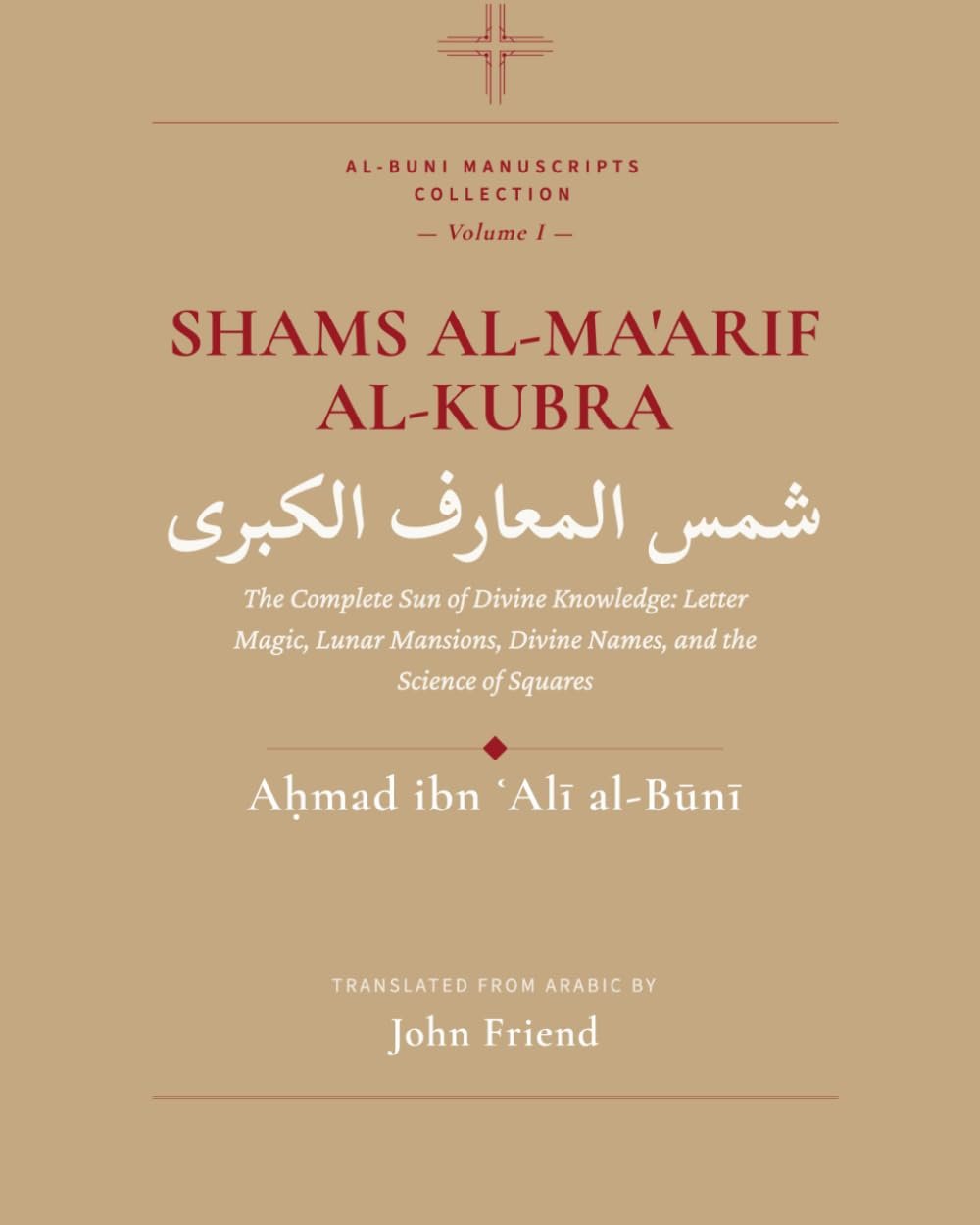
The first unabridged English translation of the Shams al-Ma’arif al-Kubra attributed to Ahmad al-Buni — based on the 1927 printed edition, with all four parts and all forty chapters — is now published as Volume I of the Al-Buni Manuscripts Collection: Shams al-Ma’arif al-Kubra: The Complete Sun of Divine Knowledge. What the forty chapters contain is described in The First Unabridged Shams al-Ma’arif in English.
For the Solomonic magic that runs parallel to al-Buni’s letter-mysticism, the Kitab al-Ajnas is the essential companion text: Kitab al-Ajnas: Solomonic Grimoire of Asif ibn Barkhiya.
Further reading: Liana Saif’s scholarship on al-Buni’s reception history is the most rigorous academic treatment available in English. Her work on Islamic occultism provides the scholarly grounding for much of what is summarized here. See also the Wikipedia entry on Ahmad ibn Ali al-Buni as an entry point into the secondary literature.