Asif ibn Barkhiya’s place in Islamic art is twofold. In Persian and Ottoman manuscript painting, Solomon enthroned among jinn, animals and birds is a familiar subject: the court in which tradition places Asif as vizier. The grimoire attributed to him, Kitab al-Ajnas, carries images of another kind: seals, magic squares and diagrams meant to be copied and engraved, reproduced in the English edition as images from the source manuscript. Both are described in Asif ibn Barkhiya in Islamic art, illustration and calligraphy below.
The Lemegeton Clavicula Salomonis — the “Lesser Key of Solomon” — is one of the most read magical texts in the English-speaking world. Its first book, the Goetia, with its list of seventy-two spirits and their seals, has become something close to a reference standard for Western ceremonial magic. Most readers who pick it up assume they are holding a European text; the name “Solomon” feels biblical, the seals feel medieval-European, and the whole apparatus reads as a product of early modern English manuscript culture.
This assumption is partially correct and substantially incomplete. The Solomonic magical tradition is ancient, multilingual, and deeply rooted in the Hebrew and Arabic sources that European practitioners largely received without acknowledgment. To understand where the Lemegeton actually comes from — and what it lost in its long journey from the Near East to seventeenth-century England — it helps to begin with a figure most Western occultists have never encountered: Asif ibn Barkhiya.
Asif ibn Barkhiya, Solomon and the Jinn
In the Quran, the figure of the Prophet Sulayman (Solomon) appears several times — as a king endowed with extraordinary divine gifts, including the ability to command the wind, understand the speech of animals and birds, and rule over the jinn (spirits). This sovereignty over jinn is central to the Quranic portrayal; Sulayman’s power derives from God’s grant of authority, and the jinn who serve him do so within a divinely sanctioned hierarchy.
In the Quranic account (Sura 27, al-Naml, verse 40), the throne of the Queen of Sheba is brought to Sulayman in an instant by “one who has knowledge of the Book,” whom the commentators identify as Asif ibn Barkhiya, Sulayman’s vizier and scribe. The verse, the commentators who named him and the meaning of his name are discussed more fully in Asif bin Barkhiya in the Quran.
The name connects to the biblical tradition: Asaph ben Berechiah appears in the Hebrew scriptures (1 Chronicles 6:39) as a Levite musician and seer appointed by King David — a figure associated with wisdom, music, and spiritual knowledge who carried over into accounts of Solomon’s court. In Jewish midrashic literature and medieval kabbalah, Asaph/Asif figures as a sage of extraordinary occult ability; in the Islamic tradition, he becomes the archetype of the human master — the one who, unlike the jinn themselves, has access to divine authority through the knowledge of the divine name.
The phrase “knowledge of the Book” (‘ilm min al-Kitab) is significant. Islamic interpreters generally understood this as knowledge of the divine names — the operative science by which spiritual realities can be moved by one who knows how to invoke them correctly. Asif ibn Barkhiya is, in this reading, the first human practitioner of the science that al-Buni would later systematize in the Shams al-Ma’arif: commanding spirits through divinely authorized knowledge rather than through transgressive pacts.
The Arabic Solomonic Corpus
The story of Sulayman and his command over jinn generated an enormous body of Arabic literature. This corpus has never been comprehensively catalogued, but it includes texts dealing with:
The Seal of Solomon (Khatam Sulayman)
The seal — typically represented as a six-pointed star formed by two interlocking triangles, though other geometric forms appear in different traditions — is the instrument of Sulayman’s authority over spirits. In the Arabic tradition, the seal is not merely a symbol; it is an operative device inscribed on rings, amulets, and talismans. The geometry of the seal encodes divine names and angelic authority; its correct use binds spirits to obedience.
The Kings of the Jinn
Arabic tradition organizes the jinn into a hierarchy of kings who rule different categories of spirits. These kings — often numbering seven, corresponding to the seven planets — each have names, attributes, and domains of authority. The Solomonic practitioner does not deal with jinn randomly but engages the appropriate king for the appropriate purpose, using the correct invocatory forms, at the appropriate planetary hour, with the seal as the instrument of authority. This hierarchical structure is one of the most consistent features across the Arabic Solomonic corpus.
The Divine Names as Keys
In the Arabic Solomonic framework, jinn are commanded not through the magician’s personal power but through the authority of divine names. The practitioner invokes God’s sovereignty over the spirits; the spirits obey because God compels them to obey, and the practitioner is the authorized channel of that compulsion. This is quite different from the pact-based model that appears in some European Solomonic texts, where the magician’s authority over spirits derives partly from personal power or threat.
Asif’s Science
Texts attributed to or associated with Asif ibn Barkhiya describe the specific operative knowledge he possessed — including methods for summoning and binding jinn kings, formulae for protective circles, and the correct names by which each class of spirit must be addressed. These texts circulated in manuscript form throughout the medieval Islamic world.
Solomon and the Jinn in an Islamic Manuscript: What Kitab al-Ajnas Records
For readers looking for a Solomon and the jinn manuscript — a text in which King Solomon commands the jinn not in legend but in working instructions — Kitab al-Ajnas is the clearest example now available in English. It speaks throughout in the voice of the vizier: “Āṣif ibn Barkhiyā said: These Names descended upon Sulaymān ibn Dāwūd in the Spiritual Tongue. The soothsayers of the jinn and humanity are powerless before them.”
The book’s Solomon is a ruler of spirits at work. When Sulaymān wished to kill a tyrannical ʿifrīt, it says, he would spread the Slab, and all around him — humans, jinn, and birds alike — would tremble. It gives “the seizure of Sulaymān, by which he used to seize all the spirits.” It names Ṣakhr as the helper empowered under Sulaymān’s hand and the master of the mandal.
And it preserves the adjuration in which the operator speaks as Solomon’s envoy — the core gesture of Solomonic conjuration in its Arabic form: “I am the messenger of Sulaymān! By the right of God and the seal that revolves upon you!” Even Solomon’s letter to the Queen of Sheba is put to work: the Quranic verse “Indeed it is from Sulaymān, and indeed it is: In the name of God, the Most Gracious, the Most Merciful” (27:30) recurs inside its adjurations.
This is what distinguishes a King Solomon and jinn manuscript of the operative kind from the Solomon stories of the commentaries: the jinn here are not characters but addressees. The book belongs beside the other major Islamic manuscript on the jinn kings, Sihr Muluk al-Jann.
Is There a “Kitab Solomon”?
A Kitab Solomon — a “Book of Solomon” in Arabic — is often what readers have in mind when they come to this material. Yet Kitab al-Ajnas does not present itself as written by Sulaymān. It presents Solomonic knowledge as transmitted by the man beside him, his vizier, speaking “on the authority of Sulaymān ibn Dāwūd.” Here, at least, the Solomonic book reaches the reader through Asif.
The Mandal of Sulaymān and the Solomonic Magic Circle
Western Solomonic texts put the operator inside a magic circle. Readers looking for a Solomonic magic circle in an Arabic manuscript will find something related but different in Kitab al-Ajnas: the mandal of Sulaymān, described as “a secret among the hidden secrets that belonged to Sulaymān” and fashioned after the mandal “upon which all the spirits would descend in subjugation and obedience.”
It is not drawn on the floor. It is engraved in silver, or in red copper whitened with naphtha, consecrated like the seals, and raised above the ground on four legs; if neither metal can be found, clean earth may be used. Its guardian is the spirit Mahākīl, and the book uses it to heal the afflicted.
Circles proper appear as well — the chapter on the carpet covers “the method of working the circles” and “the making of circles” — and the English edition reproduces the seals and the mandal as images from the source manuscript. For scrying through the mandal, see the Kitab al-Ajnas reader’s guide.
The Western Solomonic Cycle: Same Spirits, Different Wrapping
The Lemegeton Clavicula Salomonis — compiled in its English form in the seventeenth century, drawing on earlier European Latin manuscripts — contains lists of spirits, their seals, their powers, and the methods for summoning and binding them. The Goetia alone names seventy-two spirits. The Theurgia-Goetia names additional aerial spirits. Other sections name angelic and olympian spirits.
Many of these spirits have names that are recognizably Semitic in origin — distorted through the long chain of translation and transcription, but traceable. The hierarchical structure — spirits organized by rank, power, and domain — parallels the Arabic jinn-king structure. The use of a seal or pentacle as the instrument of authority over spirits parallels the Khatam Sulayman. The instruction that spirits must be bound by divine names and compelled rather than merely invited parallels the Arabic operative logic.
The genealogy is not direct — the Western Solomonic texts reached Europe through Hebrew magical texts (Sefer ha-Razim, Harba de-Moshe, and later Kabbalistic works) that themselves drew on the same Near Eastern tradition — but the family resemblance is real and substantial. The Goetia and the Arabic Solomonic corpus are related documents in a long and largely shared tradition of spirit-magic that transcends the religious divisions of Judaism, Islam, and Christianity.
This relationship has been noted by scholars of the Western esoteric tradition — Gideon Bohak’s work on Jewish magic, and Joshua Trachtenberg’s older study Jewish Magic and Superstition, both illuminate the Hebrew layer that mediated between the Arabic tradition and the European texts. The Wikipedia article on the Lemegeton (en.wikipedia.org/wiki/The_Lesser_Key_of_Solomon) provides a useful overview of the text’s structure and manuscript history.
What Gets Lost When You Only Read the European Texts
Reading the Goetia without any knowledge of the Arabic Solomonic tradition is a bit like reading a copy of a copy of a translated manuscript, without knowing that the original exists in a different language and says somewhat different things.
Several losses are particularly significant.
The Rationale for Authority
The Arabic tradition is explicit about why Sulaymanic magic works: God has granted authority over jinn to the Solomonic practitioner who correctly deploys the divine names. This is a coherent theological and operative framework. The European Solomonic texts sometimes retain this framework but often present it in a more obscured or vestigial form — the divine names are present, the conjurations invoke divine authority, but the underlying logic is less clearly stated.
The Hierarchy of Kings
The Arabic tradition’s organization of jinn into planetary kingdoms, each with its own king, attributes, and operative domain, is considerably more developed than what appears in the Goetia. The relationship between planetary timing and spirit-conjuration — which planetary hour to work in for which king — is central to Arabic practice in a way that is secondary or absent in most European Solomonic texts.
The Science of Invocatory Names
The specific names by which jinn kings are addressed in the Arabic tradition — including their “hidden names” (asma’ khafiyya) by which they are bound — often differ from the names in European texts, and the Arabic names are embedded in a richer etymological and operative context. To know the name is to know something about the spirit’s nature; the Arabic tradition is considerably more developed on this point.
The Kitab al-Ajnas and Sihr Muluk al-Jann: The Source Stream in English
John Friend Publishing has made available two texts that give English readers direct access to the Arabic Solomonic source-stream.
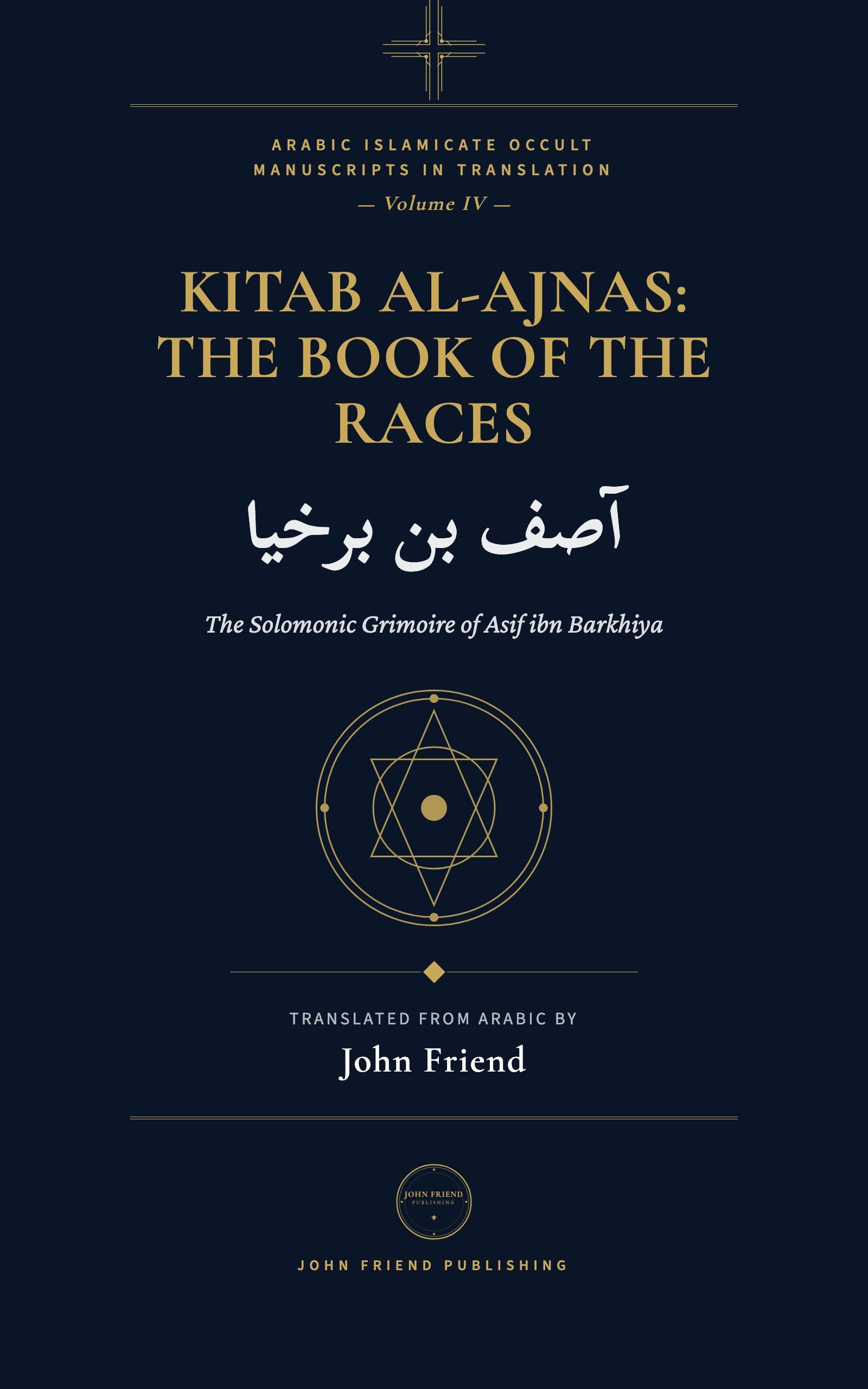
Kitab al-Ajnas: The Solomonic Grimoire of Asif ibn Barkhiya is attributed directly to Asif ibn Barkhiya himself — the first English translation of a text that sits at the center of the Arabic Solomonic tradition. This is the operative knowledge of Sulayman’s vizier: the specific science by which jinn kings are summoned, named, and commanded through divine authority. For a detailed chapter-by-chapter walkthrough, see Kitab al-Ajnas: A Chapter-by-Chapter Guide.
Sihr Muluk al-Jann: The Complete Magic of the Jinn Kings approaches the jinn kings through investitures, seals and adjurations, among them an Adjuration of the Seven Jinn Kings.
Together, these two texts give Western readers something that has not been available before: the Arabic originals of the tradition that underlies — however distantly — the Lemegeton and the Goetia. For a direct comparison between the Arabic and Western traditions, see Arabic Solomonic Magic vs. the Goetia.
A Note on Terminology: Sihr, Ruhaniyat, and Operative Authority
It is worth clarifying what the Arabic tradition means by the operative categories it uses.
Sihr — operative magic — covers a broad range of practices and carries no uniformly negative connotation in the Arabic texts themselves, even though Islamic legal discourse frequently condemned certain forms of it. The practitioner’s authority matters enormously: magic performed through the invocation of divine names and within divinely sanctioned frameworks is categorically different from magic performed through transgressive pacts with spirits.
Ruhaniyat — spiritual powers or spirits, from ruh, “spirit” — refers to the beings that populate the Arabic occult universe: angels, jinn, planetary spirits, and the subtler forces associated with letters and divine names. The Solomonic tradition is one dimension of the broader science of ruhaniyat.
The khatam — seal — as instrument of authority, and the ‘azima — the firm oath or binding adjuration — as operative speech act, are the two primary tools of the Solomonic practitioner. Both are present in the texts translated by John Friend Publishing.
Asif ibn Barkhiya: Islamic Art, Islamic Illustration, and Calligraphy
Asif ibn Barkhiya in Islamic art is usually approached through painting: Solomon enthroned among jinn, animals, and birds is a familiar subject of Persian and Ottoman manuscript illustration. But the images most closely tied to Asif’s own name are of another kind. In the grimoire attributed to him, the illustrations are instruments: seals, squares, and diagrams meant to be copied, engraved, and used.
The English translation of Kitab al-Ajnas reproduces those figures as images from the source manuscript. They include the Seal of Ṣakhr, to be engraved on a ring of red copper, of gold, or — best of all — of red carnelian; the mandal of Sulaymān; the seals of the planetary kings; and, in a remedy against the evil eye, “the heptagram of the Seal of Sulaymān,” a seven-pointed form of the seal with the Basmala and al-Fātiḥa written around it.
Set beside the six-pointed star described above, it is a reminder that the Seal of Solomon in Arabic manuscripts took more than one shape, and the Seal of Ṣakhr ring belongs to the same world of inscribed authority as the legendary ring of Solomon.
The same holds for calligraphy. The book’s title page gives the attributed author’s name in Arabic script, آصف بن برخيا, but the lettering that matters inside is operative: barbarous names (ʿajamī) transliterated exactly and printed beside the original Arabic script, never translated, because they are meant to be pronounced as written. Anyone seeking Asif ibn Barkhiya calligraphy in this tradition will find it in the names and the seals rather than in decorative panels — the Islamic illustration of Asif bin Barkhiya, in this sense, is the working page itself.
Further Reading
The Arabic Solomonic corpus is large, mostly unstudied in English, and increasingly accessible through translation. For those who want to go deeper — into the kings of jinn, the Solomonic seals, the operative science of divine names and binding adjurations — the John Friend Publishing catalog represents the primary current source of English translations from this tradition, with additional volumes in production. See also Asif bin Barkhiya in the Quran and the throne of Bilqis for the Quranic account of Asif’s powers.
