The Ghayat al-Hakim (“The Goal of the Sage” or “The Aim of the Wise”) is an Arabic compendium of astral and talismanic magic compiled around the mid-eleventh century CE, probably in al-Andalus. It is the Arabic original of the Latin Picatrix: the text was put into Castilian for Alfonso X in 1256 CE, and from Castilian into Latin. Its compiler is unknown; medieval manuscripts often credited it to Maslama al-Majriti, an attribution modern scholarship has largely rejected.
Among the most influential books in the history of Western magic, the Picatrix holds a peculiar distinction. Nearly everyone who has worked with it has been working with a translation of a translation — and with a text whose Arabic original most of them have never encountered.
The Picatrix that shaped Renaissance Neoplatonism also informed Marsilio Ficino’s astral medicine and Cornelius Agrippa’s occult philosophy, and it remains a touchstone for contemporary practitioners of ceremonial and planetary magic. Yet it is a Latin rendering of an Arabic text called Ghayat al-Hakim, “The Goal of the Sage.” And the relationship between the two is more complicated than the word “translation” suggests.
This article traces the history of both texts. It covers where the Ghayat al-Hakim came from, what it contains, how it became the Picatrix, and — critically — what Western readers have been missing by working only from the Latin.
Encyclopaedia coverage of the Picatrix (Ghayat al-Hakim) — the brief mentions in Britannica, or the Picatrix article on Wikipedia — is a reference summary by design. This essay goes deeper into the Ghayat al-Hakim book itself. It looks at the eleventh-century Arabic manuscript tradition behind the Picatrix, who wrote it, what its four books contain, and what changed when the Picatrix’s Arabic original was turned into Latin.
Key Facts
- Arabic title. Ghayat al-Hakim, “The Goal of the Sage” or “The Aim of the Wise.”
- Latin title. Picatrix, usually explained as an arabicized form of the name Hippocrates.
- Date and place. Mid-eleventh century CE; most likely al-Andalus (Islamic Spain).
- Compiler. Unknown. Medieval manuscripts often credit Maslama al-Majriti (d. c. 1007 CE), but the text is almost certainly pseudepigraphical.
- Contents. Four books: celestial philosophy (Book One), planetary correspondences and talisman construction (Books Two and Three), and Sabian and Hermetic material (Book Four).
- Route into Latin. Arabic, then Castilian for Alfonso X in 1256 CE, then Latin.
- In English. The standard English Picatrix (2011) is translated from the Latin, not the Arabic. John Friend Publishing does not publish the Ghayat al-Hakim.
The Ghayat al-Hakim: A Compendium of Arabic Astral Science
The Ghayat al-Hakim — “The Goal of the Sage” or “The Aim of the Wise” — is an Arabic text compiled around the mid-eleventh century CE, probably in al-Andalus (Islamic Spain). Its authorship is disputed. Medieval manuscripts frequently attributed it to the tenth-century Andalusian scholar Maslama al-Majriti (d. ~1007 CE). Modern scholarship has largely rejected this attribution: the text is almost certainly pseudepigraphical, using al-Majriti’s name to lend it scholarly prestige. The real compiler remains unknown. (See: en.wikipedia.org/wiki/Picatrix for an overview of the attribution debate and its scholarly history.)
What is not disputed is the text’s extraordinary scope. The Ghayat al-Hakim is a compendium — a systematic gathering of Arabic astral and talismanic science from multiple sources. These include the Hellenistic astrological tradition (Ptolemy, Dorotheus of Sidon), Neoplatonic philosophy (the Theology of Aristotle, the Liber de Causis), and Hermetic treatises that had circulated in Arabic translation. They also include Sabian religious practice from Harran (a community in northern Mesopotamia that preserved a form of planetary theurgy well into the Islamic period), alchemical literature, and original synthesis by the compiler.
The organizing principle is ambitious: to give the reader a complete system of astrological magic for working with the powers of the planets. To that end, the planets are treated as more than astronomical bodies. They are engaged as spiritual entities whose influence can be attracted, concentrated, and deployed through correctly constructed talismans, at astrologically appropriate moments, with the proper suffumigations and invocations.
What the Ghayat al-Hakim Actually Contains
The text is organized into four books, and its ambitions are systematic.
Book One: Celestial Philosophy
Before any operative instruction, the text lays philosophical groundwork. It draws heavily on Neoplatonic metaphysics — the emanation of forms from a First Principle through the celestial spheres down into matter — to explain why talismanic magic works.
The planets are not merely rocks in the sky; they are the channels through which spiritual powers flow into the material world. To attract planetary power is to work with a genuine cosmic mechanism, not to perform an arbitrary ritual. This philosophical grounding is one of the text’s most significant contributions, and also one of the sections most incompletely transmitted in Latin.
Books Two and Three: Planetary Correspondences and Talisman Construction
This is the practical core. Each planet — Saturn, Jupiter, Mars, the Sun, Venus, Mercury, the Moon — is described in exhaustive detail. The text gives its nature, its affinities, the materials associated with it (metals, stones, plants, animals), and the hours of day and night it governs. It also gives the suffumigations appropriate to it, the prayers and invocations directed to it, and the talismans that can concentrate its influence.
The instructions for talisman construction are specific: what metal to use, what image to engrave, and what hour to perform the engraving (calculated by astrological chart, with the planet appropriately positioned). They also say what words to inscribe and what to recite during the work. This level of operational detail integrates material, astronomical, and verbal elements into a single coherent practice. It is what made the Ghayat al-Hakim a working manual rather than purely a theoretical treatise.
Book Four: Sabian and Hermetic Material
The fourth book includes some of the most remarkable material in the text. It has detailed descriptions of Sabian planetary rituals from Harran and prayers addressed to the planetary spirits in elaborate invocatory forms. It also has Hermetic passages on the nature of the human soul and its relationship to the celestial spheres. This section includes the famous “invocations of the planets” that would later be excerpted and circulated independently throughout the Arabic and Latin traditions.
How the Ghayat al-Hakim Became the Picatrix
In the thirteenth century, the Castilian king Alfonso X — “Alfonso the Wise” — presided over one of the most remarkable intellectual centers in medieval Europe. Alfonso assembled scholars in Toledo who worked collaboratively to translate Arabic scientific and philosophical texts into Latin and Castilian Spanish. This Toledo School of Translators was the primary channel through which classical Arabic learning — including Aristotle’s works in their Arabic versions — entered European intellectual life.
The Ghayat al-Hakim was translated into Castilian in 1256 CE, and from Castilian into Latin shortly thereafter. The Latin version circulated under the name Picatrix — an arabicized form of the name Hippocrates, though the reason for this name remains somewhat obscure. The text was an immediate success in Latin scholarly circles, and it circulated widely through the remainder of the medieval period and into the Renaissance.
The translation process was competent but not without loss. Arabic technical vocabulary for which there were no Latin equivalents was sometimes transliterated, sometimes mistranslated, and sometimes simply omitted. The philosophical dimensions of the text — particularly the Neoplatonic metaphysics that justify the operative practices — were compressed. Passages that made specific reference to Islamic religious practice were sometimes modified or excised. And the Arabic astrological terminology, built on centuries of accumulated technical meaning, passed through the translation with varying degrees of accuracy.
The result was a text that was recognizably related to its Arabic original, with the same practices, the same planetary structure, the same basic operative logic. But it had lost some of the conceptual richness and doctrinal context that the Arabic version carried.
What Got Lost in Translation
Several things slipped through the cracks of the Arabic-to-Latin transmission.
The Sabian Context
The Harranians — the Sabian community whose planetary theurgy is extensively quoted in the Ghayat al-Hakim — were a living community with a continuous ritual practice. The Arabic text engages their material from the inside of a tradition that had not yet entirely disappeared. By the time the Latin translation was made, that context had vanished from Europe; the Sabian material in the Picatrix became exotic mysticism rather than documented practice.
The Philosophical Framing
The Arabic Neoplatonism that structures the Ghayat al-Hakim’s theory of talismanic action was partly available to Latin readers through other translations. Its key ideas are the emanation of spiritual powers through the celestial hierarchy and the concept of the nafs al-kulliyya (the universal soul) as the medium through which talismans work. But its integration with operative practice was unique to this text and was not fully preserved.
The Invocatory Prayers
Some of the planetary invocations in the Arabic version are longer and more elaborate than their Latin counterparts. These prayers call upon the planetary spirits by their Arabic names and epithets, within a framework that includes Quranic vocabulary and Hermetic imagery simultaneously. Their reduction in Latin represents a real loss of spiritual richness.
Picatrix Latin vs. Arabic: The Differences at a Glance
For readers comparing the two versions side by side, the main differences between the Latin Picatrix and the Arabic Ghayat al-Hakim come down to five points:
- Route. The Arabic original was compiled around the mid-eleventh century, probably in al-Andalus; the Latin came by way of a Castilian translation made for Alfonso X in 1256 CE.
- Philosophy. The Arabic integrates its Neoplatonic theory — the universal soul (nafs al-kulliyya) as the medium of talismanic action — directly with practice; the Latin compresses it.
- Sabian material. The Arabic quotes the planetary rituals of Harran from inside a tradition that had not yet disappeared; in Latin the same material became exotic mysticism.
- Prayers. Several Arabic planetary invocations are longer, name the spirits by Arabic names and epithets, and mix Quranic and Hermetic vocabulary; the Latin shortens them.
- Religious framing. Passages referring to Islamic religious practice were sometimes modified or excised in Latin.
What carried over intact was the seven-planet structure and the operative logic. For how the Latin Picatrix translation handles talismans in practice, see Why Your Planetary Talismans Don’t Work.
Ghayat al-Hakim Manuscript Pages: Arabic Copies and Latin Copies
A “medieval Picatrix manuscript” can mean two different things. It can mean a Picatrix Arabic manuscript in the strict sense — a copy of the Ghayat al-Hakim, of the kind medieval scribes frequently attributed to Maslama al-Majriti. Or it can mean a Latin copy of the Picatrix, descended from the 1256 Castilian translation and circulated through the rest of the medieval period and into the Renaissance.
The two families are related, but anyone studying Picatrix manuscript pages should know which one they are looking at. They are not the same book, and the Latin is the translation described above, with its compressions and omissions.
John Friend Publishing does not publish an edition of the Ghayat al-Hakim manuscript. Its translations work from Arabic manuscripts of the same astral-magic tradition. The talismanic seals and magic squares in them are reproduced as images from the source manuscript, so English readers see the figures as they appear in the Arabic source.
Why the Picatrix Became Foundational for Renaissance Magic
Despite — or perhaps because of — the translation’s losses, the Latin Picatrix became one of the most influential occult texts of the European Renaissance. Marsilio Ficino’s De Vita Coelitus Comparanda — his system for attracting astral influence through music, diet, and talismans — draws directly on Picatrix material. Heinrich Cornelius Agrippa’s Three Books of Occult Philosophy, the most comprehensive Renaissance magical encyclopedia, quotes and paraphrases the Picatrix extensively. Giordano Bruno’s memory-art system integrates planetary imagery drawn from the Picatrix tradition.
What the Picatrix gave Renaissance magic was precisely what it had taken from the Ghayat al-Hakim: a coherent philosophical framework for why planetary magic works, combined with specific operative instructions for how to do it. This combination — theory and practice unified in a single systematic text — was rare and valuable.
Ghayat al-Hakim in English: Entering the Arabic Astral-Magic Tradition
The Picatrix is now available in English translation — John Michael Greer and Christopher Warnock produced a translation in 2011 that remains the standard English reference for the Latin text. But the Arabic original, and the broader tradition it represents, has until recently remained inaccessible. For a detailed analysis of what the Latin translation lost, see The Arabic Astral-Magic System the Picatrix Borrowed From.
If you are looking for a Ghayat al-Hakim English translation made from the Arabic, or a Ghayat al-Hakim English PDF, it is worth being plain. John Friend Publishing has not published the Ghayat al-Hakim itself, and offers no PDF of it. What the press publishes are English translations made directly from Arabic manuscripts of the same tradition, and their Kindle editions are free to read with Kindle Unlimited.
John Friend Publishing’s translations open two access points into the Arabic astral-magic world that produced the Ghayat al-Hakim.
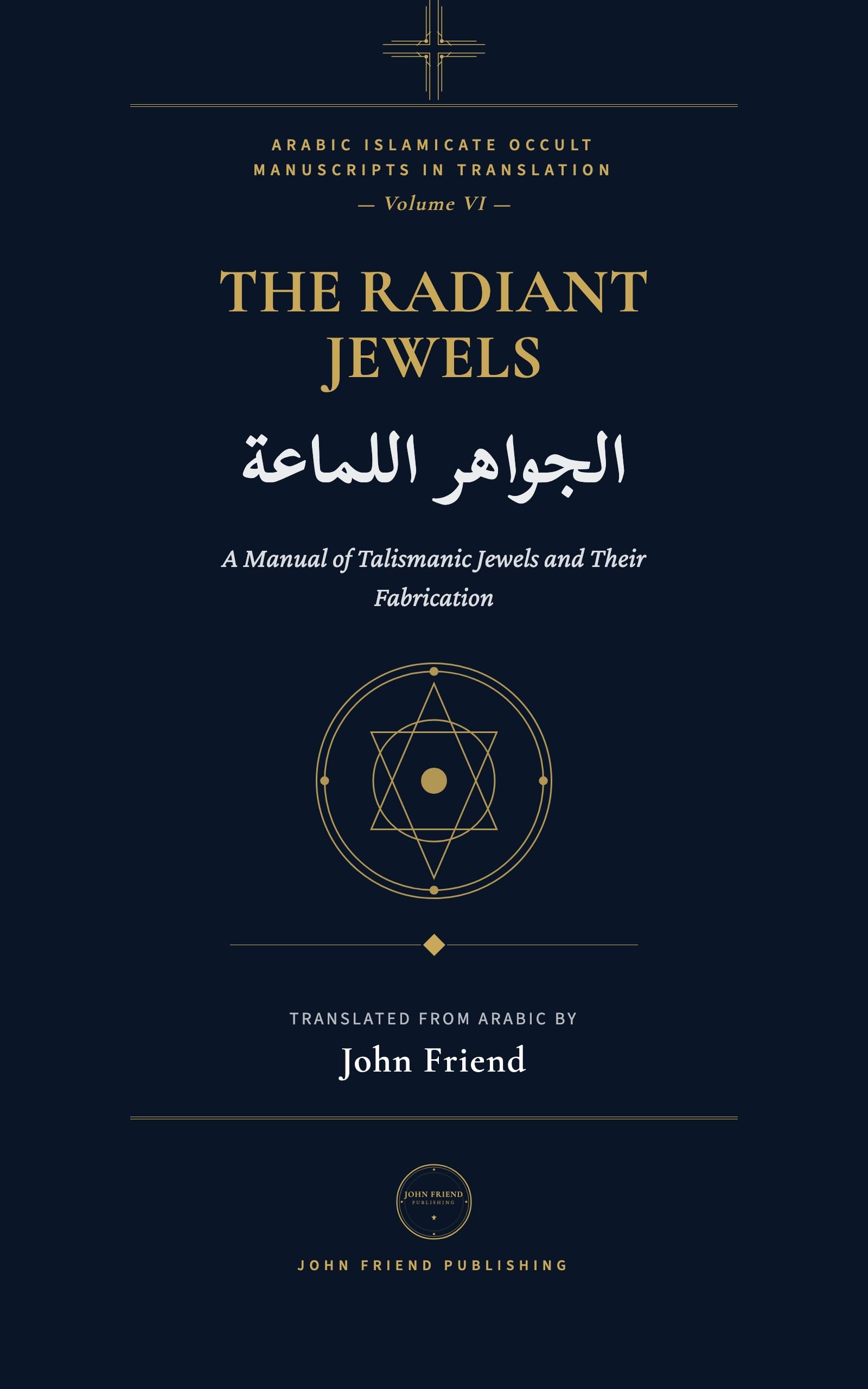
al-Jawahir al-Lamma’a: The Radiant Jewels for Summoning the Kings of Jinn works with the same planetary-hours system that is central to Ghayat al-Hakim — the correct timing of operations according to planetary hours. It also brings the Arabic jinn-conjuration material that runs alongside the astral framework into English for the first time. The planetary-hours system in the Ghayat al-Hakim and in this text share the same underlying logic.
The system is set out early in that manual. The manual counts twelve planetary hours of daylight and twelve of night, and assigns the opening hour of every day to that day's own planet (al-Jawahir al-Lamma’a, p. 14).
Suns of Lights and the Great Treasures of Secrets (Shams al-Anwar wa Kunuz al-Asrar al-Kubra) by Ibn al-Hajj al-Tilmsani (1327 CE) works directly with planetary spirits and magic squares in the al-Buni lineage. It covers material that parallels the Ghayat al-Hakim’s planetary-spirit framework from within the Arabic tradition rather than through a Latin lens.
Reading these texts alongside the Picatrix gives a stereo view of the same tradition — one that reveals how much was preserved in Latin, and how much remains only in Arabic.
Further Reading
For those who want to pursue the Arabic roots of Western astral magic more deeply, the primary-text translations from John Friend Publishing provide an increasingly substantial library. The 28 lunar mansions in Arabic magic and the planetary hour system for jinn summoning are particularly relevant companion articles — the first systematic effort to make the Arabic originals available in English. Several more volumes are in production.
For the wider family of medieval Arabic astrology manuscripts that worked with the same planetary hours and lunar mansions, and for the Picatrix planetary hours and what the Arabic sources complete, see those companion essays. For every Arabic occult manuscript now readable in English, start with the complete guide.
