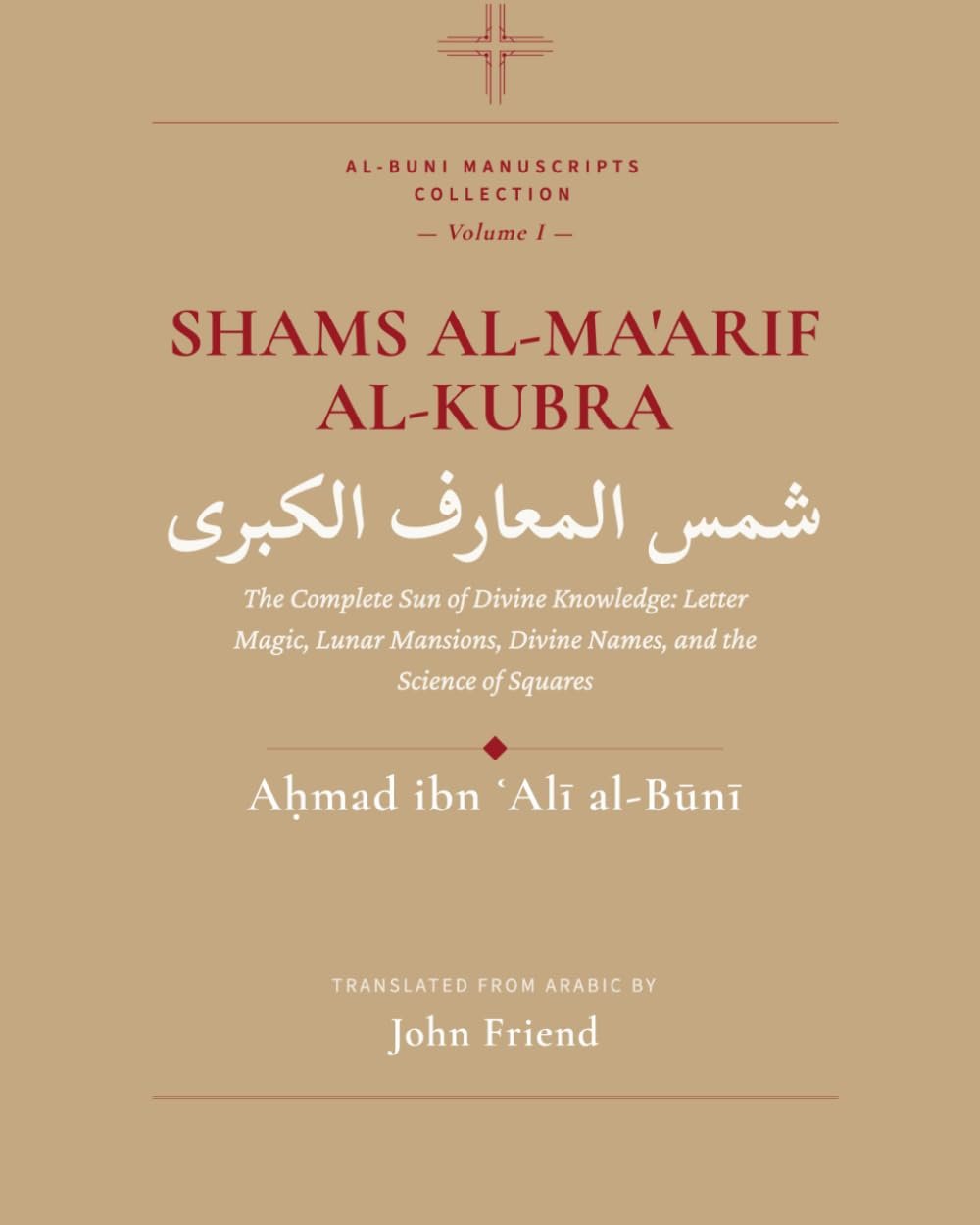
The Shams al-Ma’arif (شمس المعارف), “The Sun of Knowledge” in English, is an Arabic book of letter magic, lunar mansions, divine names and magic squares. The 1927 printed edition calls it “The Greater Sun of Knowledge and the Subtleties of Gnosis” and opens with the name of Shaykh Ahmad ibn ‘Ali al-Buni, who “died in the year 622” (1225 CE), though some sources give 630 AH. Modern scholarship treats parts of the book as written under his name by later hands.
This guide explains what the title means, who wrote the book, why it was written and how its manuscripts differ; the chapter-by-chapter contents are in the Shams al-Ma’arif book in English.
If you have spent any time in the world of Western occultism — or Arabic mysticism, or the history of magic more broadly — you have almost certainly encountered the name Shams al-Ma’arif al-Kubra. It floats through forum threads, footnotes, and bibliography lists with a kind of legendary gravity. The “Sun of Knowledge” has routinely been described as the most influential Arabic grimoire ever written — and yet, for English readers, it long remained almost entirely inaccessible.
A complete English translation now exists — Volume I of the Al-Buni Manuscripts Collection — but what existed before it was partial, contested, and often filtered through secondary accounts that flatten the text into something more sensational than it actually is.
This guide is a genuine attempt to explain what the Shams al-Ma’arif is, who wrote it, what it contains, why it matters, and — crucially — where an English reader can actually begin with the Arabic occult tradition it represents.
Shams al-Ma’arif Meaning: The Sun of Knowledge, or Sun of Gnosis
So what is the Shams al-Ma’arif, starting with its name? The book was written in Arabic, and its title is usually rendered “The Sun of Knowledge” or “The Sun of Gnosis.” Shams is “sun” — the same word that names Surah al-Shams, “The Sun,” the ninety-first chapter of the Qur’an — and ma’arif is the plural of ma’rifa, the intimate knowledge of God and of hidden realities that Sufi writers call gnosis.
The 1927 printed edition gives the work as “The Greater Sun of Knowledge and the Subtleties of Gnosis.” Al-Kubra, “the Greater,” marks it off from other works of the same name: the introduction to al-Buni’s Manba’ Usul al-Hikma speaks of a Shams al-Ma’arif al-Kubra, an al-Wusta (“the Middle”), and an al-Sughra (“the Lesser”). Whether you have seen the title written Shams al-Marif, Shamsul Maarif, or Shams al-Ma’arif, the spelling points to the same book.
Who Wrote the Shams al-Ma’arif? Ahmad ibn Ali al-Buni, the Man Behind the Text
The Shams al-Ma’arif al-Kubra is attributed to Abu al-Abbas Ahmad ibn Ali al-Buni, a scholar who died around 1225 CE. He was from Buna (present-day Annaba, Algeria), hence the nisba al-Buni, and lived and worked primarily in Cairo. He is sometimes described as a Sufi, sometimes as a magician, and often as both; in the Islamicate intellectual tradition of his era, the distinction between mystical practice and operative science was considerably more porous than modern categories suggest.
Al-Buni was a prolific author. Texts attributed to him include Manba’ Usul al-Hikma (The Source of the Foundations of Wisdom), Laṭa’if al-Isharat (The Subtleties of Signs), and numerous shorter treatises on the science of letters and divine names. Scholars working in the field today — including Liana Saif, whose research on the Arabic occult tradition has been particularly rigorous — caution that the corpus attributed to al-Buni almost certainly includes texts added by later hands.
The Shams al-Ma’arif itself exists in radically different manuscript versions, ranging from a relatively modest text to an enormous four-volume compilation. Attribution, in medieval Arabic manuscript culture, functioned differently than modern authorship: a prestigious name served as a guarantor of a text’s power and lineage, and scribes were not reluctant to attach al-Buni’s name to related material.
Al-Buni’s significance is acknowledged in major reference works: the Encyclopaedia of Islam dedicates an entry to him and the Shams al-Ma’arif, and the Encyclopaedia Britannica references the text in its coverage of Islamic esotericism. None of this diminishes the complexity of attribution. He is, by any measure, the central figure in the Arabic sihr — operative magic — tradition, and his influence on subsequent centuries of Islamic occult practice was enormous.
So who wrote the Shams al-Ma’arif? The tradition answers Ahmad ibn ‘Ali al-Buni, a thirteenth-century master: the 1927 printed edition opens with his name and gives his death as 622 AH, and the English translation notes that some sources give 630 AH (1233 CE) instead.
Modern scholarship adds a second answer — that the Shams al-Ma’arif attributed to Ahmad al-Buni is partly pseudepigraphic, a work that grew under his name. Reference works such as the Encyclopaedia of Islam, the Encyclopaedia Britannica, and Wikipedia can give al-Buni and the Shams al-Ma’arif only a compressed treatment; the texts themselves are being published in English in the Al-Buni Manuscripts Collection.
What the Shams al-Ma’arif Actually Contains
The full title — Shams al-Ma’arif wa-Lata’if al-‘Awarif — translates as “The Sun of Knowledge and the Subtleties of Gnosis.” The text is organized around several interlocking systems.
The Science of Letters (‘Ilm al-Huruf)
The Arabic alphabet is, in al-Buni’s framework, a living system. Each letter carries numerical values (abjad), elemental correspondences, planetary affinities, and spiritual properties. To know the hidden nature of a letter is to know something about the structure of reality itself — and therefore to be able to act upon it. This is ‘ilm al-huruf, the science of letters, and it is the engine that drives everything else in the text. Operations that involve writing divine names, constructing talismans, or composing invocations all depend on the correct understanding of letter-science.
The Divine Names (Asma’ Allah al-Husna)
Islam enumerates ninety-nine “beautiful names” of God — al-Rahman (the Compassionate), al-Qadir (the All-Powerful), and so on. Al-Buni treats these names as operative forces: their recitation (dhikr), their inscription in specific configurations, and their deployment at astrologically appropriate moments produces real effects in the world. This is not, in al-Buni’s framework, magic in a transgressive sense — it is the science of channeling divine power through the legitimate channels of the names God has disclosed.
Magic Squares (Wafq)
The wafq — often translated as “magic square” — is a grid of numbers or letters in which each row, each column and both diagonals sum to the same total. Al-Buni develops an elaborate science of wafq construction tied to planetary correspondences, divine names, and specific operative purposes. The three-by-three square associated with Saturn, or the four-by-four square of Jupiter, each carry distinct properties and are used in distinct types of operation. The wafq tradition al-Buni systematized became foundational for centuries of Arabic, Ottoman, and Persian occult practice, and later influenced talismanic traditions far beyond the Islamic world.
Planetary Spirits and Celestial Science
Al-Buni integrates the Arabic astrological tradition — derived from Hellenistic and Persian sources — into his operative framework. Each planet governs specific materials, hours, perfumes, and categories of operation. To work with Jupiter is to work in a Jovian hour, with Jovian suffumigations, invoking Jovian spiritual beings. The text provides detailed tables of planetary correspondences and instructions for their use.
Quranic Verses and Divine Speech
Unlike purely astrological or spirit-conjuring texts, the Shams al-Ma’arif is saturated with the Quran. Specific ayat — verses — are assigned operative properties; their recitation is part of the mechanism by which operations function. This grounding in sacred scripture is one reason al-Buni’s work was viewed, by many of its readers, as legitimately Islamic rather than transgressive.
Why Was the Shams al-Ma’arif Written?
The printed book answers this itself. It opens by citing the Ottoman bibliographical encyclopedia Kashf al-Zunun on the work’s purpose: that the reader “should know, through it, the nobility of the names of God Most High,” learn “how to operate by means of the names and invocations” together with the letters of the suras and verses, and so “attain the Lordly Presence without fatigue” and “the desires of this world without hardship.”
The Shams al-Ma’arif, in other words, was written to serve two ends at once — nearness to God and success in worldly affairs — through the same instruments: the divine names, the Qur’an, and the letters.
Why the Shams al-Ma’arif Became the Most Influential Islamic Occult Text
Several factors converged to make this text the gravitational center of the Arabic sihr tradition.
First, al-Buni synthesized. Earlier Arabic occult knowledge existed in scattered treatises on letters, in astrological manuals, in Neoplatonic texts that had been translated into Arabic during the eighth through tenth centuries. Al-Buni drew these threads into a coherent system — one that could be understood, taught, and applied as a unified body of knowledge.
Second, the text is practical. Alongside theoretical explanations, the Shams al-Ma’arif contains specific operations: how to construct a talisman for protection, how to compose an invocation for a particular planetary hour, how to write a wafq for a specific purpose. This practical orientation made it a working reference rather than purely a theoretical treatise.
Third, the text presents itself as rooted in legitimate Islamic knowledge — in the Quran, in the divine names, in the scholarly sciences. This gave it a degree of credibility and protected it, at least partially, from the kinds of condemnation that attended more overtly transgressive texts.
By the fourteenth and fifteenth centuries, the Shams al-Ma’arif had become the reference point for the Arabic occult tradition — the text against which other texts were measured, cited, or claimed to extend.
Shams al-Ma’arif Manuscripts: History and Transmission
The text exists in dozens of manuscript copies across the great libraries of Cairo, Istanbul, Tunis, Fez, and beyond. These manuscripts vary enormously — in length, in content, and in the versions of specific operations they present. There is no single authoritative text of the Shams al-Ma’arif; what we have is a tradition, alive across centuries of copying and annotation, in which the text grew, shifted, and accumulated.
Printed editions appeared in the nineteenth and early twentieth centuries, primarily in Egypt, and these are the versions most commonly referenced today. However, scholars working with the manuscript tradition have demonstrated that these printed editions are themselves composite texts that do not correspond to any single historical manuscript. The standard “Bulaq” and subsequent Cairo printed editions should be understood as a textual tradition rather than a critical edition.
This complexity is part of why a complete English translation took so long to appear. The editorial work required — establishing which manuscripts to translate, how to handle variant readings, how to annotate a text this dense — is substantial. It is the work of a scholarly generation, not a single volume.
That gap has since been filled for the printed text, but the manuscript problem remains: there is no single Shams al-Ma’arif manuscript to point to, and old manuscripts and Arabic manuscript pages of the book differ greatly from one another. The English edition from John Friend Publishing translates the 1927 printed Arabic edition — the most widely circulated recension of the text — in full.
Its talismanic seals and magic squares are reproduced as images from the source, the Arabic of key passages is included, and barbarous names are transliterated alongside the original Arabic script; where the source is illegible, the translation notes the gap rather than inventing content.
How the Shams al-Ma’arif Is Read Today
Contemporary readers come to the Shams al-Ma’arif along several different paths.
Some come through academic Islamic studies, approaching it as a historical document that illuminates the intersection of Sufism, philosophy, and operative practice in medieval Islam. Researchers like Liana Saif and Jean-Charles Coulon have produced rigorous scholarship on al-Buni and his context. (See, for example, the Cambridge-published work on Islamic occultism — en.wikipedia.org/wiki/Ahmad_ibn_Ali_al-Buni provides a starting overview with further scholarly references.)
Others come through the living ‘ilm al-huruf traditions that are still practiced — in North Africa, West Africa, South Asia, and elsewhere — by practitioners who learned from masters who learned from masters in unbroken lineages stretching back centuries. For these practitioners, the Shams al-Ma’arif is not a historical curiosity but a living reference.
And increasingly, readers come from the Western esoteric tradition — people who have encountered Agrippa, or the Picatrix, or planetary magic, and who want to understand the Arabic sources that shaped those traditions. For this last group, the challenge of inaccessibility is most acute.
The Broader Arabic Occult Corpus
Al-Buni did not work in isolation. The Shams al-Ma’arif sits within a rich tradition that includes the Ghayat al-Hakim (translated into Latin as the Picatrix), the texts attributed to Jabir ibn Hayyan on alchemical and talismanic science, the Solomonic kitabs — books — that circulated under the names of Sulayman and his court, and numerous regional and specialist texts dealing with planetary spirits, jinn, and the science of names. The Shams al-Ma’arif is the most famous node in this network, but the network itself is vast.
Understanding al-Buni requires engaging with the Ikhwan al-Safa’ (Brethren of Purity) encyclopedias, with the Neoplatonized Aristotelianism of the Arabic philosophical tradition, and with the Sufi sciences of the heart and the divine names. His work is the synthesis of a tradition, not the beginning of one.
Where English Readers Can Start
The Shams al-Ma’arif itself is available in a complete English translation, Volume I of the Al-Buni Manuscripts Collection, Shams al-Ma’arif al-Kubra; its forty chapters are summarized in the Shams al-Ma’arif contents and summary. The operational world it describes — the planetary correspondences, the wafq science, the jinn hierarchies, the letter-science — is also alive in related texts now available in English through John Friend Publishing.
Beyond Volume I itself, the closest available entry-point is Suns of Lights and the Great Treasures of Secrets (Shams al-Anwar wa Kunuz al-Asrar al-Kubra) by Ibn al-Hajj al-Tilmsani, written in 1327 CE — see Shams al-Anwar: The Forgotten Arabic Grimoire That Completed Al-Buni’s Shams al-Ma’arif for the full story of that text. The title itself — “Suns of Lights” — signals its relationship to al-Buni’s Shams al-Ma’arif.
Tilmsani worked a century after al-Buni, in the same operative lineage, deploying the same machinery of divine names, magic squares, planetary spirits, and letter-science. Apart from Volume I, this is as close as English readers can currently come to the world of the Shams al-Ma’arif in translation. For al-Buni’s own dramatic history, see The Magic Book That Was Banned and Burned.
For those interested in the Solomonic and jinn-conjuration dimensions of the tradition, al-Jawahir al-Lamma’a: The Radiant Jewels for Summoning the Kings of Jinn opens the planetary-hours and jinn-king conjuration material that runs alongside the letter-science in al-Buni’s corpus.
Further Reading
The scholarship on Ahmad al-Buni and the Shams al-Ma’arif is growing, with serious academic work now emerging from researchers in Islamic studies, the history of science, and the history of magic. For those who want to go deeper into the Arabic occult tradition in English translation, the John Friend Publishing catalog of Arabic grimoires in English — with more volumes in production — offers the most substantial body of primary-text access currently available to English readers.