Western books on ceremonial magic treat incense as atmosphere. A stick of sandalwood on the altar. A cone of frankincense “to set the mood.” The Arabic grimoires do not share this view. In the operational manuscripts of the Arabic magical tradition — the texts that were written by practitioners for practitioners — incense (bukhur) is not optional and it is not decorative. It is described, repeatedly and without metaphor, as the “table” set before the spirits and the “greatest gift” offered to them. The smoke is the medium through which spiritual entities approach, perceive, and interact with the operator. Without it, no manifestation occurs. With the wrong recipe, the operation fails — or worse.
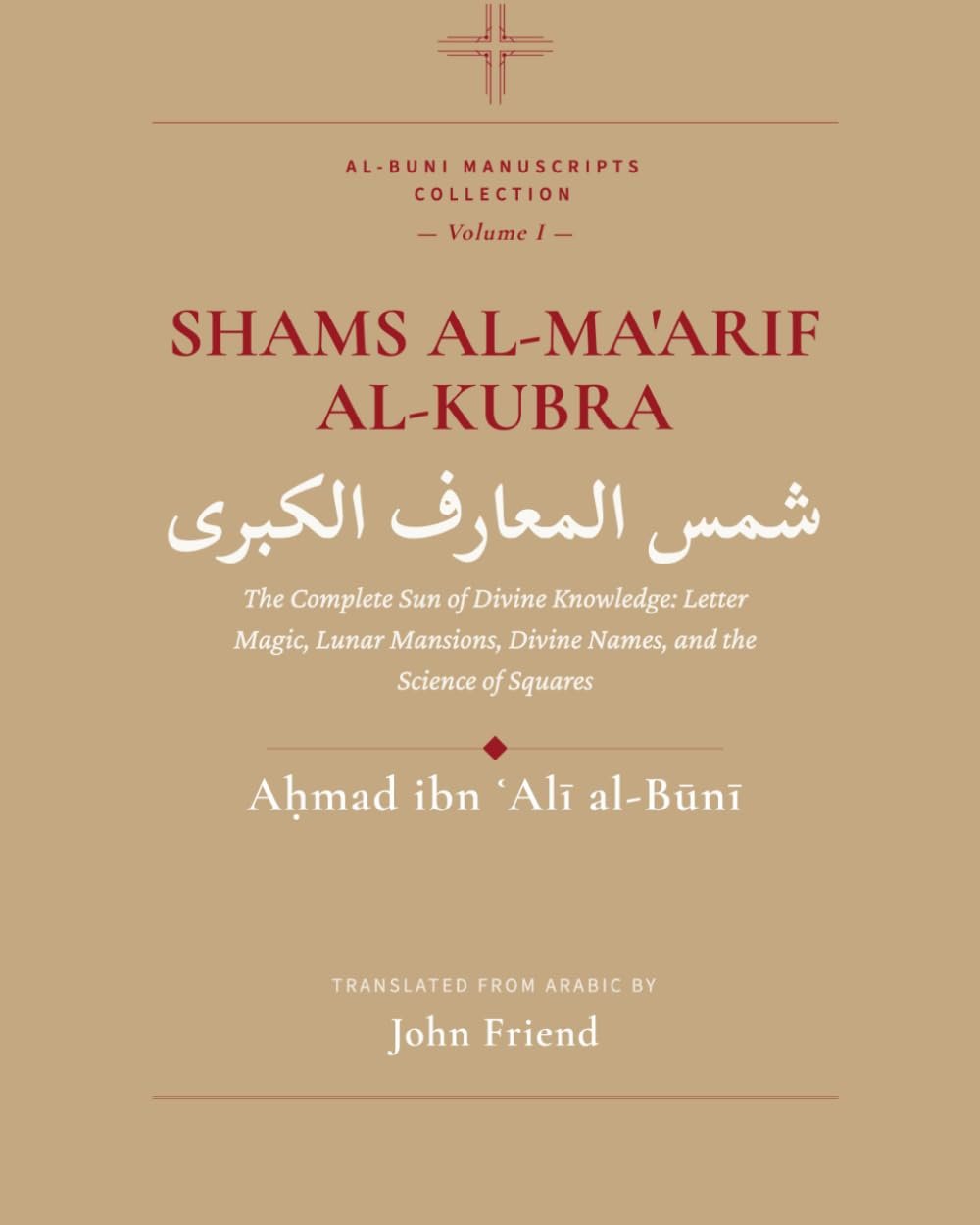
The sources are unanimous on this point. Ahmad al-Buni’s Shams al-Ma’arif treats fumigation as one of the pillars of every working. The Ghayat al-Hakim — known in the West as the Picatrix — devotes substantial passages to planetary incenses and their compositions. Ibn al-Hajj al-Tilmsani’s Shams al-Anwar wa Kunuz al-Asrar al-Kubra, the Solomonic Kitab al-Ajnas, and al-Jawahir al-Lamma’a (attributed to Ali Abu Hayy Allah al-Marzuqi) all provide specific fumigation recipes with quantities, ingredients, and timing protocols. These are not suggestions. They are prescriptions, and the texts treat deviation from them with the same gravity a pharmacist would treat a botched dosage.
Why Incense Is Not Optional
The Arabic manuscripts frame incense in functional terms, not symbolic ones. The smoke is described as the vehicle — the physical substance that spiritual entities use to take perceptible form. The Shams al-Anwar is explicit: the fumigation must burn continuously throughout the entire operation, from the first recitation to the final dismissal. If the smoke stops, even momentarily, the connection is broken. Tilmsani warns that allowing the incense to die mid-operation invites “great harm and grave danger” — not merely failure, but active spiritual backlash from entities that have been half-summoned and then abruptly cut off.
This is not a vague caution. The Kitab al-Ajnas contains a notorious passage known among manuscript scholars as the “Chapter of the Cat,” in which an operator who used the wrong fumigation during a conjuration of one of the planetary spirits found the entity manifesting not in the expected form but as a hostile presence that terrorized the operator for days afterward. The account is presented not as folklore but as a documented case — a warning to readers about the consequences of carelessness with incense recipes. The entity, the text explains, was not malicious by nature. It was offended. The wrong incense was, in effect, the wrong offering — an insult presented as a gift.
The Shams al-Ma’arif frames the principle concisely: each class of spirit has a specific nature, and that nature is attracted to specific substances. Burn the substance that corresponds to the spirit’s nature, and you create a welcoming medium. Burn the wrong substance, and you either repel the spirit entirely or provoke it. There is no neutral option. Every fumigation is either correct or it is an error.
The Universal Base: Frankincense and Coriander
Before addressing the planetary-specific recipes, the manuscripts establish a universal base that applies to virtually all operations. The Shams al-Anwar prescribes it clearly: male frankincense (luban dhakar) combined with whole, uncrushed coriander seeds. The frankincense must be of the highest quality — the pale, tear-shaped resin, not the dark or powdered commercial grade. The coriander seeds must be intact and specifically free from weevils. Tilmsani emphasizes this last point with unusual insistence: infested seeds are spiritually contaminated and will corrupt the entire fumigation.
This base serves as the default fumigation for general workings, for the dismissal of ambient jinn (sarf al-ammar), and as the foundation upon which planetary-specific additions are layered. The al-Jawahir al-Lamma’a confirms the same base recipe in its own conjuration protocols, noting that frankincense alone — without the coriander — is acceptable for minor recitations but insufficient for full operations involving the appearance of spiritual entities.
The Ghayat al-Hakim agrees on frankincense as the universal solvent of fumigation but adds its own refinement: the resin should be freshly harvested if possible, and stored in a sealed container away from moisture and light. Stale frankincense, the text notes, produces a dull and “lifeless” smoke that spiritual entities perceive as weakness in the operator.
The Seven Planetary Incenses
Every planet governs specific substances, and the Arabic manuscripts assign each planet its own fumigation recipe. This is where the Picatrix and the Arabic operational texts diverge sharply. The Ghayat al-Hakim mentions planetary incenses in general terms — aloe wood for the Sun, mastic for Jupiter, and so on — but the Arabic-language grimoires provide far more precise recipes, often with exact quantities measured in mithqal (a unit of approximately 4.25 grams).
The Shams al-Anwar gives the most systematic treatment. For Saturn, the fumigation centers on dark, heavy substances: black myrrh, opium, and sulfur, burned over charcoal during Saturn’s planetary hour on Saturday. For Jupiter, the recipe calls for aloe wood (’ud), mastic, and saffron — bright, resinous, and costly materials that reflect Jupiter’s nature of expansion and generosity. Mars demands sharp, hot substances: red pepper, ginger, and dragon’s blood resin. The Sun takes the noblest ingredients: pure amber, saffron, and musk. Venus calls for rose petals, jasmine, and white sandalwood. Mercury uses a mixture of all planetary substances in small quantities — reflecting Mercury’s nature as the mediator between worlds. The Moon’s fumigation is the simplest: white camphor and fresh frankincense, burned during the Moon’s hour on Monday.
The al-Jawahir al-Lamma’a provides its own planetary incense table, which overlaps substantially with the Shams al-Anwar but adds variant recipes for specific operations — one fumigation for conjuring a planet’s spiritual king, another for inscribing a planetary talisman, and a third for charging a completed talisman with the planet’s force. The text is clear that these are not interchangeable: a fumigation appropriate for talisman construction may be insufficient for direct conjuration, and vice versa.
The al-Jawahir al-Lamma’a’s tables go further still. One divides each planet’s fumigation into an incense of the day and an incense of the night — for Saturn, myrrh, costus and storax by day, but olive oil, benzoin and myrrh by night; for Jupiter, sandalwood, amber and frankincense by day, and aloeswood, mastic and camphor by night. Another gives every planet two opposite fumigations: an incense of attraction and an incense of repulsion. Venus attracts with sandalwood, ambergris and musk and repels with camphor, coriander and rose; Mars attracts with pepper, ginger and red sulfur and repels with a mixture that includes mustard and sulfur. The same planet can serve an operation of drawing or of driving away, and the fumigation is what marks the difference.
Incense by Lunar Mansion in the Shams al-Ma’arif
Al-Buni’s own text assigns fumigations to the lunar mansions as well as to the planets. In the third chapter of the Shams al-Ma’arif al-Kubra, the mansion of al-Butayn takes aloeswood, saffron and mastic; al-Thurayya takes flaxseed and black seed; and al-Dabaran, a mansion in which the text forbids the making of talismans, takes sweet pomegranate peel and male frankincense. The timing system behind these entries is explained in Lunar Mansions in Arabic Magic.
Is Planetary Fumigation Black Magic?
Are these recipes black magic? The Arabic grimoires do not sort their fumigations into white and black. They sort them by planet, by hour, by spirit and — as the attraction-and-repulsion tables show — by purpose, so that a single planet has one smoke for drawing and another for driving away. How the manuscripts themselves drew the line between spiritual science and sorcery (sihr) is examined in Black Magic vs. Spiritual Science: Sihr in the Arabic Manuscripts.
The Advanced Method: Deriving Incense from Arabic Magic Squares
The most sophisticated approach to fumigation in the Arabic tradition does not rely on fixed recipes at all. Instead, it derives the appropriate incense mathematically from the magic square (wafq) associated with the operation. The Shams al-Anwar describes this method in detail, and it represents the intersection of Arabic numerology, planetary science, and material pharmacology that makes these texts so remarkable.
The method works as follows. The practitioner takes the governing number of the magic square being used in the operation and divides it by three. If the remainder is one, the incense must be drawn from the mineral kingdom — sulfur, mercury, antimony, or similar substances. If the remainder is two, the incense must come from the animal kingdom — musk, ambergris, civet, or castoreum. If the remainder is zero (divisible by three), the incense is drawn from the plant kingdom — resins, woods, flowers, and seeds.
This system ensures that the fumigation is not merely “planetary” in a generic sense but is precisely calibrated to the specific numerical structure of the operation being performed. Two practitioners working with the same planet but different magic squares might use entirely different incenses — and both would be correct, because the incense is derived from the mathematics of the working itself, not from a fixed table.
The Shams al-Ma’arif alludes to this principle in its discussion of the relationship between numbers and material substances, but al-Buni, characteristically, presents it as theoretical knowledge rather than operational instruction. It is Tilmsani, a century later and writing explicitly for practitioners, who provides the step-by-step method. The Kitab al-Ajnas uses a simplified version of this system in its Solomonic operations, where the incense type is determined by the nature of the jinn being addressed rather than the magic square, but the underlying principle — that incense must correspond to the specific spiritual entity and numerical framework of the operation — is the same.
How these Arabic magic squares are built, and which square belongs to which planet, is covered in Awfaq: Arabic Magic Squares as Planetary Talismans.
Incense for Summoning a Jinn: The Jinn-King Recipes
The conjuration literature makes the point most concretely. Sihr Muluk al-Jann devotes its Seventh Section to “The Incense Preparation and Ritual Procedure.” The ingredients must be gathered at the proper time: red sandalwood is set over the fire with rose water, three measures of resin, storax and every fragrance are mixed together, and frankincense is added — “the substance that is called the incense of victory” — with a recitation spoken while it burns. The same book allows a measure of flexibility for the seal of its seventh king, ‘Azra’il: if the prescribed incense is found, the procedure stands; if not, the practitioner is to seek “whatever is available from the appropriate incenses.”
Fumigation also outlasts the summoning itself. In the al-Jawahir al-Lamma’a, a binding with a jinn king must be renewed every seven days or every lunar month by reciting the renewal formula and fumigating the talisman that bears the seal of the covenant. Anyone reading about how to summon a jinn in these texts is reading, in large part, about smoke; the full protocol is set out in How to Summon a Jinn: The Seven Kings of Jinn.
What the Western Tradition Lost
The Latin Picatrix preserves a residue of these fumigation protocols, but only a residue. The planetary incense lists survive in abbreviated form. The universal base recipe is absent. The mathematical derivation method is gone entirely. The warnings about continuous burning, about spiritual backlash from incorrect recipes, about the incense as “table” and “gift” — all of this was stripped during the translation from Arabic to Latin in the thirteenth century, and what remained was further diluted as European grimoires copied from each other across the following centuries.
By the time the Western ceremonial tradition reached its modern form, incense had been reduced to a single instruction: “burn incense appropriate to the working.” No recipes. No quantities. No warnings. No explanation of why the smoke matters or what happens when it stops. The operational knowledge — the knowledge that transforms a symbolic gesture into a functional technology — exists only in the Arabic originals.
Where to Read the Complete Recipes
The most complete presentation of fumigation science available in English is found in Shams al-Anwar wa Kunuz al-Asrar al-Kubra (Suns of Lights and the Great Treasures of Secrets), translated in full as Volume III of the John Friend Publishing series. Tilmsani’s text provides the universal base recipe, all seven planetary fumigation protocols with quantities, the mathematical derivation method from magic squares, and the operational warnings about timing and continuity that no other English-language source contains.
For the fumigation protocols specific to jinn-king conjurations — including the incenses prescribed for each of the seven planetary kings and their ministers — see al-Jawahir al-Lamma’a: The Radiant Jewels for Summoning the Kings of Jinn (Volume V). For the Solomonic fumigation traditions attributed to Asif ibn Barkhiya, including the simplified number-to-substance system used in the Solomonic operations, see Kitab al-Ajnas (Volume IV).
The manuscripts are clear on one point above all others: incense is not decoration. It is not mood. It is the medium itself — the substance through which the invisible becomes perceptible. Get it right, and the smoke carries your invocation to its destination. Get it wrong, and you discover why the texts call it dangerous.
