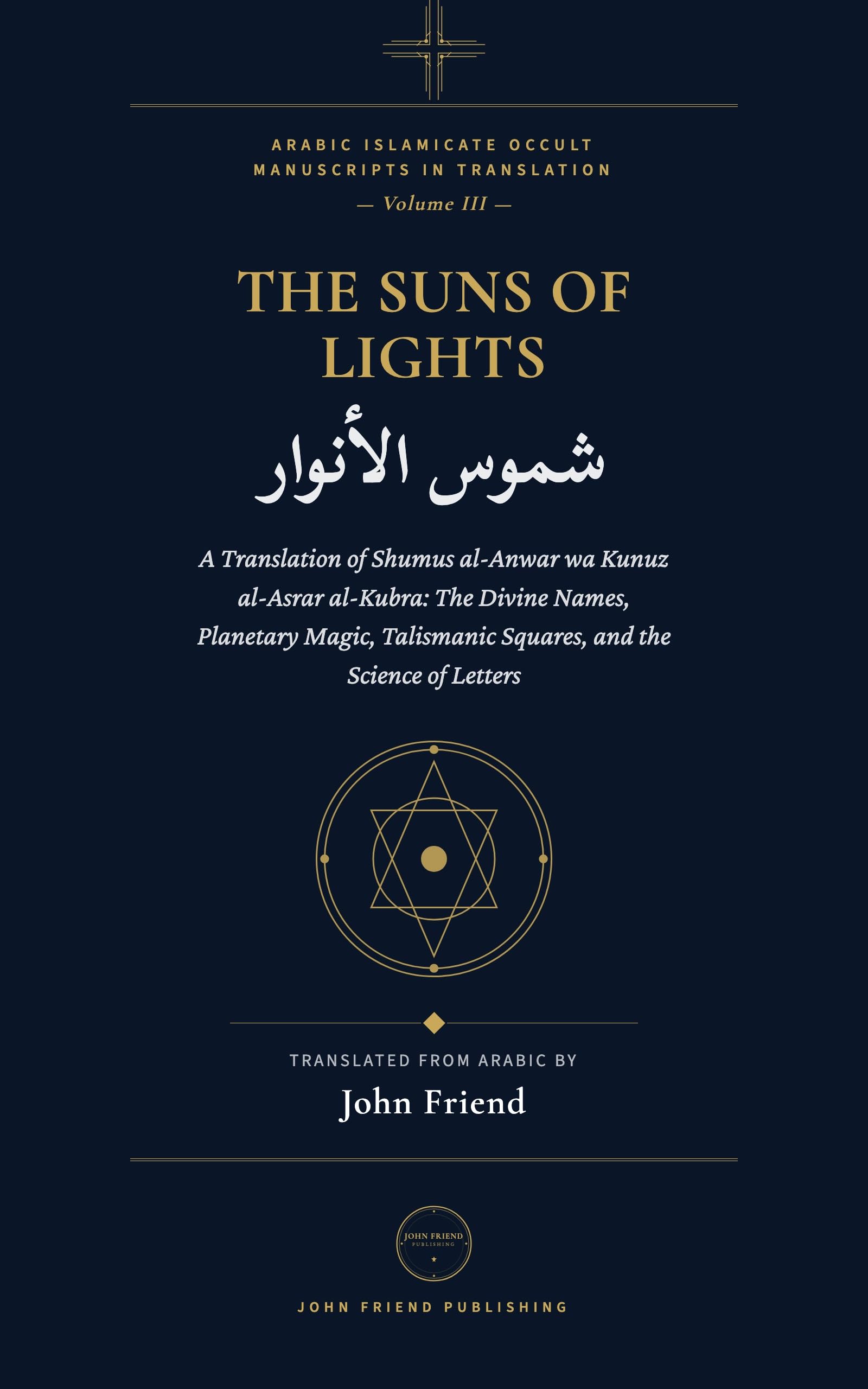
There is a 700-year-old Arabic manuscript that assigns every day of the week its own planetary spirit, its own divine name, its own incense, its own ritual hour — and its own wafq, the Arabic magic square. It is not a theoretical curiosity. It is an operational system, complete and consistent from Monday to Sunday, requiring nothing from the practitioner beyond timing, preparation, and the will to work it. It was written in 1327 CE by Ibn al-Hajj al-Tilmsani al-Maghribi, a North African scholar working in the lineage of the great al-Buni. For seven centuries it circulated in manuscript form across the Arabic-speaking world, copied and recopied by practitioners who understood its value. It has never before appeared in English — until now.
Shams al-Anwar is a magic square talisman manuscript in the full sense: an Arabic talismanic square manuscript that shows how the squares were made, timed, and carried, not only how they were drawn. Its awfaq are the working center of its talismans, and the text specifies the metal, the hour, the incense, and the divine name that each one requires. (For a beginner’s overview of the wider practice, see Arabic talisman making.)
What the Awfaq System Actually Is
The word wafq (plural awfaq) is usually translated as “magic square,” but that translation loses something important. A magic square in the recreational-mathematics sense is a curiosity — a grid where the rows and columns sum to the same number. A wafq in the Arabic occult tradition is something closer to a materialized divine formula: a spatial arrangement of numbers or letters whose internal harmony reflects and participates in the harmonic order of creation.
In Shams al-Anwar wa Kunuz al-Asrar al-Kubra — “Suns of Lights and the Great Treasures of Secrets” — Ibn al-Hajj al-Tilmsani devotes an entire chapter to the construction of these squares. Chapter Nine (al-Bāb al-Tāsiʿ fī Waḍʿ al-Awfāq, “On the Magic Squares”) provides the theoretical grounding. But the operational deployment of awfaq runs through the entire book — tied, at every point, to the seven classical planets and their governing days.
The correspondence table is fundamental. Each Arabic letter carries an abjad numerical value, a planetary affiliation, and an elemental quality. The manuscript makes this explicit:
“Letter Alif, abjad value 1, element Fire, planet Sun. Letter Bāʾ, abjad value 2, element Air, planet Moon. Letter Jīm, abjad value 3, element Water, planet Mars…”
— Shams al-Anwar, p. 44
Every wafq built from these letters is simultaneously a numerical structure and a planetary invocation. The choice of which names to embed in a square, which numerical values to arrange, which grid size to use — all of these decisions are planetary decisions, tied to the day and hour of operation.
The Seven Planets, the Seven Days, the Seven Systems
The planetary-day correspondence is the backbone of the entire system — the same system that governs the timing of jinn summoning. In classical Arabic astrological tradition (inherited from Hellenistic sources and embedded in Islamic practice by al-Buni and his predecessors), each day of the week has a planetary ruler:
- Sunday — the Sun (al-Shams)
- Monday — the Moon (al-Qamar)
- Tuesday — Mars (al-Mirrīkh)
- Wednesday — Mercury (ʿUṭārid)
- Thursday — Jupiter (al-Mushtarī)
- Friday — Venus (al-Zuhra)
- Saturday — Saturn (Zuḥal)
What Shams al-Anwar provides is not merely this general table — which any medieval student of astrology would have known. It provides the complete operational protocol for each day: the specific divine names (asmaʾ ) appropriate to that planet, the incense (bukhūr) to burn, the planetary hour within which the operation must be conducted, and the form of the wafq that embeds and amplifies the planetary power.
Ibn al-Hajj al-Tilmsani is explicit about the necessity of timing. The practitioner must calculate the planetary hours in advance and act at precisely the right moment:
“The timing of the fumigation must coincide with the planetary hour of the operation, and the incense should be placed upon the brazier at the exact moment the planetary hour begins. The practitioner must have calculated the planetary hours in advance and have his incense and brazier prepared so that no time is lost in preparation when the hour arrives. These are the seven planets and their correspondences, and these same rules apply throughout all the operations described in this book. The practitioner who masters these correspondences has mastered the foundation of the art, and all subsequent knowledge builds upon this base.”
— Shams al-Anwar, p. 61
This passage is characteristic of the text’s voice: rigorous, systematic, and concerned above all with the practitioner’s ability to execute correctly.
How the Planetary Angels Are Invoked
The awfaq system is inseparable from the angelology that runs through Shams al-Anwar. Chapter Five (al-Bāb al-Khāmis fī al-Malāʾikah al-Thāniyah min al-Buyūt — “On the Angelic Beings of the Houses”) establishes the planetary angel hierarchy. Each planet has a governing angel whose qualities mirror the planet’s astrological character and who responds to invocations conducted in the appropriate spirit.
The manuscript describes the Thursday invocation of Jupiter’s angel in terms that clarify what the system expects of the practitioner:
“The angel of the sixth heaven is the angel of Jupiter, and its governance extends over matters of wisdom, expansion, wealth, and spiritual rank. Jupiter is the greater benefic, and its angel is among the most generous in responding to the sincere practitioner. The invocation is performed on Thursday at the hour of Jupiter. […] Know that the invocation of the angels requires more than mere recitation. The practitioner must embody the qualities that correspond to the angel he is invoking. To invoke the angel of Jupiter, he must embody generosity and wisdom. To invoke the angel of Venus, he must embody love and beauty of character. To invoke the angel of Mars, he must embody courage and righteous determination.”
— Shams al-Anwar, p. 54
This is not the impersonal mechanism of a grimoire instruction manual. Ibn al-Hajj al-Tilmsani is describing an ethics of invocation — a requirement that the practitioner’s character align with the planetary quality being sought. It is, in this sense, an integrated spiritual practice, not merely a set of techniques.
The Friday Night Practice: Venus, Love, and al-Wadud
Among the most vivid operational passages in Shams al-Anwar is the description of Friday night practice, when Venus governs and the divine name al-Wadud (“the Loving One”) is invoked. The manuscript is unusually specific:
“And the practitioner should know that each of the seven nights of the week is governed by one of the seven planets, and each planet has its corresponding angel, incense, and divine name. And whoever aligns his spiritual practice with these correspondences will find that his work is strengthened and his results are multiplied many times over. And among the tested practices for the nights: whoever recites on the night of Friday — which is the night governed by Venus — the name ‘the Loving One’ (al-Wadūd / الودود) in a number corresponding to its abjad value, and fumigates with mastic and sandalwood during the hour of Venus, will find that love is placed in th[e hearts of those around him]…”
— Shams al-Anwar, p. 210
The system extends to each of the seven nights. Monday night carries a particular quality — the angels descend “in great numbers” and prayers made in sincerity are answered. The practitioner is counseled to occupy Monday night with remembrance (dhikr) and supplications. Each night has its own medicine.
Constructing the Talisman: Metal, Hour, and Material
The wafq does not exist in isolation. Chapter Twenty-Nine (al-Bāb al-Tāsiʿ wa-l-ʿIshrūn fī Taṣnīʿ al-Ṭilasm — “On the Construction of the Talisman”) provides one of the most complete accounts in the text of how the planetary talisman is physically made:
“And the practitioner should write the talisman, sealing it with the stamp of authority, using saffron ink during the hour of the appropriate planet, and fumigating it with the corresponding incense. And the writing should be upon the material that corresponds to the planet — silver for the Moon, gold for the Sun, copper for Venus, iron for Mars, tin for Jupiter, lead for Saturn, and a mixed alloy for Mercury.”
— Shams al-Anwar, p. 259
The JFP edition reproduces the talismanic seals and magic squares directly from the source manuscript as images, preserving their visual integrity. These are not reconstructions. They are the same figures that have moved through seven centuries of manuscript culture — the same squares that practitioners in Fez, Cairo, Istanbul, and Delhi once inscribed on parchment and silver.
From Wafq to Talisman: The Three Talismanic Square Types in the Manuscript
The clearest answer to how an Arabic magic square talisman was actually made comes in a run of short chapters in the second volume of Shams al-Anwar (pp. 131–134). Three consecutive headings name three types of talisman, and every one of them is built on the square: Ṭilasm al-Ḍarb al-Awwal (the talisman of the first type), Ṭilasm al-Ḍarb al-Thānī wa Ṣūratuhu al-Wafq (“the talisman of the second type, and its image is the magic square”), and Ṭilasm al-Ḍarb al-Thālith wa Ṣūratuhu al-Khātam (“the talisman of the third type, and its image is the seal”).
- The first type begins with a divine name. The practitioner computes its numerical value, distributes the numbers across the cells of the square, and writes it on clean paper in saffron ink dissolved in rosewater, in a state of ritual purity, fumigating the paper with Indian aloeswood before writing and again after the square is complete. The finished square is folded, wrapped in silk whose color matches the planet of the name — green for Jupiter, white for the Moon, red for Mars, yellow for the Sun — and carried on the person.
- The second type is a larger square with more cells, its dimensions dictated by the numerical root of the name. The manuscript calls it more powerful than the first because it holds more numbers and more correspondences, and it asks the practitioner to recite the name continuously while writing each number into its cell.
- The third type, described as the most potent, sets the magic square inside a geometric seal — a circle, a hexagram, a pentagram, or another sacred figure — with the numbers inscribed in its sections and the divine name written around the perimeter. The text reserves it for advanced practitioners and warns that an error in its construction can make it ineffective or even harmful.
This is what separates an Arabic talismanic magic square manuscript from a book of number puzzles. The square is the image (ṣūra) of the talisman: the place where a divine name, its number, its planet, and its hour are fixed into a single object. Every one of these talismans starts from a name, and the book puts the names first: its second chapter, on the Beautiful Names of God — the same names known in English as the 99 Names of Allah — comes well before the ninth, on the magic squares, and closes by promising squares “based upon their numerical values.”
Simple, Lettered, and Combined Squares
A later section on the form of the talisman (Faṣl fī Shakl al-Ṭilasm) sorts the squares themselves into three kinds (p. 209). There is the simple square (al-wafq al-basīṭ), which holds only numbers; the lettered square (al-wafq al-ḥarfī), in which the letters of a divine name are distributed according to their numerical values; and the combined square, in which letters and numbers appear together — the type the manuscript calls the most powerful. The practitioner verifies his work by confirming that each row, each column and both diagonals reach the same total, which the text calls the constant of the square (al-thābit). For how these Arabic talismanic squares differ from the recreational magic square, see the separate essay on the wafq.
The same section gives the talismanic properties of particular planetary squares. Carried on the person, the square of Jupiter brings favor in the eyes of judges and rulers; the square of Venus brings love and affection from all people, blessed marriages, and harmony in the household; the square of Mercury grants eloquence and sharpness of mind. In this scheme the square of Venus is the seven-by-seven — the Venus magic square 7x7, which has its own essay on this site — while the six-by-six is the square of the Sun. The full planetary sequence of grids, and the correspondences of the Sun’s magic square, are given in the companion essay on this Arabic magic square manuscript.
Taken together, these chapters make Shams al-Anwar an Islamic talismanic square manuscript in the fullest sense: each wafq magic square is specified not only by its numbers but by the ink, the paper, the incense, the silk, and the hour that turn it into a working talisman.
Why This Is Not the Shams al-Ma’arif
Readers familiar with al-Buni’s Shams al-Ma’arif al-Kubra — the most famous Arabic grimoire in history, explored in What Is the Shams al-Ma’arif? — will recognize the framework immediately. The planetary days, the divine names, the awfaq, the incenses: all of these are present in al-Buni’s text, which established them as the operational vocabulary of the Arabic occult tradition.
Shams al-Anwar is a different book. Written a century after al-Buni’s death, it is the work of a scholar who has fully absorbed the Bunian system and is extending it — adding new material on the properties of Quranic verses as operative formulas, on the protocols for working with spiritual beings, on the construction of multiple types of talisman. The chapter “On the Manner of Constructing Talismanic Squares” (Fī Kayfiyyat ʿAmal al-Awfāq, p. 124) goes beyond al-Buni in its treatment of the awfaq as a complete system with multiple operational types.
If the Shams al-Ma’arif is the theoretical and encyclopedic statement of the tradition, Shams al-Anwar is the practitioner’s manual — closer to the workbench. It assumes you know the framework. It teaches you how to use it. For the full story of the relationship between the two texts, see Shams al-Anwar: The Forgotten Arabic Grimoire That Completed Al-Buni’s Shams al-Ma’arif.
Read It in English for the First Time
Suns of Lights and the Great Treasures of Secrets is the first complete English translation of Shams al-Anwar wa Kunuz al-Asrar al-Kubra, published by John Friend Publishing as part of the Arabic Islamicate Occult Manuscripts in Translation series. The 264-page edition preserves the full text — every chapter, every operative instruction, every wafq — with Arabic terms presented in scholarly transliteration alongside the original script.
Read it on Amazon (Kindle, Hardcover, Paperback)
The edition is also available through Kindle Unlimited for subscribers.
Further Reading
If Shams al-Anwar opens the door, these titles in the same series extend the tradition:
-
al-Jawahir al-Lamma’a: The Radiant Jewels for Summoning the Kings of Jinn — a complete grimoire of planetary hours and jinn-king conjuration, structured around the same seven-planet system. The closest parallel to Shams al-Anwar in the JFP catalog for planetary operations.
-
Kitab al-Ajnas: The Solomonic Grimoire of Asif ibn Barkhiya — the Arabic Solomonic source tradition: the vizier of Solomon and the commanding of spirits through divine authority. Where Shams al-Anwar works through planetary angels, Kitab al-Ajnas works through Solomonic authority.
-
Tumtum al-Hindi: The Book of Tumtum the Indian — stellar magic, talismanic operations, and love spells from the Indian-Islamic esoteric crossroads. Shares the talismanic logic of Shams al-Anwar while drawing on a different source tradition.
The Wikipedia article on Islamic magic provides a useful orientation to the broader tradition. For the planetary magic framework shared across these texts, see also the Wikipedia entry on Astrology in medieval Islam.
