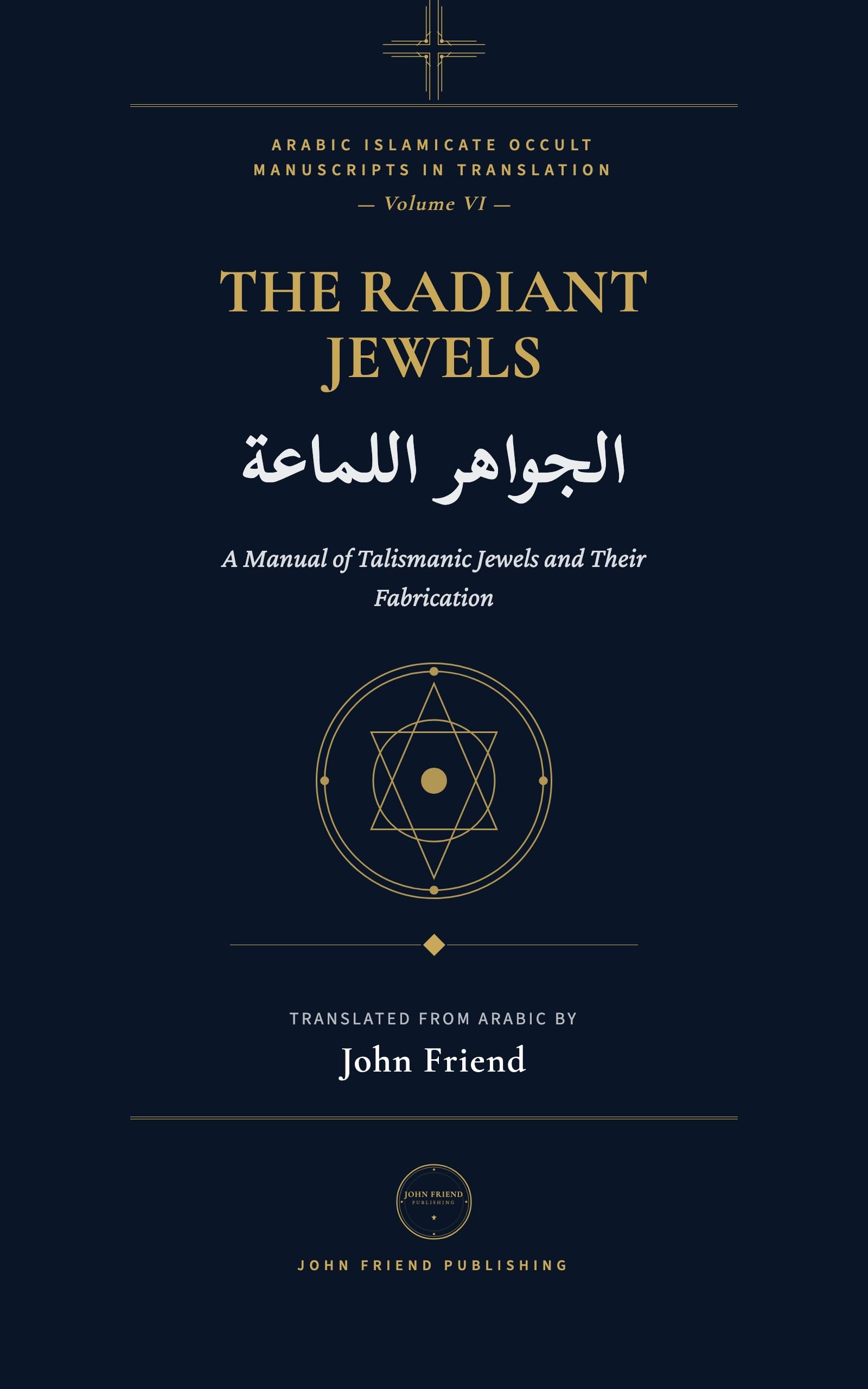
Medieval Arabic Solomonic magic insists on one principle above all others: timing is everything. Get the planetary hour wrong and the operation fails — or, in the more alarming passages of the manuscripts, fails badly. Al-Jawahir al-Lamma’a, “The Radiant Jewels,” a manual attributed to Ali Abu Hayy Allah al-Marzuqi and now available for the first time in English translation, devotes significant early chapters to planetary-hour calculation before presenting any operative instruction. The logic is simple and uncompromising: each of the seven jinn kings is governed by one of the seven classical planets, and he can only be effectively reached during the planetary hours that his ruler governs.
This article unpacks that system from the manuscript itself.
Why Timing Was Non-Negotiable
The Arabic astral-magic tradition that underlies al-Jawahir al-Lamma’a inherited from Hellenistic astrology a model of time as unevenly distributed spiritual influence. Not all hours are alike. Each hour of the day — and each hour of the night — belongs to one of the seven classical planets (Saturn, Jupiter, Mars, the Sun, Venus, Mercury, the Moon), and the planet of the hour determines what kind of spiritual work can be performed during it, what entities are accessible, and what outcomes are favored.
This is not metaphor. For the authors and practitioners of these manuscripts, planetary hours were a technical fact about how the cosmos is organized — a scheduling constraint built into the fabric of creation, not a symbolic preference. Working outside the correct hour was like attempting a transaction at the wrong bank: the infrastructure simply was not there.
The Ghayat al-Hakim — the great 11th-century Arabic compendium that became the Latin Picatrix — develops this model at length. Al-Jawahir al-Lamma’a inherits the same framework and applies it specifically to the conjuration of jinn kings.
The Planetary-Hour System: How It Works
The Arabic tradition uses what modern astrologers call “unequal” or “seasonal” hours. Rather than dividing the day into 24 equal sixty-minute segments, it divides the period from sunrise to sunset into 12 equal parts, and the period from sunset to sunrise into 12 equal parts. In summer, a daylight hour is longer than a nighttime hour; in winter, the reverse.
Each of these 24 daily hours is assigned to a planet in a fixed sequence. The first hour of each day — beginning at sunrise — is governed by that day’s ruling planet. Sunday’s first hour belongs to the Sun; Monday’s to the Moon; Tuesday’s to Mars; Wednesday’s to Mercury; Thursday’s to Jupiter; Friday’s to Venus; Saturday’s to Saturn. The hours then cycle through the seven planets in the descending Chaldean order: Saturn, Jupiter, Mars, Sun, Venus, Mercury, Moon — and repeat.
The practical consequence is that every planet governs multiple hours across every day and night. The practitioner had to calculate which hours these were for the current date and latitude — a task requiring either astronomical knowledge or access to pre-computed tables of the kind that circulated alongside manuscripts like this one.
Al-Jawahir al-Lamma’a states this requirement directly in its opening chapter on practical preparation:
The method of this section is that you should recognize the day, or the night and the ascendant planet, then you should identify the planet to which the hour is attributed. Once you identify the planet, seek out the spiritual servants assigned to it. For each star has specific incense, and the table below shows the planets with the incenses of the day.
— al-Jawahir al-Lamma’a, p. 17
The instruction is operational rather than theoretical. The reader is expected to perform this calculation before proceeding to any invocation.
The Seven Jinn Kings and Their Planetary Hours
The manuscript maps each jinn king to a day of the week and its governing planet. This mapping determines which planetary hours give access to that king. The manuscript’s oath-of-summoning chapter names this correspondence explicitly:
The specific names of the jinn kings that are invoked in this oath include: the king of Sunday (the Sun), the king of Monday (the Moon), the king of Tuesday (Mars), the king of Wednesday (Mercury), the king of Thursday (Jupiter), the king of Friday (Venus), and the king of Saturday (Saturn).
— al-Jawahir al-Lamma’a, p. 147
The operative conclusion is straightforward: to summon the king of Sunday, you work during a solar hour — ideally the first solar hour of Sunday itself, which begins at sunrise. To summon the king of Thursday, you work during a Jovian hour. And so forth.
The tradition across manuscript sources attaches names to these kings. The seven most commonly attested across the Arabic grimoire tradition are: al-Mudhhib (Sun/Sunday), Murra al-Abyad (Moon/Monday), al-Ahmar (Mars/Tuesday), Burqan (Mercury/Wednesday), Shamhurish (Jupiter/Thursday), Abyad (Venus/Friday), and Maymun (Saturn/Saturday). Individual manuscripts vary in spelling, order, and attribution — al-Jawahir al-Lamma’a positions them within its own structural logic — but this seven-fold planetary alignment is consistent across the genre. For a comprehensive overview of the summoning tradition, see How to Summon the Seven Kings of Jinn.
Working in the first hour of the king’s own day was considered most powerful. The second-best option was any hour on any day governed by his ruling planet. An operation begun on a Sunday during a solar hour, with the Sun well-dignified in the ascendant, was optimal. An operation begun on a Thursday during a solar hour — a Jovian day, solar hour — was less ideal but still within the system’s logic.
What Incense Accompanied Each Hour
Planetary-hour calculation was only the beginning. The manuscript specifies that each planetary hour requires its own incense — both to signal which planetary power the practitioner is working with and to create the atmospheric conditions hospitable to the relevant spiritual entity.
The table in al-Jawahir al-Lamma’a reads:
| Planet | Incense of the Day |
|---|---|
| Sun | Saffron, mastic, and aloeswood |
| Venus | Sandalwood, ambergris, frankincense, and musk |
| Mercury | Mastic, aloeswood, and camphor |
| Moon | White camphor, musk, sandalwood, and camphor |
| Saturn | Myrrh and costus, mastic, and olive oil |
| Jupiter | Sandalwood, aloeswood, and frankincense |
| Mars | Pepper, ginger, euphoria, and red sulfur |
— al-Jawahir al-Lamma’a, p. 17
The range of materials here is notable. The Sun’s incenses — saffron, mastic, aloeswood — are warm, golden-tinged, costly. Saturn’s — myrrh, costus, olive oil — are heavier, more austere. Mars takes pepper and red sulfur: hot, sharp, sulfurous. These are not arbitrary aesthetic choices. They reflect the Arabic medical-astrological tradition’s understanding of each planet’s elemental qualities, applied to the practical work of creating an environment in which that planet’s spiritual servants — and the jinn king they govern — could be reached.
This incense logic runs parallel to the system in the Picatrix, which also assigns suffumigations to each planet with comparable specificity. The Arabic and Latin traditions are drawing from the same source here. What al-Jawahir al-Lamma’a adds is the explicit connection to the jinn-king conjuration protocols — something the Picatrix approaches differently, from within a different operational framework.
The Conditions Beyond Timing
Correct planetary-hour selection was necessary but not sufficient. The manuscript specifies additional ritual conditions that had to be in place before any summoning could proceed.
The practitioner had to be in a state of complete ritual purity (tahara) — the full ablution (ghusl), not merely the partial washing of ordinary prayer. Fasting was standard for serious operations. Seclusion (khalwa) in a clean space removed from mundane activity was required. Some operations named specific additional conditions: the abstinence from meat, the avoidance of contact with anyone in a state of ritual impurity, the maintenance of silence outside of the prescribed recitations.
The manuscript frames these not as optional enhancements but as prerequisites:
First, invoke God Most High by His greatest names. Then invoke the angels by their names. Then command the jinn kings by their names. Then state the purpose of the summoning. Then recite the binding oath that compels obedience.
— al-Jawahir al-Lamma’a, p. 147
The sequence is fixed. The practitioner moves through a hierarchy — divine names, then angelic names, then jinn kings — with the planetary hour determining when this sequence can be initiated and the incense determining the atmospheric register in which it occurs.
The authority invoked throughout is Solomonic. The Prophet Sulayman’s God-granted dominion over the jinn is the theological premise that makes the entire operation legitimate rather than illicit. For a specific example of how this authority manifests in a single adjuration, see Al-Ahmar, the Red King of Jinn.
How This Compares to the Picatrix System
The Latin Picatrix — derived from the Arabic Ghayat al-Hakim — also centers planetary hours as the primary timing mechanism for magical operations. A talisman must be engraved during the correct hour, with the governing planet appropriately placed in the ascendant or otherwise dignified. The correspondences between planets and hours follow the same Chaldean-order logic.
The difference is in what the hour unlocks. In the Picatrix tradition, the planetary hour primarily governs talisman construction and the timing of suffumigation. The spiritual dimension — the specific entities accessible within that hour — is discussed but less operationally foregrounded than it is in al-Jawahir al-Lamma’a.
In the Arabic jinn-king tradition, the planetary hour is not primarily about talisman construction. It is about access to a specific spiritual being. The king of the Sun is reachable in the solar hour because that is when the solar hierarchy is maximally present. The system is animate in a way that the Latin transmission sometimes muted.
This is one reason the Arabic primary sources matter for anyone working seriously with the Picatrix material. They show the tradition before the Latin translation compressed and sometimes flattened its spirit framework. For that comparison in detail, see The Arabic Astral-Magic System the Picatrix Borrowed From.
What the Manuscript Names, What the JFP Edition Contains
Al-Jawahir al-Lamma’a in the John Friend Publishing English edition covers the full operational system: the planetary-hour calculation method, the incense formulas for each planet, the names and correspondences of the jinn kings, the invocatory sequences, the binding oaths, the talisman protocols, and the conditions that make the whole system operative. The text runs to 211 pages and includes reproductions of talismanic seals and magic squares from the manuscript.
It names each king. It names each hour. It names each ritual condition. It names the specific divine names that compel each king’s obedience — transmitted through the Solomonic chain of authority that runs through the genre.
The planetary-hour system described in this article is there in its original operative form. Not reconstructed, not interpreted — translated directly from the Arabic manuscript that has preserved it.
Frequently Asked Questions
What planetary hour should you use to summon each jinn king?
Each of the seven jinn kings is governed by a classical planet. You summon each king during his planet’s hour — the Sun king at a solar hour, the Moon king at a lunar hour, and so on. The first hour of the king’s own day, beginning at sunrise, is considered the most powerful timing.
What is the planetary hour system in Arabic magic?
The Arabic planetary hour system divides daytime into 12 equal parts and nighttime into 12 equal parts, each assigned to a planet in Chaldean order: Saturn, Jupiter, Mars, Sun, Venus, Mercury, Moon. Each planet’s hours determine which spiritual operations and entities are accessible.
What incense is used for each planetary hour in jinn summoning?
Al-Jawahir al-Lamma’a specifies distinct incenses for each planet: saffron and aloeswood for the Sun, sandalwood and musk for Venus, pepper and red sulfur for Mars, myrrh and costus for Saturn, and similar correspondences for the remaining planets.
Where can I read al-Jawahir al-Lamma’a in English?
The first English translation of al-Jawahir al-Lamma’a is published by John Friend Publishing and available on Amazon in Kindle, hardcover, and paperback editions. The 211-page translation includes the full planetary-hour system, incense formulas, and talismanic seals.
Read al-Jawahir al-Lamma’a in English on Amazon
The Kindle edition is included free with Kindle Unlimited — page-reads also support the press.
Further Reading
The planetary-hour and jinn-king traditions are well-represented across the John Friend Publishing catalog.
- Sihr Muluk al-Jann: Magic of the Jinn Kings — the primary operational text in this genre, with the most extensive jinn-king protocol in the series
- Suns of Lights and the Great Treasures of Secrets (Shams al-Anwar) — covers planetary-spirit work and magic squares in the al-Buni tradition, with material that parallels the planetary-hour framework from a different manuscript lineage
- The Tested Remedies of the Monks (Mujarrabat al-Ruhban) — tested operations that run on the same planetary-correspondence logic
For the Wikipedia overview of the planetary-hour system and its history in both Arabic and Western astrology, see the article on Planetary hours.
