The Picatrix is famous for using astrology to time magical workings. It is less famous for being a Latin translation of an Arabic text — a history explored in Picatrix: The Arabic Original Behind the Most Famous Grimoire in the West — and even less discussed is how much of the Arabic source-system the Latin rendering compressed, altered, or left behind. Most Western practitioners who study planetary magic through the Picatrix have been studying a second-hand version of a system that remained alive, intact, and technically detailed in the Arabic tradition long after the Latin text had diverged from its roots.
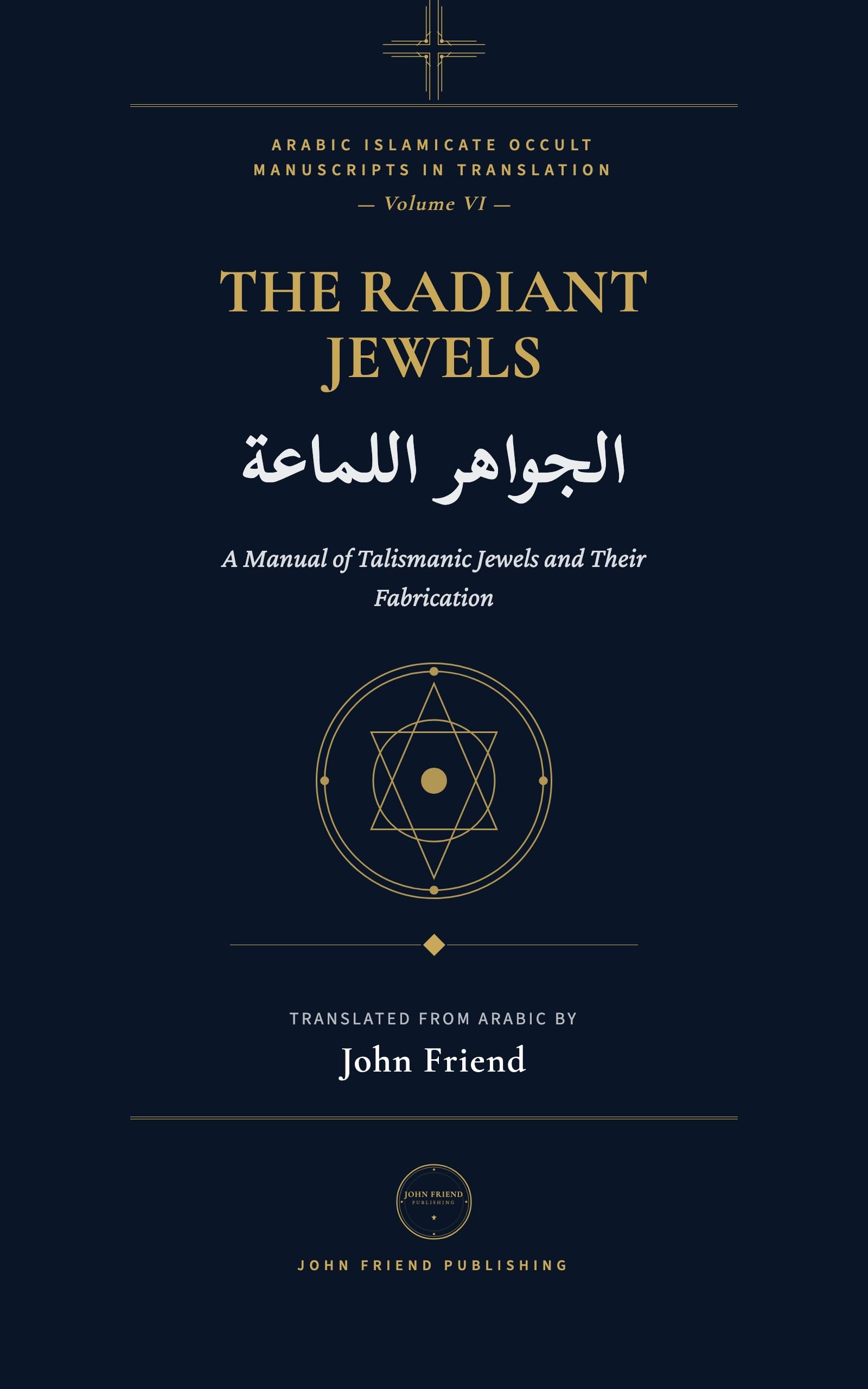
Al-Jawahir al-Lamma’a — “The Radiant Jewels,” a 15th-century Arabic manual now available in English for the first time — is one of the manuscripts that preserves the operational form of that system. It is not itself the source the Picatrix drew from; it is something more useful: a later text that shows the system still working, still being transmitted, still being applied — with the Arabic technical vocabulary intact and the astral-magic logic undiluted.
If you have been studying the Picatrix, you have been studying the engine in second-hand form. This is the engine.
What the Arabic Astral-Magic System Actually Is
The astral-magic tradition that underlies both the Ghayat al-Hakim (the Arabic original of the Picatrix) and texts like al-Jawahir al-Lamma’a rests on a cosmological premise: the seven classical planets — Saturn, Jupiter, Mars, the Sun, Venus, Mercury, the Moon — are not merely astronomical bodies. They are the channels through which spiritual power flows from higher levels of reality into the material world. Working with these powers is not symbolic or metaphorical; it is technical engagement with a genuine cosmic infrastructure.
The practical system built on this premise has four interlocking components:
Planetary hours — the division of each day and night into 12 unequal periods, each governed by a planet in fixed sequence. The appropriate hour for any operation is determined by which planet governs it.
The mansions of the Moon (manazil al-qamar) — the 28 stations through which the Moon passes in its monthly cycle, each associated with specific operations, spiritual beings, and effects. The Moon’s position in a specific mansion opens or forecloses specific kinds of work.
The ascendant ruler — the planet governing the zodiac sign on the eastern horizon at the moment of an operation. A strong ascendant ruler aligned with the working’s planetary correspondence reinforces the operation’s effectiveness.
Spiritual prerequisites — the ritual conditions (purity, fasting, isolation, specific incenses, and verbal formulas) that make the practitioner a suitable channel for the planetary power being invoked.
These four components work together. An operation that has the correct planetary hour but the wrong moon station, or the right incense but the practitioner in an impure state, is considered incomplete and likely ineffective. The system requires all four to be aligned simultaneously.
The Mansions of the Moon: The Layer the Picatrix Compressed Most
The manazil al-qamar — the lunar mansions — are among the most technically detailed elements of Arabic astral magic, and among the elements that suffered most in the Latin transmission. (See: Lunar mansion for the general historical background.)
The Arabic tradition divides the Moon’s monthly path through the zodiac into 28 stations, each of approximately 12 degrees 51 minutes. Each mansion has a name, a governing star or asterism, a specific set of operations it supports, and a set of operations it opposes. The Moon’s transit through a mansion typically takes about 24 hours, creating a rotating window of opportunity for specific kinds of work.
Al-Jawahir al-Lamma’a devotes an entire chapter — “The Specific Invocations for Each Mansion of the Moon” (p. 95) and the following “The Mansions of the Moon and Their Invocations” (p. 99) — to the operative use of the lunar mansions. This is not descriptive astronomy. It is a working protocol: for each mansion, a specific invocation, addressed to the spiritual beings governing that station, for the specific purposes that mansion supports.
The chapter on planetary operations makes the integrated nature of this system explicit. The practitioner does not simply consult the Moon’s mansion in isolation. The lunar-mansion timing must be coordinated with the planetary-hour system and with the condition of the ascendant. The al-Jawahir al-Lamma’a chapter “The Operations of the Planets and Their Spiritual Servants” (p. 92) positions the mansions within this multi-factor timing framework.
The Picatrix discusses lunar mansions — there are well-known passages on this — but the Latin treatment compresses the operational detail and loses some of the direct invocatory material. The Arabic manuscripts retain the full working protocol.
How the Ascendant Ruler Changes Everything
Western practitioners familiar with the Picatrix will recognize the emphasis on timing a magical working so that the relevant planet is well-placed in the ascendant. This principle has a more systematic form in the Arabic source tradition.
The ascendant ruler — the planet governing the zodiac sign on the eastern horizon at the moment the operation begins — acts as a kind of master key for the working. If the operation is Venusian (love, harmony, attraction), the ideal is to begin with Venus on the ascendant, well-dignified, in a Venus-ruled sign, during a Venus planetary hour. Each condition reinforces the others. The absence of any one condition weakens the whole.
Al-Jawahir al-Lamma’a opens its practical section with exactly this instruction:
The method of this section is that you should recognize the day, or the night and the ascendant planet, then you should identify the planet to which the hour is attributed. Once you identify the planet, seek out the spiritual servants assigned to it.
— al-Jawahir al-Lamma’a, p. 17
The sequence is telling: recognize the day, identify the ascendant planet, identify the hour’s planet. Only after establishing both the ascendant ruler and the planetary hour does the practitioner “seek out the spiritual servants” — the jinn kings and their hierarchies — associated with that configuration.
This double-check — ascendant ruler and planetary hour — is more careful than the Picatrix’s Latin presentation, which tends to foreground one or the other rather than consistently requiring both to be evaluated simultaneously. The Arabic practice is more conservative: both astrological factors must be aligned before the operation can begin.
The Invocatory Architecture: Divine Names, Angels, Jinn Kings
One of the clearest places where the Arabic system’s internal logic is visible — and where the Latin transmission simplified things — is in the structure of the invocations themselves.
Arabic spiritual conjuration in this tradition operates through a strict hierarchy. The practitioner does not address the jinn king directly and immediately. The approach moves through layers of authority: first the divine names that establish the cosmic order within which jinn are bound, then the angelic names that enforce that order at the celestial level, and only then the specific jinn king, addressed by name, within the authority framework that the preceding invocations have established.
The manuscript describes this architecture explicitly:
First, invoke God Most High by His greatest names. Then invoke the angels by their names. Then command the jinn kings by their names. Then state the purpose of the summoning. Then recite the binding oath that compels obedience.
— al-Jawahir al-Lamma’a, p. 147
This is not decoration. It is the operative mechanism. The jinn king’s compulsion to appear and cooperate derives not from the practitioner’s personal power but from the divine authority invoked before his name is spoken. The whole structure is Solomonic: it works because the Prophet Sulayman’s God-granted dominion over the jinn established a precedent that the practitioner is invoking, not creating.
The Picatrix has invocatory passages — the famous planetary prayers, for instance — but they exist within a different theological framework, shaped by the shift from Arabic/Islamic context to Latin/Christian context. The Picatrix’s invocations often address the planetary spirits directly, without the layered divine-authority preamble that the Arabic tradition requires. This difference matters for understanding how the operative logic was conceived differently on either side of the translation.
What the Latin Text Kept and What It Left Behind
The Latin Picatrix is a substantial and sophisticated text. What it preserved from the Ghayat al-Hakim is remarkable: the seven-planet framework, the planetary-hour system, the correspondence tables (metals, stones, plants, animals for each planet), the suffumigation instructions, the basic talisman-construction protocols, and the philosophical argument (from Neoplatonism) for why any of this works.
What was attenuated or lost:
The Quranic and Islamic religious framing. The Arabic texts operate within an Islamic theological context — the authority of God, the precedent of Sulayman, the legitimacy of working with jinn as bounded spiritual entities subject to divine law. The Latin translation had to navigate this material carefully, and it did so by reducing or Christianizing it. The resulting text is less doctrinally grounded, even if equally operative.
The lunar mansion invocations. The full invocatory texts for each of the 28 lunar mansions, as preserved in Arabic manuscripts like al-Jawahir al-Lamma’a, are richer and more operationally specific than their Latin counterparts.
The letter-science (‘ilm al-huruf). Al-Jawahir al-Lamma’a devotes several chapters to the Arabic science of letters — the numerical values of letters, the composition of divine names from their letters, the construction of magic squares and talismans from letter-numerical compositions. This material has some parallel in the Picatrix’s Latin context but cannot be fully transported into a language with a different script and a different numerical encoding. The whole operational logic of the letter-science exists primarily in Arabic.
The specific jinn hierarchy. The detailed taxonomy of jinn types — fire jinn (marid), air jinn (ifrit), water jinn, earth jinn, each with their ruling kings and chains of command — is developed more fully in Arabic texts than the Picatrix transmits. The Ghayat al-Hakim is not primarily a jinn-conjuration manual; al-Jawahir al-Lamma’a is, and the two texts complement rather than duplicate each other.
The Binding and Renewal Logic
One element of the Arabic astral-magic system that the Picatrix barely touches — but that is central to the jinn-king tradition — is the logic of binding and renewal. A jinn king, once successfully summoned, does not remain perpetually available. The covenant established between practitioner and king must be renewed at regular intervals.
The manuscript specifies this directly:
And the binding is renewable: it must be renewed at regular intervals (typically every seven days or every lunar month) by reciting the renewal formula and fumigating the talisman that bears the seal of the covenant.
— al-Jawahir al-Lamma’a, p. 148
This is a fundamentally different model of spirit-work than most Western practitioners encounter in the Picatrix. Rather than a one-time talisman construction that captures and holds a planetary influence, the Arabic jinn-king tradition involves an ongoing relationship that requires maintenance. The planetary hours matter not just for the initial summoning but for every renewal — a system detailed in Planetary Hours for Jinn Summoning. The Moon’s mansion at the time of renewal matters. The incense matters. The full system of astrological timing applies not just to initiation but to the continuity of the working relationship.
This ongoing-maintenance model reflects the Arabic tradition’s understanding of jinn as genuine spiritual entities with wills and hierarchies of their own, bound by divine authority but not mechanically controllable. They must be periodically approached with the proper respect and the proper ritual conditions — at the right hour, with the right incense, with the right formulas — or the covenant lapses.
Reading the Source in English
Al-Jawahir al-Lamma’a in the John Friend Publishing English translation is 211 pages, translated directly from the Arabic by John Friend. The translation follows IJMES romanization with full diacritical marks. Barbarous names — the untranslatable invocatory sequences meant to be pronounced as written — are transliterated exactly with the original Arabic script alongside them. Where the source manuscript is illegible, the translator notes the lacuna rather than invent content.
This is a primary source, not an interpretation. It presents the Arabic astral-magic system as its 15th-century practitioners understood and applied it — with the planetary-hour framework, the lunar-mansion invocations, the jinn-king hierarchy, the letter-science, the binding oaths, and the incense formulas all in their original operational form.
For anyone who has been studying the Picatrix and wondering what the system looked like before it passed through a Latin translation — this is the place to look.
Read al-Jawahir al-Lamma’a in English on Amazon
The Kindle edition is included free with Kindle Unlimited — page-reads also support the press.
Further Reading
Several other John Friend Publishing titles extend and contextualize the Arabic astral-magic tradition:
- Suns of Lights and the Great Treasures of Secrets (Shams al-Anwar) — Ibn al-Hajj al-Tilmsani’s 1327 CE manual of planetary spirits and magic squares, working in the al-Buni tradition; the closest Arabic-tradition parallel to the Picatrix’s planetary-spirit framework
- Tumtum al-Hindi — a manuscript in the Hermetic-Arabic lineage that preserves additional astral-magic material predating the Ghayat al-Hakim’s synthesis
- Sihr Muluk al-Jann: Magic of the Jinn Kings — the primary operational text in the jinn-king conjuration genre, complementing al-Jawahir al-Lamma’a’s astral framework with the fullest available protocol for working with the seven kings
For the academic background on the Picatrix and its Arabic sources, the Wikipedia article on Picatrix provides a useful overview of the text’s history and its relationship to the Ghayat al-Hakim.
