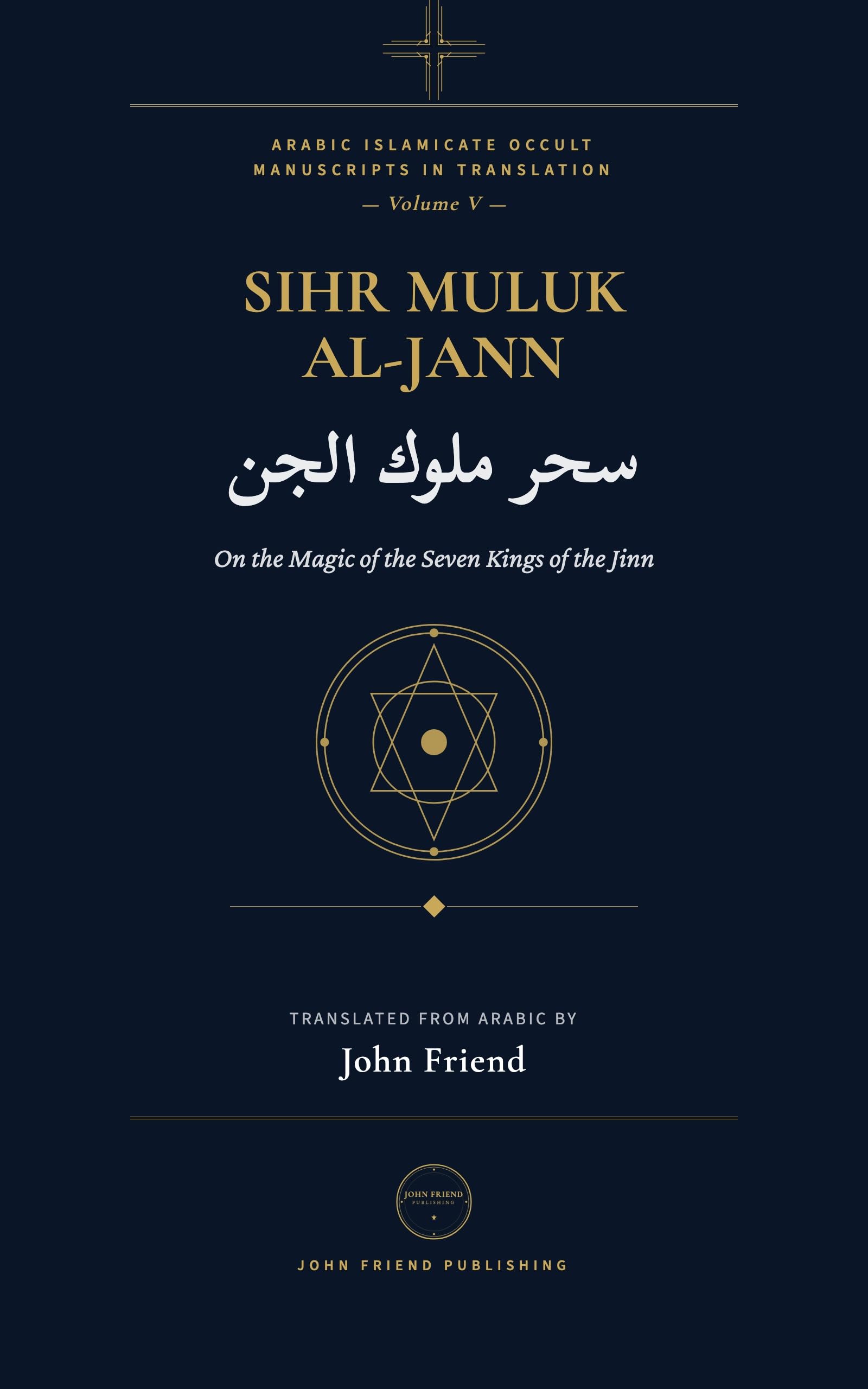
Deep in a medieval Arabic manuscript — one of the handful of primary sources that preserve the operational tradition of the seven jinn kings — there is a two-line formula that the tradition holds will compel al-Ahmar, the Red King of the jinn, to answer. The formula has a name, a structure, and a theology. The manuscript names the authority by which it operates. Until now, this material existed only in Arabic. It has never appeared in English — until the Sihr Muluk al-Jann translation published by John Friend Publishing in 2026.
This article is not a how-to guide. It is a record of what the manuscript says.
Adjuration and Conjuration: A Definition
An adjuration is a solemn command made under oath: the speaker charges someone to act “by” a higher name or authority. The word comes from the Latin adiurare, “to swear to.” The usual conjuration definition is close but broader: from the Latin coniurare, “to swear together,” a conjuration is the summoning of a spirit by invocation, and by extension any spell that calls something into presence. In the Solomonic manuals the two overlap — the conjuration summons, and the adjuration binds what is summoned to obey.
The Arabic manuscripts pair them the same way. The Sihr Muluk al-Jann uses both verbs in a single breath: “These are the names that shall be called, and with them one conjures and fulfills the purpose. I adjure you, O servants of these names, by the truth of these names” (p. 42). Elsewhere it gives the Arabic behind the English — aqsamtu ‘alaykum, “I have adjured you” — and its section titles speak of conjuration: “Conjuration of the Jinn by Their Names” (p. 28) and “The Conjuration of the Sun and Its Spirits” (p. 39). The Red King formula below is an adjuration in the strict sense: a command to answer and obey, issued “by the power of these names.” For how this Arabic Solomonic conjuration differs from its European descendants, see Arabic Solomonic vs. Western Goetia: Names of Power.
The Red King in the Seven-Kings Tradition
The seven kings of the jinn are one of the organizing structures of the Arabic Solomonic tradition — for the full framework, see How to Summon the Seven Kings of Jinn. Each king rules one weekday and one planet; each has a color, a domain of power, and a set of divine names by which he is bound. The system maps the seven classical planets — Sun, Moon, Mars, Mercury, Jupiter, Venus, Saturn — onto seven spirit-kings whose authority runs through every hour of every day.
Al-Ahmar is the king of Tuesday and of Mars. The Shams al-Ma’arif and the al-Jawahir al-Lamma’a record him too, and the essay on who al-Ahmar is sets out what each manuscript says of him.
His name means “The Red One” — a direct reference to Mars, the red planet of Babylonian and Hellenistic astronomy, the planet of war, fire, and iron. The al-Jawahir al-Lamma’a, which seats al-Ahmar on Tuesday, gives Tuesday (Mars) to “operations of victory, courage, and overcoming enemies.”
Among the seven, al-Ahmar also carries one of the clearest traces of the pre-Islamic planetary tradition. Mars as the martial planet, red in color, governing war and metal — this is a cosmological inheritance that flows directly from the Babylonians through the Greeks through the Arabic astronomers of the Abbasid translation movement into the medieval jinn-king manuscripts. The practitioner holding the Sihr Muluk al-Jann in hand is, whether he knows it or not, handling a tradition with roots reaching back two thousand years before the manuscript was written.
The Red Jinn in the Wider Arabic Tradition
In the Arabic manuscripts we translate, the red jinn king is al-Ahmar, whose name is simply “the Red One” — and he is not confined to the Sihr Muluk al-Jann. In the Shams al-Ma’arif al-Kubra, an adjuration addressed to Samsamāʾīl, “the king appointed over the sphere of Mars,” continues: “answer, O Samsamāʾīl, by the presence of Aḥmar the king. Answer, O Aḥmar, by the right of the king whose command is dominant over you, Samsamāʾīl.” The verb is the same ajib, “answer,” that opens the Red King formula translated below; elsewhere the Shams adjures a servant “by the right of the king whose command over you is overpowering, Abī Muḥriz al-Aḥmar.”
The Shams also ties the color to the stars. In its treatment of the letters, the first lunar mansion, al-Sharatayn, is given the letter alif and the planet Mars, and “its servant is the Red One” — see the chart of all 28 lunar mansions. For al-Ahmar’s place among the 7 jinn kings, and the names Western lists garble, see 7 Jinn Kings: The Real Names the Goetia Got Wrong; for a fuller profile, see Who Is al-Ahmar? The Red King of the Jinn.
The Adjuration: What the Manuscript Says
The Sihr Muluk al-Jann preserves the adjuration to al-Ahmar with unusual directness. Where some passages in the manuscript are technically dense — chains of divine names, tables of planetary hours, instructions for the preparation of talismanic seals — this particular formula is brief, structurally clear, and immediately comprehensible.
Here is the text as it appears in the manuscript (p. 217 of the JFP edition), in full:
Adjuration to the Red King: Answer, O King al-Ahmar! By the power of these names, obey!
Ajib ya al-Malik al-Ahmar! Bi-quwwati hadhihi al-asma’ ati’!
اأجب يا الملك الأحمر بقوة هذه الأسماء أطع
The formula contains four operative elements in two lines. “Answer” (ajib) is the command to appear. “O King al-Ahmar” is the naming — identification is the precondition for compulsion in every Solomonic system. “By the power of these names” is the authority clause — the formula does not work by the practitioner’s own power but by the power of the divine names that bind al-Ahmar. “Obey” (ati’) is the command to comply.
The manuscript pairs the formula with two physical seals: a numerical seal and a triangular seal with names inscribed at each vertex and a central name of power at the center. The translator’s note in the JFP edition clarifies that these seals are reproduced as images from the source manuscript.
This is the complete surviving text of the Red King adjuration as it appears in this manuscript. The translator’s note says lacunae are marked where the source is illegible; none is marked in the adjuration passage.
The formula sits in the chapter the manuscript titles “Chapter on the Spiritual Marriage and the Adjuration of the Spirits,” which begins on p. 208; the chapter that follows it, on p. 218, is the “Chapter on the Dismissal of the Spirits and the Recitation of Quran.” In the manuscript’s own order, dismissal follows command.
What “By the Power of These Names” Actually Means
The phrase bi-quwwati hadhihi al-asma’ — “by the power of these names” — is the theological linchpin of the formula, and it requires unpacking. The “names” referred to are not simply labels. In the Arabic Solomonic tradition, divine names carry operative force. They are understood as real concentrations of divine power, not metaphors or representations.
The theoretical framework draws on classical Islamic theology regarding the Asma’ al-Husna — the ninety-nine beautiful names of God, each of which describes a genuine divine attribute. In the Solomonic operational tradition, these names, combined with additional sequences of “barbarous names” (asma’ ‘ajamiyya) transmitted through the manuscript tradition, form the authority-chain by which spirits are bound. When al-Ahmar is commanded to obey “by the power of these names,” the names are not a rhetorical flourish. They are, within the tradition’s own logic, the actual mechanism of compulsion.
The Sihr Muluk al-Jann includes an extended section titled “The Grand Table of Barbaric Names and Their Permutations” (p. 46 of the JFP edition) and a separate chapter on “The Science of the Seven Names and Their Angelic Servants” (p. 113).
This is not magic by personal will. It is compulsion by delegated divine authority.
The Conditions the Manuscript Specifies
The adjuration does not stand alone.
Al-Ahmar is the king of Tuesday. The Kitab al-Ajnas has his seal fashioned “in the ascendant of Mars on Tuesday.” For the complete planetary-hour timing system, see Planetary Hours for Jinn Summoning.
The incense requirement is specific. The Sihr Muluk al-Jann includes a detailed planetary correspondence and incense table (p. 16 of the JFP edition) listing the appropriate incense for each day.
Ritual purity (tahara) is required. The introduction of the Sihr Muluk al-Jann tells the operator to “observe the ablutions and perform the ritual purity” (p. 9). It is not a casual requirement.
Finally, the triangular seal must be prepared correctly. The manuscript specifies that the seal is “drawn with the names inscribed at each vertex, and within it the central name of power is placed.”
Compelling a Spirit: The Theological Frame
The word used in the adjuration — ati’, “obey” — is the language of legitimate authority, not of sorcery. This distinction matters enormously for understanding what the Sihr Muluk al-Jann is and is not.
Arabic Solomonic magic is not a tradition of independent magical power. The practitioner does not compel al-Ahmar by his own will or by some inherent occult force. He compels him by the authority of Solomon (Sulayman), to whom God explicitly granted power over the jinn — the Quran records this in 38:37-38 and 21:82, not as legendary but as established fact within the tradition’s cosmology. Solomon’s authority over the jinn is a Quranic given. The practitioner who invokes it is appealing to a divinely ordained hierarchy.
This means that within its own internal logic, the adjuration to al-Ahmar is not an act of sorcery (sihr in the pejorative sense, which the Islamic tradition condemns). It is an act of taskhir — subjugation or compulsion of spirits through God’s authority as transmitted through Solomon. The manuscript’s title, Sihr Muluk al-Jann, uses sihr in a technical rather than pejorative sense.
The practitioners who used these formulas — and the manuscripts circulated; they were used, not merely collected — understood themselves as operating within divine sanction, not against it. Whether one accepts that claim or not, it is the claim that structures the entire operation, including the adjuration to the Red King.
Why This Text Has Not Been Available Until Now
The Sihr Muluk al-Jann is dated by the JFP edition to approximately the 14th–16th century CE and is attributed to an anonymous author — a common feature of this genre of manuscript, where the practical knowledge mattered more than authorial credit. The text circulated in manuscript form within the Arabic-speaking world and was never translated into a European language in the medieval or early modern period. Unlike the parallel Solomonic tradition that reached Latin Europe through the Toledo translation school, the Arabic jinn-king operational texts traveled an entirely separate path and remained inaccessible to non-Arabic readers until the present edition.
This is the first complete English translation of the Sihr Muluk al-Jann. It includes sections on divine names, planetary correspondences, and incense, the talismanic seals reproduced as images from the manuscript, and a translator’s note.
For the seven planetary magic squares, see Seven Magic Squares for Seven Jinn Kings. For anyone seriously interested in the history of Solomonic magic — not the 17th-century European version filtered through the Toledo translation school, but the original Arabic operational tradition in its own language and its own cosmological framework — this is a primary source.
Frequently Asked Questions
What is the definition of adjuration?
An adjuration is a solemn command made under oath, charging someone to act by a higher name or authority; the word comes from the Latin adiurare, “to swear to.” In the Sihr Muluk al-Jann, such formulas often open with aqsamtu ‘alaykum, “I have adjured you,” and bind a spirit “by the power of these names.”
What is the conjuration definition, and how does it differ from adjuration?
A conjuration is the summoning of a spirit by invocation, from the Latin coniurare, “to swear together”; by extension it can mean any spell. An adjuration is narrower: the sworn command that binds the summoned spirit to obey. The Sihr Muluk al-Jann uses both in one passage: “with them one conjures and fulfills the purpose. I adjure you, O servants of these names.”
Who is the red jinn al-Ahmar?
Al-Ahmar, “the Red One,” is the jinn king of Tuesday and of Mars, one of the seven planetary kings of the jinn in the Arabic Solomonic tradition.
What does the adjuration to al-Ahmar say?
The formula (p. 217 of the JFP edition of the Sihr Muluk al-Jann) reads: “Answer, O King al-Ahmar! By the power of these names, obey!” — in Arabic, Ajib ya al-Malik al-Ahmar! Bi-quwwati hadhihi al-asma’ ati’! It is paired with a numerical seal and a triangular seal.
Further Reading
The Complete Magic of the Jinn Kings (Sihr Muluk al-Jann) — the source text for the Red King adjuration. Read the manuscript in English.
The Kindle edition is included free with Kindle Unlimited — page-reads also support the press.
Related JFP titles in the same tradition:
- Kitab al-Ajnas: Solomonic Grimoire of Asif ibn Barkhiya — the foundational text attributed to Solomon’s vizier; provides the Solomonic cosmological architecture within which the Red King adjuration operates.
- al-Jawahir al-Lamma’a: Radiant Jewels — a companion text focused on invocation protocols and the structure of Solomonic spirit-authority.
- Suns of Lights & Treasures of Secrets (Shams al-Anwar) — the al-Buni-lineage text providing the letter-science and divine-name framework underlying the adjuration’s “names of power.”
For the Quranic passages on Solomon’s authority over spirits, see Quran 38:37-38 and 21:82. For an entry into the scholarly literature on jinn in Islamic cosmology, the Wikipedia article on Jinn and the related entry on Solomonic literature provide useful starting points.
