Imagine a manuscript in which a Quranic verse appears in the middle of a Christian prayer, and neither the scribe nor the intended reader seems to notice anything unusual about this.
Imagine a talisman grid — the wafq, the standard Arabic magic square — inscribed by a Coptic monk for a client who may have been Muslim, containing divine names drawn from both the Christian and Islamic traditions, written in Arabic because that was the language of literate Egypt, and described as mujarrab — tested, proven by experience — because that was how serious practitioners marked formulas that actually worked.
Imagine that this manuscript was not a curiosity, not a one-off eccentric text produced by a single heterodox practitioner, but one representative example of a genre — a whole category of Arabic manuscript production in which the boundaries between Islam and Christianity dissolved at the level of practical magic, even when they held firm in theology, law, and formal religious identity.
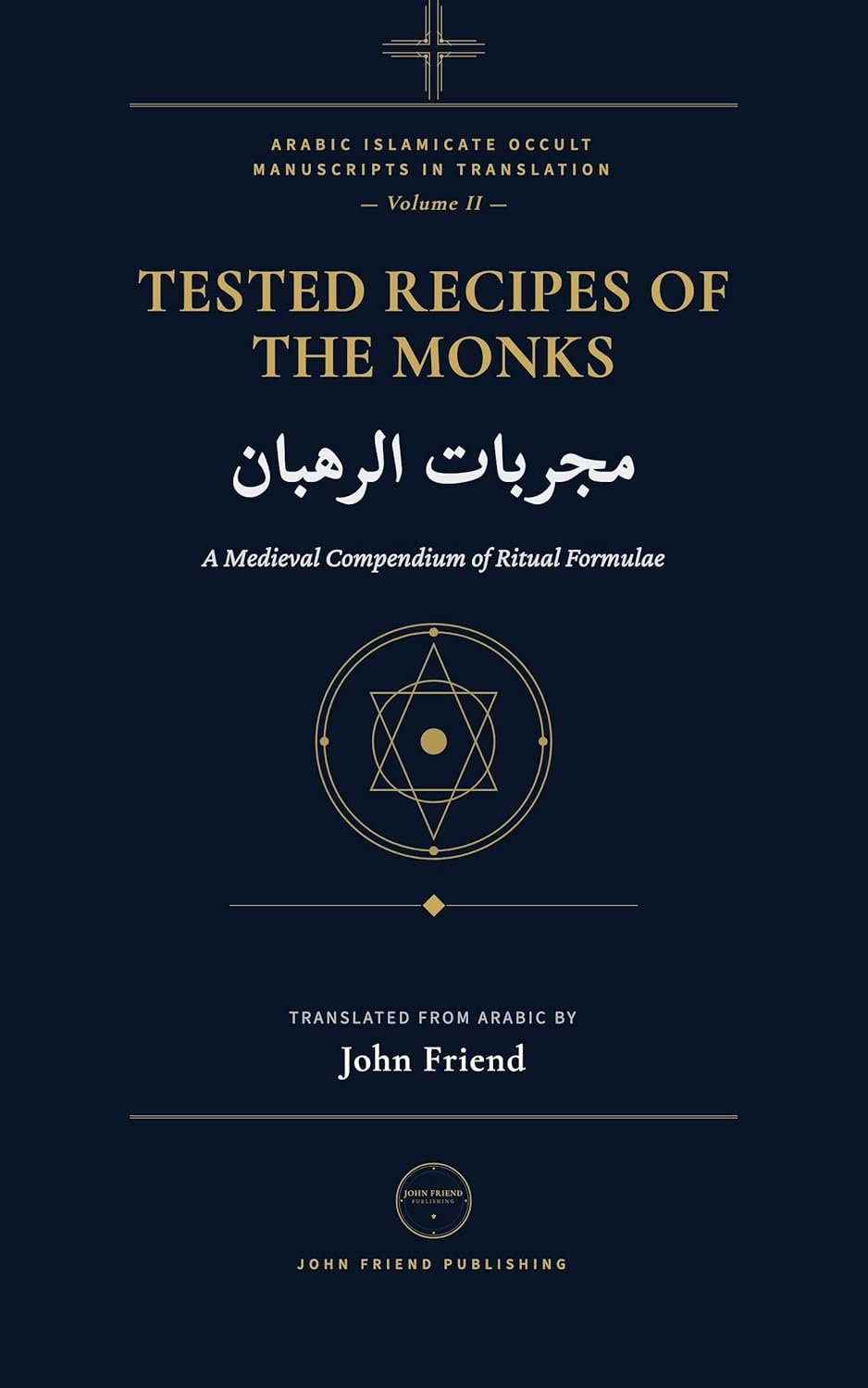
This is not a thought experiment. The manuscript is called Mujarrabat al-Ruhban — “The Tested Remedies of the Monks” — explored further in Christian Monks and Arabic Magic — and it survived for centuries because the people who needed what it contained did not much care which tradition had first produced the formulas, so long as the formulas worked.
The World That Made This Manuscript Possible
Medieval Egypt was not a tolerant utopia. It had legal hierarchies, religious discrimination, periodic violence, and the formal subordination of Christian and Jewish communities under Islamic law as dhimmi — protected non-Muslims who paid a poll tax, faced restrictions on public religious expression, and occupied a legally inferior position relative to Muslim subjects. None of this is disputed.
What is also true, and harder to fit into the standard categories, is that the same medieval Egypt produced 400 years of remarkably intimate cultural contact. Christians administered Fatimid (and later Mamluk) government offices. Coptic physicians treated Muslim patients. Jewish merchants employed Muslim agents and maintained commercial partnerships with both Christian and Muslim trading houses. Neighborhoods were mixed; markets were mixed; the practical texture of daily life involved constant negotiation across confessional lines in ways that formal legal categories did not capture.
This proximity had consequences. Languages mixed: Arabic absorbed Coptic vocabulary as Coptic declined; Judeo-Arabic became the literary medium of Egyptian Jewish communities. Food mixed: the culinary traditions of the medieval Mediterranean were already cosmopolitan before Arab rule, and they became more so afterward. And knowledge mixed — including the practical, often secret knowledge of how to protect a household, heal a sick child, reconcile a marriage, or ensure safe passage through the spirit world.
Mujarrabat al-Ruhban is a document of that mixing. Its existence is not surprising once you understand the world it came from. What is surprising — and revealing — is how rarely the standard histories of medieval religion make room for documents like it.
The Architecture of an Impossible Text
The manuscript’s title announces its paradox in four words: Mujarrabat (tested formulas) al-Ruhban (of the monks). In Arabic, ruhban refers to Christian monks specifically — ascetics who had withdrawn from the world into desert monasteries or urban religious communities. The title asserts that what follows is their tested knowledge: practical formulas that Coptic Christian ascetics had tried, verified, and recorded.
What follows is written entirely in Arabic, makes extensive use of Quranic verses as operative formulas, invokes angelic beings named according to the conventions of Arabic occult literature, and employs the wafq magic square in its standard Arabic form (a tradition explored in Seven Magic Squares for Seven Jinn Kings). It is, in every feature of its external presentation, a product of Arabic Islamic textual culture. The Christian element is embedded in the content — in specific divine names, in references to the Messiah and the Virgin, in chains of spiritual authority running through Christian saints — but the container is entirely Arabic.
This is the document’s operating principle: it belongs formally to the Arabic mujarrabat genre while encoding Christian sacred content within that framework. It is not half-Christian and half-Islamic. It is both simultaneously, in the same sentences, without apparent strain.
What the Monks Were Actually Doing
The operational procedures recorded in Mujarrabat al-Ruhban give a clearer picture of the monastic practice the text represents than any theoretical framing can. The monks described in this manuscript were not engaged in interfaith dialogue. They were engaged in practical spiritual work: writing talismans, performing invocations, dispatching spiritual agents toward specific targets for specific purposes.
The invocation described on page 139 of the manuscript shows the full texture of this practice:
Recite these invocations with certainty. I have collected them and performed the action. I recited the invocation, and it is this: Barbaric names: Qishtish, Kashish, Kahmunish, Kishruyalush, Qantarashish, Khamishish, Ghalmurishish […] I invoke you, O spirits, by this invocation. From it, on a single night, seal it with God, and rise. Its companion is its protector, from among the faithful, trustworthy, and righteous. Indeed, protect us with the strong veils. This is the formula of the invocation, performed by the servant through fire, while a spirit descends. Recite it three times during the night as a seeking. — Mujarrabat al-Ruhban, p. 139
Several elements here deserve attention. The “barbaric names” — Qishtish, Kashish, Kahmunish, and so on — are voces magicae, nonsense-sound strings that appear in magical texts across the Mediterranean from the Greek Magical Papyri of late antiquity onward. They carried power by virtue of their foreignness, their non-translatability, their apparent antiquity. The late antique magical tradition in Egypt had been using strings like this for centuries before Islam arrived; the monks inherited them.
The phrase “performed by the servant through fire, while a spirit descends” places the invocation in a specific physical setting: fire as the medium of communication with spiritual beings, the practitioner positioned as a servant of the divine rather than a sovereign commanding spirits. The theological framing is submission, not coercion — but the operative intention is active direction of spiritual forces toward a named end.
And then: “Recite it three times during the night as a seeking.” Three is not Islamic convention here; it is a number that appears in Christian liturgical tradition as readily as in any other. The formula bridges traditions at the level of number as naturally as it bridges them at the level of divine names.
The Quranic Core Inside a Christian Text
The most direct evidence for the manuscript’s genuinely syncretic character is its use of Quranic material as operative sacred technology. This was not superficial: the Quran’s language functions at the center of several major formulas.
Consider the love and reconciliation formula preserved on page 121:
To bring back a divorced woman through love, approach the supplicant with this method. Its instrument is the One: He pours upon the target His water and His soul, and the target remains under the invocation. He will not leave you by night or by morning. Then engrave a seal resembling a ring, bearing upon it the name of the deity. Adjure over it in a session of four repetitions. Then give the seal to the seeker. The session number is 456. This is the invocation. / God is sufficient for us — what an excellent Guardian is God! / Hasbuna Allah wa ni’ma al-wakil / حسبنا البله ونعم الوكيل — Mujarrabat al-Ruhban, p. 121
The Quranic verse invoked here — “God is sufficient for us, what an excellent Guardian is God” — is from Quran 3:173, a verse with strong associations to trust in divine protection under adversity. It appears in countless Islamic talismanic contexts. In the Mujarrabat al-Ruhban, it is the operative core of a Christian-authored formula designed to restore a marriage.
The logic that made this possible is stated, implicitly, in the formula itself: “Its instrument is the One.” God — monotheism’s single divine power — is the source of the formula’s efficacy. A Christian monk who believed in one God and a Muslim believer in the same God were drawing on the same ultimate source. The Quranic verse worked not because it was Islamic but because it addressed God, and God was one.
This is practical monotheism: the theological common ground shared by Christianity and Islam made cross-traditional magical practice coherent in a way that it could never be in a polytheistic system where the gods of one people are different from and hostile to the gods of another.
The Cairo Geniza: Evidence That This Was Normal
The Mujarrabat al-Ruhban would be easier to dismiss as a single eccentric text if it did not fit so precisely into a documented pattern of inter-religious magical exchange that is one of the best-attested phenomena in the archaeology of medieval Egypt.
The Cairo Geniza — the repository of over 300,000 manuscript fragments discovered in the Ben Ezra synagogue in Fustat (Old Cairo) in the late 19th century — contains a substantial collection of magical texts from the Jewish communities of medieval Egypt. What those texts reveal directly parallels what Mujarrabat al-Ruhban reveals from the Christian side: practical magical formulas that cross religious lines without apparent embarrassment.
Jewish practitioners in medieval Cairo used Quranic verses in their protective amulets. They invoked angels by names drawn from the Islamic as well as the Hebrew tradition. They incorporated elements of Islamic du’a (supplicatory prayer) into their protective charms. Muslim practitioners on their side occasionally incorporated Hebrew divine names — Adonai, Elohim, Yah — into their own formulas, drawing on the perceived antiquity and power of the Hebrew sacred vocabulary.
The scholars who have studied this material most carefully — Gideon Bohak in his foundational work on ancient and medieval Jewish magic, Peter Schäfer and Shaul Shaked in their critical editions of the Geniza magical texts — are consistent in their findings: inter-religious magical exchange in medieval Egypt was not exceptional. It was a normal feature of a pluralistic society where practical spiritual need outran confessional boundary-keeping.
Mujarrabat al-Ruhban is the Christian witness to the same phenomenon the Cairo Geniza documents from the Jewish side. Together, they establish beyond reasonable dispute that religious syncretism in medieval Egyptian magical practice was structural, not accidental.
How a Text Like This Survived
The survival of Mujarrabat al-Ruhban through the medieval and early modern periods is worth dwelling on, because the conditions of its survival reveal something about the social function it served.
Manuscripts survive when people copy them. People copy manuscripts when those manuscripts are useful. Mujarrabat al-Ruhban survived because it was useful — which means practitioners across several centuries believed its formulas produced results. In a world without effective medicine, where epidemic disease, infant mortality, and sudden financial ruin were omnipresent threats, the person who could provide a working protective talisman or a formula for reconciling an estranged marriage was providing a genuine social service. The monks who compiled and transmitted this text were meeting real needs.
The text also survived because it occupied a social niche that made it relatively safe. It was not a formal theological statement. It made no claims about doctrine. It was not the kind of text that prompted interreligious argument or that challenged the authority of formal religious institutions. It was a practical handbook — equivalent in social function to a manual of folk medicine or domestic management — and practical handbooks do not usually attract the attention of censors unless they are spectacularly public.
The Islamic mujarrabat tradition within which Mujarrabat al-Ruhban is embedded also provided some protection by normalizing the genre. When a Coptic text appeared alongside Islamic mujarrabat collections in a manuscript anthology, its presence was naturalized by the genre framing. It was another practical handbook, another collection of tested remedies. The fact that its particular tested remedies bore Christian signatures was legible within the framework of the genre — monks had special spiritual knowledge, and their mujarrabat were worth having.
A Night Sending and the Angel of the Planets
One of the most technically elaborate passages in the manuscript concerns a procedure called Irsal Mujarrab Laylat — a tested night sending. The passage is brief but dense with operational specificity:
Recite it four hundred and forty-four times after Surat al-Fatiha, and invoke the angels of the planets: the angel Qurṭam Ṭāyīl, the angel Ṣarṭam Ṭāyīl, the angel Barṭam Ṭāyīl, and the angel Sharṭam Ṭāyīl. These are the angels who are entrusted as guardians. Call upon them from the night, and they hasten to answer. — Mujarrabat al-Ruhban, p. 259
Surat al-Fatiha — the Opening Chapter of the Quran, the seven-verse prayer that every Muslim recites at minimum seventeen times daily — here precedes a sequence of 444 recitations and the invocation of four planetary angels whose names appear in no standard Islamic or Christian angelic catalogue. This is a synthesis of Quranic liturgical practice with an older, possibly pre-Islamic planetary magic tradition. The number 444 has numerological significance in the Arabic letter-number system (abjad); the Fatiha provides both purification and divine sanction for what follows.
The planetary angels — Qurtam Tayil, Sartam Tayil, Bartam Tayil, Shartam Tayil — follow a naming pattern common in late antique and medieval angelic magic: a characteristic ending attached to names that suggest non-Arabic, perhaps Aramaic or Greek, origins. These are not Islamic angels in any standard sense. They are figures from an older stratum of Near Eastern magical tradition, surviving inside the Arabic textual framework by virtue of the genre’s pragmatic openness to whatever worked.
A Coptic monk reciting the Quran’s opening prayer 444 times and then invoking four planetary angels with Aramaic-derived names: this is what the Mujarrabat al-Ruhban records as standard operational practice.
The Categories the Manuscript Does Not Allow
Reading Mujarrabat al-Ruhban carefully makes clear that the standard historical categories for medieval religion do not fit the world the manuscript comes from.
“Syncretism” is accurate but insufficient — it implies a deliberate mixing of two distinct things, when the text reads more like a tradition that never separated those things into distinct categories in the first place. “Folk religion” undersells the sophistication of the talismanic and numerological procedures. “Cross-contamination” implies that something pure was corrupted, which is exactly what the text refuses: for its practitioners, using the most effective formula available was not contamination but competence.
What the manuscript actually documents is a form of religious practice that operated by different rules than formal theology: rules organized around efficacy, accumulated experience, and the transmission of tested knowledge from practitioner to practitioner across confessional lines. The monks who compiled it were not confused about their Christianity, and they were not pretending to be Muslims. They were doing something for which modern religious categories do not have a clean name — something that was, in their world, simply practical. For the six love-spell categories the monks organized their formulas into, see Medieval Arabic Love Spells Categorized by Christian Monks.
This is the harder thing the manuscript requires of its readers: not to learn what medieval people believed in the abstract, but to see how medieval people actually managed the most pressing practical dimensions of their lives, in a world where the boundaries between traditions were nowhere near as clean as the official documents suggest.
Read the Manuscript in English
John Friend Publishing has translated Mujarrabat al-Ruhban into English for the first time, making this window into medieval syncretic practice available outside of specialist Arabic manuscript collections.
The Tested Remedies of the Monks (Mujarrabat al-Ruhban) — Amazon
Available in Kindle and paperback. Kindle Unlimited members read free.
Further Reading
For related texts in the tradition of Arabic occult manuscripts translated by John Friend Publishing:
-
Kitab Danyal al-Nabi (The Book of the Prophet Daniel) — A biblical prophetic figure claimed by all three Abrahamic traditions becomes an authority in the Arabic manuscript tradition; an essential companion to understanding how sacred authority crossed religious lines.
-
Jawahir al-Asrar (Jewels of Secrets) — A deeper dive into the Arabic occult manuscript tradition’s treatment of spiritual beings, invocation protocols, and talismanic construction from within the classical Islamic framework.
For the documentary evidence of inter-religious magical exchange in medieval Egypt, the best starting point is the Wikipedia article on the Cairo Geniza. For the late antique background to Egyptian syncretic magical practice — the world the Coptic monasteries inherited — see Wikipedia on the Greek Magical Papyri.