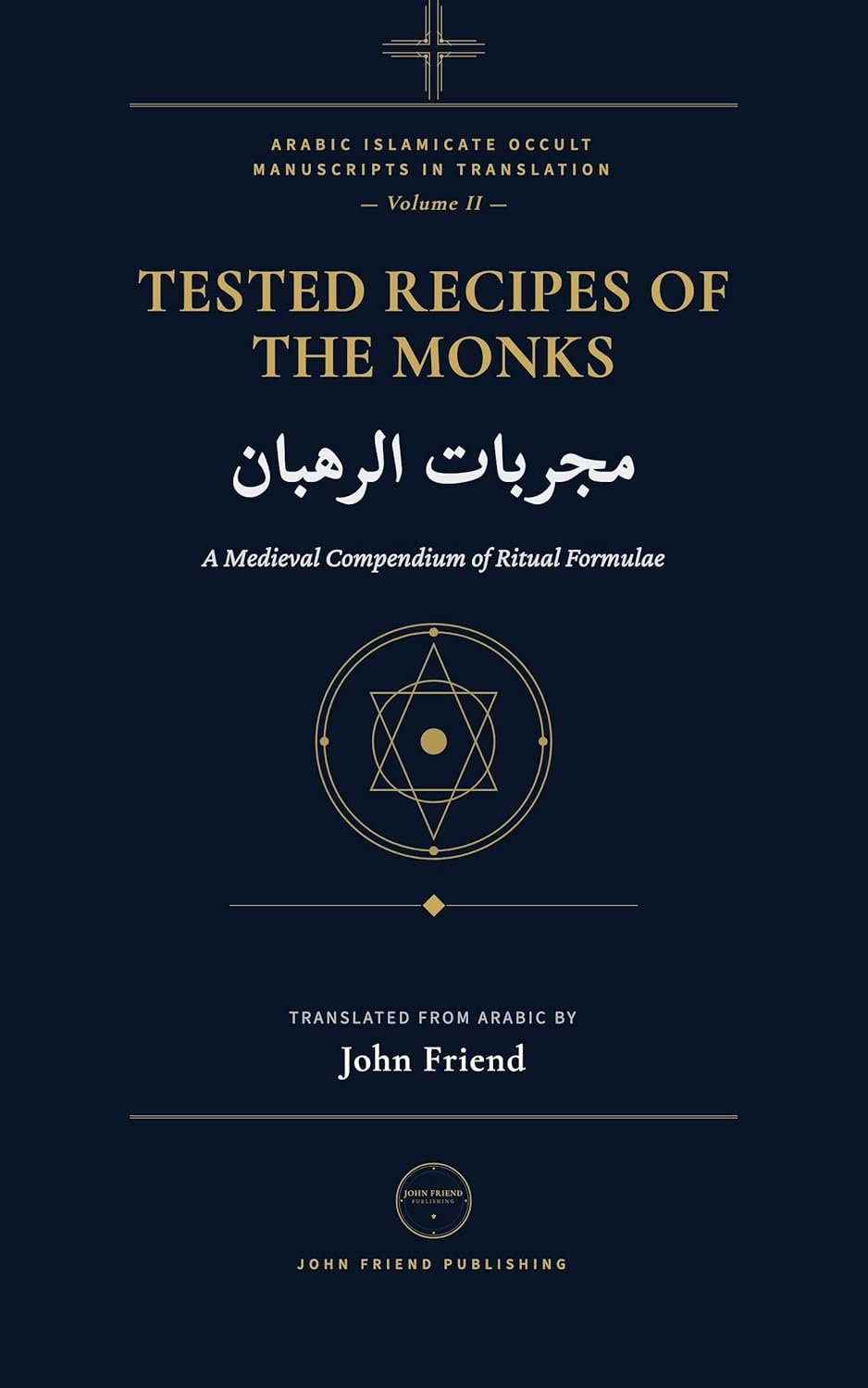
Somewhere in the medieval Arabic-speaking world, a compiler sat down and wrote out a spell to make someone fall in love.
He wrote it in Arabic. He specified the ink — saffron, musk, and rose water. He specified the day — Friday, the hour of Venus. And then he wrote, in what reads as a straightforward technical note, that the result manifests within seven days. “This has been tested and verified by the monks.”
That phrase — mujarrab, tested — gives the Mujarrabat al-Ruhban its name. It is not a theoretical treatise on the occult properties of letters and names. It is an operational record of formulas that practitioners claimed to have tried, refined, and confirmed through direct experience. The word carried serious weight in medieval Arabic intellectual culture. It was the term used in medicine, in natural philosophy, in alchemy. When you called something mujarrab, you were invoking the authority of empirical observation — not faith, not tradition alone, but the testimony of results.
What those results were claimed to produce, and how the book proposed to achieve them, is one of the stranger stories in the history of medieval magic. For the full manuscript history and its syncretic context, see The Syncretic Arabic Grimoire; for the book-level overview, see Christian Monks and Arabic Magic.
What Mujarrab Actually Means — and Why It Mattered
The Arabic root j-r-b carries the meaning of testing, trying, or putting to proof. A mujarrab formula is not merely received wisdom or inherited doctrine. It is something someone tried and found to work. The genre of mujarrabat — “tested remedies” or “proven formulas” — was one of the most widespread categories of practical manuscript in the medieval Arabic world. Collections of mujarrabat circulated across North Africa, Egypt, the Levant, Persia, and Anatolia, covering medicine, veterinary practice, agriculture, and the management of spirits and human desire in equal measure.
This empirical framing was deliberate and significant. The practitioners who compiled mujarrabat collections were implicitly distinguishing their material from two things: pure speculative philosophy (which made no practical claims) and straightforward superstition (which made no claim to experiential verification). The mujarrabat genre occupied a middle position — practical knowledge, claimed to be tested, presented without elaborate theoretical scaffolding. You followed the procedure. You checked whether it worked. You recorded the result.
The Mujarrabat al-Ruhban — “The Tested Remedies of the Monks” — belongs squarely to this genre. Its attribution to ruhban (monks, ascetics) added a specific kind of authority: monks were understood in both Christian and Islamic cultures to possess elevated spiritual perception gained through years of ascetic practice, fasting, prayer, and withdrawal from ordinary social life. A formula tested and verified by monks carried not just empirical authority but spiritual authority. These were men who, by the standards of the era, had demonstrated their access to the unseen world. (Ruhban, the plural of rahib, is the ordinary word for monks in Arabic.)
The Monastic World and the Language of Magic
The one place the book names for its monks is Mount Lebanon: one chapter is introduced as “a tested chapter from the monks of Mount Lebanon” (p. 295). Their formulas, like everything else in Mujarrabat al-Ruhban, are written in Arabic.
This linguistic fact has a consequence that is easy to underestimate: formulas written in Arabic were written in the language of the Quran. Arabic was not a neutral medium. It came freighted with the sacred associations of Islamic textual culture. The divine names invoked in Arabic carried weight partly because Arabic was the language God had used to speak to Muhammad. Whoever wrote a love formula in Arabic was, whether consciously or not, drawing on that authority.
The result is what makes Mujarrabat al-Ruhban so remarkable: a manuscript in which Christian sacred authority and Islamic textual power operate alongside each other, in the same formulas, for the same practical ends.
The Six Categories of ‘Tested’ Love Formulas
The manuscript’s table of contents reveals a systematic treatment of human desire in all its practical dimensions. The chapter headings are explicit about their purposes in ways that medieval European magical texts rarely are. Here are the primary categories of love-related formulas the book compiles:
1. Jalb al-Mahabba — Attracting Love
The most fundamental category. Jalb (attraction, drawing toward) appears as a chapter heading multiple times, sometimes alone, sometimes paired with mahabba (love, affection). These formulas were designed to draw a specific person toward the practitioner — not merely to create good feelings but to create the active pull of attraction.
2. Tahbib — Making Love / Endearment
Tahbib comes from the root h-b-b, meaning love or habitude. The tahbib formulas aimed to install affection — to cause a named person to feel fondness, warmth, or love for the practitioner or for a third party. This was the gentler end of the love-magic spectrum: not compulsion but the kindling of genuine-seeming feeling.
3. Taskhir — Subjugation / Making Compliant
A distinctly more aggressive category. Taskhir appears in the same chapter headings as jalb and tahbib — “Chapter on Attraction, Making Love, and Subjugation” — without apparent embarrassment about the pairing. Medieval Arabic magical culture did not draw the line that modern readers might expect between love and compulsion. Taskhir was understood as making a person favorable, compliant, or available, and it occupied a continuous spectrum with the more affective categories.
4. Sulh — Reconciliation
One of the most practically important categories: “Chapter on Reconciliation Between a Woman and Her Husband.” Reconciliation formulas addressed estranged couples, the aftermath of marital conflict, or the restoration of a relationship damaged by third-party interference. The specific focus on a woman and her husband reflects the social world the manuscript addressed — one in which marriage was the primary site of formal love relationships, and its disruption was a serious practical and social problem. A parallel treatment of love-spell categories from a different tradition appears in the Tumtum al-Hindi love-spell manual.
5. Rabt — Binding
Rabt (binding, tying) appears in combination with attraction and endearment formulas. Binding magic aimed to fix a relationship, to prevent departure or desertion, or to tie two people together emotionally. The “Chapter on Attraction, Endearment, and Binding” represents the most complete operational package: attract, endear, bind.
6. Irsal — Sending / Dispatch
A category that spans several chapters and involves sending spiritual agents — arwah (spirits), angelic powers, or activated talismanic forces — to act upon a target at a distance. “Sending” formulas are among the more technically elaborate in the manuscript, involving specific sequences of nights, repetitions of names or verses, and the dispatch of specific named spiritual entities to accomplish the practitioner’s goal.
What the Formulas Actually Said
The manuscript preserves enough operational detail to move beyond category descriptions into the actual texture of what these formulas required. Several passages survive in the translated edition that show how the manuscript describes its mujarrab procedures:
Take the name of the beloved and the name of the seeker, and write them upon a piece of paper with ink made from saffron, musk, and rose water. Calculate the abjad value of each name, and from the combined total, construct a wafq of love. The fumigation for love is performed with sugar, coriander, and ʿūd. The invocation is recited on the night of Friday during the hour of Venus, and the result manifests within seven days. This has been tested and verified by the monks. — Mujarrabat al-Ruhban, p. 299
This single passage encodes a complete operational system. The ink composition (saffron, musk, rose water) corresponds to Venusian sympathies — saffron and musk being considered materials appropriate to love workings in the Arabic natural philosophy tradition. The abjad calculation reduces names to numerical values using the ancient Semitic numeral-alphabet system, and the wafq (magic square) constructed from those values becomes a personalized talisman tuned to the specific relationship. The fumigation materials (sugar, coriander, oud wood) are again Venusian correspondences. The timing (Friday night, hour of Venus) places the working in the planetary hour most favorable to love. Seven days is the standard operational window in the manuscript.
This is not vague magical hand-waving. It is a precise technical procedure with specified materials, specified timing, and a specified follow-up protocol.
The binding and endearment formulas show a different face of the tradition:
Take clay and burn incense with musk for the invocation of the Creator. If the purpose is ease for a departure, the invocation is performed in the house. If the purpose is longing, proceed from there with the invocation. This is the invocation of the heart, the invocation of love. — Mujarrabat al-Ruhban, p. 127
The layered structure here — physical materials (clay, musk incense), spatial specification (performing in the house versus proceeding outward), and named purpose (longing versus ease for departure) — reflects a sophisticated operational logic. Different desired outcomes required different spatial and material configurations. The formula was not a one-size operation but a procedure tuned to specific relational circumstances.
The more elaborate sending formulas show the full complexity of the system:
On the first night, begin the invocation. Then continue on the second night, the fourth night, the third night, the fifth night, the sixth night, and the seventh night. Upon each paper, inscribe the truth of the invocation. — Mujarrabat al-Ruhban, p. 122
Note the non-sequential ordering of nights (first, second, fourth, third, fifth, sixth, seventh) — this is not a transcription error but a feature of the system, reflecting a specific pattern of planetary day correspondences that determined when each stage of the working was most effective.
The Role of Quranic Verses in Christian Love Magic
Among the most striking features of Mujarrabat al-Ruhban is the consistent presence of Quranic material in a book that also swears by the Torah and the Gospel (p. 72) and blesses the Lady Maryam and the Master ‘Isa (p. 27). This was not accidental, and it was not a case of confused scribal transmission.
The manuscript preserves at least one formula that makes the Quranic integration explicit:
God is sufficient for us — what an excellent Guardian is God! From His bounty — indeed we are to God returning. Hasbuna Allah wa ni’ma al-wakil — Mujarrabat al-Ruhban, p. 121
This is Quran 3:173 — a verse with strong protective and trust-in-God associations, used widely in Islamic talismanic contexts. In the Mujarrabat al-Ruhban formula, it appears as part of a working “to bring back a divorced woman through love.” The invocation framework that surrounds it also specifies a seal to be engraved with a divine name and a session of four repetitions at a count of 456 — standard Arabic numerical magic procedure.
A Quranic verse invoked in the monks’ book to facilitate marital reconciliation. This is the reality of the manuscript tradition, stated without hedging: the Quran worked, and the book used it.
The logic is not difficult to reconstruct. If God is one — and both Christians and Muslims agreed on this foundational point — then the Quran’s power derived from God. A Christian monk who believed in God’s sovereignty had no theological barrier to using a Quranic formula if he believed God would honor it. The mujarrabat tradition was consistently pragmatic in this way: the question was not which formula belonged to which religious tradition but which formula produced results.
How the Talismans Were Constructed
The physical form of the love talismans described in Mujarrabat al-Ruhban followed standard Arabic talismanic practice. The basic format involved inscribed paper or other material, activated through fumigation, prayer, and specific timing.
The wafq — the magic square — was the central talismanic object. These numerical grids, in which the sums of rows, columns, and diagonals are equal, had been adapted from Indian and Persian mathematics into Arabic occult practice and were by the medieval period the standard form of Arabic talismanic inscription. The Mujarrabat al-Ruhban uses wafq grids derived from the numerical values (abjad) of names — both the practitioner’s and the target’s — making each talisman unique to the specific relationship being addressed.
The manuscript also specifies the inscribing of “mystical letters” — disconnected Arabic letters (huruf muqatta’at) that appear at the beginning of certain Quranic chapters and whose interpretation has been disputed by Islamic scholars for centuries. In the mujarrabat tradition, these letters were understood as operative symbols carrying power independent of their linguistic meaning.
Mystical letters: ha - lam - alif h - l - a / ح ل ا / Command: O servants of these letters, bring about attraction, praise, and charity for the named person, son of the named person. — Mujarrabat al-Ruhban, p. 122
The formula addresses the “servants of these letters” — spiritual entities understood to be bound to the Quranic letters and obligated to carry out their commanded functions. This is the activation logic of the entire system: the written symbol summons and directs a spiritual agent, who acts upon the target in the physical world.
The reconciliation wafq shows the method from start to finish. Among “the tested methods from the monks,” the manuscript gives this one for two people in enmity: take both names, calculate the abjad value of each, combine them, construct a wafq from the total, write it on clean white paper with saffron ink during the hour of Venus on the night of Friday, fumigate it with sugar and coriander seeds, and place it between the garments of the two parties (p. 290).
Read as an Arabic talisman manuscript rather than a book of spoken charms, the Mujarrabat al-Ruhban is full of objects like this — an amulet for marriage (Hirz al-Zawaj, p. 158), a tested protective amulet “for every work” (p. 248), talismanic shapes for provision (p. 278) — and the English edition reproduces its seals and magic squares as images from the source manuscript. For the wider craft, see Arabic talisman making; for the square used in love and harmony talismans, see the Venus magic square.
Fire, Paper, and the Seven-Night Protocol
One of the most frequently repeated operational frameworks in the love sections of Mujarrabat al-Ruhban involves writing formulas on paper and then engaging with that paper over a seven-night sequence. The completion method varies: some formulas involve burying the paper, some involve giving it to the target, and some involve fire:
Write this name and its number on papers. On the back of each paper, write a statement of reliance. Place incense upon each paper in generous quantity, then place them all in the fire and read the mentioned name over them until the invocation takes effect. Wait for three days. If the effect has not come, repeat the action three times each day. Listen well, O sea of attraction, praise, charity, and tenderness — to the love and to the truth. — Mujarrabat al-Ruhban, p. 134
The fire here is not destructive but transformative. Burning the inscribed paper releases the invocation into the world — smoke as the medium by which a written formula becomes an active force. The “statement of reliance” written on the back (tawakkul, reliance on God) frames the entire operation within a theological position of submission to divine will rather than coercion of it. The practitioner is not commanding; he is petitioning, with spiritual tools.
The three-day follow-up protocol — “if the effect has not come, repeat” — is itself significant. It implies an empirical attitude toward the results. The practitioner was expected to observe, wait, and respond to what actually happened rather than simply trust that the formula worked regardless of observable outcome. This is the mujarrab stance: committed to verification, willing to repeat, willing to record failure.
Frequently Asked Questions
What does mujarrab mean in Arabic magic?
Mujarrab means “tested” or “proven by experience.” From the Arabic root j-r-b (to test or try), a mujarrab formula is one that practitioners claimed to have tried and found effective. The term carried the authority of empirical observation in medieval Arabic intellectual culture, distinct from mere tradition or speculation.
What are the six categories of love spells in the Mujarrabat al-Ruhban?
The manuscript organizes love formulas into six operational categories: jalb (attraction), tahbib (endearment), taskhir (subjugation), sulh (reconciliation between estranged spouses), rabt (binding to prevent departure), and irsal (sending spiritual agents to act on a target at a distance).
Why does the Mujarrabat al-Ruhban use Quranic verses in its love spells?
The book is written in Arabic — the dominant literary language — and its formulas set Quranic verses beside an oath by the Torah and the Gospel because both traditions affirmed one God. The mujarrabat genre was pragmatic: the question was not which religious tradition a formula belonged to, but which formula produced verified results.
Where can I read the Mujarrabat al-Ruhban in English?
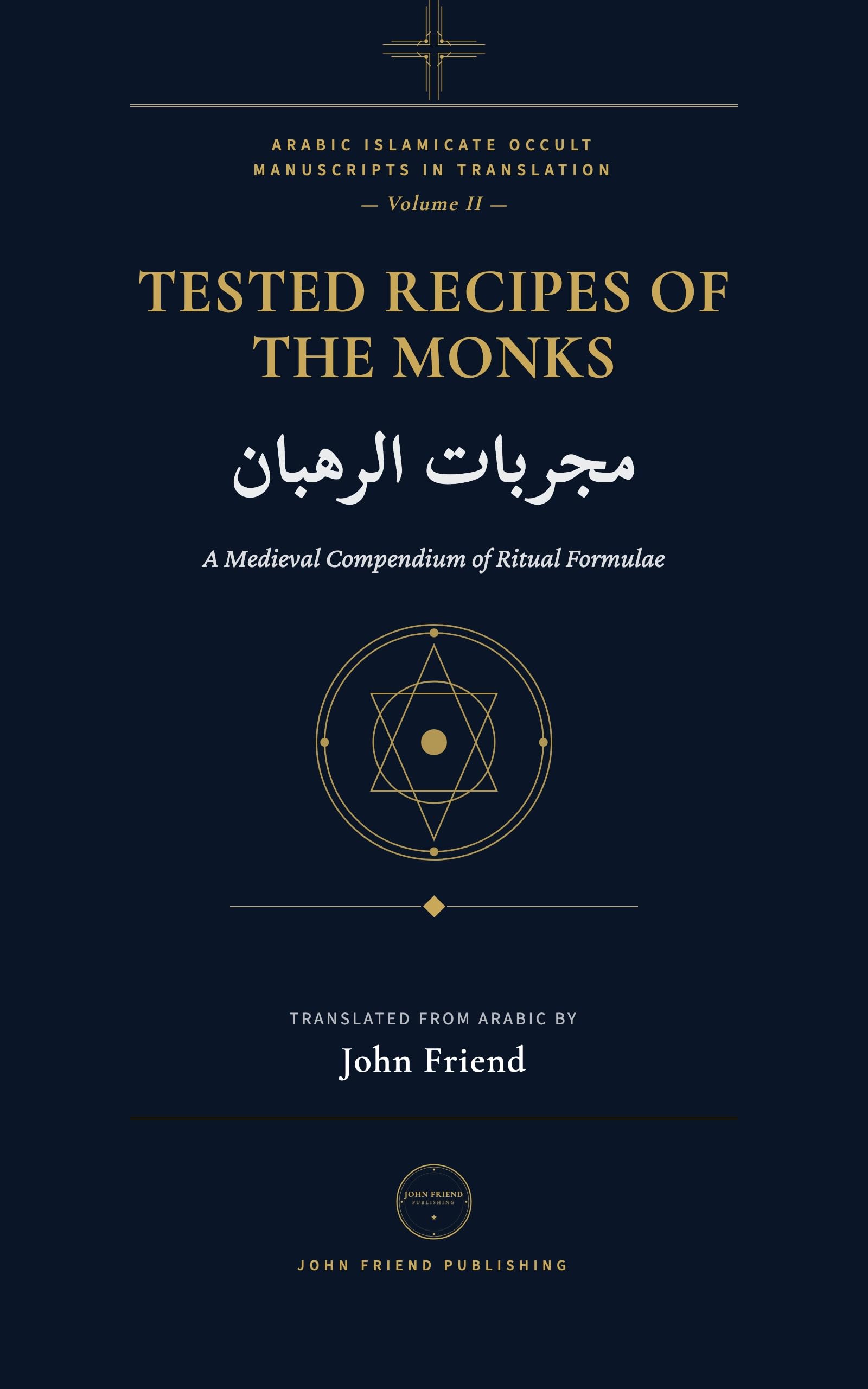
The first English translation of the Mujarrabat al-Ruhban (The Tested Remedies of the Monks) is published by John Friend Publishing, available on Amazon in Kindle and paperback. Kindle Unlimited members read free. The edition includes all operational formulas and the complete chapter sequence.
Is the Mujarrabat al-Ruhban an Arabic talisman manuscript?
Yes, in large part. Alongside its invocations it gives instructions for seals and amulets — a seal engraved with a divine name for bringing back a divorced woman (p. 121), an amulet for marriage (p. 158), a reconciliation wafq built from the abjad values of two names (p. 290) — and the English edition reproduces its talismanic seals and magic squares as images from the source manuscript.
How is a reconciliation talisman made in the Mujarrabat al-Ruhban?
One tested method from the monks takes the names of two estranged people, calculates the abjad value of each, combines the values and builds a wafq from the total. It is written on clean white paper in saffron ink during the hour of Venus on Friday night, fumigated with sugar and coriander seeds, and placed between the two parties’ garments (p. 290).
Read the Manuscript in English
The Mujarrabat al-Ruhban has been translated into English for the first time by John Friend Publishing. The full text — with all operational formulas, talismanic procedures, and the complete chapter sequence from Jalb al-Mahabba through the planetary workings — is available now.
The Tested Remedies of the Monks (Mujarrabat al-Ruhban) — Amazon
Available in Kindle and paperback. Kindle Unlimited members read free. Full details of the edition are on the Mujarrabat English translation page.
Further Reading
For Arabic love spells from a different lineage, see the Arabic love spells of Tumtum al-Hindi; for the wider genre, see Arabic spells for love and attraction.
For related texts in the same Arabic occult manuscript tradition translated by John Friend Publishing:
-
Shams al-Anwar (Sun of Lights) — The foundational Arabic text on letter-science, numerical squares, and angelic invocation that forms the theoretical background to the mujarrabat tradition.
-
Sihr Muluk al-Jann: The Complete Magic of the Jinn Kings (Vol. VII) — An anonymous Arabic manual on the magic of the seven kings of the jinn: investitures, seals, magic squares and conjurations, including operations of love and attraction.
For the historical background on the Cairo Geniza magical texts and the syncretism of medieval Egyptian religious practice, see the Wikipedia article on the Cairo Geniza. For the late antique magical papyri that form the historical background to Egyptian magic before the Islamic period, see the Wikipedia article on the Greek Magical Papyri.