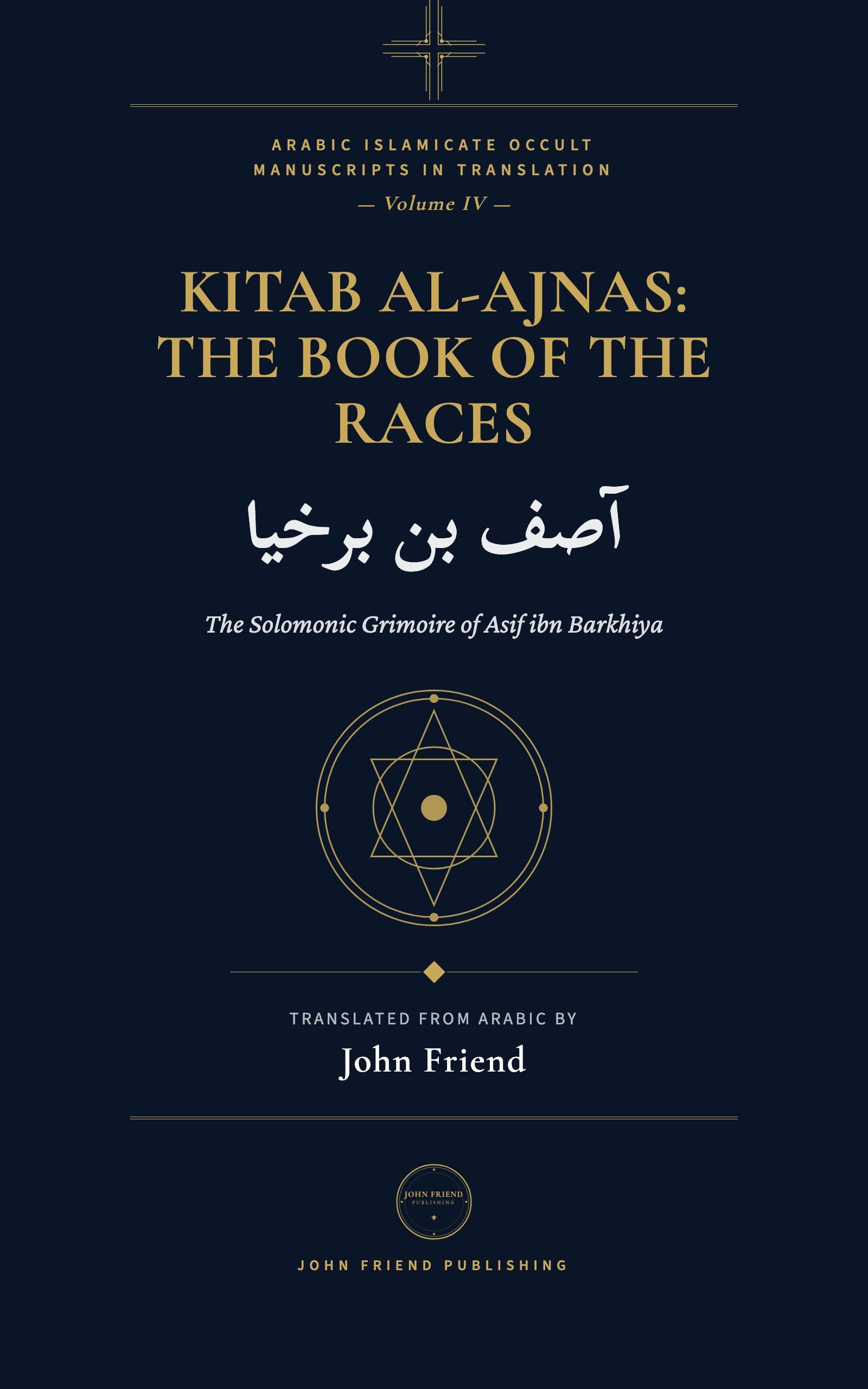
There is a story in the Solomonic manuscripts that the authors clearly intended as a warning. It appears in the Kitab al-Ajnas — the “Book of Genres,” attributed to Asif ibn Barkhiya, the minister of the Prophet Sulayman — and it is not presented as legend or metaphor. It is presented as a case study. A student attempted a Solomonic invocation. He had a copy of the text. He had the names. He had the incense. What he did not have was any instruction from a living master on the oaths required, the proper procedures, or the specific fumigations that the operation demanded. He performed the ritual anyway.
The spirit appeared as a small cat.
Then it grew. It swelled in size until it filled the room, as large as a water buffalo. And then it struck him with what the manuscript describes as a flaming meteor — shahab min nar. The text says his senses were ruined and his body was paralyzed. The chapter is called Bab al-Qitt — the Chapter of the Cat — and it exists in the manuscript for one reason: to make absolutely certain that no reader attempts what that student attempted.
The story is horrifying. It is meant to be. And the lesson it teaches is the single most important principle in the entire Arabic Solomonic tradition — a principle so fundamental that the manuscripts return to it again and again, in passage after passage, with a seriousness that borders on desperation. It is also the one principle that every modern practitioner working from Western grimoires either does not know about or actively ignores.
That principle is the ijazah.
The Ijazah: Authorization from a Living Chain
The ijazah is the authorization — the formal permission, the chain of transmission — from an accomplished master to a student. It is the same concept that governs the transmission of hadith in Islamic scholarship, the same structure that authenticates Quranic recitation chains going back to the Prophet Muhammad. In the context of the Solomonic operative tradition, it means this: you do not learn this work from a book. You learn it from a person who learned it from a person who learned it from a person, in an unbroken chain stretching back to the original source of the knowledge.
The Kitab al-Ajnas is explicit. Practitioners who attempt the work “without guidance from accomplished sheikhs” have, the text says, perished. Not failed. Not been disappointed. Perished. The Arabic word used carries the weight of complete destruction — spiritual, mental, and sometimes physical. The reason, according to the manuscripts, is that the published text of any grimoire — even a complete and authentic one — contains only the visible portion of the operative system. The hidden portion — the shurut, the conditions, the safety measures, the specific adjustments required for different temperaments and circumstances — is transmitted orally, master to student, and is never committed to writing.
This is not an accident. It is a deliberate security architecture.
Ahmad al-Buni addresses this directly in the Shams al-Ma’arif. The knowledge is layered: the outer layer is the written text, available to anyone who possesses the manuscript. The inner layer — the operational key that makes the outer layer functional and safe — is the ijazah, the living transmission. Without it, the text says, the practitioner is working blind. He possesses the words but not the understanding. He has the ingredients but not the recipe. He has a loaded weapon with no knowledge of which direction it is pointed.
“He who works without the guidance of the masters is like a child without a father — exposed to every danger, with no one to protect him and no one to warn him of what lies ahead.”
The Ghayat al-Hakim — known in the West as the Picatrix — frames this in philosophical terms, speaking of the “chain of sages” through whom knowledge descends. The Shams al-Anwar of Ibn al-Hajj al-Tilmsani is blunter: the conditions (shurut) of each operation are numerous, and ignorance of even one of them can be fatal. The al-Jawahir al-Lamma’a puts it most starkly of all: the spirits know whether you have authorization. They can tell. And an unauthorized practitioner is, to them, not a summoner but a trespasser.
What the Western Tradition Stripped Out
The concept of the ijazah has no equivalent in Western ceremonial magic. Not really. The Golden Dawn had its grades. Thelema has its degrees. But these are institutional hierarchies — organizational structures that confer status within a group. They are not what the Arabic manuscripts mean by ijazah. The Arabic concept is not about rank. It is about a specific, personal, oral transmission of operative knowledge from someone who has successfully performed the work to someone who is being prepared to perform it. It is closer to a medical residency than to a Masonic degree — you learn by working alongside someone who already knows, under their direct supervision, until they judge you ready to work alone.
When the Arabic Solomonic material entered Europe — through the Latin Picatrix, through Agrippa’s compilations, through the various Solomonic grimoires that were themselves translations and adaptations of Arabic originals — the ijazah was the first thing to disappear. It had to disappear. The European scribes and scholars who received these texts were not part of any operative chain. They had no masters. They had manuscripts, acquired through trade, theft, or the libraries of conquered territories. They could copy the circles, the names, the conjurations. They could not copy the living chain of transmission, because they were not in it.
And so the Western Solomonic tradition was born incomplete. The Key of Solomon, the Lemegeton, the Grimorium Verum — these texts contain material that is recognizably derived from Arabic Solomonic originals. But they contain it the way a photograph contains a person: the image is there, but the life is not. The safety protocols were stripped. The conditions were lost. The ijazah was forgotten entirely. What remained was the spectacular surface — the names of spirits, the designs of circles, the words of conjuration — without the operative infrastructure that made those elements safe to use.
The Tahsin: What Happens Without Protection
The manuscripts do not leave the consequences to the imagination. They describe, in specific and unsettling detail, what happens to a practitioner who works without proper authorization and its accompanying protections.
The first and most critical protection is the tahsin — the protective fortification. This is not the circle itself, though the circle is part of it. The tahsin is a comprehensive spiritual barrier that must be established before any invocation of any kind. The Kitab al-Ajnas describes its function in language that is both beautiful and terrifying: the tahsin, when properly established, creates a barrier described as “blinding the eyes of the oppressors with a light whose flash almost takes away their sight.” It renders the practitioner invisible to hostile entities — not physically invisible, but spiritually shielded, enclosed in a fortress of divine names and Quranic verses that no entity can penetrate without the permission of God.
The tahsin shields against everything. The manuscripts are comprehensive in their enumeration: “Jinn, humans, devils, rebellious giants, and the armies of Iblis.” This is not a metaphor. This is a threat assessment. The practitioner who opens a channel of communication with the unseen world is not only contacting the specific entity being summoned. He is making himself visible to everything in that world — including things that are hostile, predatory, and vastly more powerful than he is.
Without the tahsin, the manuscripts warn, the dynamic is lethally asymmetric. The spirits “see you from where you do not see them.” This is a direct quotation from the Quran (7:27), and the operative texts deploy it as a tactical warning: you are entering a domain where your adversaries have total surveillance capability and you have none. The tahsin is the countermeasure. Without it, you are a man walking blindfolded through a battlefield.
“Do not EVER trust them, and wear the protective armor.”
That line appears in the Shams al-Anwar, and its tone is not advisory. It is a command. The word “ever” is emphasized in the original Arabic. The manuscripts treat the entities encountered in this work as fundamentally untrustworthy — not because they are all malevolent, but because their nature, their motivations, and their relationship to truth are so different from human norms that even a “friendly” spirit cannot be relied upon to act in the practitioner’s interest. The tahsin is not a courtesy. It is survival equipment.
What the Kitab al-Ajnas Prescribes: Conditions, Circles and the Mandal
Readers who come to this subject looking for a Solomonic magic circle manuscript usually have the circles of the Lesser Key of Solomon in mind. The Arabic conjuration book behind this essay frames its apparatus differently, and it states its first principle in plain words. Its section on the practitioner’s prerequisites opens: “Know that nothing in the sciences of any school is completed except with its conditions, its commandments, and its duties” (p. 188). It goes on to require cleanliness of body and garments, avoidance of forbidden food and of sleep, and piety.
The circles themselves belong to a chapter on “the carpet, its employments, and what is connected to it” — including “the making of circles, and the stellar consecration of the seals” (p. 187). Alongside them stands the Mandal of Sulayman, which the book calls “a secret among the hidden secrets that belonged to Sulayman” (p. 120). It is engraved in silver, or in red copper whitened with naphtha, or made of clean earth, and in every case “raised above the ground on four legs”; it is “fashioned after the mandal of Sulayman ibn Dawud, which was the one upon which all the spirits would descend in subjugation and obedience” (p. 121). Its master is named: Sakhr, “the helper empowered under the hand of Sulayman ibn Dawud,” whose seal the book also describes, is “the master of the mandal” (p. 116), and Mahakil is its guardian (p. 117).
The protective layer is spelled out too. Under the heading “Protective Fortification Before Any Operation,” the book gives an invocation to be recited “before any operation three times or seven times” (p. 290). It asks God to “fortify me against all varieties of the jinn” with an “impenetrable veil” whose ceiling is the light of the divine name al-Qayyum, whose walls are the verse “Peace — a word from a Merciful Lord,” and whose perimeter — in Arabic its da’ira, the word for a circle — is the Quranic verse of the angels who guard a person “before him and behind him” (p. 291). Here the protective circle is built from divine names and Quranic verses.
None of this makes the Kitab al-Ajnas a “Kitab Solomon” in the strict sense: the book is attributed not to Sulayman himself but to his vizier, Asif ibn Barkhiya. For the wider Solomonic stream in Islam, see Kitab Solomon and the Asif ibn Barkhiya tradition; for how Arabic names of power differ from those of Western Solomonic conjuration, see that comparison; and for the Lesser Key of Solomon’s links to Islamic sources, see the Goetia’s Arabic root.
The Chapter of the Cat Revisited
Return now to the story of Bab al-Qitt. Understanding the ijazah and the tahsin, the story becomes not a fable but a forensic report. The student had the text. He had the names of the spirits. He had the physical materials. What he lacked was the ijazah — and with it, knowledge of the proper oaths, the correct fumigations, and most critically, the tahsin that would have shielded him from the entity he was about to summon.
He performed the invocation. Something responded. It appeared small and unthreatening — a cat. This detail is significant: the manuscripts repeatedly warn that spirits test practitioners by appearing in diminished, harmless forms before revealing their true nature. The small cat was not a small cat. It was something vast and powerful, presenting itself in a form designed to assess the practitioner’s defenses.
It found none.
The spirit grew to its full size. It attacked. The student was destroyed — not killed, but ruined, his senses shattered, his body paralyzed. The manuscript records this not with satisfaction but with grief. The student was not evil. He was not reckless in the way we might use that word casually. He was ignorant — and his ignorance was specifically of the shurut, the conditions, that only the ijazah could have provided.
The chapter exists in the Kitab al-Ajnas as a firewall. It is placed early in the text, before the operative material, as a gate that every reader must pass through. Its message is not subtle: these texts are not games. The original authors included safety protocols for a reason. The work without the transmission is not merely ineffective — it is dangerous.
Why This Matters Now
The modern occult revival has produced an enormous appetite for Solomonic material. The internet is full of practitioners working from the Lesser Key of Solomon, the Ars Goetia, the Grimorium Verum, and a dozen other texts that descend — at several removes — from Arabic originals. Almost none of these practitioners have any awareness that the tradition they are drawing from considers their approach not just incomplete but actively reckless.
This is not a judgment. It is a statement of what the source texts say. The Arabic manuscripts that contain the earliest and most complete versions of the Solomonic operative system are unanimous on this point: the book alone is never enough. The hidden conditions — the shurut — must come from a living chain of transmission. The protective fortification — the tahsin — must be properly established by someone who knows how to establish it. The practitioner must be authorized, prepared, shielded, and supervised. Without these things, possessing a grimoire is like possessing a surgeon’s scalpel with no medical training: you have the tool, but you do not have the knowledge that makes the tool safe to use.
The original authors of these texts knew this. They wrote it down, over and over, in language that could not be misunderstood. The Western tradition lost those warnings. The Arabic manuscripts preserve them in full.
Where to Read the Source Material
The Bab al-Qitt narrative, the ijazah requirements, and the complete tahsin protocols appear in their fullest form in Kitab al-Ajnas (The Book of Genres), attributed to Asif ibn Barkhiya and translated in full as Volume IV of the John Friend Publishing series. This text, one of the foundational documents of the Arabic Solomonic tradition, has never before been available in complete English translation. It contains the operative procedures, the safety protocols, the hierarchies of spiritual entities, and the cautionary accounts — including the Chapter of the Cat — that the Western Solomonic tradition lost in transmission. Details of this conjuration book in English are on the Kitab al-Ajnas page.
For the complementary material on the tahsin, protective fortifications, and the preparatory retreat protocols that precede any Solomonic operation, see Shams al-Anwar wa Kunuz al-Asrar al-Kubra (Suns of Lights and the Great Treasures of Secrets) by Ibn al-Hajj al-Tilmsani (Volume III). For the jinn kings, see Sihr Muluk al-Jann: The Complete Magic of the Jinn Kings (Volume VII).
The manuscripts are clear, and they have been clear for seven hundred years: the one mistake that makes every Solomonic ritual fail is attempting the work without the transmission. The book is the map. The ijazah is the terrain. No amount of studying the map will substitute for knowing the ground beneath your feet.
Frequently Asked Questions
Does the Kitab al-Ajnas describe a Solomonic magic circle?
It describes several kinds of circle-work. A chapter on the carpet covers “the making of circles, and the stellar consecration of the seals” (p. 187); the Mandal of Sulayman is engraved in silver or copper, or made of clean earth, and raised on four legs (pp. 120–121); and its protective fortification describes a veil whose perimeter — its da’ira, or circle — is a Quranic verse (p. 291).
What must a practitioner do before Solomonic conjuration, according to the Kitab al-Ajnas?
Observe the conditions first. The book states that “nothing in the sciences of any school is completed except with its conditions, its commandments, and its duties,” requires cleanliness of body and garments, avoidance of forbidden food and of sleep, and piety (p. 188), and prescribes a protective fortification to be recited “before any operation three times or seven times” (p. 290).
Who wrote the Kitab al-Ajnas?
It is attributed to Asif ibn Barkhiya, the vizier of the Prophet Sulayman (Solomon). The English edition presents the author as pseudo-Asif ibn Barkhiya: an attribution to antiquity rather than a historical author.
Is the Kitab al-Ajnas available in English?
Yes. It is translated as Volume IV of the John Friend Publishing series, with barbarous names transliterated alongside the original Arabic script and its talismanic seals and magic squares reproduced as images from the source manuscript.
