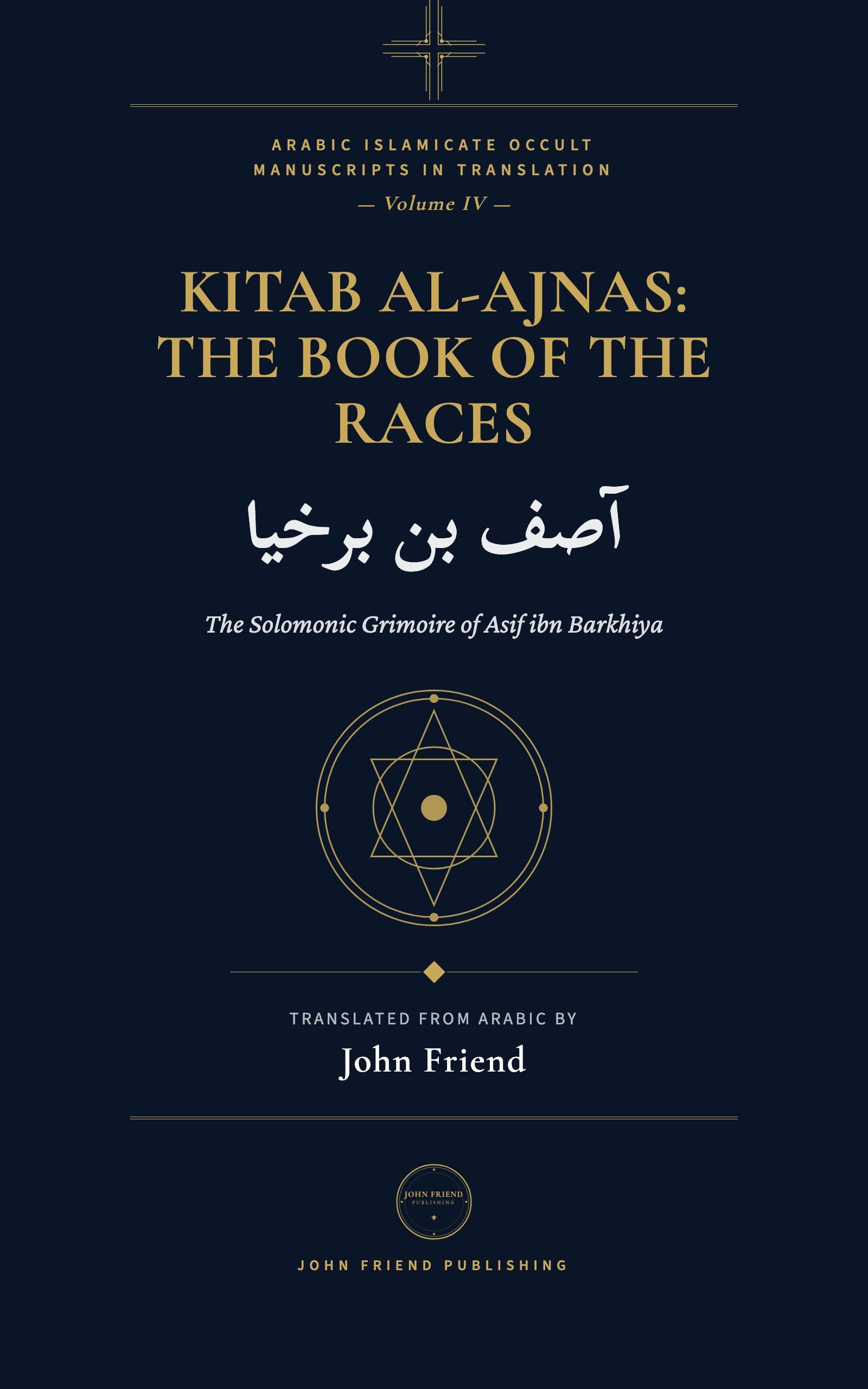
Ask anyone with a passing interest in the occult what the Seal of Solomon looks like, and you will get the same answer: a hexagram. Two interlocking triangles. The Star of David. This is the image reproduced in the Key of Solomon (Clavicula Salomonis), the Lesser Key of Solomon (Lemegeton), and virtually every Western grimoire that claims a Solomonic lineage. It is engraved on pentacles, printed on talismans, and tattooed on the forearms of ceremonial magicians from London to Los Angeles. And it bears almost no resemblance to what the Arabic manuscripts actually describe.
The Arabic tradition does not present the Seal of Solomon as a geometric symbol at all. It presents it as a ring — khatam Sulayman — with a specific physical structure, specific inscriptions arranged in four concentric layers, and a specific metaphysical function that goes far beyond the decorative hexagram of Western magic. The manuscripts that describe this ring in operational detail — the Kitab al-Ajnas, the al-Jawahir al-Lamma’a, and sections of Ahmad al-Buni’s Shams al-Ma’arif — agree on the essential features. What they describe is not a symbol. It is a technology.
The Western Version: How the Hexagram Became the Seal
Before examining what the Arabic sources say, it is worth understanding how the Western tradition arrived at its own version. The Testament of Solomon, a Greek text dating to roughly the first through fifth centuries CE, is the earliest Solomonic magical text in any European language. It describes Solomon receiving a ring from the archangel Michael that gave him power over demons, but it says remarkably little about the ring’s physical form. The Key of Solomon, compiled in its current form during the Italian Renaissance from earlier Latin and possibly Hebrew sources, introduced the hexagram as the defining image — but this was a European editorial decision, not a transmission from the original Arabic or Hebrew traditions.
The Lemegeton, or Lesser Key of Solomon, compiled in the seventeenth century, continued this convention. So did every subsequent Western grimoire that drew on these sources. By the time the Golden Dawn and Aleister Crowley adopted Solomonic imagery in the late nineteenth and early twentieth centuries, the hexagram was so thoroughly identified with the Seal that no one thought to ask whether the identification was correct.
The Arabic manuscripts, which predate most of these Western compilations by centuries, tell a completely different story.
The Four Layers of the Ring
The Kitab al-Ajnas — the “Book of Types,” attributed to Asif ibn Barkhiya, Solomon’s own vizier — provides the most detailed physical description of the Seal that we have found in any Arabic manuscript. According to this text, the ring was constructed in four concentric layers, each inscribed with specific declarations.
The first layer bore the inscription: “In the name of God, the Living, the Self-Subsisting, who neither slumbers nor sleeps.” This is not arbitrary text. It is a direct echo of the opening of the Ayat al-Kursi — the Throne Verse, Quran 2:255 — the single most powerful verse in the Islamic tradition for spiritual protection and divine authority.
The second layer was inscribed: “In the name of God, the Eternal, who begets not nor was begotten.” This echoes Surah al-Ikhlas (Quran 112), the declaration of God’s absolute oneness and self-sufficiency.
The third layer bore: “In the name of God, before whom every tyrant bows and every rebellious spirit submits.” This is the operative declaration — the layer that established the ring’s authority over spiritual entities. It is not a prayer. It is a statement of jurisdiction.
The fourth layer — the innermost circle, closest to the stone of the ring itself — contained the complete text of the Ayat al-Kursi and, according to multiple manuscripts, the Ism al-A’zam: the Greatest Name of God. This is the name whose identity is the subject of an enormous body of Islamic theological and esoteric speculation. Al-Buni devoted entire chapters of the Shams al-Ma’arif to its identification and properties. The Kitab al-Ajnas states plainly that it was inscribed on the innermost layer of Solomon’s ring, and that it was the presence of this name — not the geometric shape of the ring — that gave it power.
Compare this with the Western tradition’s hexagram: a geometric figure with no inscriptions, no layers, no textual content, no reference to any specific divine name. The distance between the two conceptions is not a matter of minor variation. They are describing fundamentally different objects.
The Ghayat al-Hakim and the Stellar Connection
The Ghayat al-Hakim — known in the West as the Picatrix — approaches the Seal from a different angle. While the Kitab al-Ajnas emphasizes the ring’s inscriptions and divine names, the Ghayat al-Hakim connects it to the broader system of planetary and stellar magic that governed Arabic talismanic practice. In this framework, the Seal’s power was not only theological but cosmological — the ring functioned as a nexus point where divine authority and celestial influence converged.
This is why the al-Jawahir al-Lamma’a — The Radiant Jewels for Summoning the Kings of Jinn — places the Seal within its system of planetary hours and jinn-king hierarchies. The ring was not a standalone artifact. It was the central instrument in an entire operative architecture: the correct planetary hour, the correct fumigation, the correct divine names recited in the correct sequence, and the Seal as the focal point through which all of this was directed. Remove any element, and the system fails. Reduce the Seal to a hexagram, and you have removed its entire content.
How the Arabic Ghayat al-Hakim differs from the Latin Picatrix that Europe read is explained in The Picatrix Is Not the Ghayat al-Hakim.
Khatim Sulayman: The Ring of Solomon in the Manuscripts’ Own Words
The Seal of Solomon goes by two Arabic spellings, khatam Sulayman and khatim Sulayman, and both vocalizations are used for “seal” in the manuscripts translated in this series: the Kitab al-Ajnas titles its Part Five Khatim Mitatrun, “The Seal of Mitatrun,” while al-Jawahir al-Lamma’a names a “Seal of the Crown of Religion (Khatam Taj al-Din).” In Arabic, seal and signet ring are the same word. That is the first thing the Arabic sources restore: the Seal of Solomon is the ring of Solomon, an object worn on the hand. The Complete Magic of the Jinn Kings adjures the spirits “by the majesty and might of Solomon, by his seal and signet ring,” and the Kitab al-Ajnas has the operator announce, “I am the messenger of Sulayman! By the right of God and the seal that revolves upon you!”
Even where a manuscript does call for the seal to be drawn, it is not the Western hexagram. In a Kitab al-Ajnas operation for returning “the evil eye and the envious glance to its sender,” the text sets down Ayat al-Kursi — Ayatul Kursi, the Throne Verse — among the formulas of the adjuration, and at its close instructs: “write after it the heptagram of the Seal of Sulayman.” A heptagram is a seven-pointed figure, not a six-pointed one.
The Mandal of Sulayman: A Solomonic Magic Circle in Manuscript
The Kitab al-Ajnas also preserves the other great instrument of Solomon’s court: the mandal, the conjuring figure the text elsewhere calls “a circular mandal” — the Solomonic magic circle of the Arabic manuscripts. It describes “the mandal of Sulayman, peace be upon him,” as “a secret among the hidden secrets that belonged to Sulayman,” the one “upon which all the spirits would descend in subjugation and obedience.” The practitioner’s copy is engraved in silver, or in red copper whitened with naphtha, or made of clean earth, and in every case raised above the ground on four legs. It is consecrated together with two seals: that of Mahakil, “the one appointed over the mandal of Sulayman,” and that of Sakhr, “the helper empowered under the hand of Sulayman ibn Dawud” and “the master of the mandal,” whose seal is fashioned as a ring of red copper, gold, or red carnelian. How the mandal is used is set out in the Kitab al-Ajnas reader’s guide to mandal scrying.
Solomon’s Other Instruments of Power
The Arabic manuscripts do not treat the Seal as Solomon’s only instrument. The Kitab al-Ajnas and the al-Jawahir al-Lamma’a describe an entire apparatus of spiritual authority, each component with its own function.
The magical carpet (bisaat) is perhaps the most famous outside the ring itself. The manuscripts describe it not as a flying carpet in the fairy-tale sense but as a consecrated textile inscribed with four “locked” Hebrew names of God. These names were sealed — maqful — meaning that their pronunciation was restricted and their power activated only under specific conditions. The Kitab al-Ajnas warns that when Solomon’s servants or jinn disobeyed while standing upon the carpet, the names would activate and the disobedient spirit would be struck by lightning. This was not metaphorical. The text describes it as a literal enforcement mechanism, a failsafe built into the carpet’s design.
The collar (tawq) was a neck-piece inscribed with protective divine names that Solomon wore during conjurations. Where the ring established authority, the collar provided protection — a second layer of defense against entities that might resist or retaliate. The manuscripts describe it as functioning in concert with the ring: the khatam commanded, the tawq shielded.
And then there were the four Afarit ministers — the most powerful class of jinn in Solomon’s service. The Kitab al-Ajnas names them: Dimyat, Shughal, Hadliyaj, and San’iq. These were not summoned servants who came and went. They were permanent officers of Solomon’s spiritual court, each governing a cardinal direction and commanding legions of lesser jinn beneath them. The seven kings of the jinn have a volume of their own, The Complete Magic of the Jinn Kings.
Asif ibn Barkhiya: The Vizier Who Was Faster Than an Eye-Blink
The Arabic Solomonic tradition does not attribute its magical knowledge to Solomon directly. It attributes it to his vizier, Asif ibn Barkhiya, whose abilities the Quran itself references. In Surah al-Naml (Quran 27:40), when Solomon asks who among his court can bring the throne of the Queen of Sheba — Bilqis — before she arrives, an ifrit of the jinn offers to bring it before Solomon can rise from his seat. But Asif ibn Barkhiya, “one who had knowledge of the Book,” said he could bring it faster than that — in the time it takes for the eye to return to the one who blinks. And the throne appeared.
The Kitab al-Ajnas presents itself as the grimoire that preserves Asif’s methods — the operative techniques by which he accomplished this feat and others like it. This is not a minor attribution. It means that the most detailed Solomonic grimoire in the Arabic tradition claims its authority not from Solomon the king but from the vizier whose spiritual knowledge exceeded even that of the jinn. The methods in the Kitab al-Ajnas — the conjurations, the divine names, the layered inscriptions — are presented as Asif’s technology, transmitted through Solomon’s court and preserved in manuscript form for those who can meet its preparatory demands.
The Quranic episode itself, and what the tradition says about the vizier who knew the Greatest Name, is told in full in Solomon’s Vizier: Asif ibn Barkhiya and the Throne of Bilqis. The wider stream of Solomonic books attributed to him and to Solomon’s court — which readers often look for as a single “Kitab Solomon” — is surveyed in Solomonic Magic in the Islamic Tradition.
What Was Lost in Translation
The Western Solomonic tradition received its material through a chain of transmission that stripped out nearly everything described above. The Arabic sources passed through Hebrew intermediaries, then into Latin, then into Italian and French and English — each stage losing specificity, losing the inscriptions, losing the four-layer structure, losing the divine names, losing the operational context. What survived was the image: two triangles. A hexagram. A shape without content.
This is not a minor scholarly footnote. It is the reason that Western Solomonic magic, for all its elaborate ceremonial apparatus, has always felt hollow to serious practitioners — because it is working with the container and not the contents. The Arabic manuscripts preserve the contents. The four layers of the ring. The Ism al-A’zam. The Ayat al-Kursi. The carpet with its locked names. The collar. The Afarit ministers. The vizier’s methods. All of it.
The Western tradition kept the shape. The Arabic tradition kept the power.
Where to Read the Primary Sources
The most complete account of Solomon’s Seal, his instruments of power, and the operative methods attributed to his court is found in the Kitab al-Ajnas (Volume IV of the John Friend Publishing series), the grimoire attributed to Asif ibn Barkhiya himself. This is where the four-layer ring description appears in full, along with the carpet, the collar, and the names of the four Afarit ministers. It is translated without abbreviation from the Arabic manuscripts.
For the jinn kings themselves, see The Complete Magic of the Jinn Kings (Volume VII). For the stellar and planetary magical system that contextualizes the Seal within the broader Arabic talismanic tradition, see al-Jawahir al-Lamma’a: The Radiant Jewels (Volume V).
The Shams al-Ma’arif and the Ghayat al-Hakim both discuss the Seal in their broader treatments of divine names and talismanic science, but the Kitab al-Ajnas is the source that provides the physical description, the inscriptions, and the operational context in a form that practitioners can actually use. Everything else is commentary. This is the primary text.
The hexagram is a shape. The khatam Sulayman is a four-layered instrument inscribed with the words of God. The difference between the two is the difference between a photograph of a door and the key that opens it.
