Before alif was a letter, it was a drop. That's how al-Būnī tells it in Uṣūl ʿIlm al-Ḥurūf, a story he got from al-Mihrājī. God made the Pen and told it to write, and the Pen asked what it should write. Then, in the book's words, "He looked at it with the eye of awe, and a drop dripped from its head." God looked at the drop and it became a hamza, the small mark you often see sitting on an alif. He looked again, and it stretched out into the alif itself.
So alif came first, and the texts treat it that way. Al-Būnī's magnum opus, Shams al-Maʿārif al-Kubrā, calls it the first of the letters and the first of the numbers, and gives it the value one. Its nature is fire. Its day is Sunday, today, and its work is done in the hour of the Sun, which on a Sunday is the first hour of the day.
Al-Būnī taught the power and transformational abilities this single letter carries. Carried on the body, it kept fever away. Placed on the chest of a slow-witted man, it helped him remember what he learned. Not every use is a kind one, however. Al-Būnī also recorded the use of alif to dry up a well, and in another of his books he states that the letter will serve the one who works with it for good or for evil.
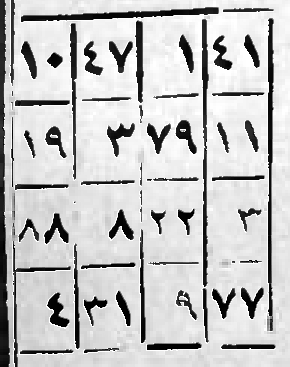
Here is one of its kind uses. For someone struggling financially, or who needs to earn a living, al-Būnī suggests a four-by-four square of alif.
Write it on the day of the Sun, Sunday, and the hour of the Sun, the first hour of the day. Manbaʿ Uṣūl al-Ḥikma counts the first hour of Sunday among the hours of fortune, but if you miss it, the eighth hour of Sunday will work as well.
It is to be written on clean parchment, with a mixture of musk and saffron. Copy the square from right to left, starting with the top row. When the square is finished, put the letter alif around it.
No incense is needed, as al-Būnī says the spirituality of alif needs none. Over the square, recite the name Allāh (الله), and the name al-Razzāq (الرزاق), the Provider. Then, simply fold it and keep it on your person. Keep it clean, and treat it with respect. Al-Būnī's promise is that for its bearer, "God will provide for him from where he does not reckon."
One more thing al-Būnī says about alif. He writes that "the bāʾ is the flattened surface of the alif." Lay the alif down on its side and you have bāʾ, the second letter. Bāʾ has a dot under it, and occult texts have a lot to say about that dot. More on that another time.