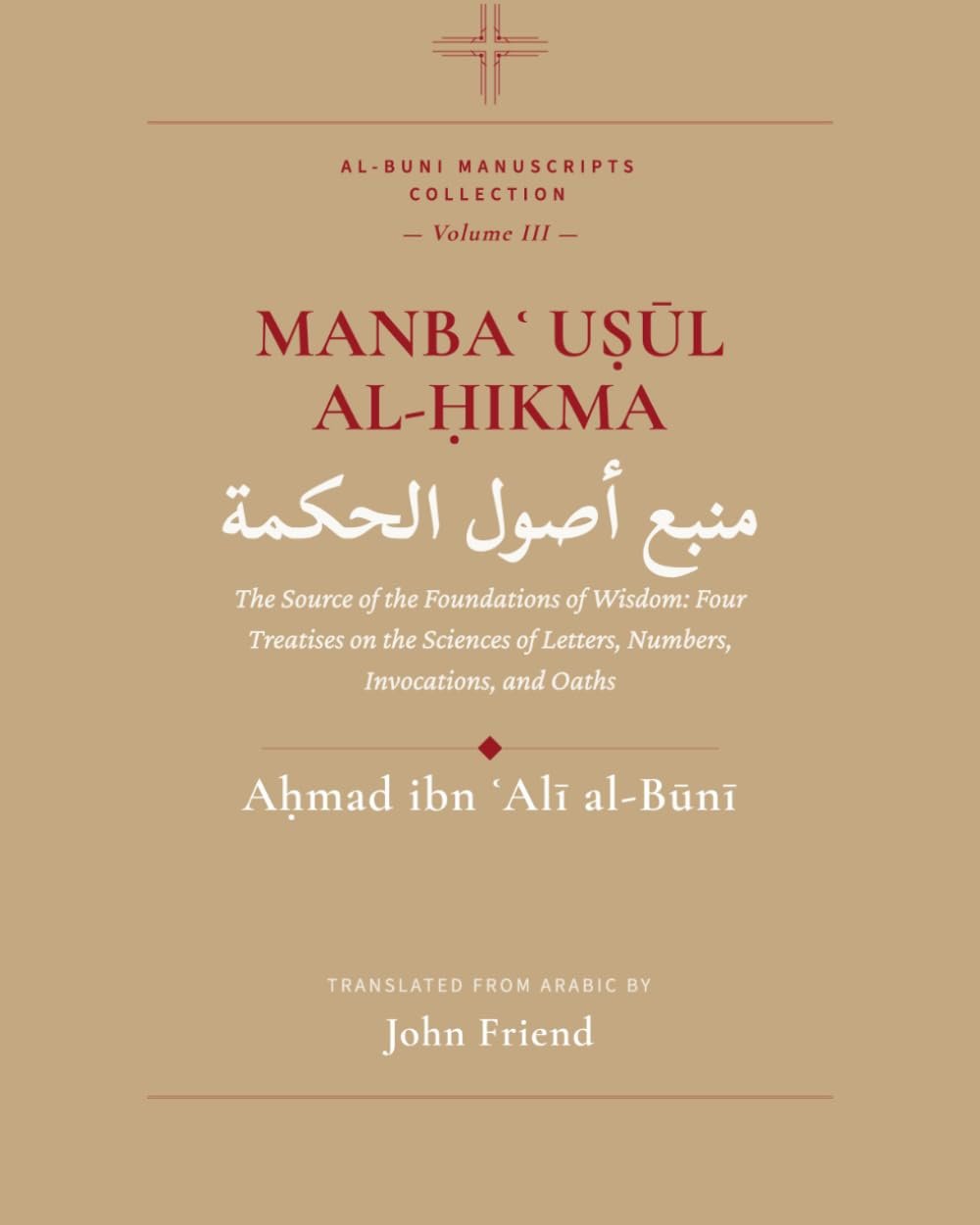
Volume III — Al-Buni Manuscripts Collection
Manba' Usul al-Hikma Al-Buni's Source of the Foundations of Wisdom
منبع أصول الحكمة
English translation of al-Buni's Manba' Usul al-Hikma — containing the Barhatiyyah oath, considered the most powerful conjuration in the Arabic magical tradition, alongside systematic magic square construction methods and divine name operations.
Kindle $139.95 Paperback $139.95
Bookstores & libraries: order wholesale direct from the publisher
What's Inside
- The source and foundations of wisdom according to al-Buni — his most comprehensive treatment of the underlying principles.
- Comprehensive tables of divine name permutations, systematically organized across hundreds of pages.
- Operational instructions for constructing complex talismans, with precise specifications for each type.
- One of the longest and most detailed works in the al-Buni corpus — 485 pages of foundational material.
Manba' Usul al-Hikma: The Source of the Foundations of Wisdom
Manba' Usul al-Hikma (منبع أصول الحكمة) — also written Manba Usul al-Hikmah, or Manba Ushul Hikmah in Indonesian spelling — means “The Source of the Foundations of Wisdom.” Its introduction presents four important treatises on the sciences of letters and numbers, invocations, and oaths, by Abu al-Abbas Ahmad ibn Ali al-Buni, “who died in 622 AH, author of Shams al-Ma'arif al-Kubra.” It is among the Ahmad al-Buni manuscripts translated in full for this series.
Four Treatises and Seven Sciences
The book is arranged in four parts: The Sapiential Principles and Rules; a second part on the placement of wafqs, listed in the introduction as The Desire of the Yearning One for Knowledge of the Arrangement of Magic Squares; the Commentary on al-Barhatiyyah, known as the Commentary on the Ancient Covenant; and the Commentary on the Great Jaljalutiyyah. The introduction names the seven sciences on which, it says, the work of spiritual disposal turns — numbers, awfaq, letters, the four natures, composition with the zodiac signs and mansions, stellar elections, and the Names and invocations — and calls them together the science of simiya.
An Awfaq Book in Three Treatises
That second part is the dedicated manual that makes Manba' Usul al-Hikma an awfaq book. Its first treatise sets the natural magic squares, placing numbers in odd, even, and even-odd forms. The second explains the bases of awfaq and how names and verses are placed into them, by breaking and by composition. The third covers the times of writing suited to works of good and evil, the crafts of numbers and the balances of letters, and extracting the names of the angels, the incenses, and the oath. Wafq constructions then recur throughout the commentaries on the Barhatiyyah and the Great Jaljalutiyyah.
For the general method of how to make a magic square in al-Buni's system, see al-Buni's magic square construction method; for what the wafq magic square is, and is not, read Arabic Magic Squares Are Not What You Think. The name Buduh, familiar to readers of the buduh square, recurs in this volume as well: it is invoked in the Barhatiyyah oath, one square is filled by the method of Buduh Ahwat, and a later operation calls for writing the square of Baduh.
The Barhatiyyah and Surat al-Mulk
The third part is a full commentary on the Barhatiyyah — often spelled berhatiah — the oath explored in our essay What Is the Barhatiyyah. Its text weaves Qur'anic phrases into the chain of names, including the opening verse of Surat al-Mulk, also called Surah Tabarak: “blessed is He in whose hand is the kingdom, and He is powerful over every thing.” Surah al-Mulk is not reproduced in full; here the verse stands as a single line inside the oath, and the surah returns in the commentary on the Great Jaljalutiyyah, in a Formula for Dominion over Hearts by Surat al-Mulk that pairs recitation of the surah, morning and evening, with a verse-line said to hold its secret. Elsewhere the book's practices draw on al-Fatihah, Ayat al-Kursi, Surat al-Jinn, Surat al-Waqi'ah, Surat Ya Sin, and the closing verses of Surat al-Hashr.
Anyone searching for a berhatiah PDF will find the complete commentary here instead, in a Kindle edition that is free with Kindle Unlimited and a 485-page paperback.
Manba' Usul al-Hikma: Frequently Asked Questions
What is Manba' Usul al-Hikma?
Manba' Usul al-Hikma, “The Source of the Foundations of Wisdom,” is an Arabic occult book attributed to Ahmad ibn Ali al-Buni. Its introduction describes four treatises on the sciences of letters and numbers, invocations, and oaths. This complete English translation is Volume III of the Al-Buni Manuscripts Collection.
Who wrote Manba' Usul al-Hikma?
The book is attributed to Abu al-Abbas Ahmad ibn Ali al-Buni. Its introduction calls him the author of Shams al-Ma'arif al-Kubra and gives his death as 622 AH.
Is Manba' Usul al-Hikma an awfaq book?
Yes. Its second part is a dedicated awfaq manual: it teaches how numbers are placed in odd, even, and even-odd magic squares, how names and verses are placed into awfaq by breaking and by composition, and which times of writing suit each work. Wafq constructions also recur throughout its commentaries on the Barhatiyyah and the Great Jaljalutiyyah, while the first part covers the principles of the wisdom sciences.
Does Manba' Usul al-Hikma contain Surah al-Mulk (Surat Tabarok)?
Not in full, but it draws on the surah. The Barhatiyyah text quotes “blessed is He in whose hand is the kingdom, and He is powerful over every thing,” the first verse of Surat al-Mulk, as one line within its chain of names. Later, the commentary on the Great Jaljalutiyyah gives a Formula for Dominion over Hearts by Surat al-Mulk, in which a verse-line is recited three times after the surah, morning and evening. The full text of the surah is not reproduced.
Is there a Manba Usul al-Hikmah PDF in English?
This English translation is published as a Kindle edition and a 485-page paperback rather than a PDF. The Kindle edition is free to read with Kindle Unlimited, and a free sample is available on Amazon.
Which Arabic source is this translation based on?
It is a complete translation of the printed Arabic compilation of Manba' Usul al-Hikma, whose four treatises are attributed to al-Buni and appear here in full. That printed edition also references two further treatises by other authors, al-Shinnawi's al-Sirr al-Jali fi 'Ilm Bast al-Huruf and al-Shatanufi's al-Durrah al-Fakhirah, which do not appear in the compilation itself and are not part of this translation.
Follow the Translation
New essays on the Arabic occult tradition, manuscript discoveries, and translation notes.