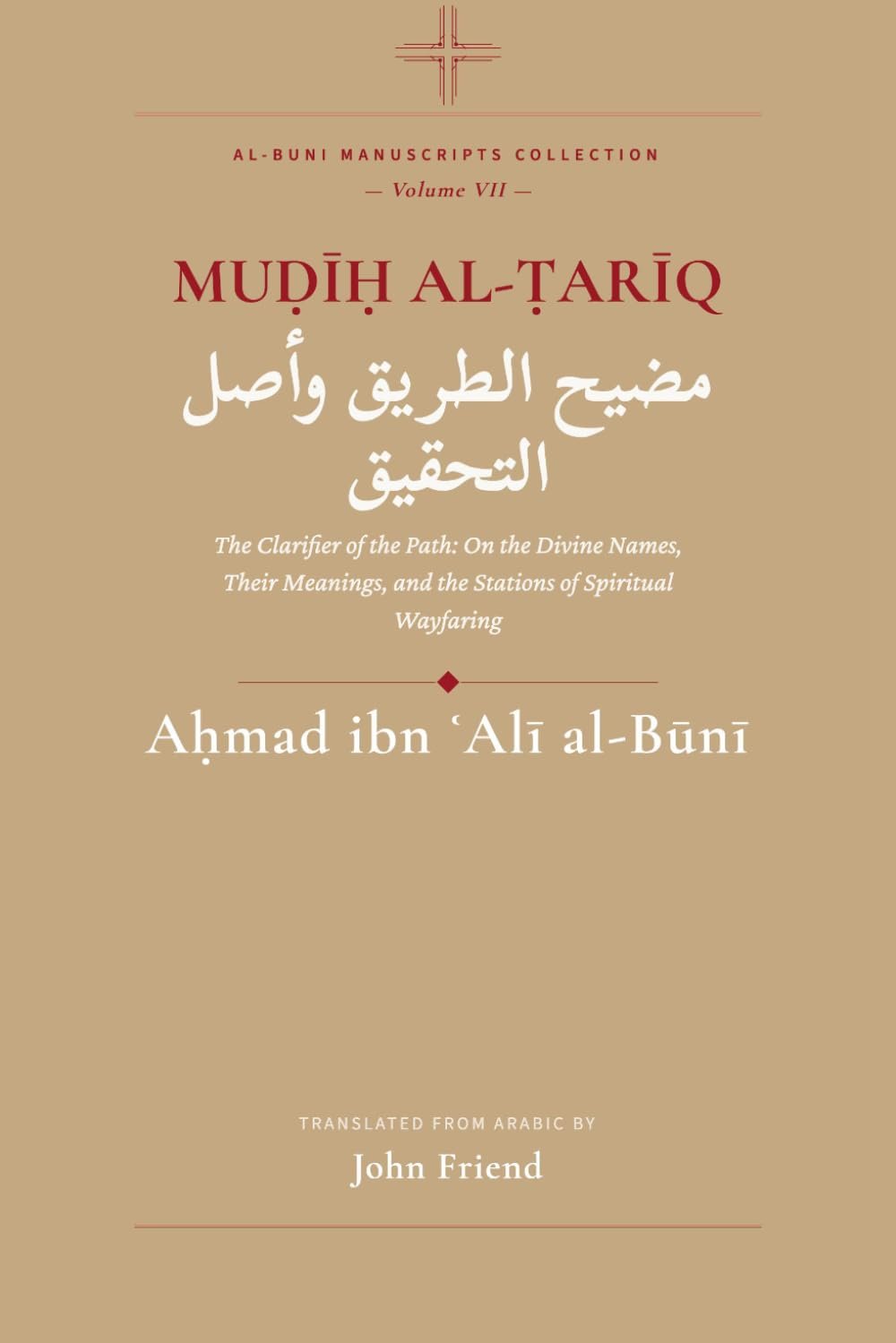
Volume VII — Al-Buni Manuscripts Collection
Mudih al-Tariq The Divine Names Manuscript of al-Buni
مضيح الطريق
English translation of al-Buni's Mudih al-Tariq — a massive work on the divine names across 80 chapters, each devoted to a single name or a pair of names. Each name is treated with its properties, invocation methods, and operative applications. The most comprehensive treatment of divine name practice in the Bunianum corpus.
Kindle $149.95 Paperback $149.95
Bookstores & libraries: order wholesale direct from the publisher
What's Inside
- The definitive treatise on the divine names — the meaning of each name explained, from Allah and al-Samad to al-Wahhab and al-Ghani.
- Mathematical-mystical relationships between numbers and divine names, the theoretical core of the entire system.
- The most comprehensive divine-name work in the al-Buni corpus — 571 pages on the meanings of the names and the stations of spiritual wayfaring.
- A text that makes the divine-name chapters of the Shams al-Ma'arif look like an introduction.
Al-Buni on the 99 Names of God
Mudih al-Tariq (مضيح الطريق وأصل التحقيق) is the divine names manuscript of the Al-Buni Manuscripts Collection. Its full title is Mudih al-Tariq wa-Asl al-Tahqiq, and the cover of this edition describes it as a work “on the divine names, their meanings, and the stations of spiritual wayfaring.” One of the Ahmad al-Buni manuscripts translated for the series, it is attributed to Ahmad ibn Ali al-Buni and translated here in full.
Eighty Chapters, from Allah to al-Ghani
After an opening Counsel to the Seeking Wayfarers, the book moves through 80 chapters, each devoted to a single name or a pair of names. It begins with the name Allah, then the One, al-Samad, al-Hayy, and al-Qayyum, and closes with al-Ghani and a final chapter on the names “He begets not, and He is not begotten.” Paired chapters include al-Qabid and al-Basit, al-Zahir and al-Batin, and al-Awwal and al-Akhir.
“One Hundred Less One”: The Hadith of the Names
Early on, the book cites the Prophetic saying that “God has ninety-nine names, one hundred less one; whoever enumerates them enters the Garden.” This is the list known as the 99 names of Allah, also called Allah ke 100 naam in Hindi and Urdu. For how al-Buni's chapters compare with that familiar list, read The 99 Names of God: What Al-Buni Actually Wrote.
Individual chapters go deep on single names. Chapter Twenty-Eight presents al-Wahhab as “the subtle giver who is beyond compensations.” Chapter Forty-Eight pairs al-Qabid and al-Basit, the Contractor and the Expander, teaching that from contraction fear is born, and from expansion hope and intimacy.
Ayat al-Kursi and the Throne
Al-Hayy and al-Qayyum, the two names in the opening line of Ayat al-Kursi (the Throne Verse), each receive a chapter of their own, and the book quotes the verse's line “His Footstool encompasses the heavens and the earth” in its discussion of the Throne and the Footstool. For a chapter on the properties of the Throne Verse itself, see Chapter Eighteen of Shams al-Ma'arif al-Kubra.
Mudih al-Tariq: Frequently Asked Questions
What is Mudih al-Tariq?
Mudih al-Tariq wa-Asl al-Tahqiq is a treatise attributed to Ahmad ibn Ali al-Buni on the divine names, their meanings, and the stations of spiritual wayfaring. This 571-page English translation is Volume VII of the Al-Buni Manuscripts Collection.
How does al-Buni treat the 99 names of God in Mudih al-Tariq?
After an opening Counsel to the Seeking Wayfarers, the book gives 80 chapters to single divine names or pairs of names, beginning with Allah and ending with al-Ghani and the names “He begets not, and He is not begotten.” It cites the saying that God has ninety-nine names, “one hundred less one,” and explains the meaning of each name it treats.
What does Mudih al-Tariq mean?
The cover of this English edition reads The Clarifier of the Path. Its full Arabic form is Mudih al-Tariq wa-Asl al-Tahqiq.
Does Mudih al-Tariq discuss Ayatul Kursi?
It quotes the line of Ayatul Kursi “His Footstool encompasses the heavens and the earth” and gives chapters to al-Hayy and al-Qayyum, the two names in the verse's opening line. A full chapter on the properties of the Throne Verse appears in Shams al-Ma'arif al-Kubra, Chapter Eighteen.
Is Mudih al-Tariq on Kindle Unlimited?
Yes. The Kindle edition is included in Kindle Unlimited, and the 571-page paperback sells for $149.95 on Amazon. Use the Read Free Sample button above to preview the book.
Follow the Translation
New essays on the Arabic occult tradition, manuscript discoveries, and translation notes.