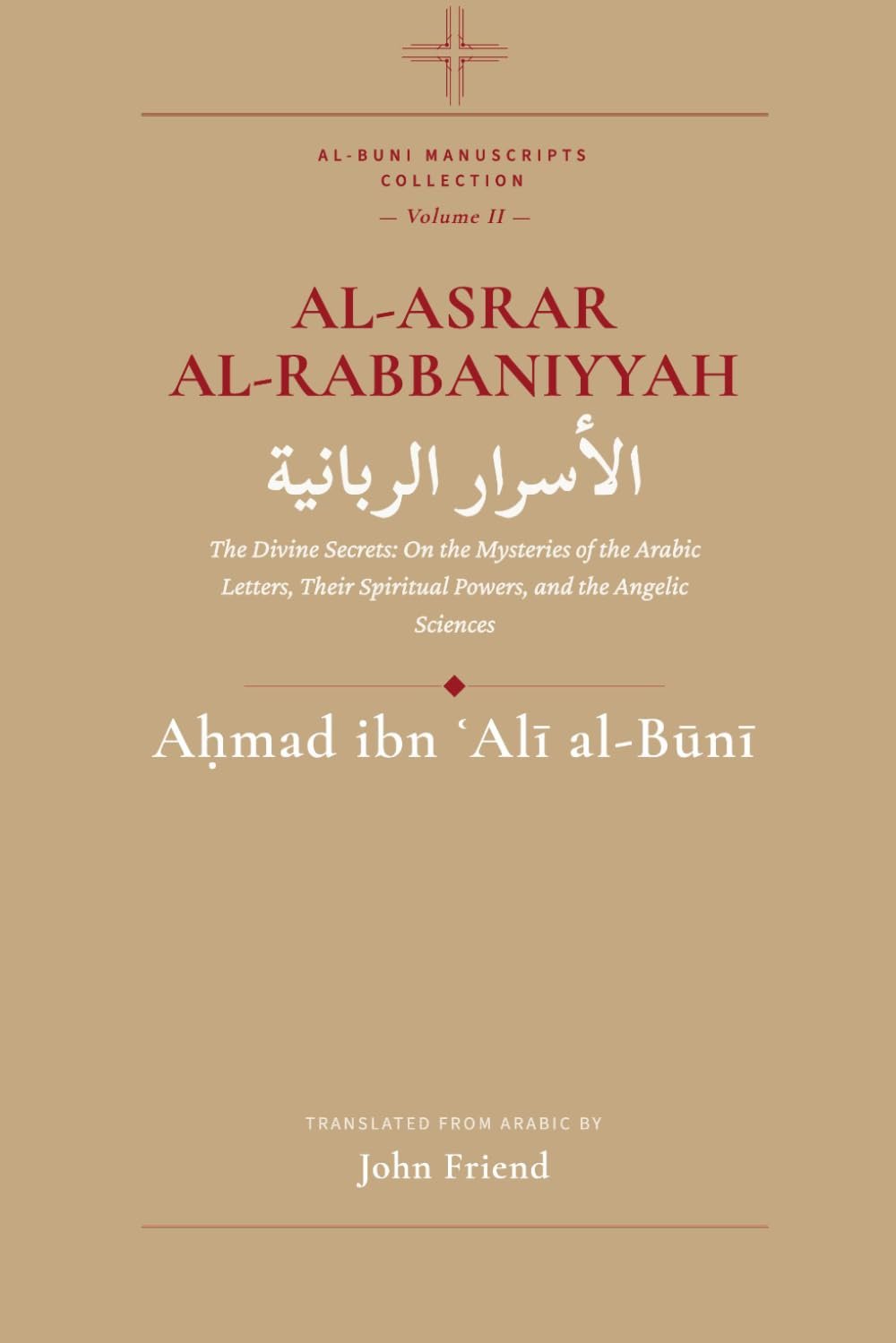
Volume II — Al-Buni Manuscripts Collection
al-Asrar al-Rabbaniyyah: The Divine Secrets
الأسرار الربانية
English translation of al-Buni's al-Asrar al-Rabbaniyyah — the foundational text on the spiritual properties of the Arabic letters. Each of the 28 letters is treated as a living entity with its own spirit, element, and celestial correspondence. A systematic guide to the inner architecture of the Arabic alphabet. Rabbaniyyah means “lordly” or “divine” (from Rabb, Lord) — hence the English title, The Divine Secrets.
Kindle $49.95 Paperback $49.95
Bookstores & libraries: order wholesale direct from the publisher
What's Inside
- Divine secrets of the lordly sciences attributed to al-Buni — advanced material that extends beyond the scope of the Shams al-Ma'arif.
- Advanced letter-number correspondences developed beyond the foundational system, with new combinatorial operations.
- Spiritual purification protocols required before operations — the preparatory discipline underlying al-Buni's practice.
- Prayers and invocations for protection against unseen forces, grounded in the Sufi tradition al-Buni inhabited.
Inside al-Asrar al-Rabbaniyyah: The Letters One by One
This Ahmad al-Buni manuscript opens with the Alif and the origin of the letters, then gives a chapter to the science of the letters before working through them one at a time: Ba', Mim, Ha', Nun, Qaf, Jim, Dal, Ta', Sad and Tha'. The chapters move between a letter's inner meaning and its practical forms, seals and operations. Seals and lettered squares from the source manuscript are reproduced as images, and the chapters include the Correspondence Table of the Gradations of the Powers and the Numerical and Lettered Form for Subjugation.
Al-Buni counts twenty-eight letters and sorts them into fiery, airy, watery and earthly groups. He matches them to the twenty-eight lunar mansions: fourteen letters are dotted and fourteen undotted, just as fourteen mansions stand above the earth and fourteen below it. For more on numbers and letters, the text sends the reader to “our book” Shams al-Ma'arif.
This discipline is the science of letters ('ilm al-huruf), usually called lettrism in English. For the foundations of the system, see Usul 'Ilm al-Huruf; like the other Ahmad al-Buni manuscripts in this series, al-Asrar al-Rabbaniyyah is translated in full, with a transliteration and the Arabic set beside the English.
The Secret of Bismillah al-Rahman al-Rahim
Several sections turn on the basmala, Bismi Allah al-Rahman al-Rahim (often shortened to Bismillah rahman rahim) — “In the name of Allah, the Most Gracious, the Most Merciful.” Al-Buni follows the formula through the scrolls of Noah and Solomon to the first revelation, “Read in the name of your Lord,” and explains why the letter Ba' stands first in Bismi Allah.
He teaches that the basmala contains three worlds — dominion, creation and spirit — and that the Supreme Name of God may be inferred from its secrets. A section called The Point takes up the famous point beneath the Ba'.
Ayatul Kursi and the Chapter of the Footstool
Ayat al-Kursi (also written Ayatul Kursi), the Throne Verse of Qur'an 2:255, appears in the book's operations. One working is written after a two-unit prayer together with the Throne Verse, the Fatiha and “God is One”; another is written on a Friday, in a state of purity, after five days of fasting, together with the Throne Verse.
The chapter titled The Footstool and Its Directions treats the Kursi itself. Elsewhere the text reads the verse's words “His Kursi extends over the heavens and the earth” as pointing to God's knowledge, citing the saying that the heart of the believer is the Throne of God.
Questions About al-Asrar al-Rabbaniyyah
What does al-Asrar al-Rabbaniyyah mean?
Is al-Asrar al-Rabbaniyyah by Ahmad al-Buni?
Does the book explain Bismillah al-Rahman al-Rahim?
How is Ayatul Kursi used in al-Buni's letter magic?
How does al-Asrar al-Rabbaniyyah use the science of letters?
Follow the Translation
New essays on the Arabic occult tradition, manuscript discoveries, and translation notes.