Think of the periodic table of elements. Hydrogen, helium, lithium — each element has a number, a weight, a set of properties, a category. The table is not a catalog of random substances; it is a map of material reality, organized by underlying structure. Every physical substance in the universe is composed of these elements in various combinations, and understanding the elements means understanding the building blocks of matter.
Now imagine a tradition that claims to have produced the same kind of map — not for physical matter, but for spiritual reality. A system in which every force that operates in the cosmos can be traced back to fundamental units, each with its own number, its own properties, its own category of action. And imagine that these fundamental units are not atoms or molecules but letters.
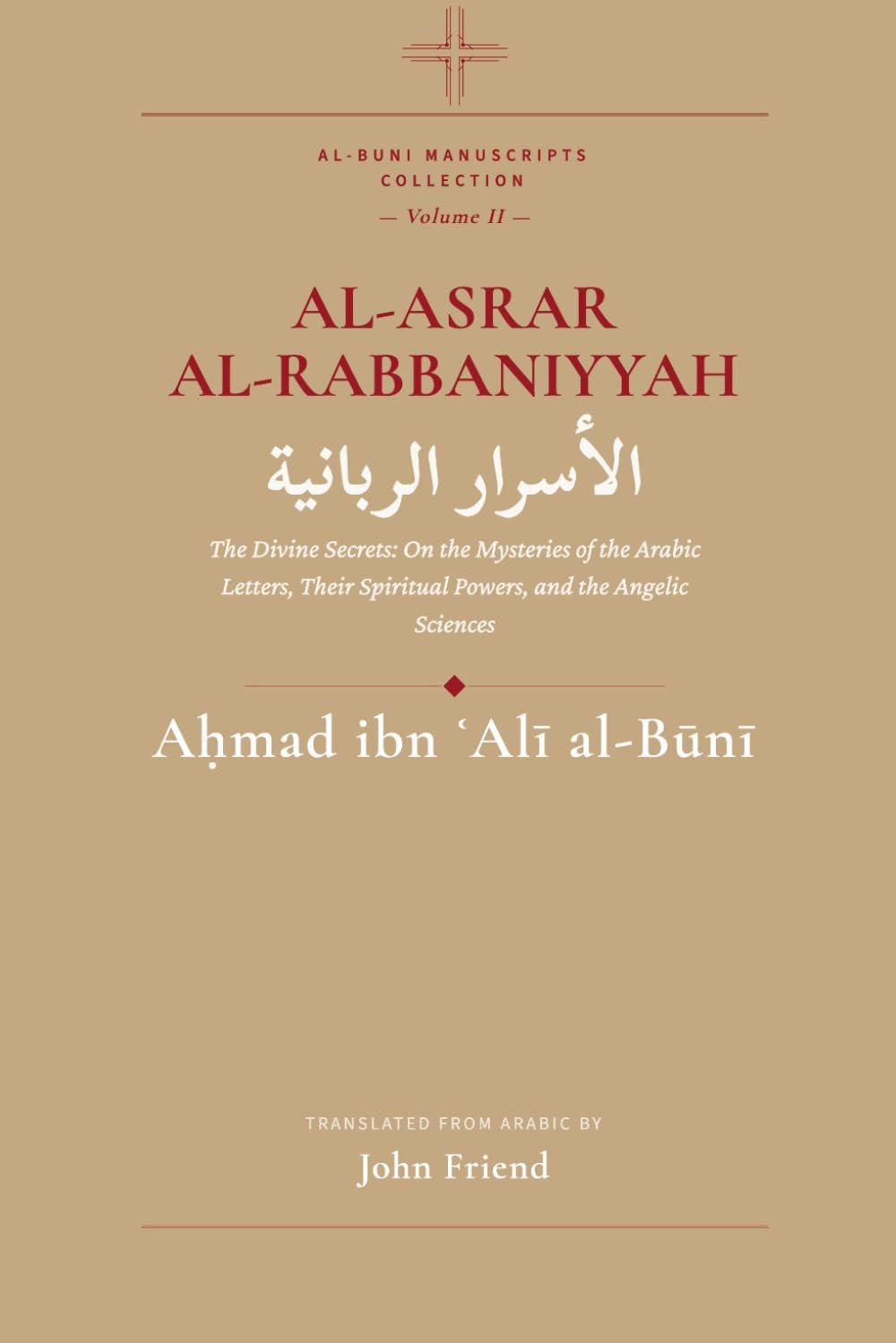
This is what Ahmad ibn ʿAlī al-Buni (d. 622 AH / ~1225 CE) constructed in the al-Asrar al-Rabbaniyyah (The Divine Secrets), published as Volume II of the Al-Buni Manuscripts Collection. It is the most detailed letter-by-letter classification of spiritual forces in the Arabic occult tradition.
The Four-Dimensional Classification
Al-Buni does not assign a single property to each letter. He classifies each letter across four simultaneous dimensions, creating a coordinate system for locating any letter within the cosmic framework.
Numerical Identity: Through the abjad system, each letter carries a fixed numerical value. Alif is 1, Ba’ is 2, Jim is 3, and so on through Ghayn at 1000. These are not arbitrary assignments — the abjad system predates Islam, with roots in the Aramaic and Phoenician writing traditions. Al-Buni treats these numerical values as inherent to the letters, not as conventions.
Elemental Nature: The 28 Arabic letters are divided among the four classical elements: fire, air, water, and earth. Seven letters belong to each element. This division determines which letters harmonize with each other and which conflict — fire letters combined with fire letters amplify heat and action; fire combined with water creates tension and opposition. The elemental classification governs the “chemistry” of letter combinations.
Celestial Correspondence: Each letter corresponds to a celestial body — the seven classical planets (Sun, Moon, Mars, Mercury, Jupiter, Venus, Saturn) and the fixed stars. This correspondence determines the optimal timing for operations involving specific letters: a letter governed by Jupiter should be inscribed during a Jovian planetary hour, on Jupiter’s day (Thursday), with Jovian suffumigations.
Spiritual Guardian: Each letter has a ruhaniyya — a spiritual entity or angel that governs it. The relationship between a letter and its spiritual guardian is not merely symbolic; the tradition holds that invoking a letter’s guardian activates its spiritual potential. The method for deriving angelic names from letter permutations is one of the most technically complex aspects of al-Buni’s system.
How the Letters Interact
The power of al-Buni’s system lies not in the individual letters but in their combinations. Just as chemical elements combine to form compounds with properties that differ from their constituents, Arabic letters combine to form divine names, invocations, and talismanic formulas with operative properties that emerge from the interaction of their component letters.
The rules governing these interactions are precise. Elemental harmony and conflict determine which letter combinations are effective for which purposes. A talisman for cooling anger, for instance, would be constructed from water letters, not fire letters. A talisman for decisive action would favor fire and air. A protective charm might combine earth letters (stability) with water letters (cooling, calming).
The numerical dimension adds another layer. The abjad values of letters in a divine name sum to a total that itself carries significance. When that total matches the numerical value of a specific magical square, the name can be “seated” within the square, creating a compound talisman that combines the operative power of both the name and the mathematical structure.
This is why the Shams al-Ma’arif devotes so much space to magic square construction: the squares are the frameworks within which letter combinations achieve their maximum operative effect. And it is why the al-Asrar al-Rabbaniyyah’s letter-by-letter treatment is essential: without understanding the individual properties of each letter, the practitioner cannot predict or control what happens when letters are combined.
The Basmala as a Case Study
The chapter titled “The Spiritual Mysteries and Wondrous Benefits of the Basmala” provides the most accessible illustration of how al-Buni’s system works in practice.
The Basmala — Bismillah al-Rahman al-Rahim — is the phrase that opens nearly every chapter of the Quran. It contains 19 Arabic letters. In al-Buni’s framework, each of those 19 letters brings its own elemental nature, celestial correspondence, numerical value, and spiritual guardian into the compound. The Basmala’s spiritual effect is the product of all 19 letters interacting simultaneously.
Al-Buni analyzes these interactions. The elemental balance of the Basmala’s 19 letters produces a specific elemental “profile” — a particular mixture of fire, air, water, and earth that determines its operative character. The sum of the abjad values of its letters yields a number with its own significance. The celestial correspondences of its letters create a pattern of planetary influences.
The result is a precise description of what the Basmala does, spiritually speaking, and why it is so universally deployed in the Islamic magical tradition. It is not a vague blessing. It is a precisely engineered compound of letter-forces that produces a specific set of effects when spoken, written, or inscribed.
Fire Letters, Water Letters, Air Letters, Earth Letters
The elemental classification of the Arabic letters is one of the most practically important aspects of al-Buni’s system, because it governs the “temperature” and “humidity” of any operation.
Fire letters are associated with heat, action, force, and transformation. Operations that require energy, decisive action, or the breaking of obstacles favor fire letters. But fire is dangerous when uncontrolled — excessive fire in a talismanic formula can produce effects that are too aggressive, too volatile, too destructive.
Water letters are associated with cooling, calming, healing, and purification. Protective operations, healing talismans, and formulas for peace and reconciliation draw on water letters. Water without fire, however, lacks the energy to manifest change.
Air letters are associated with communication, movement, intellect, and social influence. Operations involving persuasion, learning, travel, or the transmission of messages favor air letters.
Earth letters are associated with stability, grounding, material prosperity, and physical health. Operations aimed at securing property, establishing foundations, or promoting physical well-being draw on earth letters.
A skilled practitioner, in this tradition, composes talismanic formulas the way a pharmacist compounds a medicine: selecting specific letters in specific proportions to achieve a specific effect, balancing the elements to avoid harmful excess, and timing the composition to the optimal celestial moment. The broader system within which these letter-formulas operate is described in the foundational guide to the Shams al-Ma'arif.
The 28 Letters and the 28 Lunar Mansions
The Arabic alphabet has 28 letters. The moon passes through 28 mansions (manazil al-qamar) in its monthly cycle. This is not, in al-Buni’s framework, a coincidence.
The correspondence between letters and lunar mansions creates a calendar of operative timing. Each night of the lunar month is governed by a specific mansion, which is in turn governed by a specific letter. Operations involving that letter are most effective during its mansion’s governance. This creates a 28-day cycle of operative opportunities, each night favoring a different set of letter-based operations.
The Shams al-Ma’arif’s Part III (detailed in the Volume I overview) develops this correspondence in full, providing talismanic designs and invocations for each of the 28 mansions. The al-Asrar al-Rabbaniyyah provides the letter-level foundation that makes those mansion-based operations intelligible: to understand why a specific talisman is inscribed on a specific night, you must understand the letter that governs that night’s mansion.
Why This System Endured for Eight Centuries
Letter mysticism in one form or another appears across cultures — in Hebrew Kabbalah, in Greek isopsephy, in Sanskrit mantra science. What distinguishes al-Buni’s system is its systematization. He did not merely assert that letters have spiritual properties; he constructed a complete classificatory framework — numerical, elemental, celestial, angelic — that allows practitioners to derive operative conclusions from first principles.
This systematization is what made the tradition transmissible. A practitioner trained in al-Buni’s framework can evaluate a new divine name, a new Quranic verse, or a new talismanic formula by analyzing its component letters according to the four-dimensional classification. The system is generative: it does not merely catalog a fixed set of operations but provides the principles for creating new ones.
It is also what makes the tradition legible across linguistic and cultural boundaries. The same framework has been applied by practitioners in Morocco, Nigeria, Indonesia, and India — communities separated by thousands of miles but united by a shared understanding of how the Arabic letters function as operative forces. For the theological question of where this practice falls on the spectrum from prayer to magic, see the difference between spiritual science and sorcery in the Arabic tradition.
Reading the Classification
The al-Asrar al-Rabbaniyyah is available in paperback as Volume II of the Al-Buni Manuscripts Collection. The translator’s note confirms that Arabic terms follow IJMES romanization with full diacritical marks, supporting accurate pronunciation and precise identification of terms for readers without Arabic.
Readers approaching this text will benefit from familiarity with the abjad system and the basic framework of the four elements. For those new to the tradition, the companion article on the letter spirits provides essential context. For the broader system into which the letters feed, the complete Shams al-Ma’arif shows how letter science integrates with magic squares, lunar mansions, and divine name operations.