In the Western alphabet, a letter is a sound. It represents a phoneme, a unit of pronunciation, and its meaning is entirely functional. The letter A does not possess a personality. B does not carry a spiritual charge. The alphabet is a tool — nothing more.
In the Arabic occult tradition attributed to Ahmad ibn ʿAlī al-Buni (d. 622 AH / ~1225 CE), the alphabet is something else entirely. Each letter of the Arabic script is a living entity: it has a spirit (ruhaniyya), a celestial correspondence, an elemental nature, a numerical identity, and an operative power. The letter Alif is not merely the first letter of the alphabet. It is the vertical stroke of divine unity, the number one, the element fire, the celestial principle of primacy. To know Alif is to know something about the structure of existence. And to use Alif correctly — in talismanic inscription, in divine name invocation, in wafq construction — is to work with the force it represents.
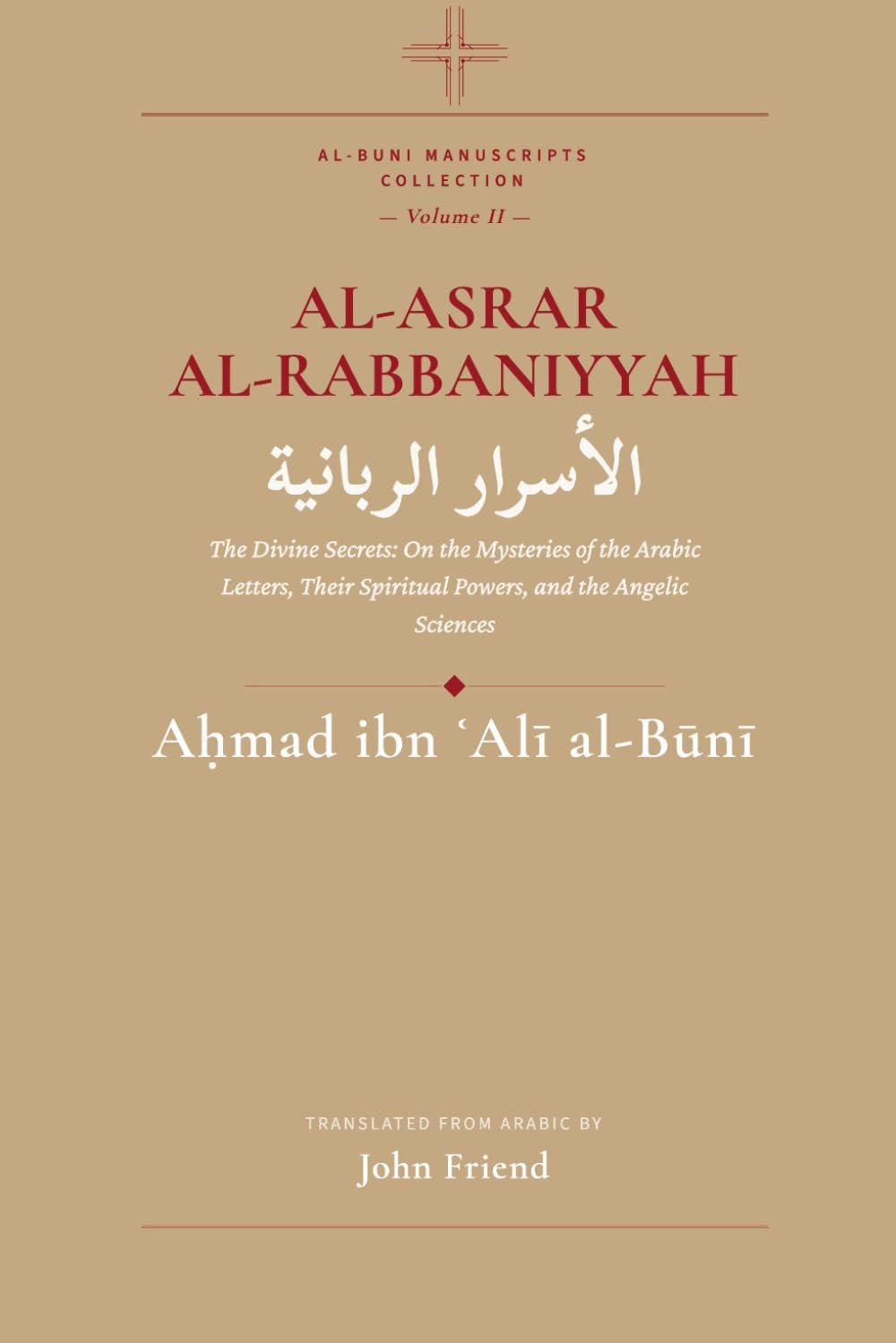
This is ’ilm al-huruf — the science of letters — and the text that presents it in its most concentrated form is the al-Asrar al-Rabbaniyyah, The Divine Secrets, published as Volume II of the Al-Buni Manuscripts Collection.
A Book That Goes Letter by Letter
What makes the al-Asrar al-Rabbaniyyah unique within the Buni corpus is its structure. The Shams al-Ma’arif — al-Buni’s most famous work, explored in detail here — presents the science of letters as part of a vast system that includes magic squares, lunar mansions, planetary correspondences, and divine name operations. The letter science in the Shams is foundational but spread across its chapters, interwoven with other material.
The al-Asrar al-Rabbaniyyah does something different. It takes the Arabic alphabet and dedicates individual chapters to individual letters. The table of contents reads like a roll call of the Arabic script: The Letter Alif. The Letter Ba’. The Letter Mim. The Letter Ha’. The Letter Nun. The Letter Qaf. The Letter Jim. The Letter Dal. The Letter Ta’. The Letter Sad. The Letter Tha’.
Each chapter treats its letter as a complete spiritual subject. Not as a phoneme, not as a grapheme, but as an entity with properties, powers, and applications. The text goes deep where the Shams goes wide.
What the Letter Chapters Contain
The tradition of letter mysticism in Islam draws on multiple sources: the Quranic use of isolated letters (al-huruf al-muqatta’a) at the beginning of certain suras, the Neoplatonic emanation theories that entered Arabic philosophy through the translation movement, and the abjad numerological system that assigns numerical values to Arabic letters. Al-Buni synthesized these into a unified framework in which each letter is simultaneously a sound, a number, an element, a planet, and a spiritual force.
In the al-Asrar al-Rabbaniyyah, this framework is applied letter by letter. Each chapter addresses the specific spiritual identity of its letter — the tradition holds that each letter has a ruhaniyya, a spiritual entity or angel that governs it. The chapter describes the letter’s celestial affinities, its role in the construction of divine names, and its operative applications. Some letters are described as having healing properties when inscribed in specific configurations. Others are associated with protection, attraction, or the binding of harmful forces.
The precision is striking. This is not vague mysticism. Each letter’s chapter provides specific information about what the letter does, how it relates to other letters, and how a practitioner might deploy it. The system is internally consistent: the letters interact according to rules — elemental harmonies and conflicts, numerical relationships, celestial sympathies — that govern which combinations produce which effects.
The Spiritual Mysteries of the Basmala
Beyond the individual letter chapters, the al-Asrar al-Rabbaniyyah contains a treatment of the Basmala — the phrase Bismillah al-Rahman al-Rahim (“In the name of God, the Compassionate, the Merciful”) — that opens nearly every sura of the Quran. The chapter is titled “The Spiritual Mysteries and Wondrous Benefits of the Basmala,” and it treats the phrase not merely as a devotional formula but as a structure of operative power.
The Basmala contains 19 letters in Arabic. In al-Buni’s framework, each of those 19 letters carries its own spiritual identity, and the specific sequence in which they appear in the Basmala creates a compound effect that exceeds the sum of the individual letters. The chapter explores the spiritual properties of the Basmala as a whole, the relationships between its constituent letters, and the operative applications that flow from its correct understanding.
For practitioners in the ’ilm al-huruf tradition, the Basmala is one of the most frequently deployed formulas — inscribed on talismans, recited in invocations, incorporated into magic squares. The al-Asrar al-Rabbaniyyah’s treatment of its internal mechanics provides the theoretical basis for these ubiquitous applications.
The Alphabet as a Map of Creation
The underlying claim of al-Buni’s letter science is audacious: the Arabic alphabet is not a human invention but a divine disclosure. Its 28 letters correspond to the 28 stages of the lunar cycle, a correspondence explored in depth in the guide to the 28 lunar mansions of Arabic magic. The letters are the building blocks from which God created the world — a concept with roots in both Quranic theology (the creative command Kun, “Be!”, is composed of two letters) and Neoplatonic emanation theory (in which reality proceeds from the One through successive levels of manifestation).
In this framework, to study the letters is to study creation itself. The al-Asrar al-Rabbaniyyah presents each letter as a window into the architecture of existence. Alif, the first letter, represents divine unity and the primordial act of creation. Ba’, the second letter, represents the first differentiation — the emergence of duality from unity. Jim, Dal, Ha’ — each letter marks a further stage in the unfolding of the cosmos from its singular source.
This is why practitioners in the tradition treat the letters with such gravity. They are not working with arbitrary symbols. They believe they are working with the same forces that brought the world into being — and that the correct manipulation of these forces, through letter combinations, divine name recitation, and talismanic inscription, can produce real effects in the world.
How This Relates to the Shams al-Ma’arif
The al-Asrar al-Rabbaniyyah and the Shams al-Ma’arif al-Kubra are complementary texts within the corpus attributed to al-Buni. The Shams — available as Volume I of the Al-Buni Manuscripts Collection — provides the broad systematic framework: letter science, divine names, magic squares, lunar mansions, planetary correspondences, invocations. The al-Asrar al-Rabbaniyyah drills into the letter science specifically, providing the focused, letter-by-letter depth that the Shams’s wider scope cannot accommodate. For the related art of combining letters into operative grids, the guide to Arabic magic squares and what they actually are provides indispensable context.
A reader who studies both texts gains access to the letter science at two complementary scales. The Shams shows how the letters function as components of a larger system — how they populate magic squares, how they construct divine names, how they govern talismanic timing. The al-Asrar al-Rabbaniyyah shows what each letter is in itself — its spiritual identity, its specific powers, its individual applications.
The tradition understands these as inseparable. To build a magic square without understanding the individual letters that populate it is to construct a machine without understanding its parts. To study individual letters without understanding the systems they compose is to examine components without grasping the whole. The two texts together constitute al-Buni’s complete letter science.
Why This Text Matters for Western Readers
The Western esoteric tradition has its own history of letter mysticism — most notably in the Kabbalistic tradition, where the 22 Hebrew letters are treated as the building blocks of creation and assigned paths on the Tree of Life. Readers familiar with that tradition will recognize the structural parallels in al-Buni’s system: letters as cosmic forces, letters as divine instruments, letters as keys to operative power.
But the parallels should not obscure the differences. Arabic ’ilm al-huruf developed within Islamic Neoplatonism and Sufi cosmology, drawing on different sources and arriving at different conclusions than Hebrew letter mysticism. The Arabic alphabet has 28 letters (corresponding to the 28 lunar mansions), not 22. The abjad numerological system assigns different values than the Hebrew gematria system. The cosmological framework is Islamo-Hellenistic, integrating Ptolemaic astronomy, Aristotelian elements, and Quranic theology into a synthesis that has no exact parallel in Western esotericism.
For Western readers, the al-Asrar al-Rabbaniyyah opens a door into a tradition of letter mysticism that is both recognizably related to and profoundly different from the Kabbalistic tradition. It demonstrates that the intuition that letters are more than sounds — that the alphabet encodes the structure of reality — is not culturally specific but appears across multiple civilizations, each developing it according to its own theological and philosophical commitments.
Reading the Divine Secrets
The al-Asrar al-Rabbaniyyah is 135 pages — considerably shorter than the Shams al-Ma’arif’s 818 pages. But its concentrated focus on individual letters makes it, in some ways, the more intense text. Each chapter is a deep dive into a single letter’s spiritual identity and operative potential, and the cumulative effect is of encountering the Arabic alphabet as a living system of cosmic forces.
The translation follows IJMES romanization with full diacritical marks for Arabic terms. The text is available in paperback as Volume II of the Al-Buni Manuscripts Collection.
For readers who have encountered the fear and mystique surrounding al-Buni’s works, the al-Asrar al-Rabbaniyyah offers a revealing complement to the Shams al-Ma’arif. Where the Shams is often feared for its operational completeness, the Divine Secrets is feared for a different reason: it claims to reveal the spiritual identities behind the letters themselves — the entities that, in this tradition, practitioners invoke whenever they write, recite, or inscribe the Arabic script.