Ask anyone in Cairo, Casablanca, or Karachi about the Shams al-Ma’arif and watch what happens. The conversation drops. Eyes shift. Someone will tell you not to say the name aloud. Someone else will insist that merely owning a copy invites jinn into your home — that the book chooses its reader, not the other way around. A third person, if they trust you enough, will lean in and whisper that they knew someone who read it, and that person was never the same afterward. These are not fringe beliefs held by a superstitious few. Across the Arabic-speaking world and far beyond it, the Shams al-Ma’arif al-Kubra carries a reputation that borders on the supernatural: the book that drives people mad.
But here is the question nobody seems to ask: what does the text actually say? What fills those 818 pages, those 40 chapters, those four systematic parts? And does what it contains justify the terror that surrounds it?
The answer is more interesting than the legend.
The Reputation: Fatwas, Burnings, and Whispered Warnings
The fear surrounding the Shams al-Ma’arif is not modern. For centuries, religious authorities across the Islamic world have viewed the text with alarm. Fatwas have been issued against it. Copies have been seized and burned. In some communities, booksellers refuse to stock it openly — it circulates instead through back channels, passed hand to hand with the gravity of contraband.
The objections have always been theological. Islamic jurisprudence distinguishes between permissible spiritual practices — Quranic recitation, supplication (du’a), the invocation of divine names — and sihr, operative magic that crosses into forbidden territory. The Shams al-Ma’arif, critics argue, does not merely describe the mechanics of spiritual forces. It provides instructions for deploying them. It teaches the reader how to construct talismans, how to invoke planetary spirits, how to bind and compel spiritual beings. That operational precision is what makes it dangerous in the eyes of religious authority: it is not a book about magic. It is a manual of magic. For readers new to how these talismans and invocations actually work in practice, the beginner's guide to Arabic talisman-making provides the foundational context.
But the popular fear goes further than jurisprudence. In the folk imagination of the Arabic-speaking world, the Shams al-Ma’arif is not merely forbidden — it is alive. People believe that the text exerts a pull on certain readers, drawing them in before they understand what they are engaging with. They believe that reading specific passages without proper spiritual preparation — without wudu (ritual purification), without the guidance of a qualified shaykh, without protective invocations — can open doorways that cannot easily be closed. They believe that the book attracts the attention of jinn, and that jinn do not appreciate uninvited guests in their territory.
These beliefs are remarkably consistent across geographies. You will hear them in Morocco and Malaysia, in Nigeria and Pakistan, in communities that otherwise share very little cultural common ground. The Shams al-Ma’arif occupies a unique position in the Islamic world: a text that is simultaneously revered and feared, sought and avoided, condemned by scholars and treasured by practitioners.
What the Text Actually Contains: A 40-Chapter System
Strip away the legend and examine the manuscript. The Shams al-Ma’arif al-Kubra — attributed to Ahmad ibn ’Ali al-Buni (d. 622 AH / 1225 CE) — is organized into four parts comprising 40 chapters across 818 pages. It is not a haphazard collection of spells. It is a systematic treatise — arguably the most systematic ever produced in the Arabic occult tradition.
Part I: Foundations
The text opens with the infrastructure. Part I lays out the foundational sciences upon which everything else depends: the nature of the Arabic letters and their correspondence to the four elements, the celestial spheres, the signs of the zodiac, and the method of deriving angelic names from letter permutations. This is not mystical hand-waving. It is a precise system in which every Arabic letter carries a numerical value through the abjad system, an elemental correspondence (fire, air, water, earth), a planetary affinity, and a spiritual identity. To know the letter alif is to know its number (1), its element (fire), its celestial sphere, and its guardian angel. Al-Buni presents this as a science — ’ilm al-huruf, the science of letters — with the rigor of someone who believes he is describing the operating system of creation.
Part II: The Divine Names and the Science of Squares
Part II is where the text earns its most enduring reputation. Here al-Buni addresses the ninety-nine divine names of God and their operative deployment, then presents the wafq — magic square — tradition in extraordinary detail. The construction methods move from the famous 3×3 Buduh square through increasingly complex grids up to 9×9 configurations. Each square is tied to a specific planet, a specific set of divine names, and a specific category of operation. The Buduh square alone — a 3×3 grid that sums to 15 in every direction — has been reproduced on talismans, amulets, and architectural inscriptions across the Islamic world for eight centuries. The deeper history of Arabic magic squares shows just how far this tradition extends beyond al-Buni himself.
What makes Part II especially potent, from the perspective of those who fear the text, is its precision. Al-Buni does not merely show finished squares. He explains the mathematical and spiritual principles behind their construction, how to populate them with letters instead of numbers, how to charge them with divine names, and when — down to the planetary hour — to inscribe them for maximum effect.
Part III: Lunar Mansions and Talismans
Part III maps the 28 lunar mansions (manazil al-qamar) and their corresponding talismanic operations. Each mansion governs a specific category of worldly affairs — love, commerce, protection, binding, separation — and al-Buni provides the talismanic designs, suffumigations, and invocations appropriate to each. This section connects the letter science and divine names of the earlier parts to the astronomical and astrological framework that governs timing. The practitioner must not only know what to write but when to write it, and Part III provides the celestial calendar. The 28 lunar mansions of Arabic magic are among the most precisely mapped astronomical systems in the entire grimoire tradition.
Part IV: Invocations, Prayers, and Practice
The final part turns fully operational. Part IV contains the invocations (da’awat), prayers, and divine name recitations that constitute the active practice of al-Buni’s system. Here the theoretical framework of Parts I through III meets lived application: specific formulas for specific purposes, with detailed instructions on preparation, timing, materials, and spiritual prerequisites.
Where the Fear Actually Comes From
Understanding the text’s structure makes the source of the fear legible. The Shams al-Ma’arif is terrifying not because it is chaotic or incomprehensible, but because it is the opposite: it is complete. It provides a total system — from cosmological theory to operative practice — with nothing omitted. Most occult texts gesture toward secrets they never fully reveal. The Shams al-Ma’arif provides the formulas, the timing, the materials, and the exact sequences of divine names. It holds nothing back.
For practitioners who believe these operations genuinely engage spiritual forces, that completeness is both precious and dangerous. A partial manual cannot do much harm because the reader lacks the keys to make it function. But a complete manual — one that provides every step from theory to execution — puts real power in the hands of anyone who can read Arabic. And power without preparation, in this tradition, is the fastest route to catastrophe.
The folk belief that the book causes madness may be understood, from this angle, as a protective narrative. It is the tradition’s way of saying: this is not a book to pick up casually. The stories of readers driven mad, of jinn attracted to incautious scholars, of copies that bring misfortune to their owners — these function as guardrails, warning the unprepared away from material that the tradition considers genuinely operative.
The Scholarly Reality
Modern scholarship treats the Shams al-Ma’arif as one of the most significant texts in the history of Arabic intellectual culture. Researchers like Liana Saif and Jean-Charles Coulon have demonstrated that al-Buni’s work sits at the intersection of Neoplatonic philosophy, Sufi mysticism, Hellenistic astrological science, and indigenous Arabic letter mysticism. The text is a synthesis — drawing together streams of knowledge that had circulated separately for centuries and weaving them into a unified operative framework.
The attribution to al-Buni (d. 1225 CE) is itself complex. Modern scholars recognize that the corpus Bunianum — the body of texts attributed to al-Buni — almost certainly includes material added by later hands. The Shams al-Ma’arif exists in manuscript versions that range from relatively modest texts to enormous multi-volume compilations, suggesting a living tradition of accretion over centuries. This is not unusual in medieval Arabic manuscript culture, where attribution to a prestigious name served as a guarantor of a text’s authority and lineage.
What is unusual is the text’s endurance. Eight centuries after its composition, the Shams al-Ma’arif remains the single most referenced text in the Arabic occult tradition — consulted by practitioners, feared by the pious, studied by scholars, and rumored about by everyone else.
Why an Unabridged Translation Matters
Every previous English encounter with the Shams al-Ma’arif has been partial. Selected chapters, summarized passages, curated extracts. The Hamade and Inloes translation — the most well-known English version — is explicitly subtitled “in Selected Translation.” What was selected and what was left out shaped an English-language understanding of the text that is, at best, incomplete.
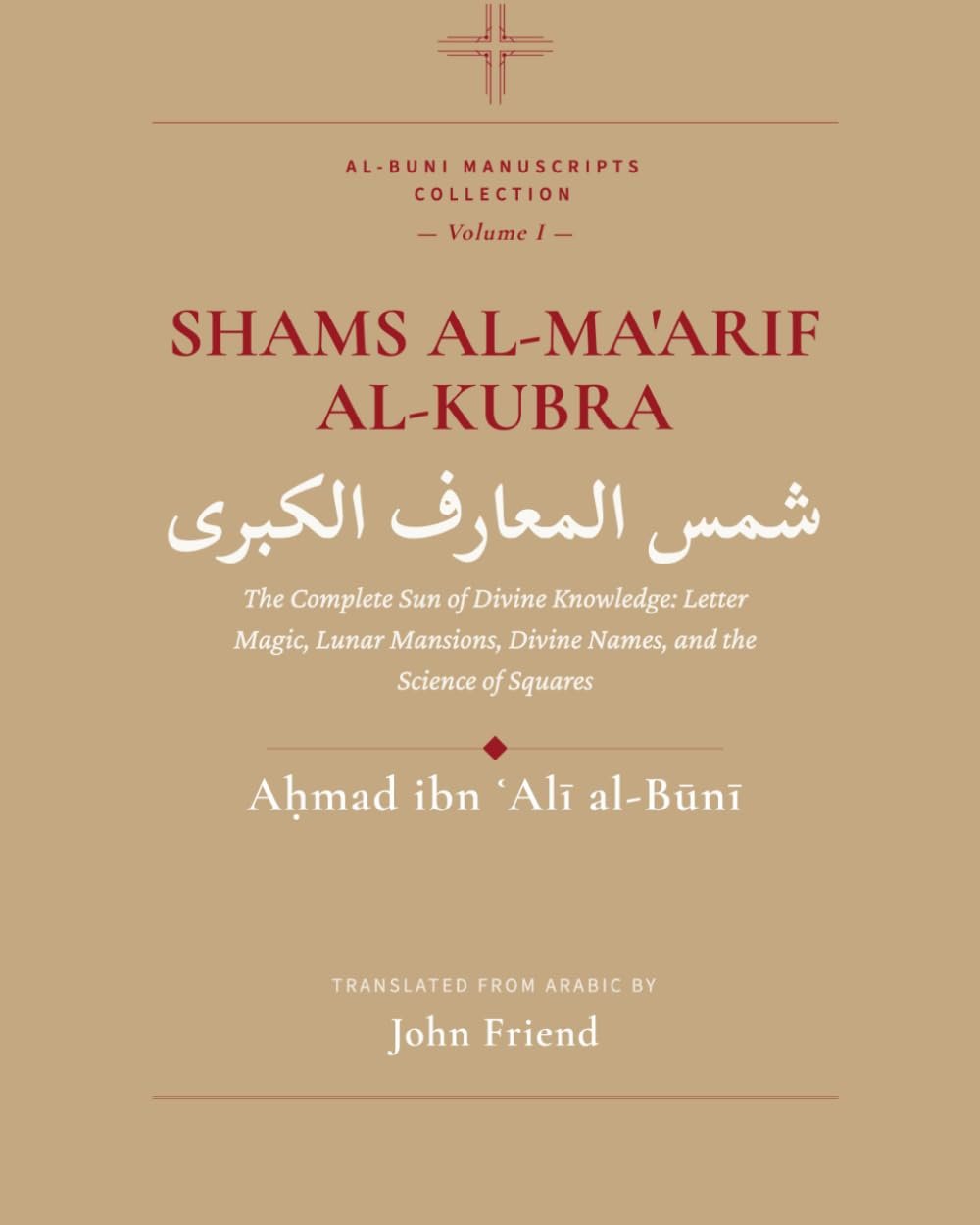
The Al-Buni Manuscripts Collection, Volume I presents the first unabridged English edition — a complete translation of the 1927 printed Arabic edition that has served as the standard reference across the Arabic-speaking world for the past century. All 40 chapters. All 4 parts. 818 pages. Nothing removed, nothing summarized, nothing sanitized for a Western audience. The text as it stands in the Arabic tradition, now rendered fully into English for the first time.
This matters because the partial translations created a distorted picture. The sections most commonly excerpted were the most dramatic — the conjurations, the talismanic designs, the invocations. What was left out was the systematic infrastructure: the letter science, the mathematical principles of square construction, the astronomical frameworks, the theological grounding. Without that infrastructure, the Shams al-Ma’arif looks like a collection of spells. With it, the text reveals itself as something far more ambitious: a comprehensive science of the relationship between language, number, cosmos, and the divine.
What Readers Should Know
The Shams al-Ma’arif is a difficult text. Not because it is badly written — al-Buni is a clear and systematic author — but because the knowledge it assumes is vast. A reader approaching this text benefits from familiarity with the abjad numeral system, the Arabic astrological tradition, the 99 divine names, the Quranic verses that al-Buni treats as operative formulas, and the broader cosmological framework of medieval Islamic science. For readers coming from the Western esoteric tradition, the foundational guide to the Shams al-Ma’arif provides essential context.
The text is in paperback format. The translation follows the IJMES romanization system with full diacritical marks for Arabic terms. The Arabic text of key passages is included for readers who wish to work with the original language.
As for whether it will drive you mad — that depends entirely on what you mean by madness. If encountering a complete, operational system of cosmological science eight centuries old, one that treats the Arabic alphabet as a living map of creation and the divine names as functional keys to the mechanics of reality, constitutes a form of madness — then yes, perhaps it will. But that is the madness of discovery, not of destruction. And the Shams al-Ma’arif has been waiting eight hundred years for readers willing to risk it.
For more on the history of suppression and survival, see The Magic Book That Was Banned and Burned.