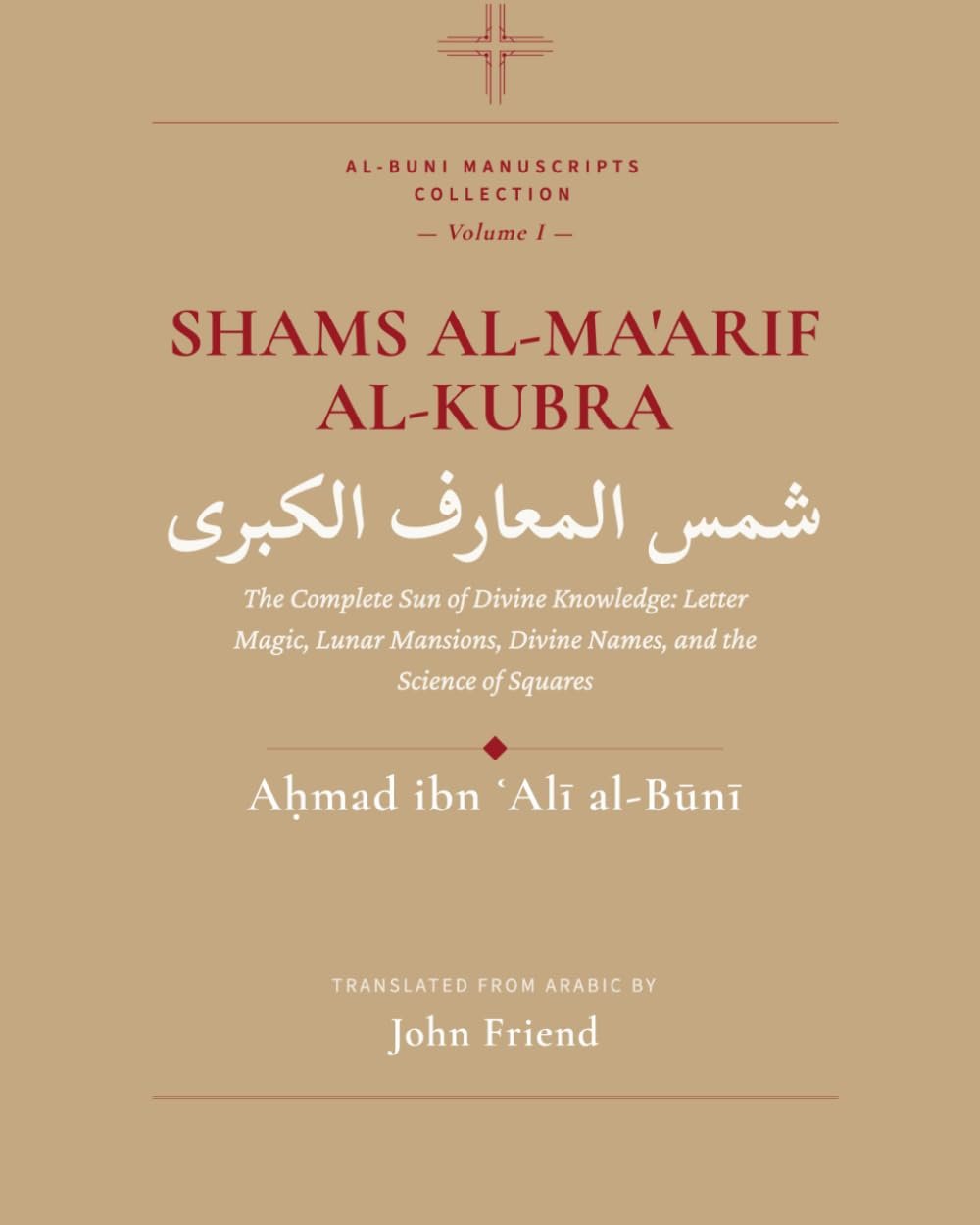
This page sets out what the Shams al-Ma’arif al-Kubra (شمس المعارف الكبرى) contains, chapter by chapter, and how its first unabridged English translation was made. That translation was published in 2026 as Volume I of the Al-Buni Manuscripts Collection: all 40 chapters in four parts, 818 pages, translated from the 1927 printed Arabic edition. The book is attributed to Ahmad ibn ‘Ali al-Buni (d. 622 AH / 1225 CE). Its full title, given in the preface, is Shams al-Ma’arif wa-Lata’if al-‘Awarif; the heading of Part One reads The Greater Sun of Knowledge and the Subtleties of Gnosis. For what the book is, what its title means and who wrote it, see what is the Shams al-Ma’arif.
For decades, English-speaking readers who wanted to read the Shams al-Ma’arif faced the same problem: every available version was incomplete. Selected chapters. Summarized passages. Editorial decisions about what to include and what to leave on the cutting-room floor. The book was available in English only in fragments. Readers encountered the legend of the book far more often than they encountered the book itself.
That changes now. The Al-Buni Manuscripts Collection, Volume I presents the first unabridged English edition of the Shams al-Ma’arif al-Kubra: a complete translation of the 1927 printed Arabic edition that has served as the standard reference across the Arabic-speaking world for nearly a century. All 40 chapters. All 4 parts. 818 pages. Nothing removed, nothing summarized, nothing editorially curated for presumed Western sensibilities.
This article explains what that means — what was missing before, why it matters, and what readers will find when they open the complete text for the first time.
Shams al-Ma’arif English translation availability: the full English translation is available now, as a Kindle edition that is free to read with Kindle Unlimited and as an 818-page paperback, both on Amazon. It is not published as a PDF. Formats and a free sample are on the Shams al-Ma’arif al-Kubra book page.
What Previous Translations Left Out
The most commonly referenced English version of the Shams al-Ma’arif has been the Hamade and Inloes translation, which is explicitly subtitled “in Selected Translation.” That subtitle is honest, and it matters enormously. A selected translation is, by definition, an editorial act: someone decided which chapters to include, which passages to translate in full, which to summarize, and which to omit entirely.
The selections were not random. Across the various partial English versions that have circulated, the pattern is consistent: the most dramatic material was prioritized. Conjurations, talismanic designs, invocations — the sections that read most like what Western audiences expect from a “grimoire” — tended to survive the editorial process. What was cut was the infrastructure.
The Missing Foundations
Part I of the Shams al-Ma’arif lays out the complete theoretical framework of ’ilm al-huruf — the science of letters. This is not a brief introduction. It is a systematic presentation of how each Arabic letter corresponds to an element, a celestial sphere, a zodiacal sign, and an angelic identity. Al-Buni does not merely assert these correspondences; he derives them, showing how the structure of the Arabic alphabet maps onto the structure of the cosmos. Without this foundation, the operations in later parts are incomprehensible — or worse, they appear to be arbitrary recipes rather than applications of a coherent system.
Previous translations either summarized Part I or skipped it entirely. Readers were given the spells without the science, the talismans without the cosmology, the divine names without the letter-mathematics that explain how those names function as operative forces.
The Missing Mathematics
Part II contains what may be the most sophisticated treatment of magic square (wafq) construction in any language. Al-Buni does not merely present finished squares — he teaches the reader how to build them. The construction methods for odd-order squares (3×3, 5×5, 7×7), even-order squares (4×4, 6×6, 8×8), and even-odd hybrid forms are presented with mathematical precision. Then he shows how to populate these squares with divine names instead of numbers, how to derive operative outcomes from the completed grids, and how to time their inscription to specific planetary hours.
This material — the Buduh square and its relatives, the relationship between the 99 divine names and specific grid configurations, the extraction of angelic names from completed squares — is the mechanical heart of Ahmad ibn ʿAli al-Buni’s (d. 622 AH / ~1225 CE) system. It is also the material most consistently absent from previous English translations, presumably because it requires mathematical and linguistic competence that is difficult to render in translation.
The Lunar Mansions in Part One
The lunar material sits early in the book, in Part One. The third chapter gives the judgments of the 28 lunar mansions: their letters, the works each suits or forbids, and their fumigations.
Shams al-Ma’arif in English: The Editions Compared
Each English edition below states its scope in its own title or subtitle.
| Edition | Scope |
|---|---|
| Shams al-Ma’arif al-Kubra: The Complete Sun of Divine Knowledge (Al-Buni Manuscripts Collection, Volume I; John Friend Publishing, 2026) | Complete: all 4 parts and all 40 chapters, 818 pages, translated from the 1927 printed Arabic edition |
| The Sun of Knowledge (Shams al-Ma’arif): An Arabic Grimoire in Selected Translation (Revelore Press) | A selected translation, as its subtitle states |
| Shams Al-Ma’arif The Sun of Gnosis: Part IV | Part IV, as its title states |
What the Complete Text Reveals
Reading the complete Shams al-Ma’arif is a fundamentally different experience from reading the excerpted versions. The partial translations created the impression of a spellbook — a collection of discrete operations that a reader could pick through like a recipe book. The complete text reveals something far more ambitious: a unified science of the relationship between language, number, cosmos, and the divine.
Al-Buni’s argument, sustained across all 40 chapters, is that the Arabic letters are not arbitrary symbols. They are the building blocks of creation, and their numerical values, elemental correspondences, and celestial affinities are not assigned but inherent. To understand the letters is to understand the architecture of reality. And to manipulate the letters — through magic squares, divine name recitation, talismanic inscription — is to work with the same forces that sustain the cosmos.
This argument cannot be grasped from excerpts. It requires the full arc: the letters, lunar mansions and hours of Part One; the Beautiful Names and their magic squares in Part Two; the ten lines of the Beautiful Names in Part Three; and the uses of the letters, the Most Beautiful Names and the invocations of Part Four. Each part depends on the ones before it. Remove any section and the system collapses into a collection of unconnected recipes.
The 1927 Arabic Edition
The base text for this translation is the 1927 printed Arabic edition of the Shams al-Ma’arif al-Kubra. This requires a word of explanation, because the manuscript tradition of the Shams al-Ma’arif is extraordinarily complex.
The text exists in dozens of manuscript copies across the libraries of Cairo, Istanbul, Tunis, Fez, and beyond. These manuscripts vary enormously in length, content, and the specific versions of operations they present. There is no single “original” text of the Shams al-Ma’arif; what exists is a tradition that grew and shifted across centuries of copying, annotation, and accretion.
The printed editions that appeared in Egypt in the nineteenth and early twentieth centuries — sometimes called the “Bulaq” tradition after the famous Cairo press — represent a specific textual recension that became the standard reference. The 1927 edition is the culmination of that tradition: the version that has been read, studied, and practiced across the Arabic-speaking world for the past century. It is the text that practitioners mean when they say “the Shams al-Ma’arif.”
This is not a critical edition in the academic sense — it does not collate manuscript variants or establish a stemma. It is the received text of the living tradition, and that is what has been translated.
Readers sometimes ask for a Shams al-Ma’arif original copy in English. As the manuscript history above shows, there is no single original copy to translate; this English translation is made from the 1927 printed Arabic edition, which the translator’s note calls “the most widely circulated recension of this text,” and the Arabic source text itself is in the public domain. Readers who want the Shams al-Ma’arif al-Kubra Arabic text beside the English will find the original Arabic script given for barbarous names and key formulas, and the talisman pages and magic squares reproduced as images from the source.
Translation Principles
The translation follows IJMES (International Journal of Middle East Studies) romanization with full diacritical marks for all Arabic terms. This is a scholarly standard that allows readers with Arabic knowledge to reconstruct the original terms precisely, while remaining accessible to readers without Arabic.
Key decisions included the treatment of technical vocabulary. Terms like wafq (magic square), ’ilm al-huruf (science of letters), da’wa (invocation), and bakhur (suffumigation) are preserved in transliterated Arabic with English glosses, rather than being flattened into approximate English equivalents. The Arabic alphabet carries operative significance in this text — replacing Arabic terms with English substitutes would strip the translation of its functional dimension.
Where the operative precision of the original Arabic is essential — in divine name formulas, talismanic inscriptions, and invocational sequences — the Arabic script is included alongside the English translation. A reader working with talismanic material needs the original Arabic, not merely a transliteration.
One thing readers sometimes look for is not there: the word “abracadabra” does not appear in this translation of the 1927 text. What does appear are barbarous names (ʿajamī) — “sequences of letters meant to be pronounced as written” — which this edition transliterates exactly, presents alongside the original Arabic script, and never translates.
The 40 Chapters: A Complete Map
For readers approaching the text for the first time, the structure is worth previewing. The 40 chapters move through a deliberate progression:
Part One (Chapters 1–14) opens with the letters and love, then orders works “According to Times and Hours,” gives the judgments of the twenty-eight lunar mansions (Chapter 3) and of the twelve zodiacal signs (Chapter 4), and continues through the Basmalah, seclusion and retreat, the names by which Jesus revived the dead, the four Tawaqif, the openings of the Quran, the Fatiha, penetrations and spiritual lights, the Greatest Name of God, the omitted letters of the Fatiha with their magic squares, and “Answered, Subjugating Supplications.”
Part Two (Chapters 15–20) covers the conditions required for some matters and not for others, the Beautiful Names of God “and Their Useful, Tested Magic Squares,” the letters Kāf Hā Yā ʿAyn Ṣād, the Throne Verse, “Certain Magic Squares and Useful Talismans,” and Surat Yā Sīn. For how these squares work, see Arabic magic squares are not what you think.
Part Three (Chapters 21–37) arranges the Beautiful Names of God in ten lines, with the invocations and operations belonging to each line (Chapters 21–30), then treats the Arabic letters with their planets and servants, the unveiling of the spiritual thrones, the circle of encompassing, the Zayirjah and the ratios of letters, the “Khayzabalian rules,” the lordly effusion and the properties of plants, and the works of Simiya.
Part Four (Chapters 38–40) closes with the uses of the letters and their retreats, an explanation of the Most Beautiful Names of God, and the individual invocations for all nights and times. A collection of four treatises follows the fortieth chapter.
Shams al-Ma’arif Contents Summary: Every Chapter Title in the 1927 Edition
The most exact Shams al-Ma’arif summary is the book’s own table of contents. These are the forty chapter titles of the 1927 edition as they appear in the translation:
- On the Letters, Love, and What Is Arranged Within It of Secrets and Experiments
- On Breaking and Expansion and the Ordering of Works According to Times and Hours
- On the Judgments of the Twenty-Eight Mansions of the Moon and the Celestial Spheres
- On the Judgments of the Twelve Zodiacal Signs and What Belongs to Them of Indications and Connections
- On the Secrets of the Basmalah and What It Possesses of Particular Properties and Hidden Blessings
- On Seclusion and the Etiquette of Retreat That Leads to the Higher Realms
- On the Names by Which Jesus, Peace Be Upon Him, Used to Revive the Dead
- On the Four Tawaqif and What Belongs to Them of Chapters and Circles
- On the Properties of the Openings of the Quran and the Clear Verses
- On the Secrets of the Fatiha, Its Invocations, and Its Famous Properties
- On Penetrations and on Spiritual Lights
- On the Greatest Name of God and What Belongs to It of Hidden Operations
- On the Omitted Letters of the Fatiha and What Belongs to Them of Magic Squares and Invocations
- On Disciplines, Remembrances, and Answered, Subjugating Supplications
- On the Conditions Required for Some Matters and Not for Others
- On the Beautiful Names of God and Their Useful, Tested Magic Squares
- On the Properties of Kāf Hā Yā Ayn Ṣād and Its Lordly, Most Holy Letters
- On the Properties of the Throne Verse and the Hidden Blessings Within It
- On the Properties of Certain Magic Squares and Useful Talismans
- On Surat Yā Sīn and the Answered Invocations Belonging to It
- On the Beautiful Names of God, Their Lines, and the Invocations and Operations Belonging to Each Line
- On the Second Line and What It Contains of the Wahiyyat Names
- On the Third Line and What It Indicates of the Eternal Attributes
- On the Fourth Line and What It Contains of the Secrets of the Lord
- On the Fifth Line and What It Contains of Desirable Properties
- On the Sixth Line and What It Contains of the Secrets of Prescribed Matters
- On the Seventh Line of the Names of God Most High
- On the Eighth Line of the Beautiful Names of God
- On the Ninth Line of the Beautiful Names of God
- On the Tenth Line of the Beautiful Names of God
- On the Arabic Letters and What Belongs to Them of Planets and Servants
- On the Secrets of Unveiling the Spiritual Thrones
- On the Secrets of the Circle of Encompassing
- On the Science of the Zayirjah and the Ratios of Letters
- On the Letter Property According to the Khayzabalian Rules
- On the Lordly Effusion and the Properties of Plants
- On the Works of Simiya and All the Treatises
- On the Uses of the Letters and Their Retreats
- On Explaining the Most Beautiful Names of God
- On the Individual Invocations for All Nights and Times
After the fortieth chapter, the 1927 edition adds “A Collection of Four Treatises” by the sayyid ʿAbd al-Qādir al-Ḥusaynī, translated here as well (see Arabic geomancy below).
Ilm al-Huruf: The Science of Letters in the Shams
Letter science runs through the whole book rather than sitting in one block. Chapter 1 opens with the letters; Chapter 17 treats the opening letters Kāf Hā Yā ʿAyn Ṣād; Chapter 31 gives the planets and servants of the Arabic letters; Chapter 34 turns to the Zayirjah and the ratios of letters, Chapter 35 to the “Khayzabalian rules,” and Chapter 38 to “the uses of the letters and their retreats.”
The Shams also leans on the early Quran commentators. It quotes Ibn ʿAbbās repeatedly on the disjoined letters that open the surahs — on alif-lām-mīm-ṣād, for example, he is reported to have said, “I am God; I know.” The Shams is not a tafsir of Ibn ʿAbbās and no substitute for the manuscripts of his commentary, but it preserves his interpretations of the letters, woven into al-Buni’s system.
Abjad Numerology in the Shams al-Ma’arif
Ahmad al-Buni’s numerology in the Shams al-Ma’arif rests on the abjad system, the numerical value of each Arabic letter. One method for learning “the condition of the sick person and the absent one” tells the reader to “calculate his name and his mother’s name by the greater abjad, add to them what has passed of the Arab lunar month, and add to it the base, twenty,” then cast the total down by thirties. Another uses the “great abjad reckoning” of a ruler’s name to estimate how long he will remain in office. The book even gives the abjad order a sacred history: “As for Abjad, it is Syriac; it was sent down upon Adam, Idris, Noah, Moses, and Jesus.”
Shams al-Ma’arif Magic Squares, Wafq and Talismans
Magic squares (wafq, plural awfaq) are named in the Shams al-Ma’arif’s chapter titles themselves: Chapter 13, on the omitted letters of the Fatiha “and What Belongs to Them of Magic Squares and Invocations”; Chapter 16, on the Beautiful Names of God “and Their Useful, Tested Magic Squares”; and Chapter 19, “On the Properties of Certain Magic Squares and Useful Talismans.” In this edition the talismanic seals and magic squares are reproduced as images from the source, and where the source is illegible the translator notes the gap rather than inventing content. For how al-Buni built the squares, see al-Buni’s magic square construction method.
Shams al-Ma’arif Jinn Summoning and the Angelic Chain of Command
In the Shams al-Ma’arif, jinn summoning sits inside the devotional framework rather than apart from it. In Chapter 14, on disciplines, remembrances and “subjugating supplications,” the invocations call jinn kings by the authority of the beings set over them: “Answer, O Maymūn, by the right of the angel Kashfāʾīl, whose command prevails over you.” Al-Aḥmar is called in the same way, “by the right of the king whose command is dominant over you, Samsamāʾīl.” One recitation promises a visitor who is “one of the believing kings of the jinn who embraced Islam at the hand of the Prophet.” For the seven kings as a system, see how to summon the seven kings of jinn.
Lunar Mansions, Zodiac and Timing
Timing comes early. Chapter 2 orders works “According to Times and Hours,” Chapter 3 gives the judgments of the twenty-eight lunar mansions, and Chapter 4 those of the twelve zodiacal signs. How the Shams al-Ma’arif lunar mansions govern the timing of operations is explored separately.
Arabic Geomancy and the Four Appended Treatises
The 1927 printed edition closes with “A Collection of Four Treatises” by the sayyid ʿAbd al-Qādir al-Ḥusaynī. The first, on “the Balance of Justice concerning the aims of the judgments of geomancy” (Mīzān al-ʿAdl fī Maqāṣid Aḥkām al-Raml), is a treatise on Arabic geomancy, ʿilm al-raml: it counts sixteen houses of geomancy, each with its own name, among them Jūdilah and Aḥyān, and describes the sixteen forms by their qualities. The other three treat the particular properties of the planetary times, the indications of the zodiacal signs, and the properties of the wandering planets.
Who This Translation Is For
This edition serves several distinct audiences. Scholars of Islamic intellectual history will find the complete text essential for understanding al-Buni's place in the Arabic philosophical and mystical traditions. Practitioners of the ’ilm al-huruf tradition — the living lineages of letter science that continue in North Africa, West Africa, South Asia, and elsewhere — will have access to the complete source text in English for the first time. Readers coming from the Western esoteric tradition, who know the Shams al-Ma’arif by reputation but have never been able to read it in full, will finally encounter the text itself rather than the legend.
And readers who have been told that this book will drive them mad — who have heard the whispered warnings, the stories of jinn attracted to incautious readers, the fatwas and the burnings — will be able to see for themselves what the text contains and make their own judgment. For more on the mystique and fear surrounding the text, see Why People Say the Shams al-Ma’arif Will Drive You Mad.
The book is available in paperback as the Al-Buni Manuscripts Collection, Volume I.