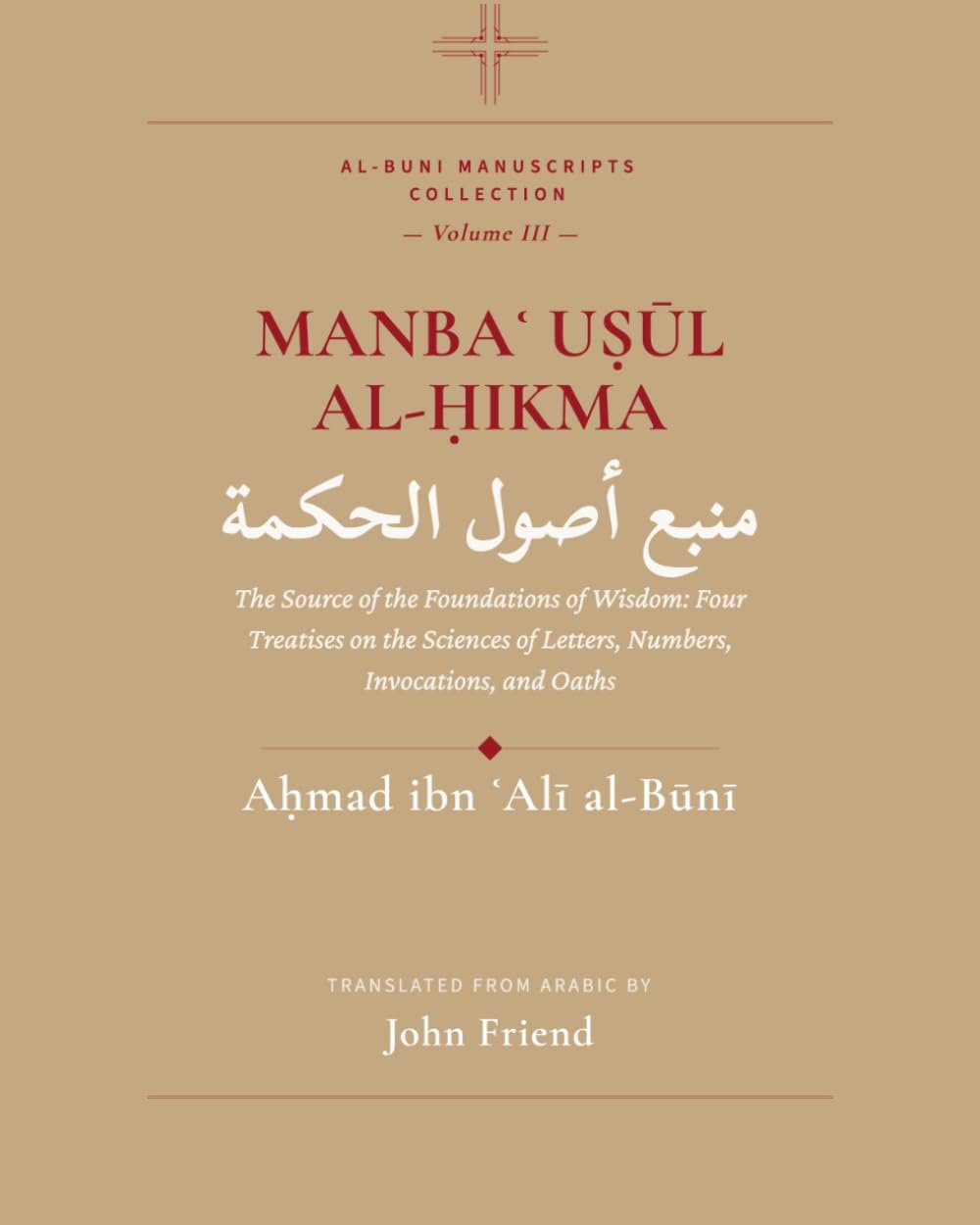
The Barhatiyyah (also spelled Berhatiah, Barhatiah, Barhatiya or Barhatiyah) is an oath of twenty-eight names, set out in the Commentary on al-Barhatiyyah in Manba’ Usul al-Hikma, attributed to al-Buni. The commentary calls the names “a majestic adjuration” handed down from the ancients, who knew them as the Ancient Covenant, and gives every name its own letter and its own lunar mansion.
What does the oath contain? Where does the commentary say it comes from, and how is it meant to be used?
The answers have been locked inside Arabic manuscripts for eight hundred years. Volume III of the Al-Buni Manuscripts Collection — Manba’ Usul al-Hikma, the Source of the Foundations of Wisdom — contains the most detailed surviving commentary on the Barhatiyyah ever attributed to al-Buni. And what it reveals is more systematic, more structured, and more unsettling than the legends suggest.
Al-Buni’s commentary spells out the first name’s vowels letter by letter — beginning with a kasrah, an i-vowel, on the opening ba’ — so forms such as Berhatiah and Birhatiyah are attempts at the same sound.
The Ancient Covenant: What the Barhatiyyah Actually Is
The names of the Barhatiyyah are not ordinary Arabic words. The English edition prints them as barbarous names (‘ajami), “sequences of letters meant to be pronounced as written,” beside the original Arabic script. The introduction to Manba’ Usul al-Hikma describes al-Buni’s Commentary on the Ancient Covenant as a book “concerning the names mentioned in Hebrew,” and the commentary says of the first name, “In Hebrew it is called Quddus.” It then sets out how the names are voiced and, for almost every one, gives a meaning in Arabic: the third name, Tatliyah, means “the Holy, the Powerful.”
In the tradition attributed to al-Buni, the Barhatiyyah functions as a master key. Where ordinary invocations address specific spiritual entities by name and request their assistance, the Barhatiyyah operates at a different level entirely. It does not request. It compels. It invokes the original covenant — the binding agreement between God and the spiritual hierarchies — and by pronouncing its words, the practitioner claims authority under that covenant. Every spiritual being, from the lowest servant to the seven kings of the jinn, is bound by it. Not because the practitioner is powerful, but because the oath itself carries the authority of the original agreement.
This is why practitioners fear it. To invoke the Barhatiyyah is to stake a claim on a level of spiritual authority that most human beings have no business wielding. The tradition is explicit about the consequences of presumption: those who pronounce the oath without proper preparation, without purification, without authorization from a qualified master, risk attracting the attention of beings who do not respond kindly to unauthorized summons. The Red King al-Ahmar and his court, the tradition warns, do not distinguish between a worthy summoner and a foolish one — they distinguish only between those who carry genuine authority and those who do not.
The Structure of Volume III: From Wisdom to Weapon
Volume III of the Al-Buni Manuscripts Collection is organized into four parts across 485 pages, and its architecture reveals a deliberate pedagogical progression — from theoretical foundations to the most powerful operative techniques the tradition possesses.
Part I: Sapiential Principles (p. 7)
The volume opens with what al-Buni calls the principles of wisdom — the philosophical and cosmological framework upon which everything that follows depends. This is not optional reading. The sapiential principles establish the relationship between divine knowledge, human understanding, and the spiritual hierarchies that mediate between them. Without this foundation, the operative material in the later parts is not merely dangerous — it is incomprehensible.
Part II: The Science of Wafq Construction
Part II is the technical core of the volume. It comprises three treatises that collectively represent the most detailed account of magic square construction in the al-Buni corpus. The first treatise addresses the placement of numbers in odd forms — the 3×3, 5×5, and 7×7 grids that form the backbone of Arabic talismanic mathematics. The second treatise covers even forms, and the third treats even-odd forms — the hybrid constructions that require the most sophisticated mathematical understanding.
But the mathematical construction is only the beginning. The second section of Part II moves from numbers to names, teaching the practitioner how to embed divine names and Quranic verses within the grid structure. This transforms the wafq from a mathematical curiosity into an operative instrument — a talisman that carries spiritual charge. The third section then addresses timing and results: when to inscribe the squares, how to extract the names of angels and the appropriate incenses from the numerical structure, and the specific oath required to activate the completed work.
That oath, in many cases, is the Barhatiyyah.
The volume’s own introduction places this treatise within al-Buni’s wider library. It names his dedicated awfaq book, Bughyat al-Mushtaq fi ‘Ilm al-Awfaq (“The Longing Seeker’s Aim in the Science of Awfaq”), as “an adequate compendium of this majestic art,” and his Sharh al-‘Ahd al-Qadim — the Commentary on the Ancient Covenant — as the book that explains the forms of the names, their meanings, and their properties. The opening Sapiential Principles have already assigned each planet its square: Saturn the third wafq (3×3), Jupiter the fourth, Mars the fifth, the Sun the sixth, Venus the seventh, Mercury the eighth, and the Moon the ninth.
Part III: Commentary on al-Barhatiyyah, the Ancient Covenant (p. 75)
Beginning at page 75, al-Buni turns to the Barhatiyyah itself. This section is titled explicitly: Commentary on al-Barhatiyyah, the Ancient Covenant. It is the most sustained analysis of the oath in the surviving Arabic manuscript tradition.
What al-Buni provides here is not merely the words of the oath — those have circulated widely, often in corrupted form. What he provides is the commentary: the explanation of what each element of the oath means, why the words take the form they do, what spiritual forces are engaged by each syllable, and how the oath relates to the broader cosmological framework established in Parts I and II.
The commentary reveals that the Barhatiyyah is not a single invocation but a structured sequence. Each portion of the oath addresses a different level of the spiritual hierarchy, ascending from lesser servants through intermediate authorities to the highest ranks of the unseen world. The oath builds in power as it progresses, each section unlocking access to a higher level of authority. To recite only part of it is to open doors without the keys to the rooms beyond. To recite all of it is to claim dominion over the entire hierarchy — a claim that, if genuine, grants the practitioner authority that the tradition describes in terms approaching the prophetic.
This is the source of both the oath’s power and its terror. The Barhatiyyah does not politely request assistance from spiritual beings. It invokes a covenant that those beings are bound to honor. If the practitioner genuinely carries the spiritual authority to make that claim, the results are described as absolute and immediate. If the practitioner does not — if the claim is hollow, if the preparation was insufficient, if the purification was incomplete — then the practitioner has announced themselves to the highest levels of the spiritual hierarchy as a trespasser.
And the tradition is unanimous about what happens to trespassers.
Inside the Commentary: Twenty-Eight Names, Letters, and Lunar Mansions
Read in full, the commentary opens with the oath’s pedigree. Al-Buni calls the names of al-Barhatiyyah “the adjuration transmitted concerning them from ancient time” and lists what the ancients called them: the Ancient Covenant, the Mighty Pact, the Preserved Secret, the Hidden Treasure, and the Red Sulfur. He traces their transmission from the first sages to Solomon son of David, then to Asaf ibn Barkhiya, then to the sage Fatitamaryus and those taught by him.
The claim made for the oath is total — “No angel opposes it, and no jinn, ‘ifrit, marid, or shaytan disobeys it” — and its design is exact. The Barhatiyyah “comprises twenty-eight names, according to the number of the letters of the alphabet and the lunar mansions, and every name has a letter and a mansion.” The first name, Barhatiyah, takes the letter alif and the mansion al-Nath; the second, Karir, glossed as “God of every thing,” takes ba’ and al-Butayn; the third, Tatliyah, takes jim and al-Thurayya. Each name then receives its vowelling and its properties — what it is written or recited for. The twenty-eight-fold scheme mirrors the circuit of the 28 lunar mansions.
This vocabulary also yields a working conjuration definition. Here a conjuration is an adjuration: an oath sworn by names that the spirits addressed are bound to obey — and the commentary says the Barhatiyyah names “dispense with all other charms and oaths.” Its uses include scrying. The reciter, “in complete purity of garment, body, and place,” seats a skilled gazer before a Chinese mirror or a bottle of clear water, names whichever kings or servants he wishes alongside the oath, and “they will come to him and inform him of everything he asks them about.” In one mandal operation the gazer is told to present “what has been prepared for the seven kings.”
Part IV: The Great Jaljalutiyyah (p. 113)
The volume closes with a companion piece to the Barhatiyyah: the Great Jaljalutiyyah. Where the Barhatiyyah is the oath of supreme authority, the Jaljalutiyyah functions as a parallel invocation with its own hierarchy of spiritual power. Together, the two oaths represent the twin pillars of operative authority in the Arabic magical tradition — the two master keys that, in combination, are believed to unlock every level of the spiritual world.
The Jaljalutiyyah commentary is also where the volume lays out the hierarchy these oaths command. The angel of each day descends with a servant, and the servants are the figures the tradition knows as the 7 jinn kings: al-Mudhhab on Sunday, al-Abyad on Monday, al-Ahmar on Tuesday, Barqash on Wednesday, Shamhurish on Thursday, Zawba’ah on Friday, and Maymun on Saturday. The seeker is told to “address the kings with gentleness, the helpers with severity.”
The placement of these two commentaries at the end of a volume that begins with wisdom principles and moves through magic square construction is not accidental. Al-Buni’s architecture is pedagogical: you learn the theory, you master the technique, and only then — only after you have demonstrated competence with lesser operations — are you given access to the ultimate instruments of power.
For readers new to al-Buni’s broader system, the comprehensive guide to the Shams al-Ma’arif provides the foundational context that this volume assumes.
Why the Barhatiyyah Was Never Published Properly
Despite its fame, the Barhatiyyah has never been fully published with proper commentary in any Western language. The reasons are both scholarly and traditional.
From a scholarly perspective, the text presents enormous difficulties. The words of the oath are not Arabic and do not yield to standard philological analysis. The manuscript tradition contains numerous variant readings, and without al-Buni’s commentary to anchor the text, even Arabic-literate readers struggle to determine the correct form of the oath. Translators have typically avoided it, either because the linguistic challenges were too great or because the material was deemed too specialized for a general audience.
From a traditional perspective, the Barhatiyyah was never meant to be published. It belongs to the category of knowledge that the tradition describes as protected — material that should be transmitted only from qualified teacher to qualified student, orally, with the proper spiritual preparation. The very act of committing it to writing was controversial; printing it in a widely distributed book would have been considered reckless by the tradition’s own standards.
Volume III of the Al-Buni Manuscripts Collection makes al-Buni’s commentary available in English for the first time. The translation follows the Arabic text faithfully, preserving the structure, the technical vocabulary, and the careful gradation from theory to practice that al-Buni clearly intended. It is presented in paperback format with full IJMES romanization and diacritical marks for all Arabic terms.
Looking for a Berhatiah PDF?
Anyone searching for a Berhatiah PDF should know what a bare list of the names leaves out: the commentary that gives each name its vowelling, its letter and lunar mansion, and its uses. That complete commentary is published in English in Manba’ Usul al-Hikma, Volume III of the Al-Buni Manuscripts Collection, as a Kindle edition that is free to read with Kindle Unlimited and a 485-page paperback. Its barbarous names are transliterated exactly and printed alongside the original Arabic script, never translated, and a free sample is available on Amazon.
The Weight of a Name
The Arabic magical tradition contains thousands of invocations, prayers, and oaths. Most are specialized — designed for specific purposes, addressed to specific beings, effective within defined parameters. The Barhatiyyah stands apart because it is universal. It does not address one spirit or one class of spirits. It invokes the covenant that binds all of them. It is not a tool for a specific job. It is the authority that makes all other tools function.
This is why every major text in the Arabic occult tradition references it. This is why practitioners across geographies and centuries have treated it with the same awe. And this is why, even now, the name itself carries weight in communities where the tradition remains alive. To say “Barhatiyyah” in certain circles is not to name a technique. It is to invoke a reality — one that the tradition insists is as operative today as it was when the first words of the oath were spoken in a language that no living human fully understands.
The question is not whether the Barhatiyyah is real. The question is whether you are prepared for what happens if it is.