You have seen the squares. Everyone has. The 3×3 grid that sums to 15 in every direction — scratched into amulets across North Africa, printed on talismanic shirts in Ottoman Turkey, carved into mosque doorways from Cairo to Delhi. The famous Buduh square. The most reproduced magical diagram in the Islamic world. And if you have gone deeper — if you have read about what Arabic magic squares actually are — you know that the tradition extends far beyond the 3×3: grids of 4×4, 5×5, 7×7, and beyond, each tied to a specific planet, a specific set of divine names, a specific category of operative purpose.
But here is what no one has published in English until now: how to build them.
Not the finished products. Not the pretty grids with numbers already in place. The actual construction method — the step-by-step process by which a blank grid becomes a functioning wafq, charged with divine names, timed to planetary hours, and activated through specific oaths and incenses. This is the method that has been locked inside Arabic manuscripts for eight centuries. And it is the subject of Part II of Volume III of the Al-Buni Manuscripts Collection.
Why the Method Matters More Than the Squares
Western scholarship has long been fascinated by Arabic magic squares as mathematical objects. The 3×3 square appears in countless histories of mathematics, typically presented as a curiosity — a numerical puzzle that happens to appear in talismanic contexts. The 4×4 Jupiter square found its way into European magic through Cornelius Agrippa and from there into the Western occult tradition, where it was reproduced endlessly without any understanding of the principles behind its construction.
This is the fundamental error that al-Buni’s method corrects. The finished square is not the magic. The finished square is the result of the magic — the end product of a construction process that begins with mathematical principles, moves through divine name correspondences, and culminates in specific ritual conditions. A magic square without its construction method is like a pharmaceutical without its formula: you can describe the pill, but you cannot make another one.
Ahmad ibn ʿAlī al-Buni (d. 622 AH / ~1225 CE) understood this distinction absolutely, and Volume III is organized accordingly. He does not begin with finished squares and work backward. He begins with principles and builds forward. If you have struggled with understanding why your planetary talismans do not produce results, the answer almost certainly lies in the construction method you never learned.
The Three Treatises: Odd, Even, and Even-Odd
Part II of Volume III contains three treatises that together constitute the most complete account of wafq construction in the al-Buni corpus. The division is not arbitrary — it reflects a fundamental mathematical reality that governs how magic squares can be constructed.
First Treatise: Placing Numbers in Odd Forms
Odd-order squares — 3×3, 5×5, 7×7, 9×9 — are the foundation of the tradition. The 3×3 is the square of Saturn, the slowest and most distant of the classical planets, and it carries the weight of saturnine operations: binding, restriction, protection against enemies, and the governance of time. The 5×5 is the square of Mars; the 7×7 belongs to Venus; the 9×9 is the square of the Moon.
Al-Buni’s method for odd forms follows a rotational principle. The construction begins at a specific cell — determined by the planet and the intended operation — and proceeds through the grid according to a movement pattern that ensures that each row, each column and both diagonals produce the required sum. This is not trial and error. It is an algorithm, as precise as anything in modern mathematics, but expressed in the vocabulary of medieval Arabic science.
How to Make a Magic Square the al-Buni Way: The Three-by-Three
The first worked example in the treatise is the three-by-three, and it shows how compact al-Buni’s instructions are. The cells of the grid are named by letters, and a mnemonic, Baṭad Zahaj Wāḥ, tells you where each number goes: “descend with the one into the house of ḥāʾ, the two into the house of alif, and the three into the house of wāw, and so on to the end of the wafq.” Follow the rule through to nine and the finished grid appears on the page as 4 9 2 / 3 5 7 / 8 1 6 — fifteen along each row, each column and both diagonals.
The mnemonic is the grid itself. Read as abjad numerals from right to left, its letters spell out the three rows: b-ṭ-d (2, 9, 4), z-h-j (7, 5, 3), and w-a-ḥ (6, 1, 8). The even numbers 2, 4, 6, and 8 — the letters b, d, w, and ḥ — sit in the four corners, which is why the same grid is popularly called the Buduh square. The fivefold square follows with a mnemonic verse of its own and a completion rule, Nathūth Dāris, that starts from the three-by-three lying at its center.
Second Treatise: Placing Numbers in Even Forms
Even-order squares — 4×4, 8×8 — require fundamentally different construction techniques. The 4×4 is the square of Jupiter, governing expansion, authority, wealth, and religious blessing. The 8×8 is the square of Mercury, the planet of communication, commerce, and intellectual operations.
Even forms cannot be constructed using the rotational method that works for odd forms. Al-Buni presents a different approach based on complementary pairs — numbers that, combined, produce the grid’s constant. The method involves placing these pairs in symmetric positions within the grid according to specific exchange rules. It is mathematically elegant and operatively precise.
Third Treatise: Placing Numbers in Even-Odd Forms
Even-odd forms — 6×6, 10×10 — are the most complex constructions in the tradition. The 6×6 is the square of the Sun, the most powerful planetary body, governing sovereignty, illumination, and spiritual authority. Its construction requires elements of both the odd and even methods, combined in a way that has baffled Western mathematicians encountering these squares without the underlying tradition.
Al-Buni’s treatment of the even-odd forms is the most technically demanding section of the volume. It requires the practitioner to divide the grid into quadrants, apply modified odd-form construction to certain sections and modified even-form construction to others, and then reconcile the results into a unified whole. The result is a square that produces the correct constant in every direction while maintaining the planetary and divine name correspondences that make it operatively functional.
From Numbers to Names: The Second Layer
The three treatises on numerical placement constitute only the first layer of wafq construction. The second section of Part II addresses what transforms a mathematical grid into a spiritual instrument: the placement of divine names and Quranic verses.
This is where al-Buni’s system departs entirely from Western mathematical treatments of magic squares. In al-Buni’s framework, numbers are not abstract quantities. Each number corresponds to an Arabic letter through the abjad system, each letter carries elemental and planetary correspondences, and each divine name resolves to a numerical value. The wafq operates simultaneously on two levels: as a mathematical structure that produces constant sums, and as a textual structure that arranges divine names in specific patterns of power.
The section on name placement teaches the practitioner how to translate between these levels — how to take a completed numerical grid and overlay it with the appropriate divine names, Quranic verses, or angelic appellations. The result is a wafq that can be read both as a number grid and as a sacred text, with each reading reinforcing the other. For those exploring Arabic talisman construction for the first time, this dual-layer system is the key concept that most introductory treatments miss entirely.
The Science of Extraction: Angels, Incenses, and the Oath
The third section of Part II — titled “Science of Wafqs and Extraction of Results” — addresses the final stage of the construction process: deriving from the completed wafq the specific operational requirements for its activation. This includes the extraction of angelic names, the identification of the correct planetary incense for suffumigation, and the oath required to charge the completed talisman.
The extraction method is mathematical. From the numerical values embedded in the wafq, the practitioner derives — through specific calculations that al-Buni details step by step — the names of the angels who govern the square’s operation, the incense formula appropriate to its planetary correspondence, and the timing windows during which it should be inscribed and activated.
The section titled “Times of Writing” provides the temporal framework: which planetary hours are appropriate for each type of square, which weekdays are favorable, and how the lunar cycle affects the potency of the operation. This is where the wafq tradition connects to the broader astrological framework that governs all operative work in the Arabic magical tradition.
The Treatise Behind the Method
The Arabic magic squares al-Buni teaches here sit inside a section with its own title: The Structure of the Pact in Knowing the Placement of Wafqs. He describes it as three treatises and a conclusion, and the conclusion — easy to miss in summaries — “concerns the conditions of seclusion and the proper correspondence to the time after that.” The second treatise is more specific than most accounts suggest: one chapter places names and verses “by the method of breaking,” another “by way of composition.” The third pairs the times of writing with “works of good and evil” and adds a chapter on the balances of letters.
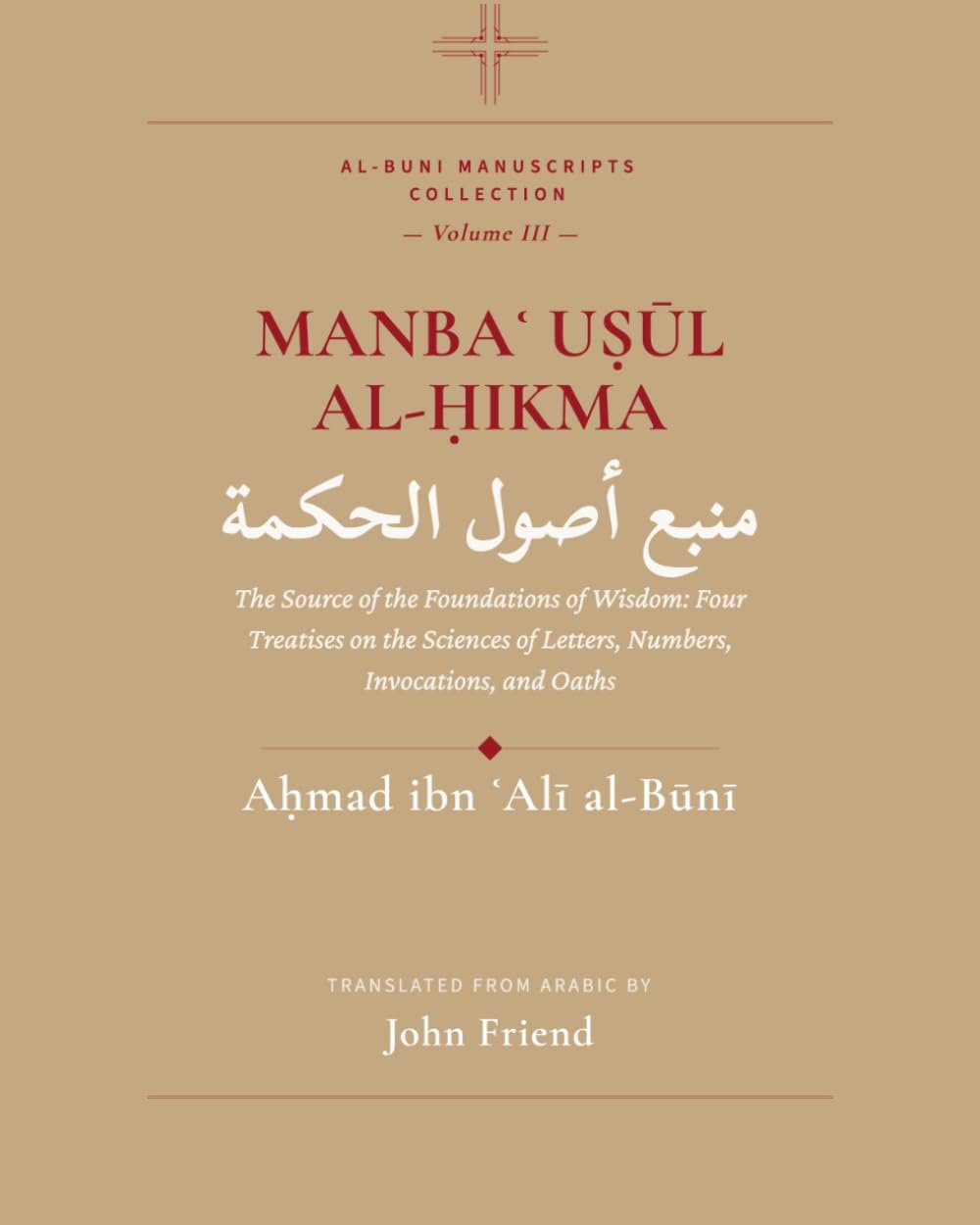
The construction method is only one part of the volume. The full Manba’ Usul al-Hikma of al-Buni opens with The Sapiential Principles and Rules and closes with two commentaries: the Commentary on al-Barhatiyyah, Known as the Commentary on the Ancient Covenant, and the Commentary on the Great Jaljalutiyyah. The Barhatiyyah — often spelled Berhatiah — is the oath explained in full in What Is the Barhatiyyah?
If you have been looking for an awfaq book that teaches construction rather than reproducing finished grids, this is the volume built for it. As the translator’s note states, its magic squares are reproduced as images from the source manuscript. For a second Arabic magic square manuscript, organized around the seven weekdays, see the Shams al-Anwar; for the planetary system that every finished wafq magic square serves, start with the awfaq explained.
Why This Was Never Published Before
The construction method presented in Volume III has been available in Arabic manuscript form for centuries. It has been referenced, cited, alluded to, and partially quoted by generations of scholars and practitioners. But it has never been published in complete English translation for the same reason that most operative material in the Arabic tradition has remained untranslated: it was considered too dangerous, too specialized, or too sacred for general dissemination.
Western mathematical historians who encountered Arabic magic squares treated them as numerical curiosities and ignored the operative framework. Western occultists who inherited the squares through Agrippa and the Latin tradition had the finished products but not the construction methods, and no access to the Arabic source material that would have provided them. The result was a tradition of reproducing squares without understanding them — of copying talismans without knowing why they were structured as they were or how to construct new ones for specific purposes.
Volume III of the Al-Buni Manuscripts Collection changes this. The complete construction method — all three treatises, the name placement system, the extraction method, and the timing framework — is now available in English for the first time. The translation is in paperback format with full IJMES romanization and diacritical marks for all Arabic terms.
The squares that have decorated amulets and mosques for eight centuries were never meant to be decorations. They were meant to be built — constructed according to precise specifications, for specific purposes, at specific times, with specific invocations. Now, for the first time in English, you can learn how.