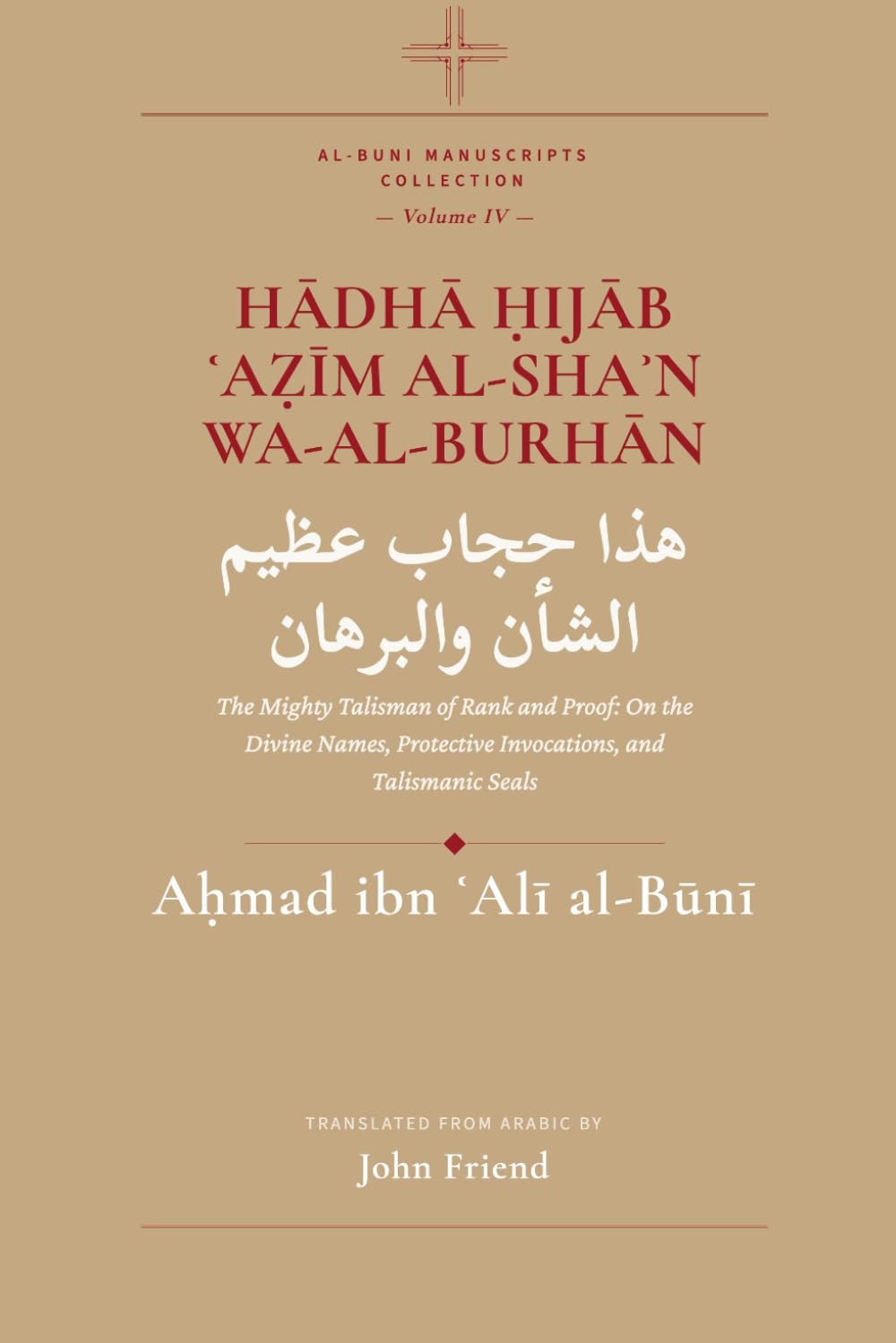
Some manuscripts survive by being copied. Others survive by being hidden. The Hijab ’Azim al-Sha’n wa-al-Burhan — the Mighty Talisman of Grandeur and Proof — survived by being feared. For centuries, this 49-page text attributed to al-Buni circulated through the margins of the Arabic manuscript tradition: referenced in catalogs, whispered about among practitioners, but rarely reproduced in the printed editions that made other al-Buni works widely available. It was not lost. It was deliberately withheld — considered too complete, too operative, too dangerous for the general reading public.
The text opens with a promise that explains the fear. On page 5, it declares its purpose in language that leaves no room for metaphor: preservation and security from every rebellious demon and devil. Protection against the evil eye, fright, and harm. This is not a theoretical treatise on the nature of spiritual defense. This is a manual — 49 pages of precise operational instructions for constructing what the tradition considers the most comprehensive protective talisman in the Arabic occult corpus.
Volume IV of the Al-Buni Manuscripts Collection makes this text available in English for the first time.
What the Hijab Azim Contains: A Chapter-by-Chapter Architecture
The Hijab Azim is organized into distinct sections, each addressing a different dimension of spiritual protection. The architecture is not random — it moves from divine authority to prophetic intercession to practical implementation, building a layered defensive system that the tradition describes as impenetrable when properly constructed.
Invocation Through Divine Names (p. 9)
The text begins where all serious Arabic magical work begins: with the divine names. This opening section identifies the specific names of God that carry protective power and provides the precise formulas for invoking them. These are not the general devotional recitations familiar from Sufi practice. They are operative deployments — specific combinations of names, recited in specific sequences, for the specific purpose of establishing a zone of divine protection around the practitioner.
For readers familiar with al-Buni’s broader system as presented in the Shams al-Ma’arif, the divine name framework here will be recognizable. But where the Shams presents the divine names as part of a comprehensive encyclopedic system, the Hijab Azim deploys them with surgical precision for a single purpose: protection.
The Working of al-Fard (p. 13)
The second section introduces a concept central to the protective system: al-Fard, the singular, the unique. This working addresses the individual practitioner’s relationship with divine unity — the theological foundation upon which all protective practice rests. In al-Buni’s framework, protection is not merely a matter of technique. It is a matter of alignment. The practitioner who is properly aligned with divine unity becomes, in a sense, invisible to hostile spiritual forces — not because they are hidden, but because they stand within a light that darkness cannot approach.
Protective Encirclement Through the Messenger of God (p. 21)
The third section shifts from divine names to prophetic intercession. Here al-Buni provides invocations that establish protective encirclement through the spiritual authority of the Prophet Muhammad. The Solomonic tradition in Arabic manuscripts treats prophetic authority as a fundamental category of spiritual power — distinct from divine names, complementary to them, and operative in domains where other methods may be insufficient.
Reliance upon God Against Harm (p. 25)
This brief but critical section addresses the inner dimension of protection: tawakkul, complete reliance upon God. The tradition attributed to al-Buni insists that no talisman, however perfectly constructed, can function if the bearer’s inner state is not aligned with its purpose. This section provides the spiritual preparation that makes the outer protections operative.
Seven Verses of Protective Veils (p. 26)
The most feared section of the entire text. The seven protective veils are Quranic verses that al-Buni identifies as forming an impenetrable spiritual barrier when recited in the correct sequence under the correct conditions. Each veil addresses a specific category of threat, and together they are described as creating a sphere of protection that surrounds the bearer on every side — above, below, before, behind, left, right — leaving no gap through which harm can enter.
The tradition surrounding the seven veils is intense. Practitioners across the Arabic-speaking world believe these veils constitute real barriers against jinn, the evil eye, and every form of spiritual aggression. The fear is not that they do not work — the fear is that they work too well, and that deploying them without understanding their full implications can create consequences the practitioner did not anticipate.
Supplication Through Prophet Muhammad (p. 28)
Following the seven veils, the text provides extended supplications that reinforce the protective framework through prophetic intercession. These are not generic prayers. They are specific formulas that the tradition treats as operative instruments, each one sealing a particular layer of the protection that the previous sections established.
Secret of Protective Names and the 6×6 Square (p. 38)
Here the text reaches its talismanic core. The 6×6 magic square — the square of the Sun, the most powerful planetary body in the classical system — is presented not merely as a mathematical construct but as the physical anchor for the entire protective system. The protective names are embedded within the square according to principles that connect to the broader Arabic talisman-making tradition, and the square itself becomes the material object that the bearer carries or displays as the tangible expression of the protection established through invocation, veiling, and supplication.
Supplication of Adam (p. 45)
The text closes with the Supplication of Adam — the prayer attributed to the first human being, offered in the moment of his greatest vulnerability. This final section reaches back to the origin of human need for protection and connects the entire system to the primordial relationship between humanity and the divine. It is the closing seal on a structure that begins with God’s names and ends with humanity’s first cry for help.
Why This Talisman Was Suppressed
The Arabic manuscript tradition contains hundreds of protective talismans. Amulets against the evil eye are sold in every marketplace from Marrakech to Jakarta. What makes the Hijab Azim different — what made it too dangerous to print — is its completeness.
Most protective texts provide fragments. A divine name here, a Quranic verse there, a partial square without its activation method. The Hijab Azim provides everything: the divine names and their operative deployment, the prophetic invocations and their precise formulas, the seven veils and their sequence, the 6×6 square and its construction, and the inner preparation that makes the entire system function. Nothing is omitted. Nothing is left to inference. Nothing requires a teacher to explain — the text itself is the teacher.
This self-sufficiency is exactly what made authorities nervous. A text that requires a teacher to interpret creates a natural barrier to access — the teacher serves as gatekeeper, admitting only those deemed ready. A text that explains itself removes that barrier entirely. Anyone who can read Arabic — or, now, English — can access the complete system. The tradition held that this was reckless: spiritual protection of this magnitude, deployed by someone without the inner preparation to sustain it, could create problems more severe than those it was designed to prevent.
For the historical context of how al-Buni’s works were systematically banned and burned, the Hijab Azim represents a concentrated case study in the tension between preservation and protection that has defined the tradition for centuries.
Protection Against What, Exactly?
The Hijab Azim is explicit about the threats it addresses. The text identifies several categories of harm that the talisman is designed to prevent:
- Rebellious demons and devils — spiritual entities that actively seek to harm human beings
- The evil eye — the envious gaze that the tradition treats as a real and measurable force
- Fright — the sudden terror that the tradition attributes to jinn encounters
- General harm — a catch-all category that encompasses both physical and spiritual dangers
For contemporary readers, these categories may sound archaic. But in communities where the Arabic magical tradition remains a living practice — and there are millions of such people across the globe — these are not metaphors. They are diagnostic categories as real and as specific as any medical taxonomy. The Hijab Azim addresses them with corresponding precision.
Now Available in English
Volume IV of the Al-Buni Manuscripts Collection presents the complete Hijab Azim in English translation for the first time. All 49 pages. All sections. The divine name invocations, the prophetic supplications, the seven protective veils, the 6×6 solar square, and the Supplication of Adam. Nothing removed, nothing sanitized, nothing left to the reader’s imagination.
The translation is in paperback format, following the IJMES romanization system with full diacritical marks for all Arabic terms. The Arabic text of key passages is included for readers who wish to work with the original language.
For eight centuries, the Hijab Azim was the talisman they were afraid to print. It is no longer hidden.