Every few months, someone in the Western ceremonial magic community reports the same experience. They followed the instructions in the Picatrix to the letter. They selected the correct planet. They waited for the correct day. They engraved the correct sigil on the correct metal. They burned incense. They spoke the invocation. And nothing happened. No perceptible shift. No result. The talisman sits on a shelf, inert — an expensive piece of engraved jewelry with no operative force behind it. The practitioner concludes either that talismanic magic does not work, or that they lack some innate gift. Both conclusions are wrong. The problem is not with them. The problem is with their source text.
The Picatrix — the Latin translation of the Arabic Ghayat al-Hakim (“The Goal of the Wise”), compiled in al-Andalus around 1000 CE — is the most widely circulated text on astrological magic in the Western world. It has been translated into English multiple times. It is the foundational reference for nearly every modern practitioner of planetary talisman work. And it is a fraction of the system it claims to represent.
This is not a matter of opinion. It is a matter of manuscript comparison. The Arabic Ghayat al-Hakim is itself a philosophical compilation, not an operational manual. The texts that contain the actual operative procedures for planetary talisman work — the al-Jawahir al-Lamma’a (“The Radiant Jewels”), the Shams al-Anwar wa Kunuz al-Asrar (“Suns of Lights and the Great Treasures of Secrets”) by Ibn al-Hajj al-Tilmsani, the Kitab al-Ajnas attributed to Asif ibn Barkhiya, and the relevant sections of Ahmad al-Buni’s Shams al-Ma’arif — were never translated into Latin. They have never been available in English until now. The Western tradition received the theory and lost the technology.
Here is what the original manuscripts actually require — and what the Picatrix does not tell you.
The Planetary Hours Are Not What You Think They Are
The single most consequential error that Western practitioners make is treating planetary hours as fixed sixty-minute blocks. Open any modern planetary-hour calculator — there are dozens of apps and websites — and you will find a neat grid: each day divided into twenty-four equal segments, each assigned to a planet in the standard Chaldean sequence. This is wrong. It is not approximately wrong. It is fundamentally wrong, in a way that renders the entire timing framework inoperative.
The al-Jawahir al-Lamma’a is explicit on this point. Planetary hours are reckoned separately for the daylight and for the night. The daytime hours are determined by dividing the total minutes of daylight by twelve. The nighttime hours are determined by dividing the total minutes of darkness by twelve. In summer, a daytime planetary hour might last seventy-five minutes while a nighttime hour lasts only forty-five. In winter, the reverse. The hours expand and contract with the actual movement of the sun, because they are measuring something real — the dominion of each planet over a specific portion of the solar cycle — not an abstract division of clock time.
This means that a talisman consecrated during what a modern calculator calls “the hour of Venus” may in fact have been consecrated during the hour of Mercury or the hour of the Sun, depending on the season, the latitude, and the exact moment of local sunrise. The practitioner did everything right according to the app. The app was wrong. The talisman was dead before the first word was spoken.
The complete planetary-hour grid covers all 168 hours of the week — not merely “use Sunday for the Sun and Friday for Venus,” as simplified Western sources suggest. Each of those 168 hours has a specific planetary ruler, a specific class of operations it governs, and specific conditions under which it is most and least effective. The al-Jawahir al-Lamma’a assigns them with precision: the hour of the Moon governs the affection of rulers and the extraction of hidden treasure. The hour of Mercury governs scholars, the solving of talismanic riddles, and intellectual operations. The hour of Venus governs attraction and joy. The hour of the Sun governs awe, subjugation, and kingship. The hour of Mars governs destruction and separation.
None of this nuance survives in the Latin Picatrix, which gives only general planetary correspondences without the hour-by-hour operational grid.
The Dual Hierarchy: Angels Above, Jinn Kings Below
The second catastrophic omission in the Western transmission is the removal of the jinn hierarchy. In the Arabic source texts, every planet is governed by a dual spiritual hierarchy: an upper angel (malak) and a lower jinn king (malik min muluk al-jinn). The angel represents the celestial, luminous aspect of the planet’s influence. The jinn king represents its terrestrial, operative aspect. Both must be addressed for a talisman to function.
The Latin translation of the Ghayat al-Hakim stripped the jinn hierarchy out entirely. What arrived in Europe was a system of planetary angels only — the celestial half of a two-part mechanism. Western practitioners have been building talismans addressed to half the relevant powers and wondering why they get half the results. Or rather, no results, because in the Arabic understanding, the angel authorizes the operation from above while the jinn king executes it below. Without the lower half of the hierarchy, there is authorization with no execution. A signed order with no one to carry it out.
The Kitab al-Ajnas names the seven jinn kings explicitly and provides the protocols for addressing each one within the correct planetary hour. The Shams al-Anwar elaborates on the relationship between the upper and lower hierarchies, explaining that the jinn king of each planet is himself bound by a covenant with the corresponding angel — a covenant that the practitioner must acknowledge and invoke as part of the consecration. The al-Jawahir al-Lamma’a gives the complete invocations: the oath to the angel, the address to the jinn king, and the specific language that activates the talisman as a bridge between the two.
Without this dual address, the talisman is a letter sent to the wrong office.
The Forgotten Prerequisites: Purity, Dismissal, Direction
Even if a practitioner somehow obtained the correct planetary-hour calculations and the complete dual hierarchy, the Arabic manuscripts insist that the talisman would still fail without a set of prerequisites that the Picatrix barely mentions and modern Western practice ignores entirely.
Absolute Purity (Taharah)
The practitioner must be in a state of complete ritual purity. This is not a metaphor. It means a full ritual bath (ghusl) before the operation and the maintenance of ablution (wudu’) throughout. The al-Jawahir al-Lamma’a states that a practitioner who breaks ablution during the consecration of a talisman must stop, purify again, and begin the entire invocation from the beginning. There is no “continuing where you left off.” A broken state of purity breaks the connection, and the connection must be re-established from scratch.
Dismissal of the Ammar
Before the consecration begins, the ambient jinn of the location — the ammar, the resident spiritual entities of the room, building, and land — must be formally dismissed. We have written about this at length in our essay on the five preparatory steps. In the context of talisman work, the principle is specific: the ammar can interfere with the planetary current being drawn into the talisman, contaminating it with irrelevant or hostile influences. The Shams al-Anwar likens this to trying to tune a musical instrument in a room full of other musicians playing different songs. You must silence the room before you can hear the note you need.
Facing the Qibla
The practitioner must face the direction of Mecca throughout the operation. This is non-negotiable in every Arabic source text we have examined. The qibla functions as a directional anchor — a fixed orientation that aligns the practitioner with the spiritual geography of the tradition. Western practitioners, working without this instruction, face whichever direction they please, or orient themselves toward the planet they are invoking. The manuscripts do not support this. The orientation is toward the qibla, always.
The Planetary Incense: Not a Suggestion
The Picatrix mentions incense in passing. The Arabic operational texts treat it as load-bearing infrastructure. Each planet has a specific fumigation recipe — not merely a “correspondence” in the vague sense that Western occultism uses the word, but a precise mixture of materials that, when burned during the correct planetary hour, creates the atmospheric conditions under which the planetary spirits can manifest and act.
The al-Jawahir al-Lamma’a provides the recipes with quantities. They are not interchangeable. Substituting sandalwood for the prescribed Jupiter incense because a supplier was out of stock is not a minor adjustment — it is the equivalent of using the wrong frequency on a radio. You will not reach the station you intended. You may reach nothing at all, or you may reach something you did not intend, which is worse.
The incense must be lit at the precise beginning of the planetary hour and must burn continuously throughout the operation. If it goes out, the operation is compromised. The Shams al-Ma’arif warns that allowing the fumigation to fail mid-invocation signals weakness to the spirits being addressed — a failure of commitment that they will not overlook.
The Oath Must Be Memorized
This is the detail that separates genuine practitioners from readers. The Arabic manuscripts are unanimous: the invocations, oaths, and divine names spoken during talisman consecration must be committed to memory. They cannot be read from a book. They cannot be read from a printed sheet. They cannot be read from a phone screen.
The reason is not arbitrary. The al-Jawahir al-Lamma’a explains it in terms of khushu’ — a state of total concentration and spiritual presence that is broken the moment the practitioner’s eyes leave the work to consult a text. Reading introduces a mediating layer between the practitioner and the spiritual reality being addressed. The words must flow from within, from memory and intention, not from an external source. A practitioner reading an invocation is like an actor reading lines for the first time during a live performance — the audience can tell, and so can the spirits.
The Shams al-Anwar is even more direct: a practitioner who cannot memorize the oath has not done sufficient preparation and is not ready for the operation. The memorization itself is part of the preparatory discipline. It forces intimacy with the material. It ensures that the practitioner understands every word, every divine name, every shift in address from angel to jinn king and back. You cannot memorize something you do not understand, and you cannot use something you have merely read.
Why the Latin Picatrix Is a Fragment
The Western occult revival of the nineteenth and twentieth centuries treated the Picatrix as a complete system. It is not. The Ghayat al-Hakim was written as a philosophical survey of astral magic — an encyclopedic overview aimed at an educated readership. It was never intended as a standalone operational manual. In the Arabic tradition, it sits alongside a constellation of operational texts that provide the specific protocols, invocations, hour tables, and spirit hierarchies that the Ghayat al-Hakim references but does not reproduce in full.
When Alfonso X of Castile commissioned the Latin translation in the thirteenth century, only the Ghayat al-Hakim itself was translated. The companion texts — the operational manuals that a practitioner in the Arabic world would have used alongside it — remained in Arabic. The jinn hierarchies were stripped out, likely because the translators found them theologically incompatible with a Christian framework. The variable planetary hours were simplified into fixed blocks, likely because the translators did not understand the astronomical basis of the original system. The purity requirements were reduced to a sentence or two, likely because they were rooted in Islamic ritual practice that had no direct Western equivalent.
What arrived in Europe was the skeleton of the system without the musculature. And for seven hundred years, Western practitioners have been trying to make the skeleton walk.
The Picatrix Latin Translation and Its Manuscripts
A note on the history explains what Western readers actually inherited. The Picatrix Latin translation was not made directly from the Arabic. The Ghayat al-Hakim was first rendered into Castilian for Alfonso X in 1256 CE, and the Latin was made from that Castilian version shortly afterward. The text is organized in four books, and Latin manuscript copies of the Picatrix circulated through the rest of the medieval period and into the Renaissance. Anyone reading a Latin Picatrix manuscript today is reading the end of that chain — Arabic to Castilian to Latin — with the operational companion texts left behind at the first step.
Its reach was enormous. Cornelius Agrippa’s Three Books of Occult Philosophy, Marsilio Ficino’s astral medicine, and the planetary magic of the Renaissance all bear the imprint of the Latin Picatrix. That influence on Agrippa and his successors carried the Picatrix’s planetary correspondences into the Western tradition — along with its gaps. Agrippa could only pass on what the Latin contained.
Picatrix: Latin vs Arabic at a Glance
For anyone asking how to make a talisman by the rules of the Arabic and Islamic talismanic tradition rather than the Latin one, the differences described above come down to five points:
- Planetary hours. The Arabic operational texts divide daylight and darkness each into twelve variable hours, counted from sunrise and from sunset; the Latin transmission reduced them to fixed blocks.
- Spirit hierarchy. The Arabic sources address both the planet’s angel and its jinn king; the Latin kept the angels and dropped the jinn.
- Prerequisites. Ritual purity, the dismissal of the ammar, and facing the qibla are required in the Arabic texts; the Picatrix barely mentions them.
- Incense and oaths. The Arabic manuals give fumigation recipes with quantities and require the oaths to be memorized; the Picatrix mentions incense in passing.
- Scope. The Ghayat al-Hakim was a philosophical survey that sat alongside operational manuals in the Arabic world; only the survey was translated.
For a step-by-step introduction to the Arabic method, see the beginner’s guide to Arabic talisman making.
Picatrix Magic Squares and Talisman Diagrams: Where the Arabic Sources Supply Them
Readers searching for Picatrix magic squares or Picatrix talisman diagrams are usually after the working apparatus of planetary magic: the seven planetary squares and the seals engraved on a talisman. The Picatrix’s own talismanic material centers on planetary images and correspondences. The Arabic manuals set the squares out directly. Al-Buni’s Manba’ Usul al-Hikma assigns each planet its wafq — Saturn the third (3×3), Jupiter the fourth, Mars the fifth, the Sun the sixth, Venus the seventh, Mercury the eighth, and the Moon the ninth — the same planetary order the West later knew from Agrippa, and the Arabic science of these awfaq reaches well beyond the grids themselves. In the John Friend Publishing translations of al-Jawahir al-Lamma’a, Shams al-Anwar, and Kitab al-Ajnas, the talismanic seals and magic squares are reproduced as images from the source manuscripts, so each Arabic talisman can be studied as drawn rather than as described.
Where the Complete System Is Now Available
The full planetary talisman system — the variable-hour grid, the dual angel-and-jinn-king hierarchies, the consecration procedures, the incense recipes, the memorized oaths, the purity protocols — is documented across several source texts that are now available in English translation for the first time.
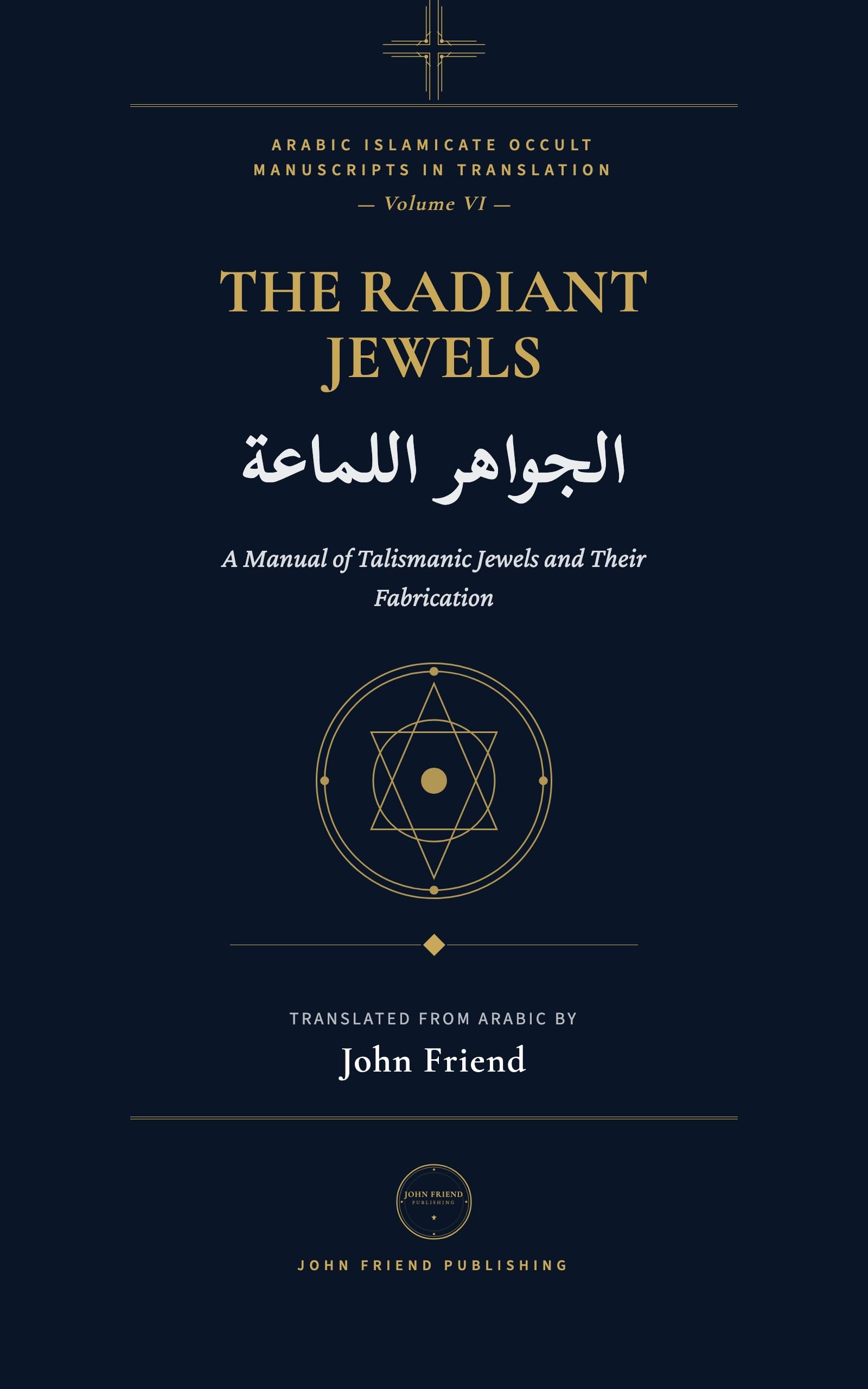
The most complete single source for the planetary-hour system and jinn-king conjuration protocols is al-Jawahir al-Lamma’a: The Radiant Jewels for Summoning the Kings of Jinn (Volume V of the John Friend Publishing series). This text provides the full 168-hour planetary grid, the specific operations assigned to each hour, and the complete invocations for addressing both the angelic and jinn hierarchies of each planet.
For the preparatory disciplines — the fasting, the purity regimen, the khalwah retreat, and the sarf al-ammar — the most detailed practitioner-oriented source is Shams al-Anwar wa Kunuz al-Asrar al-Kubra (Volume III), written by Ibn al-Hajj al-Tilmsani in 1327 CE. For the Solomonic dimension of the tradition — the binding protocols and covenant language attributed to the court of Sulayman — see Kitab al-Ajnas (Volume IV).
The Picatrix is not wrong. It is incomplete. The Arabic sources complete it. And once you see the complete system, you will understand exactly why the fragment never worked on its own.
