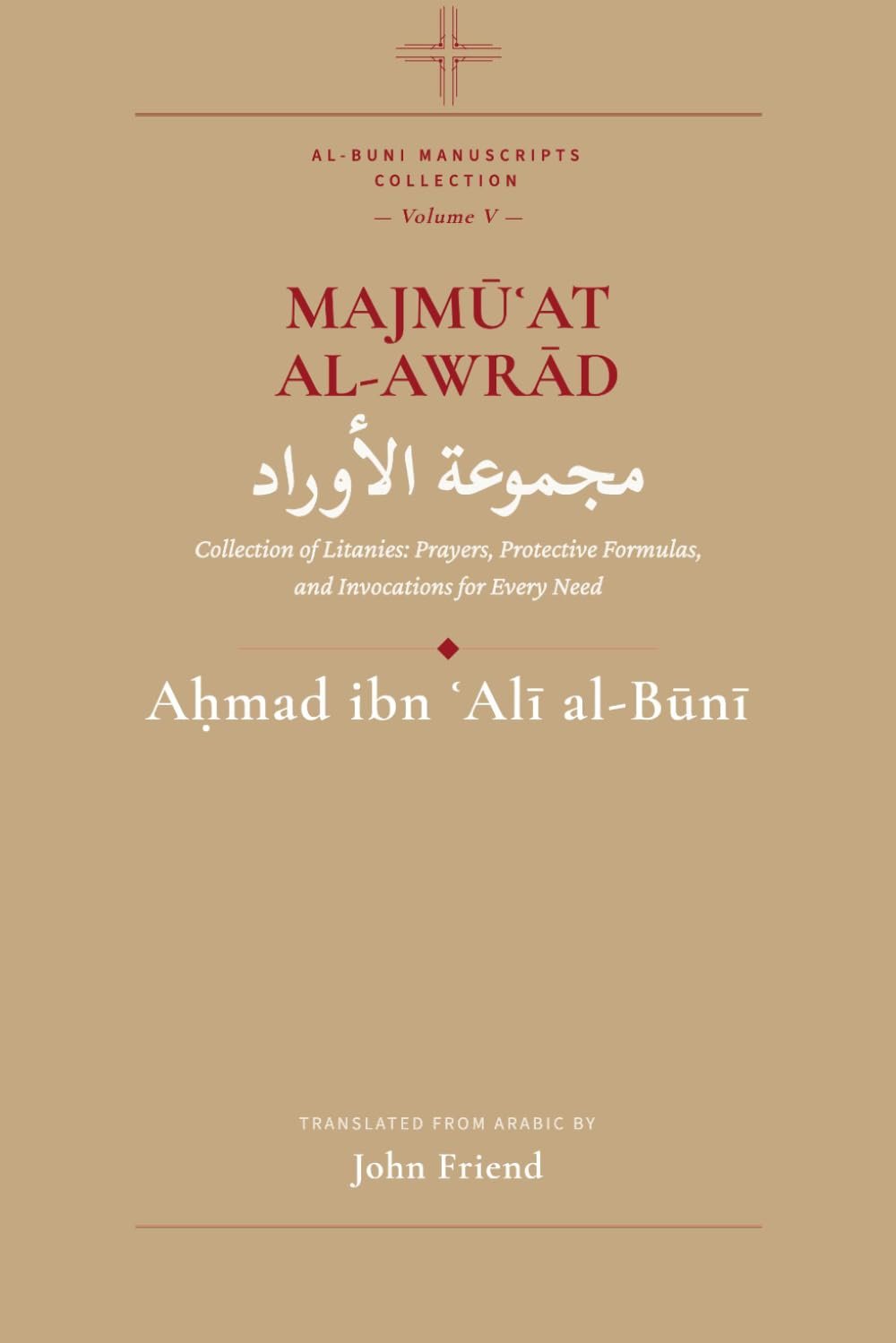
Volume V — Al-Buni Manuscripts Collection
Majmu'at al-Awrad: Al-Buni's Wird and Wazifa Litanies
مجموعة الأوراد
English translation of al-Buni's Majmu'at al-Awrad — a collection of prayers, litanies, and invocations for specific emergencies: plague, childbirth, the evil eye, spiritual distress, and moments of desperation. Practical spiritual remedies drawn from the prophetic and Sufi traditions. Majmu'at (from majmu', “gathered”) means “collection”; awrad is the plural of wird, a fixed daily litany — what many readers call a wazifa.
Kindle $24.95 Paperback $24.95
Bookstores & libraries: order wholesale direct from the publisher
What's Inside
- Collection of litanies and daily spiritual recitations from the Sufi tradition of al-Buni — the devotional core of his practice.
- Prayers organized by time of day and celestial alignment, providing a structured daily observance.
- Devotional practices that illuminate the spiritual discipline underlying al-Buni's better-known occult works.
- A practical companion to the theoretical and operational texts in the collection — the human dimension of the system.
Wird, Awrad and Wazifa: How Al-Buni's Litanies Are Recited
A wird is a set portion of prayer and remembrance kept at regular times; the plural is awrad. In Urdu, Persian and many Sufi orders the same kind of fixed recitation is called a wazifa, from the Arabic for “assigned portion.” This Ahmad al-Buni manuscript uses the words wird and awrad, and it gives two chapters to method — Intention for the Wird and Reciting the Awrad — before the litanies themselves.
Reciting the Awrad sets the order: three recitations of Surat al-Ikhlas, one Fatiha, then “La ilaha illa Allah, Muhammad rasul Allah haqqan” — “There is no god but God; Muhammad is the Messenger of God, truly” — followed by supplications, the bare la ilaha illallah repeated for a while, and the takbir three times.
Readers looking for the Ratib al-Haddad in full will find a different text here: the Ratib is the litany of Imam 'Abdallah al-Haddad, a later Hadrami scholar. Majmu'at al-Awrad belongs to the same family of Sufi litanies — Qur'anic recitation, Ayat al-Kursi, la ilaha illallah and blessings on the Prophet — but its contents are its own.
La Ilaha Illallah and the Divine Names
The formula la ilaha illallah runs through the collection. In the chapter Praise of the Beautiful, Exalted One, a long passage joins it to the divine names: “There is no deity but God, the Trustee, the Witness. There is no deity but God, the Firm, the Glorious.” Ayat al-Kursi appears in the chapter Invocation of Forgiveness and Divine Majesty.
Prayer When in Distress gives a litany “for repelling calamities,” recited seven times every day — in effect a dua for protection against everything, answering each trouble with a phrase: “For every sin, I ask God's forgiveness. For every thing, what God wills.”
The Complete Surah Yaseen and Surah al-Fath
The third chapter gives the Meccan Surah Ya Sin complete — all eighty-three verses — and the fourth gives the Medinan Surah al-Fath in its twenty-nine verses. Surah Yaseen is thus given complete in English, set out as the manuscript has it: English, transliteration and Arabic, passage by passage, within the litanies.
Prayers for Plague, Childbirth and the Evil Eye
The first chapter opens with a formula of refuge: “I seek refuge in the perfect words of God from the evil of what He has created, from every devil and harmful creature, and from every blaming eye.” Written with a sound intention and carried with respect, the text says, it is useful against the evil eye, fright and harm. The same chapter gives a formula for difficult childbirth, written in purity, bound upon the mother and removed as soon as the child is delivered.
The collection closes with a supplication for plague and other illnesses, recited morning and evening, and an invocation of Ya Latif for plague, recited twelve times each day. For more, read al-Buni's evil eye protection prayer in Arabic and what al-Buni says to recite when desperate. For a protective text meant to be carried rather than recited, see the companion al-Buni talisman book, Hijab 'Azim al-Sha'n, or browse all the Ahmad al-Buni manuscripts in English.
Questions About Majmu'at al-Awrad
What does Majmu'at al-Awrad mean?
Is a wird the same as a wazifa?
Does Majmu'at al-Awrad include the full Surah Yaseen?
Is this the Ratib al-Haddad?
What protection prayers against the evil eye does it contain?
Follow the Translation
New essays on the Arabic occult tradition, manuscript discoveries, and translation notes.