When people hear the name al-Buni, they think of jinn conjuration. They think of magic squares inscribed with mysterious letters, of planetary spirits summoned in candlelit chambers, of the most notorious grimoire in the Arabic-speaking world — the Shams al-Ma’arif. In many parts of the Middle East and North Africa, popular belief holds that merely possessing al-Buni’s works invites the attention of spiritual beings, and that reading them without proper preparation courts madness. Stories circulate of booksellers in Cairo refusing to stock certain al-Buni titles, and families reportedly burning copies found in their homes. The name carries an almost radioactive charge of fear and fascination.
But here is what almost nobody talks about: al-Buni also wrote a prayer book for pregnant women.
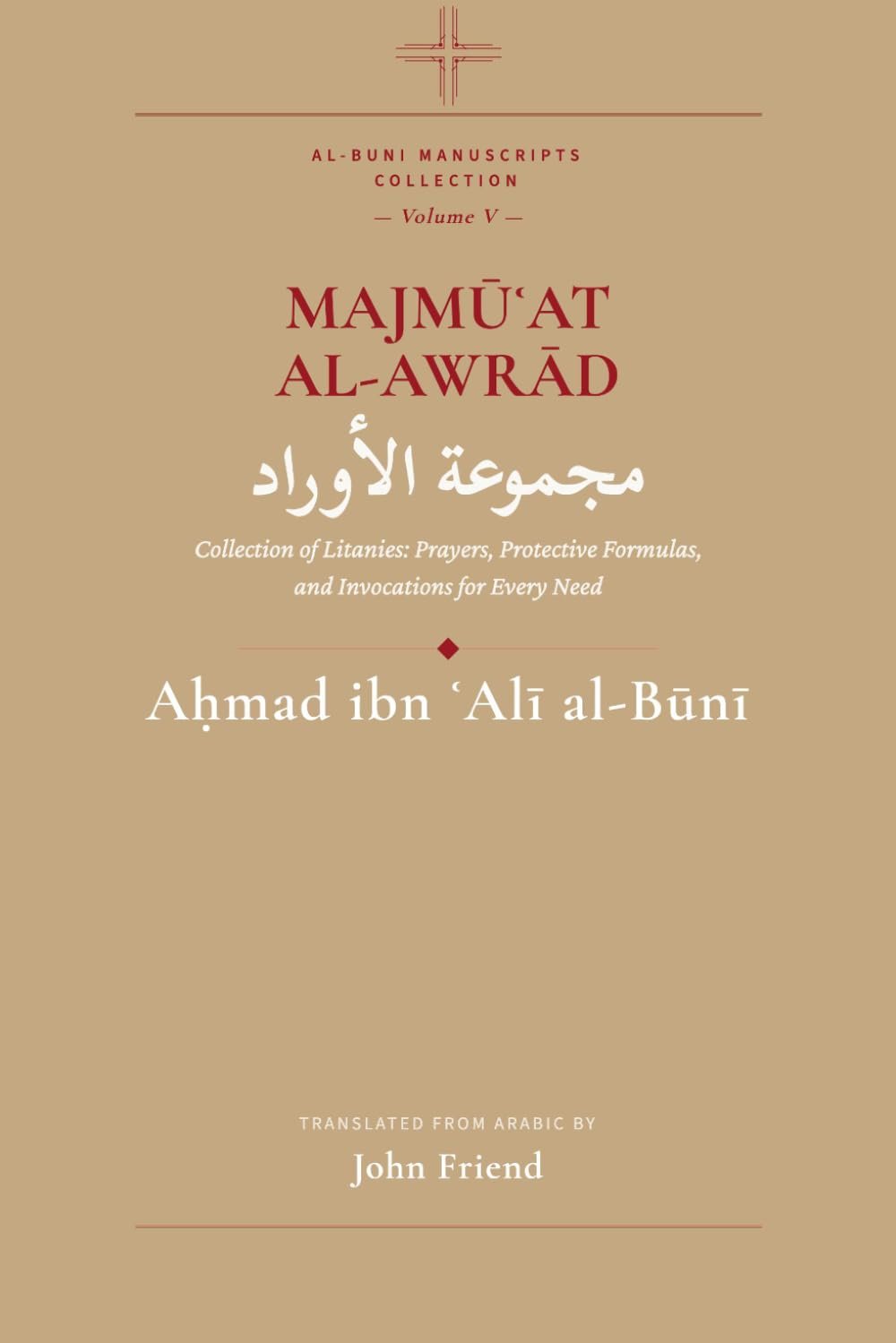
Volume V of the Al-Buni Manuscripts Collection — the Majmu’at al-Awrad (Collection of Litanies) — is not a grimoire of high ceremonial magic. It is a compact, 84-page practical manual spanning 17 chapters, and its subject matter is strikingly domestic. Chapter 1 opens with protective formulas for childbirth and relief of affliction. Chapter 16 addresses supplication for plague. Chapter 17 invokes the divine name Ya Latif specifically for epidemic disease. Between these bookends, the text covers prayers for distress, invocations of forgiveness, noble recitations, and formulas for every kind of daily need.
This is the al-Buni that the sensational reputation obscures. Not the sorcerer. The pastoral healer.
What the Majmu’at al-Awrad Actually Contains
The structure of Volume V is organized around practical need rather than theoretical categories. Its 17 chapters move through a range of human emergencies and devotional situations that would have been immediately recognizable to any medieval Muslim household.
Chapter 1: Protective Formulas, Childbirth, and Relief of Affliction opens the collection with its most striking material. The text describes a procedure for difficult childbirth: the practitioner writes a specific formula in a state of ritual purity, binds it upon the laboring woman, and removes it immediately upon delivery. For pain, fever, constriction, or distress, the text prescribes writing appropriate words on clean paper, washing the writing in pure water, and letting the afflicted person drink from it.
This technique — writing sacred words, dissolving them in water, and administering the water as a remedy — is one of the most widespread practices in the Islamic world. It appears in traditions from Morocco to Malaysia, from the medieval period to the present day. Al-Buni did not invent it. But his systematization of which words to write, for which conditions, under what state of purity, gave practitioners a structured reference where previously they had relied on oral transmission.
Chapters 2 through 9 develop the devotional framework. Chapter 2 provides formulas for relief, protection, and spiritual opening. Chapters 3 and 4 center on the recitation of specific Quranic suras — Ya Sin (83 verses, Meccan) and al-Fath (29 verses, Medinan) — which carry particular spiritual weight in Islamic tradition. Chapter 5 offers noble recitations and prayers for unveiling. Chapters 6 and 7 address the intention and practice of the wird — the regular litany of recitation that forms the backbone of Sufi devotional life. Chapter 8 presents an invocation of forgiveness and divine majesty. Chapter 9 gives praise of the Beautiful and Exalted One.
This is, in other words, a structured devotional program. A Muslim reading these chapters in sequence would move from practical emergency response through Quranic recitation into sustained litany and praise — a progression from crisis to contemplation.
The Crisis Chapters: When Everything Else Has Failed
Chapter 10: Prayer When in Distress addresses the human moment that every tradition must confront — what do you do when you are desperate and nothing is working? Al-Buni’s answer is specific: particular formulations, particular divine names, particular rhythms of recitation designed for the acute experience of overwhelm. This is not casual prayer. It is an emergency protocol.
Chapter 11: The Name al-Razzaq focuses on a single divine name — al-Razzaq, the Provider, the Sustainer. In Islamic theology, this is the name that addresses material provision, livelihood, and sustenance. Al-Buni dedicates an entire chapter to its invocation, suggesting a readership that was often facing economic hardship, famine, or deprivation. The medieval world he inhabited was one where drought, war, and economic disruption were constant threats. A chapter on invoking the Provider was not abstract theology. It was survival.
Chapter 12: Invocation Through the Divine Names and for Transforming the State introduces a more ambitious operation — not merely relief from distress but transformation of one’s condition entirely. The language of “transforming the state” (tahwil al-hal) has deep roots in Sufi vocabulary, where it refers to the shift from one spiritual station to another. But in this practical context, it likely also carried the everyday meaning: changing one’s circumstances from bad to better.
Plague, Epidemic, and the Ya Latif Tradition
The final chapters of the collection turn to the most terrifying collective experience of the medieval world: epidemic disease.
Chapter 16: Supplication for Plague and Other Illnesses provides specific devotional formulas for use during epidemic outbreaks. This chapter must be understood in its historical context. The Black Death reached the Islamic world in 1348 — roughly a century after al-Buni’s death in 622 AH / ~1225 CE — but plague and epidemic disease were persistent realities throughout the medieval period. Texts attributed to al-Buni circulated widely during and after the Black Death, and it is entirely possible that this chapter was added or expanded by later hands in response to the catastrophe. Whether original to al-Buni or compiled within the broader corpus Bunianum, it represents a tradition of spiritual response to epidemic that was deeply embedded in Islamic culture.
Chapter 17: Invocation of Ya Latif for Plague closes the collection with an invocation that remains among the most widely recited in the Islamic world today. Al-Latif — meaning the Subtle, the Gentle, the one who knows the hidden details of every situation — is the divine name traditionally invoked when affliction is beyond human understanding or control. The formula Ya Latif is recited in mosques across the Muslim world during times of epidemic, natural disaster, and collective grief. Al-Buni’s chapter systematized a practice that may well predate him, giving it a structured liturgical form within his broader devotional system.
Popular belief in many Arabic-speaking communities holds that the Ya Latif prayer has an almost tangible protective power — that communities which recite it collectively during plague are shielded by its invocation. Whether one views this as spiritual reality, psychological comfort, or communal solidarity, the practice has persisted for centuries. Al-Buni’s text is one of the earliest systematic treatments of it.
The Blurred Line Between Prayer and Magic
The Majmu’at al-Awrad forces a question that runs through all of al-Buni’s work: where does prayer end and magic begin?
The materials in this volume are drawn from unambiguously Islamic sources: Quranic verses, divine names, prophetic supplications. The practices — recitation, invocation, dhikr (remembrance of God) — are the standard tools of Sufi devotion. A Muslim scholar reading these chapters in isolation might see nothing objectionable — litanies and prayers of a kind found in any number of orthodox devotional manuals.
But the procedures surrounding these prayers — the specification that formulas must be written in a state of purity, bound upon the body, washed in water, and administered as a drink — move into territory that Islamic jurisprudence has historically debated. Is a written prayer that heals still a prayer? Or has it become a talisman? Is reciting Ya Latif 129 times at a specific hour still supplication? Or has it become an operation?
Al-Buni’s genius — or his danger, depending on your perspective — was in refusing to draw that line. The distinction between spiritual science and sorcery in Arabic tradition has never been settled, and this volume sits precisely at that fault line. For him, prayer was operative. The divine names were forces. Quranic recitation did things in the world, not merely in the soul. This theological position made his work simultaneously appealing to practitioners seeking real-world results and suspicious to scholars who insisted on a cleaner separation between devotion and magic.
The controversy has never been resolved. To this day, across the Islamic world, practitioners who use al-Buni’s methods often frame them as “spiritual science” (’ilm ruhani) rather than magic (sihr) — a distinction that is linguistically precise and theologically contested. Volume V sits squarely in this contested zone, and its contents make the debate more complicated, not less. Because if al-Buni was a sorcerer, he was a sorcerer who wrote prayers for women in labor.
Why This Volume Matters
The Majmu’at al-Awrad matters because it complicates the popular image of al-Buni as purely a figure of dark magic and forbidden knowledge. The man — or the tradition that compiled works under his name — was also concerned with the most intimate and vulnerable moments of human life: the pain of childbirth, the terror of plague, the desperation of distress, the hunger for provision.
These are not the concerns of a scholar locked in an ivory tower constructing theoretical systems. They are the concerns of a pastoral figure, a healer, a spiritual advisor to ordinary people facing ordinary crises with the tools their tradition made available — prayer, divine names, Quranic recitation, and the belief that God’s words, properly deployed, could intervene in the material world.
At 84 pages and 17 chapters, this is the shortest volume in the Al-Buni Manuscripts Collection. Its brevity is its purpose. This was a working reference — the book you reached for when the midwife looked worried, when the fever would not break, when plague entered your quarter of the city. It is compact because emergency manuals must be. Every formula, every invocation, every chapter heading addresses a specific need.
In the popular imagination, al-Buni’s books are objects of fear — texts that attract jinn, that curse their readers, that contain powers too dangerous for the uninitiated. The Majmu’at al-Awrad tells a different story. It is a book written for people who were already afraid — of death, of disease, of the evil eye, of the countless threats that filled the medieval world — and it offered them words to speak in the dark.
The Al-Buni Manuscripts Collection, Volume V is available in paperback from John Friend Publishing. It includes the complete Arabic text of the Majmu’at al-Awrad with facing English translation and scholarly annotations.