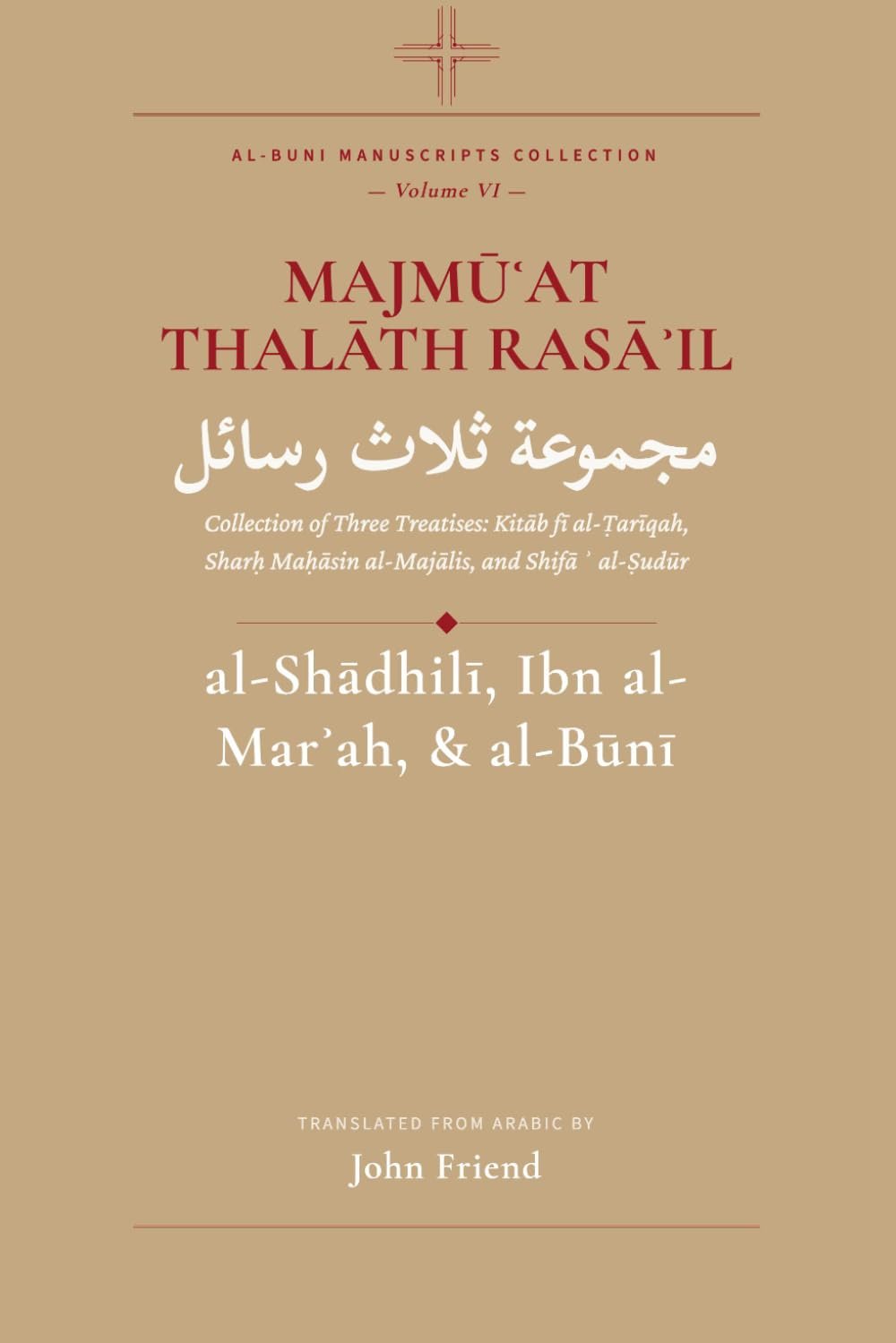
Volume VI — Al-Buni Manuscripts Collection
Majmu'at Thalath Rasa'il: Collection of Three Treatises
مجموعة ثلاث رسائل
English translation of three treatises attributed to al-Buni and his spiritual lineage — including the Sufi path of 60 gates from the Shadhili tradition. These are the forbidden treatises that circulated together in manuscript form, covering operative spirituality, mystical progression, and esoteric practice. The three are Kitab fi al-Tariqah, attributed to al-Shadhili; Sharh Mahasin al-Majalis by Ibn al-Mar'ah; and Shifa' al-Sudur, attributed to al-Buni.
Kindle $39.95 Paperback $39.95
Bookstores & libraries: order wholesale direct from the publisher
What's Inside
- Three treatises bound together as a single manuscript — each covering a distinct aspect of al-Buni's spiritual science.
- Shorter operational works complementing the major texts, with a more focused scope and practical orientation.
- Includes material not found in the Shams al-Ma'arif — unique content preserved only in this bound collection.
- 278 pages that illuminate corners of al-Buni's system that his larger works leave in shadow.
What the Three Treatises Contain
One of the Ahmad al-Buni manuscripts in this series, Volume VI binds three works into one book of 278 pages. Only the third is attributed to al-Buni himself; the first two come from the Sufi masters whose teaching frames it, so the volume moves from inner discipline to the science of letters.
Part I: Kitab fi al-Tariqah — Al-Shadhili's Sixty Gates
Attributed to Abu al-Hasan al-Shadhili, the first treatise is a Sufi manual in sixty gates. It opens by teaching that the path to the divine Name rests on four matters: remembrance, reflection, poverty and love. From The Etiquette of the Adjuring Practitioner it moves through gates on repentance, seeking forgiveness, remembrance, reliance, love and the Lordly Letters, to the divine names al-'Alim, al-Karim and al-'Azim and a final gate On Particularity. Read our essay on the Sufi path of 60 gates.
Part II: Sharh Mahasin al-Majalis — Ibn al-Mar'ah's Book of the Balance
The second treatise, The Book of the Balance, is by Abu Ishaq Ibrahim ibn Yusuf al-Mursi, known as Ibn al-Mar'ah, “the Andalusian of Murcia.” It is a commentary on Mahasin al-Majalis (The Beauties of Gatherings) by Abu al-'Abbas Ibn al-'Arif, and it includes a Risalah on the Qur'anic Order of the Praiseworthy Stations. A long passage on sama', spiritual audition, weighs when listening is permitted, citing al-Ghazali's replies to those who declared it forbidden.
Part III: Shifa' al-Sudur — Al-Buni on the Natures of the Letters
The closing treatise, attributed to Ahmad ibn 'Ali al-Buni, turns to the letters. Its chapter The Natures of the Letters teaches that hot letters benefit cold illness, cold letters hot illness, moist letters dry illness and dry letters moist illness. Further chapters follow The Knower's Passage Through the Letters, Whispered Prayers, The Rank Written by the Pen and The Drink of the Near Ones. For al-Buni's letter-by-letter treatment, see al-Asrar al-Rabbaniyyah.
Corpus Bunianum, the Shams al-Ma'arif and the “Forbidden” Treatises
Scholars call the body of works attributed to al-Buni the corpus Bunianum. Its best-known member is the Shams al-Ma'arif al-Kubra, whose full title is Shams al-Ma'arif wa-Lata'if al-'Awarif; modern scholarship regards much of it as the work of later authors writing under al-Buni's name (see what the Shams al-Ma'arif manuscript is). This volume shows the corpus's Sufi side, binding a treatise attributed to al-Buni to works attributed to al-Shadhili and Ibn al-Mar'ah.
The Shams al-Ma'arif is often described as a forbidden book in Islam, and the same caution has followed the shorter texts that circulated with it. Here the Sufi discipline comes first: al-Shadhili's opening gate asks for constant repentance and seeking of forgiveness before any approach to the Name.
Because the full title of the Shams al-Ma'arif ends in al-'Awarif, it is easily confused with 'Awarif al-Ma'arif, the Sufi manual of Shihab al-Din 'Umar al-Suhrawardi. That work is not in this volume; the nearest thing to an 'Awarif al-Ma'arif manuscript in this collection is al-Shadhili's sixty-gate manual of Sufi etiquette, translated here in full.
Questions About Majmu'at Thalath Rasa'il
What are the three treatises in Majmu'at Thalath Rasa'il?
Which treatise is attributed to al-Buni?
Is this the 'Awarif al-Ma'arif manuscript?
Why are these called forbidden treatises?
How does this volume relate to the Shams al-Ma'arif?
Follow the Translation
New essays on the Arabic occult tradition, manuscript discoveries, and translation notes.