Open any discussion of al-Buni’s works in the Arabic-speaking world, and you will hear a consistent warning: these texts are dangerous. They attract jinn. They corrupt the soul. They contain sihr — operative magic of the most powerful and forbidden kind. Across the Middle East and North Africa, governments and religious authorities have banned and burned works attributed to al-Buni for centuries. The popular imagination treats his texts as radioactive — objects that contaminate merely through proximity.
This makes Volume VI of the Al-Buni Manuscripts Collection particularly interesting. Because it opens with a Sufi devotional manual.
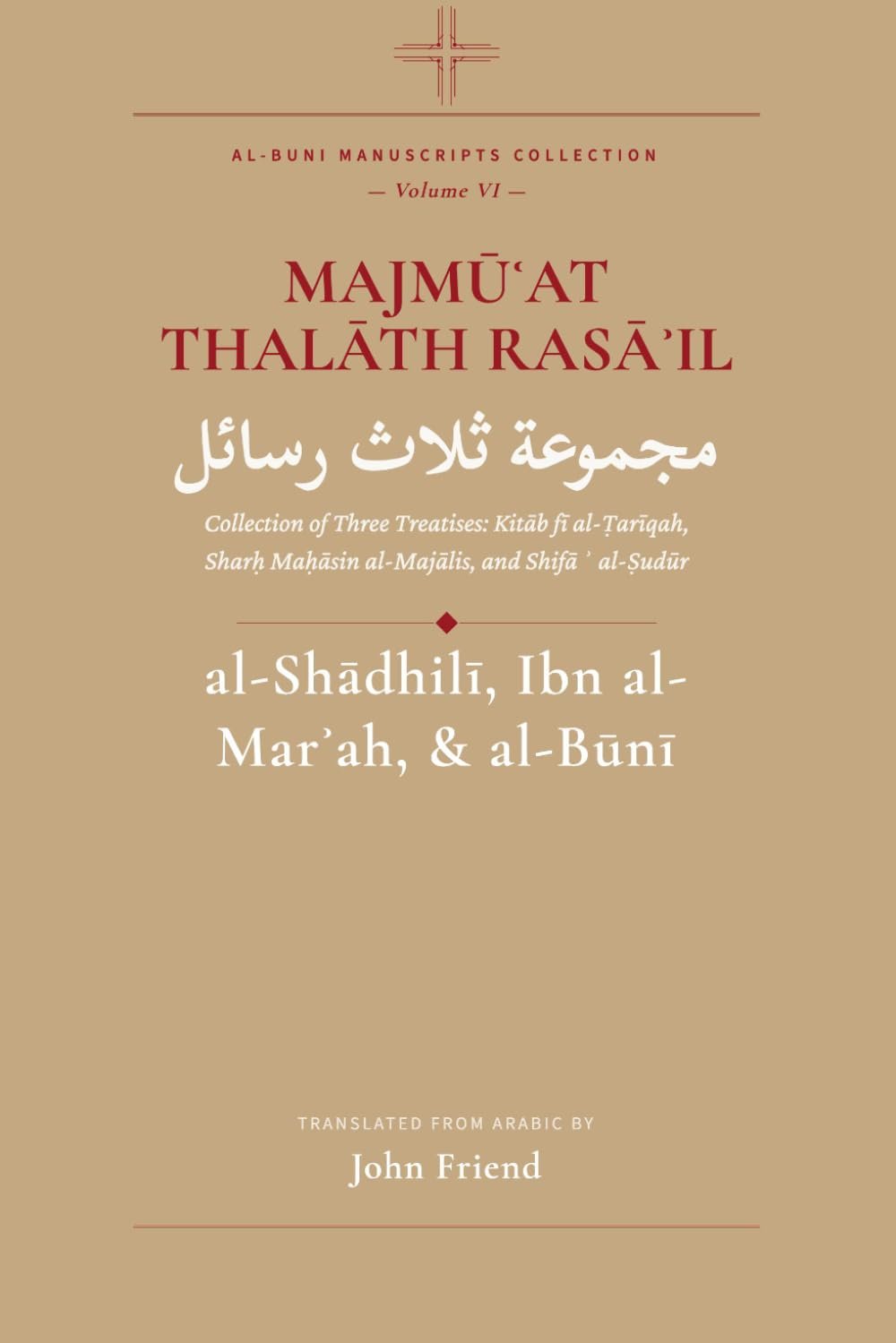
The Majmu’at Thalath Rasa’il (Collection of Three Treatises) is a compilation of 278 pages containing three distinct works by three different authors. The title page names all three: al-Shadhili, Ibn al-Mar’ah, and al-Buni. Part I is the Kitab fi al-Tariqah (Book of the Path) — a systematic presentation of the Sufi spiritual journey organized into 60 “gates,” attributed to Abu al-Hasan al-Shadhili, the founder of the Shadhiliyyah Sufi order. This is not magical instruction. It is spiritual formation — the inner discipline of the mystic’s path toward God.
And yet someone, at some point in the manuscript tradition, bound it alongside al-Buni’s work. The question is: why?
Al-Shadhili and the Shadhiliyyah
Abu al-Hasan al-Shadhili (d. 1258 CE) is one of the most important figures in the history of Sufism. Born in Morocco, he traveled extensively through North Africa, studied with major Sufi masters, and founded the Shadhiliyyah order — a tariqah (Sufi path) that would become one of the most widespread in the Islamic world, with branches stretching from West Africa through the Ottoman Empire to Southeast Asia.
Al-Shadhili’s approach was distinctive in several ways. He rejected the outward markers of asceticism that characterized some earlier Sufi movements — he did not wear the patched wool cloak (muraqqa’ah) that identified many Sufis, and he encouraged his followers to remain engaged with worldly life rather than withdrawing to monasteries or wilderness. His emphasis was on inner transformation: purifying the heart, cultivating the divine attributes within oneself, and maintaining constant awareness of God’s presence within ordinary activity.
He was also al-Buni’s near-contemporary. Al-Buni died around 622 AH / 1225 CE; al-Shadhili around 1258. They operated in the same cultural and geographical world — North Africa and Egypt — during the same period. The intellectual and spiritual currents that shaped al-Buni’s operative magic also shaped al-Shadhili’s mystical path. They were not opposites. They were neighbors.
The 60 Gates: A Map of the Spiritual Journey
Part I of Volume VI — the Kitab fi al-Tariqah — is organized into 60 gates (abwab), each representing a stage of spiritual development or a specific aspect of practice. The gates begin with foundational etiquette and progress through increasingly advanced spiritual stations.
The opening gates establish the framework. They address the etiquette of the adjuring practitioner — the adab (proper conduct) that must be observed by anyone who would engage with the spiritual world. This is significant because the Arabic word used for “adjuring practitioner” connects directly to the terminology of al-Buni’s operative magic. The Sufi path and the operative path share a starting point: proper conduct, inner purity, and correct relationship with the divine.
The middle gates develop the practitioner’s relationship with the spiritual waystations (manazil) of the Sufi path — a word that shares its root with the 28 lunar mansions (manazil al-qamar) of the astronomical tradition al-Buni mapped to talismanic practice. In classical Sufi cosmology, the journey toward God passes through a series of stations — repentance, patience, gratitude, trust, love, and ultimately annihilation of the self in the divine presence. Each gate in al-Shadhili’s manual addresses the practice, the dangers, and the signs of progress associated with these stations.
The culminating gate — the Sixtieth Gate — is titled “On Particularity” (al-khususiyyah). In Sufi vocabulary, khususiyyah refers to the unique, individual relationship between the perfected soul and God — the station at which the seeker is no longer following a general path but has been singled out for a particular divine purpose. This is the endpoint of the 60-gate system: not merely spiritual refinement but spiritual election.
Why Bind a Sufi Manual With Magical Texts?
The decision to compile al-Shadhili’s Sufi manual alongside al-Buni’s works was not casual. Medieval manuscript compilation was deliberate; the arrangement of texts within a single binding reflected the compiler’s understanding of how those texts related to each other.
The logic of Volume VI reveals a system: spiritual purification precedes operative practice. The seeker must first travel the inner path — the 60 gates of soul-cultivation — before undertaking the operative work that al-Buni’s texts describe. The Sufi manual is not incidental decoration. It is prerequisite instruction.
This understanding was widespread in the medieval Islamic world. Al-Buni himself, in texts attributed to him across the corpus Bunianum, repeatedly insists that operative work requires a pure soul, a clean heart, and a disciplined spiritual practice — which is part of why the texts have always been considered dangerous for the unprepared. The Shams al-Ma’arif opens with extensive Sufi cosmological material before introducing any operative procedures. The compiler of Volume VI made this prerequisite structure explicit by placing the Sufi manual first.
This arrangement also complicates the popular narrative about al-Buni’s texts. If these works were purely dangerous sorcery, why would they be bound with a devotional manual from one of the most respected Sufi masters in Islamic history? The compilation suggests that the original readers and copyists understood these texts differently than modern popular culture does — not as forbidden sorcery but as an integrated system of spiritual development and operative practice.
Part II: Commentary on the Spiritual Assemblies
The second treatise in Volume VI is Sharh Mahasin al-Majalis — a commentary on the beauties (or virtues) of the spiritual assemblies. This text is attributed to Ibn al-Mar’ah, a scholar whose commentary tradition bridges the devotional and the operative.
The majlis (assembly, plural majalis) in Sufi practice is a gathering for dhikr (remembrance of God), teaching, and collective spiritual practice. These assemblies were — and remain — the primary social form of Sufi devotional life. A commentary on their virtues addresses both the theology of communal worship and the practical dynamics of spiritual assembly: how they should be conducted, what energies they generate, and what dangers they present.
This second treatise functions as a bridge between the individual Sufi path described in Part I and the operative work that the broader corpus addresses. The assembly is where individual practice becomes communal power — where the combined recitation of divine names by a group of purified practitioners generates effects that no individual could produce alone. This is, in operative terms, the difference between a single practitioner and a working group.
Part III: The Healing of Hearts
The third treatise — Shifa’ al-Sudur (The Healing of Hearts, or literally, The Healing of Breasts) — is attributed to al-Buni himself. Its title connects to the Quranic phrase that describes the Quran as “a healing for what is in the breasts” (shifa’ li-ma fi al-sudur), placing al-Buni’s contribution squarely within an Islamic therapeutic framework.
The “healing of hearts” in Sufi vocabulary refers to the treatment of spiritual diseases — pride, envy, attachment, forgetfulness of God — that obstruct the seeker’s journey. By placing this treatise last in the compilation, the compiler creates a three-stage system: first, travel the path (al-Shadhili’s 60 gates); second, participate in the communal practices that amplify individual work (Ibn al-Mar’ah’s commentary on assemblies); third, heal the diseases of the heart that block spiritual power (al-Buni’s therapeutic instructions).
This is a curriculum. The compiler of Volume VI was not randomly gathering texts. They were constructing a pedagogical sequence.
The Implications for Understanding al-Buni
Volume VI challenges the popular image of al-Buni in fundamental ways. The man whose name appears on the title page alongside al-Shadhili — one of the most venerated saints in Sunni Islam — cannot be simply dismissed as a sorcerer or a purveyor of forbidden knowledge. The manuscript tradition that preserved his works understood them as part of a broader spiritual system that included orthodox Sufi devotion, communal worship, and inner purification.
This does not mean al-Buni’s works are uncontroversial. Islamic scholars have debated the permissibility of operative magic for centuries, and that debate continues. But the evidence of the manuscripts themselves — the compilation choices, the ordering of texts, the co-presence of Sufi devotional manuals and operative instructions — tells a more complex story than either wholesale condemnation or uncritical acceptance.
The Sufi path in 60 gates was bound with al-Buni’s sihr because, in the understanding of the people who made and read these manuscripts, the two were inseparable. The question of where Sufi practice ends and operative magic begins is explored directly in the essay on the difference between spiritual science and sorcery in the Arabic tradition. The gate and the operation, the prayer and the talisman, the saint and the sorcerer — these were not separate categories but stations on a single continuum.
The Al-Buni Manuscripts Collection, Volume VI is available in paperback from John Friend Publishing. The complete Majmu’at Thalath Rasa’il with facing Arabic text, English translation, and scholarly annotations.