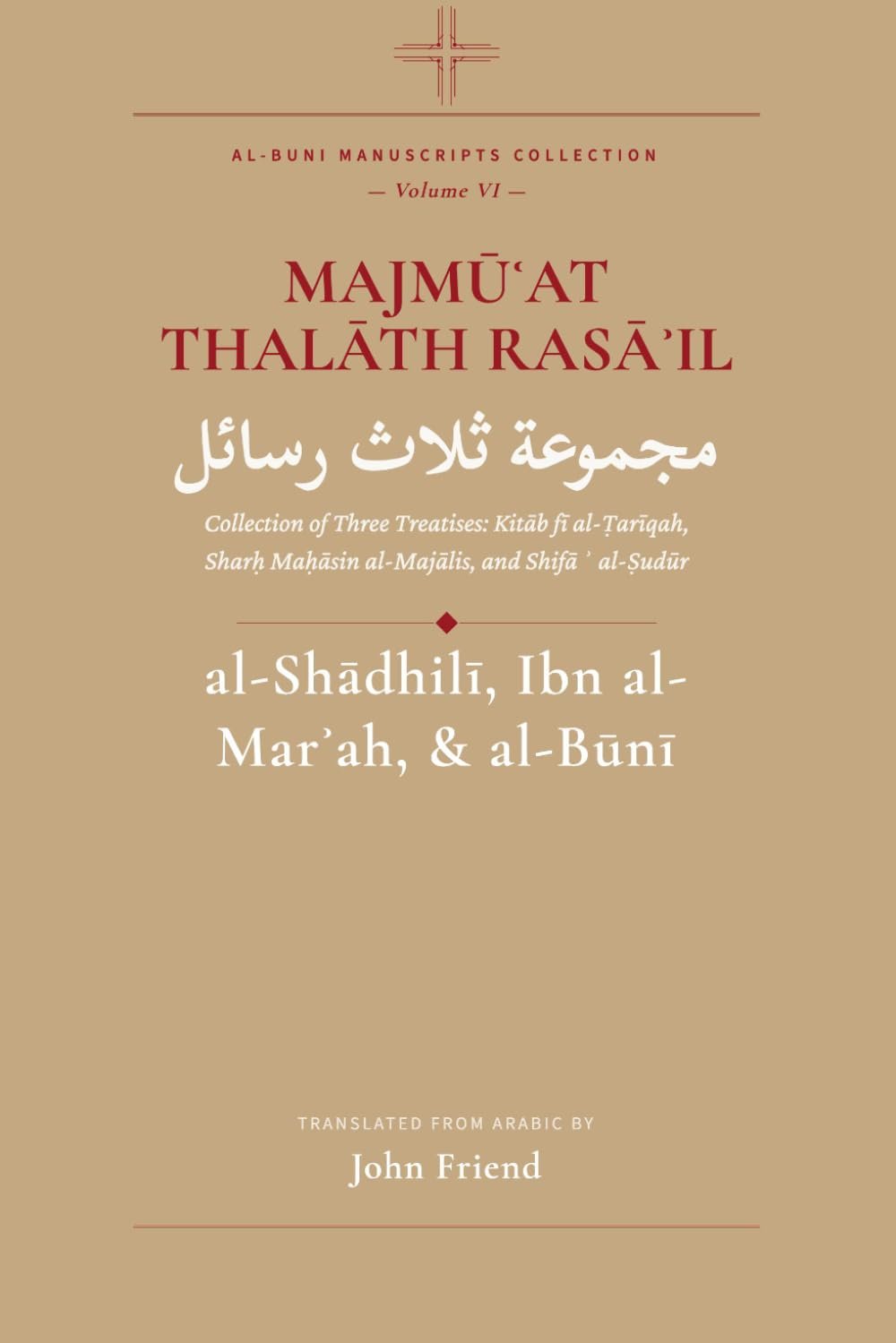
In the world of Arabic manuscripts, books are not always what they appear. A single binding may contain multiple works by different authors, assembled by a compiler whose logic may not be immediately apparent. Some compilations are haphazard — a scribe had blank pages left and filled them with whatever was handy. Others are deliberate — carefully structured anthologies in which the arrangement of texts tells a story that no individual text could tell alone.
Volume VI of the Al-Buni Manuscripts Collection is the second kind. The Majmu’at Thalath Rasa’il (Collection of Three Treatises) binds together three works by three different authors across 278 pages. The title page names all three: al-Shadhili, Ibn al-Mar’ah, and al-Buni (d. 622 AH / ~1225 CE). Each author contributed a distinct type of text. And the order in which they are arranged reveals a curriculum — a deliberate progression from inner purification through communal practice to therapeutic healing — that illuminates how medieval Muslim scholars understood the relationship between Sufism and operative magic.
This article examines why these three treatises were bound together, what each contributes to the whole, and what the compilation tells us about the intellectual world that produced and consumed al-Buni’s works.
The Title Page as Declaration
The title page of Volume VI is itself a significant document. By naming al-Shadhili, Ibn al-Mar’ah, and al-Buni together, the compiler was making a statement about the relationship between these authors and their traditions. Al-Shadhili is one of the most venerated saints in Sunni Islam, the founder of a Sufi order that spans continents. Al-Buni is the most notorious name in Arabic operative magic, a figure whose works have been banned and burned across the Islamic world. Ibn al-Mar’ah occupies a position between them — a scholarly commentator whose work bridges devotional practice and operative tradition.
Placing all three names on a single title page was not neutral. It was an argument: these traditions belong together. The saint, the scholar, and the operative magician are not opponents in a theological debate but colleagues in a single enterprise.
Part I: The Individual Path
The Kitab fi al-Tariqah (Book of the Path), attributed to al-Shadhili, presents the complete Sufi spiritual journey in 60 gates. As discussed in the companion article on this volume, these gates progress from foundational etiquette through spiritual waystations to the Sixtieth Gate — “On Particularity” — the station of individual spiritual election.
Placed first in the compilation, this treatise establishes the prerequisite: before anything else, the seeker must travel the inner path. Without the soul-work described in these 60 gates — repentance, patience, gratitude, trust, love, annihilation of the ego — the practices described in subsequent texts are not merely ineffective but dangerous. The popular belief that al-Buni's books drive readers mad may encode precisely this warning in mythological form. This is a consistent principle throughout al-Buni’s broader corpus: operative power without inner purity produces disaster.
The popular fear surrounding al-Buni’s texts may reflect precisely this understanding. When people say that al-Buni’s books “choose their reader,” or that reading them without preparation courts madness, they may be expressing in mythological terms what the manuscript tradition states explicitly: these works were designed for practitioners who had completed rigorous spiritual preparation. Used by the unprepared, they were expected to produce harm.
Part II: The Communal Dimension
The Sharh Mahasin al-Majalis (Commentary on the Beauties of the Assemblies), attributed to Ibn al-Mar’ah, addresses what individual practice alone cannot achieve. The Sufi majlis (assembly) is a gathering for collective dhikr (remembrance of God), teaching, and communal spiritual practice. Ibn al-Mar’ah’s commentary examines the theology, the virtues, and the practical dynamics of these gatherings.
In the context of the compilation, this second treatise introduces a crucial principle: the communal amplification of individual practice. A single practitioner who has traveled the inner path possesses spiritual capacity. A group of such practitioners, assembled in proper form, possesses exponentially greater capacity. The complete operative system built on this spiritual foundation is documented in the definitive guide to the Shams al-Ma'arif. The majlis is where individual spiritual accomplishment becomes communal spiritual power.
This has direct implications for operative practice. Many of al-Buni’s operations — and operations throughout the Arabic magical tradition — specify that they should be performed by groups, or that the prayers of multiple practitioners should be combined. The commentary on spiritual assemblies provides the theological and practical framework for why communal operation is more powerful than individual operation — and how such gatherings should be structured to maximize their effect.
Part III: Healing the Obstacles
The Shifa’ al-Sudur (The Healing of Hearts), attributed to al-Buni, completes the curriculum. Its title echoes the Quranic verse that describes the Quran as “a healing for what is in the breasts” — placing al-Buni’s therapeutic work squarely within an Islamic scriptural framework.
The “healing” in question is not physical but spiritual. In Sufi psychology, the heart (qalb) is the seat of spiritual perception, and it can be afflicted by diseases: pride (kibr), envy (hasad), attachment to the world (hub al-dunya), and forgetfulness of God (ghaflah). These diseases obstruct the seeker’s spiritual progress and, in operative terms, block the channels through which divine power flows.
By placing this treatise last, the compiler addresses a problem that the first two treatises raise. If the Sufi path (Part I) requires inner purity, and the communal assembly (Part II) amplifies whatever condition the individual brings, then spiritual diseases that persist despite sincere practice must be diagnosed and treated. Shifa’ al-Sudur is the diagnostic and therapeutic manual for precisely these conditions.
The progression is clear: travel the path (Part I), practice in community (Part II), heal what remains broken (Part III). Only then is the practitioner ready for operative work — work described in other volumes of the Al-Buni Manuscripts Collection.
The Compiler’s Intelligence
Anonymous compilers in the Arabic manuscript tradition rarely receive credit for their intellectual contributions. Yet the compiler of Volume VI demonstrated sophisticated understanding of how these three traditions relate. They understood that Sufism, communal worship, and therapeutic spirituality were not three separate domains but three dimensions of a single system.
The compilation also reveals something about the readership. A volume of 278 pages containing three treatises by three named authors was not a casual production. It required access to multiple source texts, literacy in the technical vocabularies of Sufi practice and operative magic, and the financial resources to commission a bound manuscript. The intended reader was educated, serious, and seeking systematic instruction — not merely dabbling in the occult.
This is consistent with what we know about the historical consumers of al-Buni’s works. Despite the popular image of these texts as dangerous curiosities for the foolish, the manuscript evidence suggests a readership of scholars, practitioners, and spiritual seekers who approached the material with intellectual rigor and devotional seriousness.
The Attribution Question
Modern scholarship rightly applies the “attributed to” qualification to medieval Arabic texts. The Kitab fi al-Tariqah is “attributed to” al-Shadhili, and whether he personally authored every word is uncertain. The same qualification applies to Ibn al-Mar’ah’s commentary and to al-Buni’s Shifa’ al-Sudur. Medieval authorship functioned differently from modern authorship — attribution to a prestigious name guaranteed a text’s lineage and authority rather than its literal provenance. This is why the question of where spiritual science ends and sorcery begins in these traditions is inseparable from questions of authorship and transmission.
But the attribution question does not diminish the compilation’s significance. Whether or not al-Shadhili personally penned the 60 gates, the text circulated under his authority within a tradition that took that authority seriously. Whether or not al-Buni personally wrote the Shifa’ al-Sudur, it was received as part of his corpus by generations of practitioners. The compilation reflects how these traditions understood themselves, regardless of modern questions about individual authorship.
What the Binding Reveals About al-Buni
Volume VI transforms our understanding of al-Buni by placing him in context. His name on a title page alongside al-Shadhili’s means that the manuscript tradition understood his work as continuous with mainstream Sufi practice — an extension and application of the same spiritual principles that the great Sufi masters taught.
This does not resolve the debate about al-Buni’s orthodoxy. Islamic scholars have argued about the permissibility of operative magic for centuries, and they will continue to do so. But the manuscript evidence is clear: the people who made, copied, bought, and read these texts did not see al-Buni as an opponent of the Sufi tradition. They saw him as its operative arm — a tradition whose most dramatic operative instructions include the complete system for working with the seven kings of jinn.
Three treatises. Three authors. One system. The binding is the argument.
The Al-Buni Manuscripts Collection, Volume VI is available in paperback from John Friend Publishing.