Everyone knows the 99 Names of God. They are printed on posters in Muslim homes from Jakarta to Detroit. They are recited on prayer beads. They appear on calligraphy in mosques, on jewelry, on phone cases. Al-Rahman, the Merciful. Al-Rahim, the Compassionate. Al-Malik, the Sovereign. The names are so familiar that they have become cultural furniture — beautiful, cherished, and mostly decorative. Ask anyone what the 99 Names mean and you will get a devotional answer: they describe the attributes of God. They are recited for blessing. They are a foundation of Islamic worship.
All of which is true. And all of which represents approximately 1% of what Ahmad ibn ʿAlī al-Buni (d. 622 AH / ~1225 CE) had to say about them.
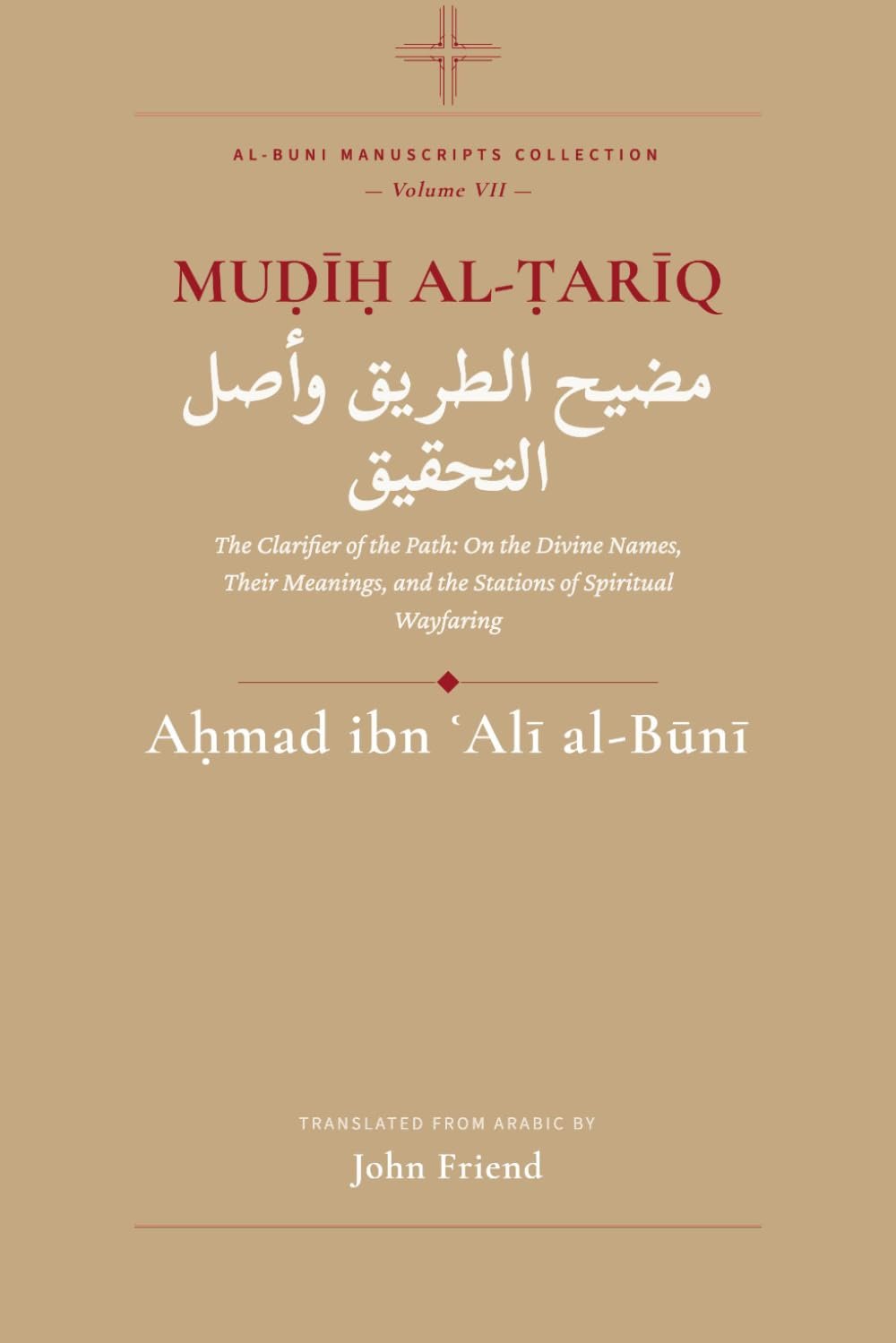
Because what al-Buni actually wrote about the 99 Names of God is not a devotional pamphlet. It is a 571-page treatise called Mudih al-Tariq — The Illuminator of the Path — containing over 80 named chapters, each dedicated to a single divine name, each providing the name’s spiritual properties, its numerical value, its letter correspondences, its planetary associations, its operative deployment, and the specific practices through which a qualified practitioner can access its particular dimension of divine power.
This is not worship in the ordinary sense. This is a science — and it is the largest single work in the entire al-Buni corpus.
The Scale Nobody Expected
Volume VII of the Al-Buni Manuscripts Collection runs to 571 pages. To put that in perspective: the Shams al-Ma’arif — the most famous text in the Arabic occult tradition — addresses the divine names in Part II of its four-part structure, alongside magic squares, letter science, and numerous other subjects. The treatment is substantial but shares space with other material.
The Mudih al-Tariq is devoted entirely to the divine names. Nothing else. 571 pages of nothing but the names, their properties, and their deployment. It is, by a wide margin, the most comprehensive treatment of the asma’ al-husna (the beautiful names) in the Arabic occult tradition — and possibly in any tradition.
The volume opens with a section titled “Counsel to Seeking Wayfarers” (p. 8) — a spiritual preparation guide that establishes the inner conditions necessary for studying the divine names. This is not a formality. In al-Buni’s framework, the divine names are not mere words. They are living realities — dimensions of divine presence that respond to the practitioner’s inner state. Approaching them without preparation is not merely ineffective; it is dangerous, like handling electrical current without insulation.
80 Chapters, 80 Names: The Architecture
After the preparatory section, the volume moves through its 80+ named chapters. Each chapter is titled with a specific divine name and provides a comprehensive treatment of that name’s significance and deployment.
The Supreme Name: Allah (p. 19)
The volume begins where it must: with the name Allah itself. This opening chapter runs 19 pages — the longest single chapter in the volume — and establishes the supreme name as the foundation upon which all other names depend. In al-Buni’s understanding, Allah is not merely the first among equals. It is the name that contains all other names, the source from which all divine attributes emanate and to which they all return.
Names of Power: al-Samad, al-Hayy, al-Qayyum
The early chapters address the names that the tradition considers most powerful in operative deployment. Al-Samad (the Eternal, p. 39) — the name that describes God’s absolute self-sufficiency, deployed for protection against need and want. Al-Hayy (the Living, p. 47) — the name that carries the essence of divine vitality, deployed for healing, renewal, and the restoration of spiritual energy. Al-Qayyum (the Self-Subsisting, p. 52) — the name that describes God’s sustaining presence, deployed for stability, endurance, and the maintenance of spiritual states.
Each chapter follows a consistent structure: the name’s meaning, its numerical value through the abjad system, its elemental and planetary correspondences, the specific conditions under which it should be invoked, the number of repetitions required for different purposes, and the spiritual effects that the tradition attributes to its proper deployment. Understanding the distinction between spiritual science and sorcery is essential context for reading these chapters correctly.
Names of Authority: al-Malik, al-Qahhar, al-Jabbar
The names of authority — al-Malik (the Sovereign), al-Qahhar (the Subduer), al-Jabbar (the Compeller) — govern the operative territory that most concerns practitioners: the ability to exercise spiritual authority over circumstances, beings, and events. These chapters are among the most detailed in the volume, providing not only the invocational formulas but the specific timing, preparation, and material requirements for their operative use.
Names of Mercy: al-Rahman, al-Rahim, al-Latif
The names of mercy occupy a different register. Al-Rahman (the All-Merciful), al-Rahim (the Especially Merciful), al-Latif (the Subtle) — these are the names deployed for healing, reconciliation, the softening of hearts, and the attraction of divine grace. The chapters on these names tend to be gentler in tone, reflecting the nature of the attributes they address, and they connect naturally to the planetary fumigation practices that accompany many divine name workings.
Names of Knowledge: al-’Alim, al-Khabir, al-Basir
The names of knowledge — al-’Alim (the All-Knowing), al-Khabir (the All-Aware), al-Basir (the All-Seeing) — govern the practitioner’s access to hidden information, spiritual insight, and prophetic vision. These chapters address one of the most sought-after categories of spiritual attainment: the ability to perceive what is normally invisible, to know what is hidden, and to see through the veils that separate ordinary awareness from spiritual reality.
The Method Behind the Names
What makes the Mudih al-Tariq a genuine system — rather than a devotional catalog — is its methodology. Each divine name is not merely described but positioned within a comprehensive framework that connects it to every other element of al-Buni’s cosmological science.
The framework includes:
- Numerical value — each name resolves to a number through the abjad system, and that number determines the name’s mathematical relationships to magic squares, letter permutations, and angelic hierarchies
- Elemental correspondence — each name carries an elemental signature (fire, air, water, earth) that determines its mode of action
- Planetary association — each name is linked to one of the seven classical planets, governing the timing of its deployment
- Recitation count — the number of times a name must be recited for different effects, calculated from its numerical value
- Incense formula — the specific fumigation appropriate to each name’s planetary association
- Operative purpose — the specific category of spiritual work for which each name is most effective
This systematic approach means that the Mudih al-Tariq is not a book to read sequentially and put down. It is a reference work — a practitioner’s manual to be consulted repeatedly for specific purposes, the way a physician consults a pharmacopoeia for specific conditions.
From Allah to al-Ghani: The Arc of the Work
The volume’s journey from its first named chapter (“Allah,” p. 19) to its last (“al-Ghani,” p. 563) traces an arc through the full spectrum of divine attributes. It begins with unity and sovereignty, moves through power and authority, passes through mercy and compassion, traverses knowledge and perception, and arrives finally at divine self-sufficiency — al-Ghani, the name that describes God’s absolute independence from all creation.
The final section, titled “He Begets Not” (p. 565), addresses the theological anchor of the divine names tradition: the absolute transcendence and uniqueness of God. This is the frame that prevents the operative use of divine names from sliding into polytheism or idolatry. The names are attributes of one God. Their power derives from that unity. Their deployment serves that unity. And the entire 571-page system is, in al-Buni’s understanding, an act of worship — the most sophisticated and comprehensive act of worship that a human being can perform.
Why This Volume Changes the Picture
The English-language understanding of al-Buni has been shaped primarily by the Shams al-Ma’arif — a text that is itself enormous and comprehensive, but that represents only one dimension of al-Buni’s output. The Mudih al-Tariq represents another dimension entirely: a focused, exhaustive, single-subject treatment that reveals the depth to which al-Buni explored the divine names.
For practitioners who work with the divine names, Volume VII provides what no previous English translation has offered: the complete system. Not selected names. Not summarized chapters. Not devotional extracts. The full 80+ chapters, the full 571 pages, the complete operative framework for every name from Allah to al-Ghani.
For scholars, the volume provides an indispensable primary source for understanding the relationship between Islamic devotional practice and operative magical tradition. The Mudih al-Tariq sits precisely at the intersection of worship and science, devotion and technique, theology and operative deployment — the intersection that defines the Arabic occult tradition as a whole. To read more about how al-Buni’s works were banned and burned, yet survived to reach the present day, is to understand why this volume matters.
The translation is in paperback format with full IJMES romanization and diacritical marks. 571 pages of what al-Buni actually wrote about the 99 Names of God — not the poster, not the prayer beads, not the calligraphy, but the science behind them all.