Ask anyone who knows the name al-Buni and they will tell you about the Shams al-Ma’arif. The cursed book. The forbidden grimoire. The 40-chapter encyclopedia of Arabic magic that has been banned, burned, and whispered about for eight centuries. The Shams al-Ma’arif is the text that made Ahmad ibn ʿAli al-Buni (d. 622 AH / ~1225 CE) a legend — and a villain, depending on who you ask. It is the work for which he is remembered.
But it may not be the work for which he should be remembered.
Because before the Shams — or alongside it, or after it, the chronology is debated — another text attributed to al-Buni appeared. Longer. More focused. More ambitious in its singular purpose. A text that takes the divine names of God — the asma’ al-husna that form the theological heart of Islamic worship — and subjects them to the most exhaustive operative analysis ever attempted in any language. Eighty chapters. Eighty divine names. Five hundred and sixty-five pages. A work that scholars who have examined the Arabic manuscript tradition consider al-Buni’s definitive treatment of his most important subject.
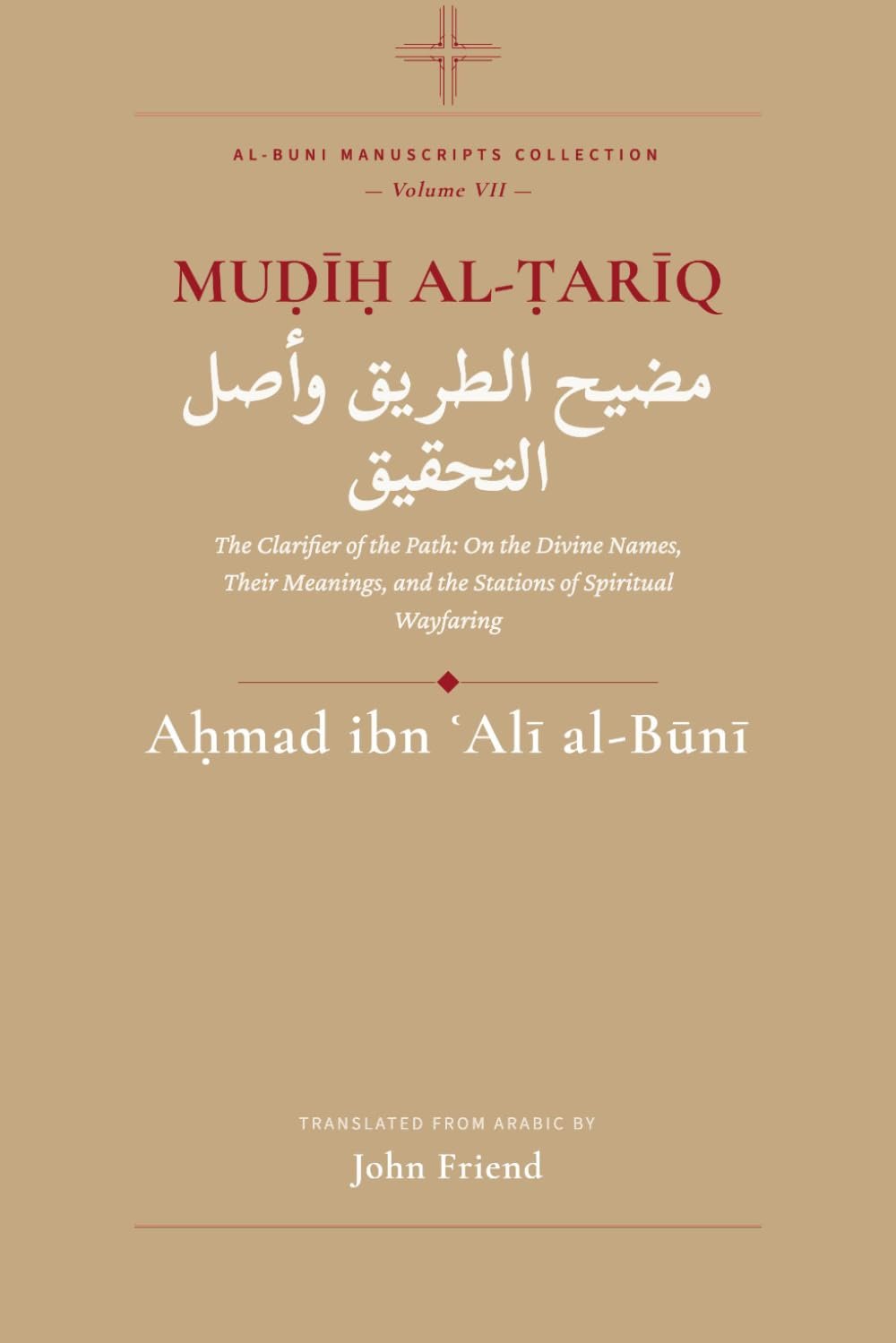
Its name is Mudih al-Tariq — The Illuminator of the Path. And until Volume VII of the Al-Buni Manuscripts Collection, it had never been published in English.
The Shadow of the Shams
The Shams al-Ma’arif cast such a long shadow that it obscured everything else al-Buni wrote. This is understandable. The Shams is dramatic, comprehensive, and terrifying — a text that combines letter science, magic square construction, lunar mansions, divine names, and operational conjurations into a single encyclopedic work. It earned fatwas, inspired legends, and generated a fear that has persisted for eight centuries.
But encyclopedic works, by their nature, sacrifice depth for breadth. The Shams addresses the divine names in Part II of its four-part structure, alongside magic squares and numerical science. The treatment is substantial but compressed — constrained by the need to cover many subjects within a single work. The result is that the English-language understanding of al-Buni’s approach to the divine names has been shaped by a treatment that represents, at best, a summary of his actual thinking.
The Mudih al-Tariq is the unsummarized version.
Structure of the Masterpiece
The volume opens with “Counsel to Seeking Wayfarers” (p. 8) — a preparatory section that establishes the spiritual and ethical framework for studying the divine names. This is not a preamble to be skipped. Al-Buni is explicit: the divine names are not tools to be picked up casually. They are dimensions of divine reality, and approaching them without proper preparation — without humility, without purification, without genuine spiritual aspiration — is not merely ineffective but actively dangerous.
From page 19 onward, the text moves through its 80+ named chapters. Each is titled with a specific divine name and structured consistently: the name’s meaning and theological significance, its abjad numerical value, its elemental and planetary correspondences, the conditions for its invocation, the number of repetitions for different purposes, and the specific spiritual effects attributed to its deployment.
The Arc from Power to Unity
The chapter sequence is not alphabetical. It follows a theological and cosmological logic that traces an arc from the supreme name through various categories of divine attribute and back to divine unity.
The opening chapters address the names of absolute divine power: Allah (19 pages), al-Samad (p. 39), al-Hayy (p. 47), al-Qayyum (p. 52). These are the names that carry the weight of divine sovereignty — the names that practitioners invoke when they need to access the highest levels of spiritual authority.
The middle chapters move through names of mercy, knowledge, and creative power. Al-Rahman, al-Rahim, al-Latif — the gentle names that govern healing, compassion, and the softening of hearts. Al-’Alim, al-Khabir, al-Basir — the names of perception that open the practitioner’s awareness to hidden dimensions of reality.
The final chapters arrive at al-Ghani (p. 563) — divine self-sufficiency — and the closing section “He Begets Not” (p. 565), which seals the entire work with the affirmation of divine transcendence. The arc is complete: from unity through multiplicity and back to unity. From the supreme name through all its expressions and back to the singularity from which they emerged.
What Makes This a Masterpiece, Not a Catalog
A catalog lists items. A masterpiece reveals a system. The Mudih al-Tariq is a masterpiece because every chapter connects to every other chapter through the framework of ’ilm al-huruf (letter science), abjad numerology, and planetary cosmology that al-Buni had been developing across his entire corpus.
Each divine name is not an isolated entry but a node in a network. Its numerical value connects it to specific magic square configurations. Its planetary association connects it to specific timing requirements. Its elemental correspondence connects it to specific incenses and planetary fumigation materials. And its operative purpose connects it to specific categories of spiritual work. For practitioners already familiar with the boundary between spiritual science and sorcery in the Arabic tradition, the Mudih al-Tariq represents the most systematic expression of the “science” side of that boundary.
To read a single chapter is to encounter a divine name. To read the entire volume is to encounter a cosmology — a complete model of the relationship between human intention, divine reality, and the mechanisms that connect them.
The Relationship to Other Volumes
Volume VII does not exist in isolation. It is the reference work that other volumes in the Al-Buni Manuscripts Collection draw upon.
Volume I — the Shams al-Ma’arif — introduces the divine names within its broader encyclopedic framework. Volume III connects divine names to magic square construction, showing how names are embedded within numerical grids. Volume IV deploys specific divine names for protective purposes through the Hijab Azim system. Volume VIII will connect the divine names to letter science and astronomical timing.
In each case, the Mudih al-Tariq provides the definitive treatment that the other volumes assume. It is the deep well from which the shallower treatments draw. And its availability in English for the first time means that readers of the entire collection now have access to the foundational layer that makes everything else cohere.
Why “Before the Shams”
Whether the Mudih al-Tariq was composed before, after, or concurrently with the Shams al-Ma’arif is a matter of scholarly debate. The manuscript tradition does not provide firm dates for individual works within the corpus Bunianum, and the question is further complicated by the possibility that later editors contributed to both texts.
But the pedagogical relationship is clear. The Mudih al-Tariq reads as foundational work — the detailed treatment of a subject that the Shams then integrates into a broader system. Whether the focused treatment attributed to al-Buni preceded the synthesis or followed it, the Mudih al-Tariq occupies the position of the master source. It is the text you would study if you wanted to understand the divine names completely. The Shams is the text you would study if you wanted to understand how the divine names fit into everything else.
Both are essential. But the Mudih al-Tariq is the one that has been missing from the English-language conversation until now.
Now in English
Volume VII of the Al-Buni Manuscripts Collection presents the complete Mudih al-Tariq in English translation for the first time. All 571 pages. All 80+ chapters. From “Counsel to Seeking Wayfarers” through “al-Ghani” to “He Begets Not.” Nothing redacted, nothing summarized, nothing left to the reader’s speculation.
The translation is in paperback format with full IJMES romanization and diacritical marks for all Arabic terms. It is the largest single volume in the collection, reflecting the scale of al-Buni’s ambition in addressing the subject he clearly considered most important.
The Shams al-Ma’arif made al-Buni famous. The Mudih al-Tariq may be the work that makes him understood.