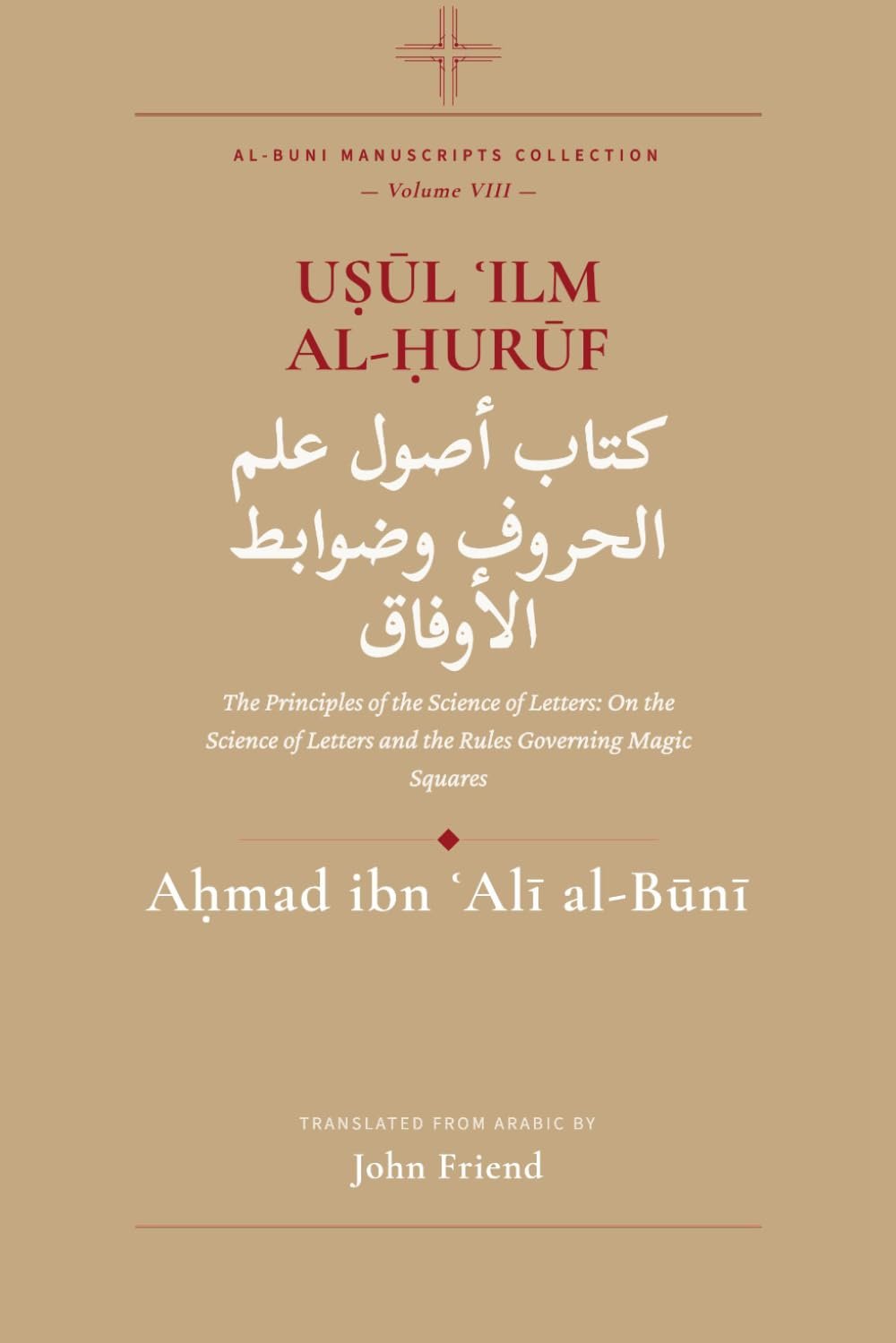
Not all letters are equal. In the Arabic magical tradition attributed to al-Buni (d. 622 AH / ~1225 CE), the 28 letters of the Arabic alphabet are not merely symbols for sounds. They are living entities — each carrying a spirit, an elemental nature, a planetary affiliation, and a fundamental moral quality. Some letters are luminous: aligned with beneficial forces, associated with healing, protection, and spiritual illumination. Other letters are dark: aligned with concealment, binding, coercion, and the manipulation of unseen forces. To know which letters are luminous and which are dark is to possess the master key to Arabic letter magic. And it is this classification — chapters XII and XIII of Volume VIII of the Al-Buni Manuscripts Collection — that practitioners across centuries have considered the most dangerous knowledge in the entire tradition.
Because once you know which letters carry which properties, you can construct anything. Any invocation. Any talisman. Any magic square. For any purpose. The dark-luminous classification is not a spell or a technique. It is the periodic table of Arabic occult science — the foundational framework from which all specific applications derive. Publishing it was, for centuries, considered unthinkable.
The Structure of Volume VIII: From Stars to Souls
Volume VIII — Usul ’Ilm al-Huruf, Foundations of the Science of Letters — is organized into four parts across 161 pages and 22 chapters. Its architecture traces an arc from the cosmic to the personal, from the movement of stars to the manipulation of human souls.
Part I: Astronomy (Chapters I–V)
The volume begins with the sky. Part I establishes the astronomical framework: the 28 lunar mansions, the seven classical planets, and the specific incenses associated with each celestial body. This is not decoration. In al-Buni’s system, every letter operation must be timed to astronomical conditions. The lunar mansions determine which days are favorable for which operations. The planets determine the hours. And the incenses create the material conditions that bridge the gap between celestial influence and terrestrial effect.
Part II: Letters (Chapters VI–XIV)
Part II is the heart of the volume — and the section that earned it its reputation. Beginning with the origin of letters from nonexistence (Chapter VI), al-Buni traces the Arabic alphabet from its metaphysical source through its spiritual properties to its operative classification.
The progression is deliberate: first the spirits of the letters (Chapter VII) — the living entities that inhabit each letter and give it its particular character. Then the natures of the letters (Chapter VIII) — their elemental correspondences (fire, air, water, earth) that determine their mode of action. Then the auspicious letters (Chapter IX) — those naturally favorable for beneficial operations. The Five Letters (Chapter X) — a select group carrying special properties. The extracted letters (Chapter XI) — derived through mathematical operations from names and verses.
And then, at the climax of Part II: the luminous letters (Chapter XII) and the dark letters (Chapter XIII). The classification that divides the Arabic alphabet into its two fundamental operative categories. The system that determines, for every conceivable operation, which letters to employ and which to avoid. The knowledge that turns letter science from a theoretical framework into an unlimited practical toolkit.
Part II closes with letter magic squares (Chapter XIV) — showing how the properties of individual letters combine when arranged in wafq configurations, creating talismanic instruments that carry the combined power of multiple letters operating in mathematical harmony.
Part III: Operations (Chapters XV–XVIII)
Part III turns from classification to application. And the applications are, by any standard, alarming. Chapter XV — “Taking Possession of Intellects, Souls, and Hearts” (p. 79) — addresses the use of letter science to influence human consciousness. Chapter XVI — “Attraction and Presence” (p. 91) — covers the techniques for drawing specific individuals into the practitioner’s sphere. Chapter XVII — “Instilling Intimacy and Love, Troubling the Adversary” (p. 93) — provides the operative formulas for both attraction and repulsion. Chapter XVIII — “Unveiling All Matters” (p. 98) — addresses divinatory applications.
These chapters explain why the dark-luminous classification was considered so dangerous. The classification itself is morally neutral — it simply describes the properties of letters. But the applications it enables include operations that cross every ethical boundary the tradition recognizes. The knowledge of which letters are dark and which are luminous, combined with the techniques of Part III, gives the practitioner the theoretical capacity to influence human minds, attract or repel specific individuals, and penetrate hidden knowledge.
Part IV: Final Matters (Chapters XIX–XXII)
Part IV addresses the consequences. Chapter XIX covers Egyptian weights — the precise measurements required for material components. Chapter XX is titled “Safeguarding This Science, Keeping Silence” (p. 102) — a direct address to the reader about the dangers of sharing this knowledge and the obligation to protect it from those who would misuse it. This chapter reads as a warning from eight centuries ago that anticipated exactly what is happening now: the publication of this material in a language accessible to a global audience.
Chapter XXI presents the Zayirjah (p. 105) — a divinatory computational instrument that represents one of the most sophisticated applications of letter science in the entire tradition. And Chapter XXII addresses the principles of planetary talisman construction that synthesize the astronomical framework of Part I with the letter science of Part II.
Why Luminous and Dark?
The classification of letters into luminous and dark is not arbitrary. It derives from the letters’ relationship to the huruf muqatta’at — the mysterious disconnected letters that appear at the beginning of certain Quranic chapters. Islamic esoteric tradition treats these letters as carrying a special divine quality: they are the letters that God chose to open His revelation, and they therefore carry a luminous charge that other letters do not possess.
The luminous letters — those that appear among the muqatta’at — are associated with divine light, spiritual elevation, beneficial influence, and protective power. The dark letters — those absent from the muqatta’at — are associated with concealment, binding, terrestrial forces, and coercive operations. Neither category is inherently good or evil. Both are necessary. A physician needs both scalpel and suture. But the dark letters carry greater risk in unskilled hands, and it is the dark letters that form the basis of the operations that religious authorities have most consistently condemned.
The Key That Unlocks Everything Else
Volume VIII occupies a unique position in the Al-Buni Manuscripts Collection because it provides the foundational key that makes every other volume intelligible at its deepest level. The Shams al-Ma’arif (Volume I) uses letter science throughout but does not explain its foundations at this level of detail. The magic square construction methods of Volume III assume knowledge of letter properties that Volume VIII provides. The divine name deployments of Volume VII depend on understanding the letters from which those names are composed.
Without Volume VIII, the other volumes can be read — but they cannot be fully understood. With Volume VIII, the entire system becomes transparent: every talisman, every invocation, every magic square can be analyzed in terms of the letters it employs, their luminous or dark properties, their planetary associations, and their elemental natures. The practitioner who masters this volume possesses, in theory, the ability to construct new operations rather than merely reproducing those found in other texts.
This is precisely what made it dangerous. And precisely why Chapter XX warns the reader to keep silence.
Now Available
Volume VIII of the Al-Buni Manuscripts Collection presents the complete Usul ’Ilm al-Huruf in English for the first time. All 161 pages, all 22 chapters, all four parts. From the astronomical framework through the letter classification to the operative applications and the final warning. In paperback format with full IJMES romanization and diacritical marks.
The dark letters and the luminous letters. The classification they never wanted published. Now published.