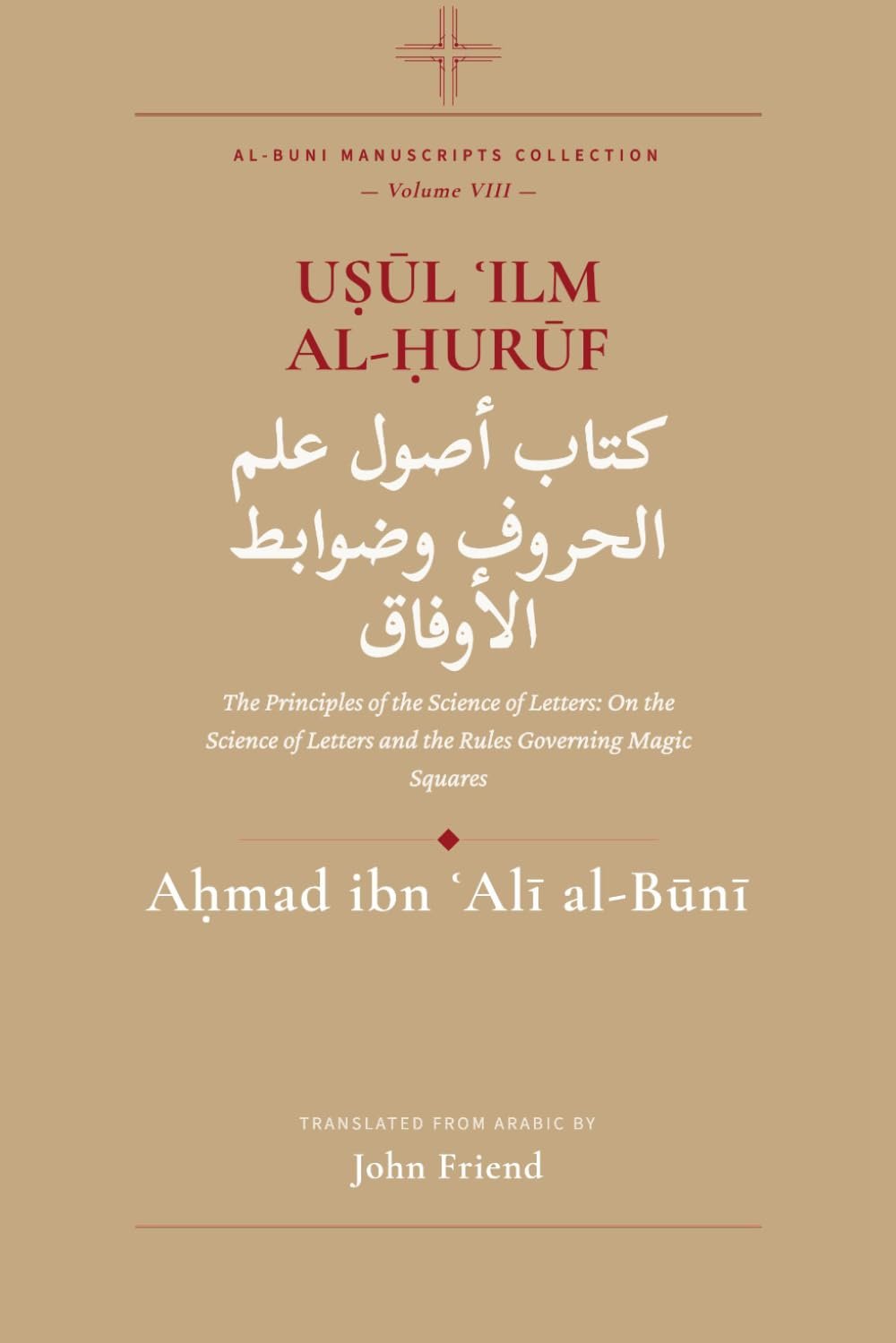
There are chapters in manuscripts that scholars translate reluctantly and publishers print nervously. Chapter XV of Volume VIII of the Al-Buni Manuscripts Collection is one of them. Its title requires no interpretation: “Taking Possession of Intellects, Souls, and Hearts.” It means exactly what it says. Al-Buni — the same figure who systematized the science of divine names, who built the mathematical framework of magic square construction, who classified the Arabic letters into luminous and dark categories — devoted an entire chapter to the question of how letter science can be deployed to influence human consciousness. Not metaphorically. Not in the vague language of self-help or positive thinking. Operatively. Specifically. With formulas, timing, and materials.
And then, five chapters later, he wrote another chapter telling his readers never to share what they had just learned.
The tension between these two chapters — the instruction and the warning — defines the most controversial section of the entire al-Buni (d. 622 AH / ~1225 CE) corpus. It is the section that religious authorities have condemned most harshly, that practitioners have guarded most jealously, and that scholars have debated most intensely. And it is now available in English for the first time.
Chapter XV: The Possession of Intellects, Souls, and Hearts (p. 79)
Chapter XV occupies pages 79 through 90 of Volume VIII and represents the culmination of everything that preceded it. The letter classification system (luminous and dark letters) provides the theoretical foundation. The astronomical framework (lunar mansions, planetary hours) provides the timing. The incense correspondences provide the material conditions. And Chapter XV provides the application: how to combine these elements to affect how another human being thinks, feels, and decides.
The tradition attributed to al-Buni presents this not as coercion but as a science of influence. The term “taking possession” (taskhir) in Arabic carries a range of meanings from gentle influence to absolute control. At the gentle end, the operations in this chapter address the practitioner’s ability to make themselves persuasive, authoritative, and compelling in speech and presence. At the extreme end, the operations address the capacity to override another person’s will — to compel obedience, to instill specific thoughts, to create attachment where none existed.
The chapter distinguishes between three targets: the intellect (’aql), the soul (nafs), and the heart (qalb). Each requires different letter combinations, different timing, and different materials. Influencing the intellect involves operations that affect rational judgment. Influencing the soul involves operations that affect emotional states. Influencing the heart — the deepest and most difficult target — involves operations that affect the fundamental orientation of a person’s being.
For context on how these operations relate to the broader tradition, see the guide to love and attraction magic in Arabic manuscripts. But note that Chapter XV goes far beyond love and attraction — it addresses the full spectrum of human influence, from the political to the personal.
Chapter XVI: Attraction and Presence (p. 91)
Chapter XVI narrows the focus to a specific category of influence: the ability to draw a specific person into the practitioner’s presence. “Attraction and Presence” refers to operations designed to create in a target person an irresistible desire to seek out the practitioner — to come to them, to be near them, to feel incomplete in their absence.
The operations in this chapter depend on the jinn hierarchies that al-Buni details elsewhere in his corpus. The attraction is not purely psychological in al-Buni’s framework — it involves the deployment of spiritual intermediaries who carry the practitioner’s intent to the target. The letters used in these operations are drawn from the dark category, and the timing typically involves nocturnal planetary hours associated with Venus or the Moon.
Chapter XVII: Instilling Intimacy and Love, Troubling the Adversary (p. 93)
Chapter XVII is explicitly dual-purpose. The first half addresses the creation of intimacy and love between people — operations designed to establish or deepen emotional bonds. The second half addresses the opposite: “troubling the adversary,” operations designed to create discord, unease, and disruption in the life of an enemy.
This duality is characteristic of al-Buni’s system. The same letter science that can create bonds can dissolve them. The same forces that attract can repel. The tradition treats love and enmity as two sides of a single coin — both governed by the same principles, both accessible through the same framework, and both carrying profound consequences when deployed improperly.
The connection to working with the jinn king al-Ahmar is explicit in this chapter. Al-Ahmar’s court governs the territory of love, attraction, and interpersonal bonds, and the operations described here invoke his authority — or the authority of spirits within his hierarchy — as the mechanism of action.
Chapter XVIII: Unveiling All Matters (p. 98)
Chapter XVIII addresses a different application of the same foundational science: the ability to see what is hidden. “Unveiling All Matters” refers to divinatory operations that use letter science to reveal concealed information — the location of lost objects, the identity of thieves, the hidden intentions of others, the outcomes of planned undertakings.
The chapter connects directly to the Zayirjah (Chapter XXI, p. 105) — the divinatory computational instrument that represents the most sophisticated technological application of letter science in the entire tradition. Where the earlier chapters use letters to influence the world, the Zayirjah uses letters to read the world — to extract information from the fabric of reality through mathematical operations on letter values.
Chapter XX: Safeguarding This Science, Keeping Silence (p. 102)
And then, after four chapters of the most powerful and ethically fraught material in his entire corpus, al-Buni writes a chapter that amounts to a retraction of permission.
“Safeguarding This Science, Keeping Silence” is al-Buni’s direct address to the reader about the consequences of sharing what they have just learned. The chapter establishes an ethical framework — a set of conditions under which this knowledge may be transmitted and a set of conditions under which it must not.
The key principles are clear: this knowledge should not be shared with those who lack spiritual preparation. It should not be given to those whose intentions are impure. It should not be written down in places where it can be found by the unqualified. And it should not be taught without the direct authorization of a qualified master who can assess the student’s readiness.
The chapter is, in effect, al-Buni’s acknowledgment that the material he has just presented is dangerous. Not dangerous in the abstract, theoretical way that scholars use the word. Dangerous in the concrete, operational way that a manual for a powerful weapon is dangerous. He wrote the manual anyway — and then he wrote instructions for how to handle it responsibly.
For the broader context of this tension between revelation and concealment, see the comprehensive guide to the Shams al-Ma’arif, which navigates the same paradox on a larger scale.
The Zayirjah: The Final Instrument (p. 105)
Volume VIII closes with the Zayirjah — a complex divinatory instrument that synthesizes the entire letter science framework into a single computational device. The Zayirjah takes a question, subjects it to a series of letter transformations based on the properties established in the earlier chapters, and produces an answer that the tradition treats as revelatory.
Ibn Khaldun, the great 14th-century historian, devoted an extended discussion to the Zayirjah in his Muqaddimah, treating it as a genuine intellectual achievement — a device that combined mathematical, linguistic, and cosmological principles in a way that had no parallel in other traditions. The version preserved in Volume VIII represents al-Buni’s contribution to this technology, grounded in the letter science framework that is his distinctive contribution to the Arabic occult tradition.
The Question the Text Forces
Volume VIII forces a question that polite scholarship tends to avoid: what do you do with knowledge that is simultaneously valuable and dangerous?
The Arabic manuscript tradition’s answer was concealment. Keep the knowledge within qualified lineages. Transmit it only through personal instruction. Never publish it widely. Al-Buni himself seems to have endorsed this approach, given Chapter XX’s explicit instructions to keep silence.
The decision to translate and publish this material in English represents a different answer. It is the answer that the modern scholarly tradition gives: knowledge is best served by transparency, and the risks of concealment — including the corruption and distortion of hidden material — outweigh the risks of publication.
Whether al-Buni would have agreed is a question the text itself cannot answer. But the text is now available, and the question belongs to the reader.
Volume VIII of the Al-Buni Manuscripts Collection: Usul ’Ilm al-Huruf. 161 pages. 22 chapters. 4 parts. The foundations of letter science. The dark letters and the luminous letters. The possession of intellects, souls, and hearts. The warning to keep silence. And the silence, after eight centuries, finally broken. In paperback.