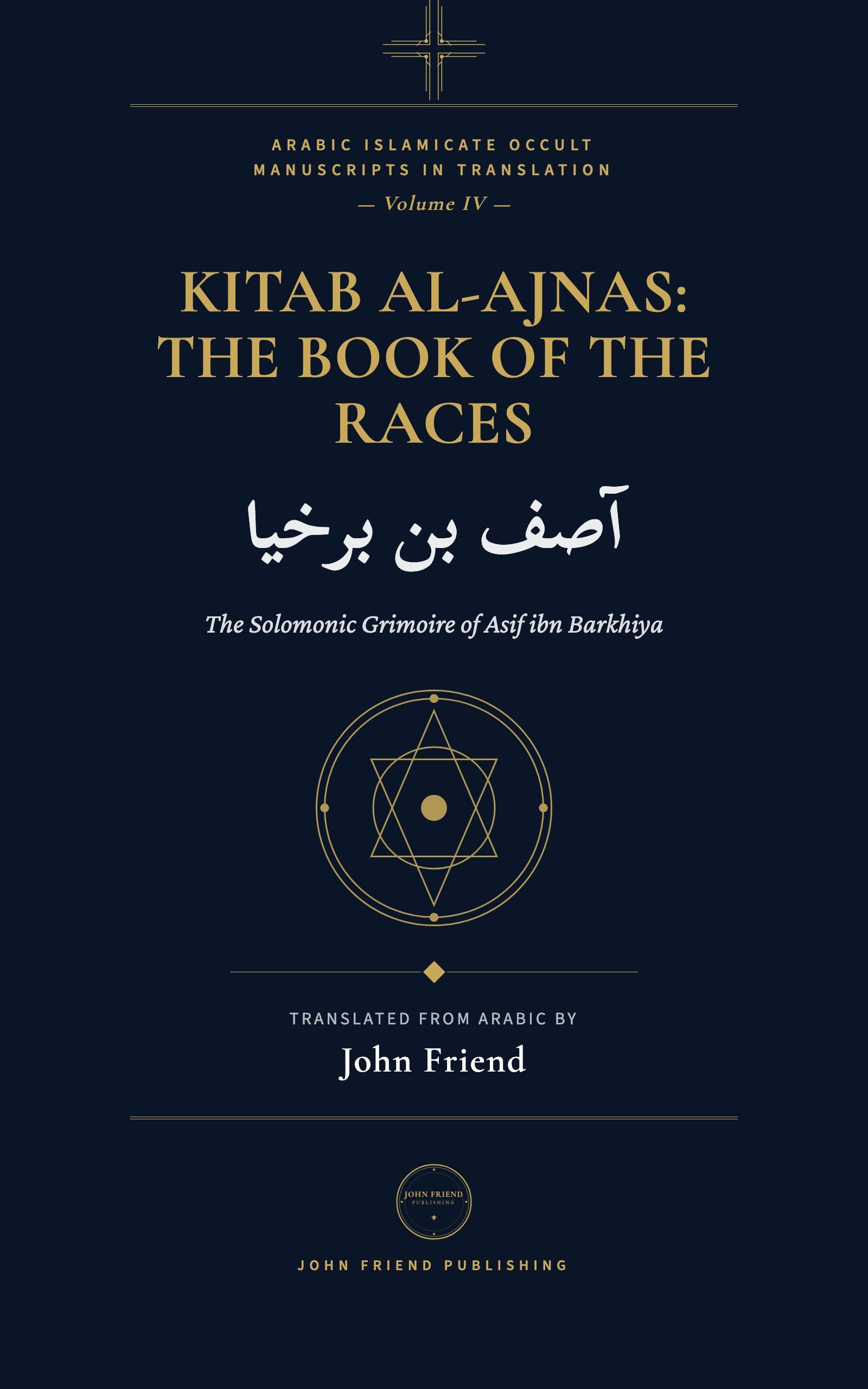
Both the Western Goetia and the Arabic Solomonic tradition are built around a central operative claim: that certain names, spoken in the right way, compel spirits to act. In the Lemegeton, the magician binds spirits using divine names as verbal locks — the names are present, they are repeated in conjurations, and they are expected to work. In the Arabic Solomonic texts, the same basic claim appears. The Kitab al-Ajnas, attributed to Asif ibn Barkhiya, contains name-sequences running into the thousands of recitations, adjurations that invoke divine authority over spirits, and seals that encode angelic names in geometric form.
The surface similarity is real. But the operative theology underneath it — the account of why names compel, which names compel, and what relationship the practitioner stands in when invoking them — is different in ways that matter for both serious practitioners and scholars of the tradition. The Kitab al-Ajnas is the clearest available evidence of how that difference actually works in practice. For a chapter-by-chapter walkthrough of the grimoire itself, see Kitab al-Ajnas: A Chapter-by-Chapter Guide.
What “Names of Power” Means in Each Tradition
The phrase “names of power” has become something of a generic term in contemporary occult discourse — it covers everything from barbarous words of evocation to mantras to sigil-names. But the concept has a specific and serious meaning in both the Western Solomonic and Arabic Solomonic traditions, and the two meanings, while related, are not identical.
In the Western Solomonic tradition as represented by the Lemegeton and associated texts, the names in question are primarily of two types. First: names of God, drawn from the Hebrew (Adonai, El, Elohim, Shaddai, YHVH and its variants), used to invoke divine authority and to threaten spirits with divine punishment for non-compliance. Second: names of specific spirits, which are required to summon and bind them — knowing a spirit’s true name gives the practitioner power over it, in a framework familiar from folklore across many cultures.
This is a serviceable system. The divine names function as a kind of credential — the practitioner presents them to spirits as proof that the operation has divine sanction. The spirit’s own name functions as a handle — knowing it allows the practitioner to specify exactly who they are addressing and to hold that specific entity to its obligations.
The Arabic Solomonic tradition, as visible in the Kitab al-Ajnas, works from the same general framework but with a significantly different understanding of what divine names are and how they operate.
The Arabic Account: Names as Direct Channels of Divine Sovereignty
In the Arabic tradition, the divine names are not primarily credentials presented to spirits. They are direct expressions of divine sovereignty — each name activates a specific aspect of God’s authority over creation, and when a practitioner invokes a divine name correctly, they are not borrowing authority but participating in the ongoing exercise of that authority.
The preface to the Kitab al-Ajnas makes this explicit when describing Moses’s practice:
“He would say: ‘My need is with the Creator of the earth and the heavens.’ At that point, he would speak the Most Beautiful Names and the Greatest Words, for which neither earth nor heaven can remain steady, which are the father of the universe and all created things.” (p. 6)
The claim here is not that Moses used divine names to impress or threaten spirits. The claim is that the names, when spoken, produce a cosmological effect — “neither earth nor heaven can remain steady” — because they are the operative expressions of divine sovereignty over existence itself. The practitioner who speaks them correctly is activating something real and powerful, not performing a ritual credential-check.
This distinction flows from the Islamic theological doctrine of the divine names (asma’ Allah) as actual attributes of divine reality, not merely labels. When the Quran says God is al-Qahhar (the Overwhelming), it is not merely using a descriptive term — it is naming a real attribute that has real effects when addressed correctly. The occult tradition takes this doctrine and develops its operative implications: if the names describe real divine attributes, then invoking those names is invoking those attributes, and the spirits who exist under divine sovereignty must respond.
The Goetia’s Credential Model vs. the Arabic Authority Model
To make the contrast concrete, consider how a typical Goetia conjuration works. The practitioner addresses the spirit by its name, commands it to appear and obey, and invokes divine names as backing for this command. The structure is broadly: “I, standing in the authority of God (whose names I here invoke), command you, [spirit name], to appear and do my will.”
The spirit is presented with a hierarchy: the practitioner’s will, backed by divine names, backed by God’s authority. If the spirit obeys, it is presumably because the divine names have made the threat credible — God will punish the spirit if it refuses. The divine names are, in this model, a deterrent.
In the Kitab al-Ajnas, the structure is different. The lengthy recitation protocols in Part Eight — where specific divine names must be recited thousands of times across multiple days, tied to Islamic prayer times, with fasting and incense — are not building a credential. They are doing something else entirely: they are saturating the practitioner’s field with a specific divine attribute until the practitioner becomes, in some sense, a living channel for that attribute’s expression.
The day-by-day schedule for the Twelve Names operation illustrates this:
“Sunday evening (the night before Monday): Pray the Maghrib prayer, break your fast, release your incense, dismiss the resident spirit, and recite the First Name — Āh Īh — 1,354 times and the invocation 7 times. When the ‘Isha’ prayer is called, pray it, release your incense, dismiss the resident spirit, and recite the Name 1,354 times and the invocation 7 times.” (p. 227)
This is not credential-building. Reciting a name 1,354 times is a form of internal transformation through repetition — the practitioner is being changed by the name, not merely wielding it. The spirits respond not because they are threatened by the name’s authority but because the practitioner has genuinely embodied the divine attribute the name expresses. The authority is real because the practitioner has actually participated in it.
Barbarous Names: Where the Two Traditions Diverge Further
Both traditions use sequences of non-meaningful syllables — what the Western tradition calls “barbarous words of evocation” and what the Arabic tradition calls ‘ajami names (literally: non-Arabic, foreign). But they treat these differently.
In the Western Solomonic tradition, barbarous names function as a kind of power-laden nonsense — their potency comes precisely from their unintelligibility, from the fact that they belong to a different register of language than ordinary speech. Their meaning, if they have one, is irrelevant to their operative use.
The Kitab al-Ajnas takes a more careful position. The translator’s note explains:
“Barbarous names (‘ajamī) — sequences of letters meant to be pronounced as written — are transliterated exactly and presented alongside the original Arabic script, never translated.” (p. 4)
The never translated is the key phrase. These names are not translated because they cannot be — they exist in a linguistic register where translation is the wrong operation. But they are also not treated as meaningless noise. They are treated as exact — precision matters, which is why the translator presents them in both Arabic script and full transliteration. A mispronounced barbarous name, in this framework, is an operative failure, not just an error of form.
The Kitab al-Ajnas contains numerous such sequences embedded in specific operations. The attraction operation involving writing on a fresh egg uses:
“Barbaric names: Lahshahsha (x3), Kashkasha (x3), Mahūla (x3), Hāʾila (x3), Khāṭifa (x3), Makhṭūfa (x3)” (p. 274)
These are to be written on a fresh egg no more than a day old. The specific names, the specific physical medium, the specific repetition count — all of it is exact, and the exactness is not arbitrary. The names are part of the operative structure; the egg’s freshness is a purity condition; the tripling of each name activates it by the established logic of the three-fold recitation.
The Role of Fasting and Purification: A Structural Difference
One of the clearest operational differences between the Western Goetia and the Arabic Solomonic tradition is the role of the practitioner’s body.
The Goetia in its 17th-century form mentions purification requirements — the magician is to be clean, to have observed certain fasts — but these appear as prefatory conditions, things done before the work rather than continuous elements woven into the work itself. In Crowley’s edition, these requirements are largely treated as optional or symbolic.
In the Kitab al-Ajnas, purification is structural. The Twelve Names protocol explicitly includes fasting: “break your fast” at Maghrib each evening means the practitioner has been fasting all day. Incense is released at every prayer time. The “resident spirit” — the spirit that has begun to attend due to the sustained invocation — is dismissed at each prayer time and re-invited at each subsequent recitation session. The practitioner’s body, in this framework, is part of the operative system, not a neutral vehicle for the work.
This connects to the Islamic theological principle underlying the whole system: the practitioner’s authority to command spirits derives from their relationship with God, and that relationship is maintained through the observances — prayer, fasting, purity — that define the properly oriented Muslim practitioner. Remove the fasting and prayer from the protocol and you have not just simplified the operation; you have removed the operative mechanism.
What This Means for the Western Practitioner
A serious Western practitioner who approaches the Kitab al-Ajnas after working with the Goetia will find both familiar territory and genuinely unfamiliar terrain.
Familiar: the hierarchical structure of spiritual beings; the use of seals as operative instruments; the expectation that spirits can be compelled to perform specific tasks; the framework of divine authority backing the practitioner’s commands.
Unfamiliar: the depth of the recitation practice (thousands of repetitions across days, not a single conjuration); the structural role of Islamic prayer times in the operative schedule; the understanding of divine names as attributes being embodied rather than credentials being presented; the precision requirements around barbarous names.
The unfamiliar elements are not obstacles. They are the operative substance that the translation process stripped from the Western texts. Understanding them does not require converting to Islam any more than understanding the Hebrew roots of the Goetia required medieval European practitioners to convert to Judaism. What it requires is taking the operative logic seriously on its own terms. The same principle of taking the Arabic source-tradition on its own terms applies to the astral-magic system the Picatrix borrowed from.
The Kitab al-Ajnas makes that logic visible in full. It is, in this respect, what the Western Solomonic tradition has always lacked: a source-text where the underlying theology is explicit, the operative protocols are complete, and the practitioner is not left to reconstruct the framework from its attenuated Latin descendants.
Read It in English
The Kitab al-Ajnas: The Solomonic Grimoire of Asif ibn Barkhiya is the first English translation of this foundational Arabic Solomonic text, published by John Friend Publishing.
Available on Amazon — Kindle, Hardcover, and Paperback
Available through Kindle Unlimited. Browse the full catalog of Arabic grimoire translations available on Amazon.
Further Reading
For related texts from John Friend Publishing that illuminate different dimensions of the Arabic operative tradition:
- Sihr Muluk al-Jann: The Complete Magic of the Jinn Kings — the primary operational text for working with the seven planetary jinn kings, with the specific adjuration protocols the Arabic tradition preserved
- Suns of Lights and Treasures of Secrets (Shams al-Anwar) — the 1327 CE al-Buni lineage text providing the divine-name and letter-science framework that underlies the authority structure in the Kitab al-Ajnas
- The Book of Daniel: Arabic Solomonic Divination — a complementary text in the Arabic prophetic-occult tradition, showing how divine-name authority extends into the divinatory sciences
- The Tested Remedies of the Monks (Mujarrabat al-Ruhban) — the operative-formulary genre that runs on the same divine-name authority structure as the Kitab al-Ajnas
For scholarly context on divine names in the Islamic tradition, the Wikipedia article on the 99 Names of God in Islam provides accessible background; for the Goetia’s manuscript history and its Arabic origins, see The Goetia’s Arabic Source and the Wikipedia entry on The Lesser Key of Solomon.
