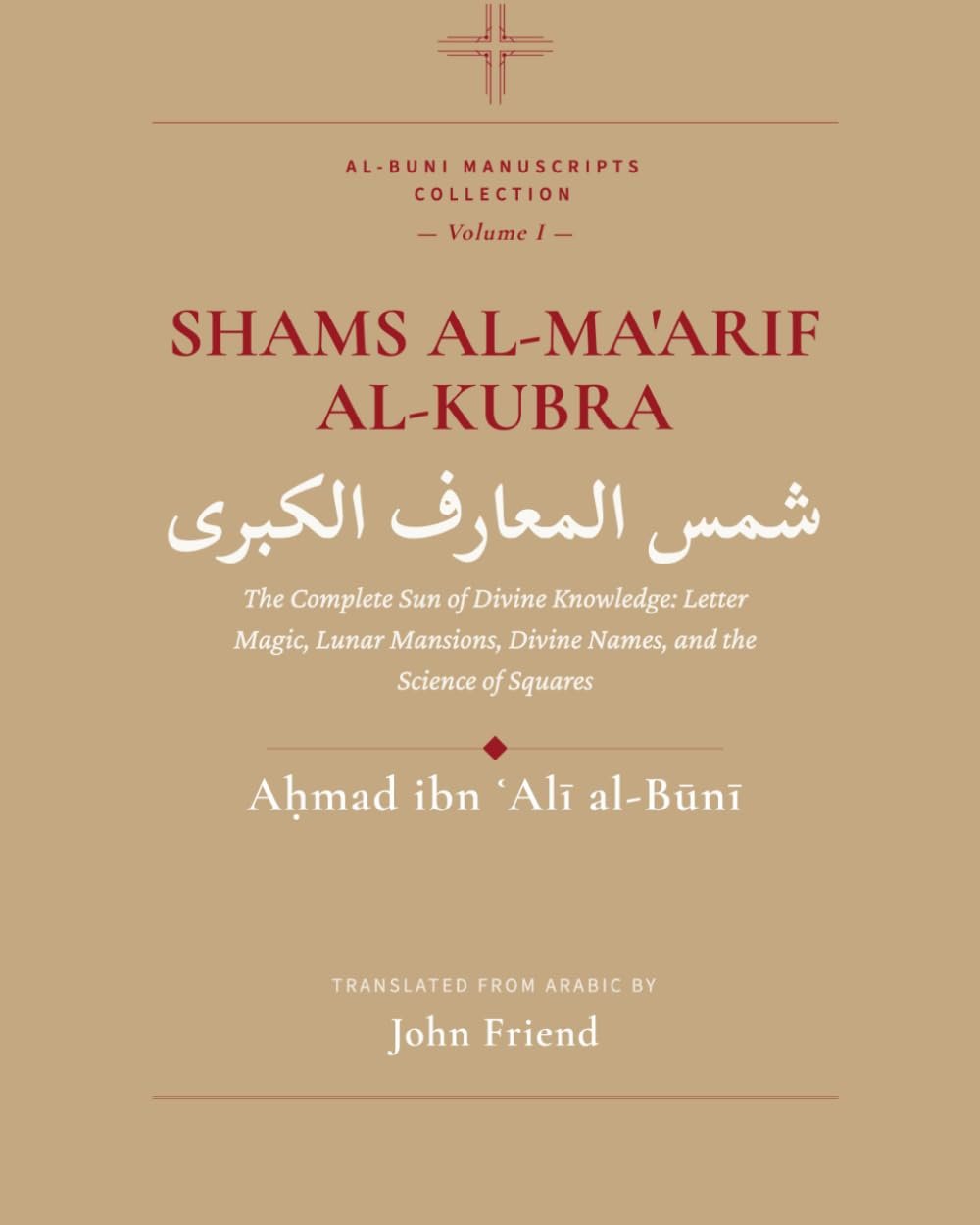
If you have spent any time reading about the Arabic occult tradition, you will have encountered two texts mentioned above all others: the Shams al-Ma’arif al-Kubra attributed to Ahmad al-Buni, and the Ghayat al-Hakim — the text the medieval Latin world called the Picatrix. Both are Arabic in origin. Both draw from the same deep reservoir of Hellenistic astral science, Neoplatonic cosmology, and late antique operative knowledge. Yet they represent genuinely different emphases, serve different purposes, and traveled through history along entirely different routes. Understanding the difference between them is essential to understanding the Arabic occult tradition as a whole.
The Same Tradition, Two Different Entry Points
The shared intellectual ancestry of these two texts is real and traceable. Both belong to the broader current of Arabic learning that absorbed, translated, and transformed the late antique knowledge of Hellenistic Egypt — particularly the Hermetic, Neoplatonic, and Ptolemaic traditions that circulated through Alexandria and were transmitted to the Arabic-speaking world during the translation movement of the eighth through tenth centuries CE. Both texts reference the Sabians of Harran, a pre-Islamic religious community whose astrological and theurgical practices became a major source for Arabic stellar magic. Both use planetary correspondences, talismanic images, and the framework of a cosmos animated by celestial intelligences.
But the family resemblance ends at the level of content emphasis, operative mechanism, and intended use. Deciding which of these two texts is “more important” depends almost entirely on what you are trying to do and which tradition you are entering from.
The Ghayat al-Hakim (Picatrix): Astral Magic and Planetary Images
The Ghayat al-Hakim — “The Goal of the Wise” — was composed in Arabic somewhere around the tenth or eleventh century CE. Its attributed authorship is complex and disputed: it is sometimes credited to the Andalusian scholar Maslama ibn Qasim al-Majriti, though most modern scholars consider the text pseudonymous. What is not disputed is its content: the Ghayat al-Hakim is a systematic treatise on astral magic, focused on the construction of talismans powered by planetary forces, the use of suffumigations and materials appropriate to each planet, and the theology of a cosmos in which the planets act as intermediaries between the divine and the terrestrial.
The text is organized around this talismanic framework. It describes planetary images — the specific figures, symbols, and substances associated with each planet — in extensive detail. It provides directions for harnessing planetary power during astrologically favorable moments. It incorporates material from the Sabian star-worshipping tradition, including prayers directed to planetary deities that have a distinctly pre-Islamic quality. And it draws heavily on Hermetic and Neoplatonic philosophical framework to explain why this operative system works: because the cosmos is a hierarchy of emanated spiritual powers, and the skilled practitioner can draw those powers down through properly constructed material vehicles.
What the Ghayat al-Hakim is not is a text saturated with Islamic devotional practice. It does not foreground Quranic verses as operative instruments. It does not systematically deploy the ninety-nine divine names of God as a magical technology. The divine names appear, but they are not the engine. This is, in a sense, what made the text so translatable: the astrological and Hermetic framework it relies on could be received by a Latin Christian readership without requiring deep engagement with Quranic Arabic.
In 1256 CE, under the patronage of Alfonso X of Castile, the Ghayat al-Hakim was translated into Castilian and then into Latin, becoming the Picatrix. That translation transformed European ceremonial magic. Agrippa’s Three Books of Occult Philosophy, the planetary magic of the Renaissance, the astrological talismanic tradition that runs through Marsilio Ficino — all of these bear the direct imprint of the Picatrix. The text became so influential in European occultism that many Western practitioners know it better than they know any Arabic source.
The Shams al-Ma’arif: Letter Science and Divine Names
The Shams al-Ma’arif al-Kubra — “The Great Sun of Gnoses” — attributed to Ahmad ibn Ali al-Buni (d. 1225 CE) operates from a different center of gravity. Where the Ghayat al-Hakim is organized around astrological time and planetary materials, the Shams al-Ma’arif is organized around the Arabic alphabet and the divine names of God. Its central operative science is ‘ilm al-huruf — the science of letters — in which each Arabic letter carries numerical, elemental, planetary, and spiritual properties derived from its position in the alphabet and its relationship to the abjad system.
Al-Buni’s system works like this: the Arabic alphabet is not merely a writing system but a living grid of divine power. The letters that compose God’s beautiful names (asma’ Allah al-husna) are operative forces — not symbols pointing to something else, but actual manifestations of divine attributes. To write these names correctly, in the right configuration, on the right material, at the right astrological moment, is to inscribe divine power into matter. The wafq — magic squares built from numbers or letters — is one of al-Buni’s key technologies for concentrating this power into a portable, durable form.
The Quranic dimension of the Shams al-Ma’arif is fundamental, not decorative. Specific verses (ayat) are assigned operative properties — this verse for protection, that verse for influencing a heart, this name of God for opening what is closed. The entire system is embedded in an Islamicate theological framework in which the legitimate channels of power are the names and words God has disclosed in revelation. This makes the Shams al-Ma’arif considerably more dependent on Arabic as a sacred language and considerably more rooted in Islamic religious practice than the Ghayat al-Hakim.
This difference helps explain why the Shams al-Ma’arif was never translated into Latin. The wafq science and the letter-science depend entirely on Arabic — on the specific numerical values of specific Arabic letters, on the theological valence of specific Arabic divine names. Translating the framework into Latin would require rebuilding the entire operative system from scratch around a different alphabet and a different theological vocabulary. The attempt was never made, and the text remained within the Arabic-speaking world.
Where the Two Texts Overlap
Despite their different emphases, the Shams al-Ma’arif and the Ghayat al-Hakim do share substantial content. Both are deeply engaged with planetary science — the same seven planets, the same hierarchical understanding of celestial influence, the same use of astrological timing as the basis for operative work. The planetary spirits (arwah al-kawakib) appear in both. The planetary hour system — dividing each day and night into hours governed by successive planets — is operative in both texts. Suffumigation recipes tied to specific planets appear in both.
The shared Hermetic and Sabian substratum means that a reader who knows one text well will recognize content in the other. The letter-perfect version of the Jovian suffumigation in the Shams al-Ma’arif deploys the same materials — the same incenses, the same colors, the same timing — that the Ghayat al-Hakim attributes to Jupiter. The planetary images that the Ghayat al-Hakim describes in detail reappear, often in compressed form, in sections of the Shams al-Ma’arif.
Both texts are nodes in a much larger network of Arabic occult knowledge — a network that includes the Ikhwan al-Safa’ encyclopedias, the works of Jabir ibn Hayyan, and dozens of regional and specialist texts that never made it into Western circulation at all.
Transmission: One Stayed, One Traveled
The most consequential difference between these two texts is not what they contain but what happened to them after they were written. The Ghayat al-Hakim crossed into Latin Europe and became the Picatrix. For several centuries, it was the primary channel through which Arabic astral magic knowledge flowed into the Western occult tradition. When Renaissance magicians wrote about planetary talismans, when Agrippa catalogued planetary correspondences, when Ficino described talismanic medicine — they were drawing, directly or indirectly, on the Arabic text that Alfonso’s translators had rendered into Latin.
The Shams al-Ma’arif, by contrast, remained in Arabic and expanded through the manuscript cultures of North Africa, the Ottoman Empire, Egypt, the Levant, West Africa, and South Asia. In these regions, it became the foundational text of the sihr tradition — the reference point against which all subsequent operative texts were measured. The texts produced in its wake — including Ibn al-Hajj al-Tilmsani’s Shams al-Anwar wa Kunuz al-Asrar, translated in the John Friend Publishing Vol. III — systematically extend and develop the Buni’an framework of letter science, divine names, and magic squares. The entire Arabic operative tradition from the thirteenth century onward is, to a significant degree, a conversation with al-Buni.
Western occultism largely missed this conversation. The handful of Western scholars who knew the Arabic tradition at all — Pico della Mirandola, who touched on Arabic Kabbalah, or later orientalists — were not engaging with the operative sihr corpus. The Shams al-Ma’arif was invisible to European readers until very recently, and its contents remain largely inaccessible without knowledge of Arabic.
What Each Text Gives the Reader
For a reader coming from the Western esoteric tradition — familiar with the Picatrix, with planetary magic, with Renaissance ceremonial practice — the Ghayat al-Hakim will feel recognizable. The planetary framework, the talismanic images, the Hermetic cosmology: these are the same bones that underlie much of Western occultism. The Ghayat al-Hakim is the bridge between that tradition and its Arabic sources.
The Shams al-Ma’arif, and the texts in its tradition, offer something genuinely different: an operative system grounded in Arabic letter mysticism, divine names, and Quranic theology. This is not a variation on the planetary magic of the Picatrix — it is an independent development that draws from the same ancient sources but builds something architecturally distinct. The magic squares (awfaq), the letter permutations, the names of God as operative instruments: none of this has a structural equivalent in the Latin Picatrix.
For readers seeking entry into the Shams al-Ma’arif tradition in English, the closest currently available access point is Shams al-Anwar wa Kunuz al-Asrar al-Kubra (Vol. III), a 1327 CE text that directly continues al-Buni’s system. The full account of that text’s relationship to the Shams al-Ma’arif is in Shams al-Anwar: The Forgotten Arabic Grimoire That Completed Al-Buni’s Work.
Two Grimoires, One Tradition
The Shams al-Ma’arif and the Picatrix are not competitors. They are different expressions of the same broad current — the Arabic synthesis of Hellenistic, Persian, and early Islamic learning — that produced the richest body of occult knowledge in the medieval world. The Picatrix traveled west and shaped European magic. The Shams al-Ma’arif stayed east and shaped everything from Ottoman court talismanism to West African Islamic protective practice to South Asian ta’wiz traditions. Both lines of descent are active today.
What has changed, very recently, is that English readers can finally begin to access the Shams al-Ma’arif tradition directly — in translation, with scholarly apparatus, from the primary Arabic sources. The tradition that stayed in Arabic for eight centuries is, at last, available in English.