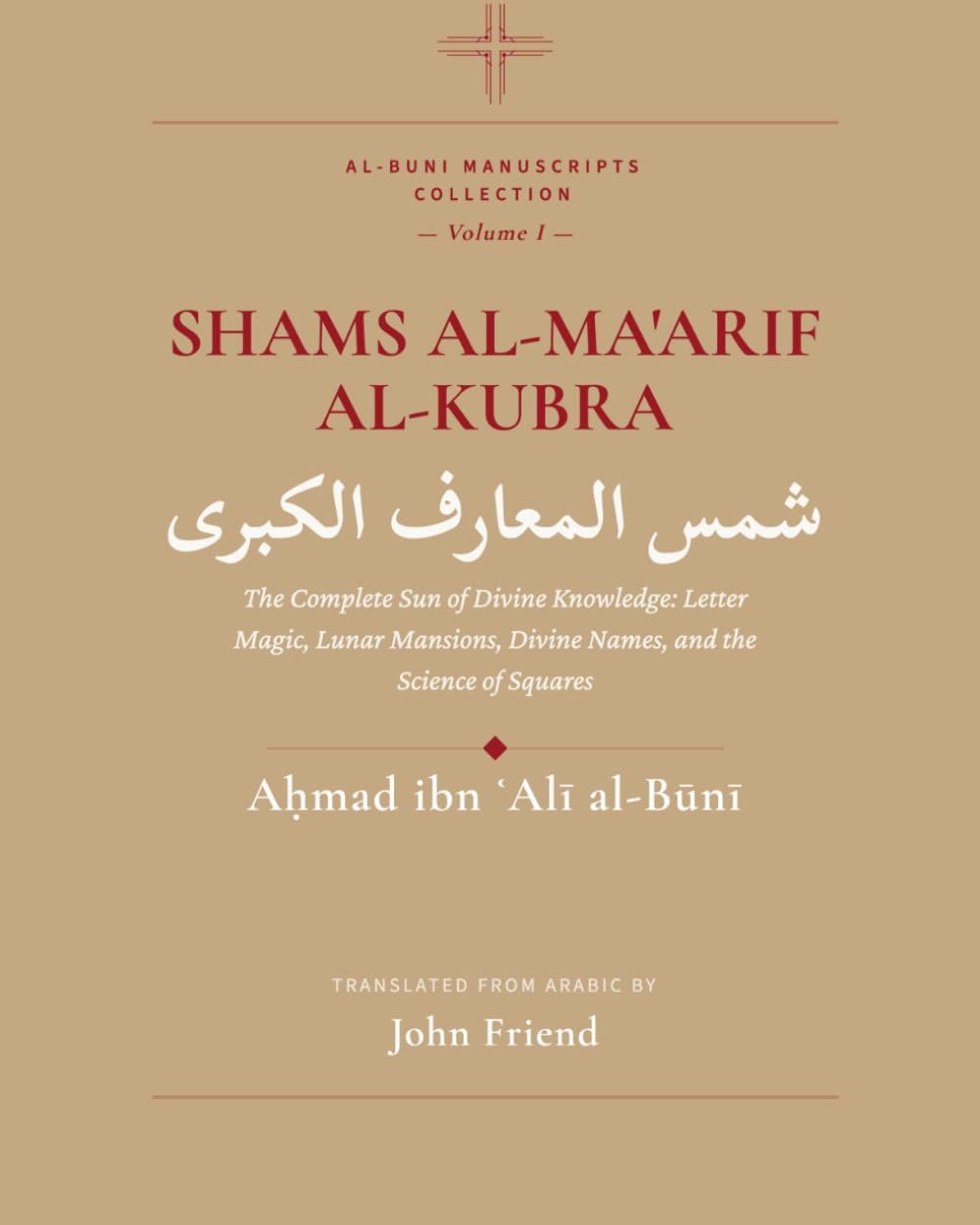
Spend ten minutes looking into the Arabic occult sciences online and you will meet three kinds of middlemen standing between you and the texts.
The first sells fear disguised as mentorship. He runs a private cohort, a Patreon tier, or a five-hundred-dollar video course on esoteric knowledge, and his pitch always opens with a threat. Try to work from Shams al-Maʿārif or Manbaʿ Uṣūl al-Ḥikma without a living teacher's paid initiation, he warns, and the spirits of the book will wreck your sleep, drain your livelihood, or strike your household. By a remarkable coincidence, the spiritual permission that keeps you safe costs the exact price of his enrollment link.
The second runs a pamphlet mill. Search any bookstore platform for occult books, esoteric books, or a black magic book, and the top rows are crowded with forty-page booklets promising to teach you how to command jinn kings in ten minutes before bed. Their authors cannot read an unvocalized page of classical Arabic. They strip away ritual ablution, planetary hours, incense, and workspace clearing, swap in modern visualization exercises, and use the back pages to funnel buyers toward high-ticket coaching.
The third slides straight into your messages. Leave a worried comment under a video by "Sheikh TikTok" or one of his imitators, and within the hour someone offers a twenty-dollar "spiritual check." Nobody ever passes a twenty-dollar spiritual check. Every person who pays is told that a relative or rival buried dark magic against their marriage or career, and that breaking it requires wiring four hundred dollars on WhatsApp for a custom taweez (the South Asian and diaspora spelling of the Arabic taʿwīdh, a written protective charm) or ordering a "jinn-bound Ring of Solomon" from an online shop.
Every century produces genuine practitioners, and every century produces con men who feed off desperate people. What makes our moment worse is how easily modern sellers exploit the language barrier, counting on the fact that most English speakers cannot check their claims against the Arabic grimoires.
Medieval Cairo's street cons, eight hundred years before TikTok
Anyone who translates medieval Arabic manuals recognizes these operators right away, because the thirteenth-century manuscripts already exposed them.
In Mamluk Egypt, the alchemist Abū al-Qāsim al-ʿIrāqī compiled his thirty-chapter handbook ʿUyūn al-Ḥaqāʾiq wa-Īḍāḥ al-Ṭarāʾiq (Wisdom of the Ages and Secret of the Sages) after watching street performers and false adepts dazzle crowds with cheap illusions while knowing nothing of the natural or spiritual laws underneath. Whole chapters of his work strip the curtain off the spiritual hustlers of his day. He describes roadside astrologers who planted an accomplice in the crowd to collapse on the ground, foam at the mouth, and feign spirit possession. One healer after another would fail over him until the astrologer stepped in, hung a slip of paper written in supposed "Davidic script" around the confederate's neck, and watched him stand up cured. After that he sat by the road and took the crowd's silver.
Elsewhere al-ʿIrāqī describes a shaykh who mounted a polished mirror high on his ceiling angled toward the street door so he could lie on his cushion pretending to read while secretly studying every visitor's clothes and face before they entered. Today the same man checks your public social media profile five minutes before your paid Zoom reading.
Across every reputable tradition and grimoire, trying to buy or take a shortcut is the single practice most fiercely warned against.
What you actually find when you cut open a $400 taweez
Start with the word itself. Whether spelled taweez, tawiz, or taʿwīdh (تَعْوِيذ), the term comes from the Arabic root meaning "to seek refuge" or "to shelter." In the classical Islamicate tradition, a taʿwīdh or ḥijāb is a sheet of skin parchment or clean paper inscribed by a ritually pure practitioner in a specific astrological window, fumigated over real resin, consecrated with Quranic recitation and divine names, folded, wrapped against dampness, and carried with strict etiquette.
When buyers finally lose patience with a three- or four-hundred-dollar mail-order taweez and cut open the stitched leather case or brass tube, they nearly always uncover one of four things:
- A photocopy of a broken magic square. Cheap reprints and photocopies of Arabic grimoires pick up scribal and typesetting mistakes until the cells of a magic square (wafq) no longer add up to a uniform sum. Online sellers photocopy those corrupted grids by the stack. In ʿilm al-awfāq, a numerical square whose rows, columns, and diagonals fail to balance is mathematically dead.
- Laser toner on printer paper. The classical manuals specify natural hand-mixed inks, above all saffron loosened in rosewater with a touch of musk, written in one focused sitting with a dedicated reed pen (qalam) while incense smoke rises around the page. Office toner fused onto copy paper by a machine holds neither consecrated breath (nafth) nor living intention.
- Zero personal linkage. When the Arabic manuals construct a targeted operation for a specific person, they anchor the work to that individual's given name alongside their mother's name (fulān ibn fulāna or fulāna bint fulāna). Pre-packaged "wealth talismans" and "love amulets" pulled out of a shipping bin have no recipient written into them.
- A spiritual leash designed for repeat payments. The ugliest version of the WhatsApp healer racket does not send Quranic protection at all. Dishonest operators send a murky lower (suflī) binding tied to the client's name and mother's name so the client feels a brief lift followed by nightmares, sudden exhaustion, and fresh bad luck a month later, driving them right back into the seller's inbox to pay for a "stronger upgrade."
Why Etsy's "Ring of Solomon" holds no spirit
The exact same rules dismantle the online marketplace trade in the so-called "Ring of Solomon." Thousands of listings promise heavy silver, brass, or pewter rings cast with six-pointed stars or pseudo-Arabic seals, advertised as housing an obedient jinn king or khādim (spirit servant) ready to bring the wearer promotions, respect, and easy money.
Look at how a genuine planetary or Solomonic work is actually made in the manuscripts. Each planet demands its own metal, its own day, and its own planetary hour, such as yellow copper refined like tin on a Friday in Venus's hour, tin at sunrise on a Thursday for Jupiter, or pure silver at Monday's sunrise for the Moon while she is waxing and free of malefic aspects. Before a single character is engraved or written, the workspace must be cleared of its resident household spirits, the proper resins must be burning, and the divine names and angelic governances must be recited to the exact numerical count of the seal.
Rings poured by the hundred into lost-wax molds in a jewelry workshop and shipped out of an e-commerce warehouse have passed through none of those gates. They are costume metal. Even when a traditional West African or Maghribi adept did construct a genuine talismanic seal-ring (khātim) for a client, traditional lore held that its spiritual bond belonged exclusively to that one commissioner, never to an anonymous secondary market.
The "paid initiation" myth vs. what al-Būnī actually asks of you
That leaves the most polished middleman of all: the online teacher charging five hundred or a thousand dollars for a private course while insisting that you need his personal ijāza (authorization) before touching an Arabic grimoire.
Open Shams al-Maʿārif itself and see what Aḥmad al-Būnī actually requires. Al-Būnī does not claim you must be born with special "occult gifts," nor does he tell you to pay a broker for spiritual access. What the manuscripts demand are disciplines that no influencer can sell you in a checkout cart:
- Ritual purity (ṭahāra) and prayer: Washing in full ablution (wuḍūʾ), putting on clean garments, facing the qibla (the direction of Mecca), and offering two units of prayer (rakʿatayn) before setting down a sacred square.
- Clearing the room first (ṣarf al-ʿummār): Dismissing the resident jinn of your workspace before you begin and returning them safely afterward, so your work neither fails nor triggers a household retaliation (ḍarba).
- Respecting script, order, and arithmetic: Writing genuine Arabic letters and Arabic-Indic numerals in their proper mathematical progression from the key (al-miftāḥ) to the lock (al-mighlāq), checking every line's sum so the square is sound.
- Quietness and restraint: Keeping your operations private, fasting or eating simply when a working calls for ascetic discipline, and approaching God's names with humility rather than greed.
That is why course-sellers invent invisible initiations. Nobody can charge you five hundred dollars to tell you to wash for prayer, clean your room, burn real frankincense instead of synthetic sticks, check your addition, and read the books for yourself.
The tradition does have a real authorization, and I have written about it in The One Mistake That Makes Every Solomonic Ritual Fail. Al-Jawāhir al-Lammāʿa lists "the general authorization" among its conditions of the work and says it is received from the shaykhs. The same book tells how the three-by-three seal itself was handed on. Al-Ghazālī travels until he reaches Balkh, finds a shaykh who holds the seal, and stays in his service "as long as God willed." Then the shaykh gives it to him and charges him to keep it from the ignorant. No money changes hands in that story. An authorization should never cost money to receive, and no stranger can sell you one through an enrollment link. When the work is the calling of spirits, that teacher is who you look for. If no such teacher is within your reach, read, and work with what you can. The working below is a verse of the Quran, and Manbaʿ Uṣūl al-Ḥikma gives it to "whoever perseveres in reciting" it.
(A brief practical safeguard: if you are currently carrying a questionable taweez bought from an online stranger and want to get rid of it, never burn an unknown charm indoors. Mixed or lower workings react badly to fire. Instead, open the pouch, submerge the paper in a bowl of clean water with coarse salt and crushed sidr (lote-tree) leaves, recite Sūrat al-Kawthar or the closing refuge chapters of the Quran over the water until the ink dissolves off the page, pour the water onto clean ground outdoors away from footsteps, and bury or shred the blank paper.)
The Working That Cuts Out Every Middleman: The 3×3 Square of Ḥasbunā Allāh (450)
To see how clean, complete, and self-sufficient the classical tradition actually is, here is a protective working built from its own rules: the three-by-three numerical square (wafq muthallath) of the Quranic verse of sufficiency from Sūrat Āl ʿImrān (3:173):
"God is sufficient for us, and He is the best Trustee of affairs."
Ḥasbunā Allāhu wa-niʿma al-wakīl.
حَسْبُنَا اللَّهُ وَنِعْمَ الْوَكِيلُ
In the Quran, believers spoke these words when people tried to terrify them into submission by warning that a great host had gathered against them; instead of panicking or paying human brokers for protection, they placed their trust in God and returned unharmed with bounty. Across the Sufi litanies and Arabic talismanic manuals, this formula is worked to cut off intimidation, workplace oppression, extortion, anxiety over livelihood (rizq), and the malice of enemies.
The Working at a Glance
- Formula: Ḥasbunā Allāhu wa-niʿma al-wakīl (Quran 3:173)
- Abjad Total: 450
- Elemental Nature: Air (450 ÷ 4 leaves a remainder of 2, giving the temperament of Air)
- Square: 3×3 (muthallath), every row, column, and diagonal totalling 450 (grand total 1,350)
- Key (al-Miftāḥ) & Lock (al-Mighlāq): Opens at ١٤٦ (146), locks at ١٥٤ (154)
- Best Days & Hours: Thursday (Jupiter's day, matching the benefic airy temperament) in the 1st hour at sunrise or 8th hour of daylight; or Sunday (the Sun's day, for authority and standing firm before superiors) in the 1st or 8th hour of daylight
- Lunar Phase: Waxing Moon, free of malefic aspects
- Companion Divine Names: Yā ʿAzīzu yā Kāfī yā Qawiyyu yā Laṭīf (whose abjad values, 94 + 111 + 116 + 129, also total 450)
- Recitation Count: 450 times, sealed seven times with Quran 3:174
What You'll Need
- A surface. In Shams al-Maʿārif, the traditional ideal is genuine animal skin parchment: gazelle parchment (raqq al-ghazāl) in the medieval texts, which today means real calfskin, lambskin, or deerskin vellum. For a Quranic taʿwīdh like this one, if vellum is out of reach, a sheet of clean, unlined white paper never used for ordinary writing will serve.
- Ink. Traditional rūḥānī ink made of saffron threads steeped in rosewater with a touch of pure musk and a pinch of gum arabic (or ready-made saffron ink). If you do not yet keep saffron ink, dedicate a brand-new fountain or roller pen with clean ink strictly to sacred writing and never use it for grocery lists or daily notes.
- A pen. If writing with saffron ink, cut or buy a fresh reed pen (qalam) kept solely for this work.
- Incense (bukhūr). As in most classical talismanic work, the smoke is not background mood. The fumigation helps bring the square alive, so keep it rising the entire time you write and recite. Match the resin to your chosen day:
- For Thursday (Jupiter): Shams al-Maʿārif pairs a Thursday sunrise working with mastic (mastakī) and white sandalwood; the planetary incense tables also list aloeswood (ʿūd), ambergris, and benzoin (jāwī).
- For Sunday (the Sun): Aloeswood (ʿūd), saffron, musk, ambergris, and sandarac (sandarūs).
- Simple universal blend: Tears of pure male frankincense (lubān dhakar) with a pinch of benzoin (jāwī) or coriander seed (kuzbara). Warm the resin on a small electric incense burner so you have clean, steady smoke with no open charcoal hazards, and skip synthetic dipped sticks.
- To finish: A tasbīḥ (prayer beads) to hold your count of 450 without losing focus, and a square of clean white or green silk (or clean cloth and wax wrap) to protect the finished amulet.
The Math and the Square
In classical abjad reckoning, the nineteen Arabic letters of حَسْبُنَا اللَّهُ وَنِعْمَ الْوَكِيلُ add up to 450:
- حَسْبُنَا (Ḥasbunā): ح (8) + س (60) + ب (2) + ن (50) + ا (1) = 121
- اللَّهُ (Allāh): ا (1) + ل (30) + ل (30) + ه (5) = 66
- وَنِعْمَ (wa-niʿma): و (6) + ن (50) + ع (70) + م (40) = 166
- الْوَكِيلُ (al-Wakīl): ا (1) + ل (30) + و (6) + ك (20) + ي (10) + ل (30) = 97
- Total: 121 + 66 + 166 + 97 = 450
Following the classical three-by-three rule given in al-Jawāhir al-Lammāʿa, subtract 12 from 450 (leaving 438) and divide by 3. That gives 146 with zero remainder, so ١٤٦ (146) is al-miftāḥ (the key, written first) and ١٥٤ (154) is al-mighlāq (the lock, written ninth). Every row, every column, and both diagonals add to 450:
| ١٤٩ (149) |
١٥٤ (154) |
١٤٧ (147) |
| ١٤٨ (148) |
١٥٠ (150) |
١٥٢ (152) |
| ١٥٣ (153) |
١٤٦ (146) |
١٥١ (151) |
Important: write the Arabic-Indic numerals only. When you draw this talisman, do not write the ordinary Western numbers or the parentheses. Those are printed above only so you can read the grid and verify the sequence. Inside your square, write strictly the traditional Arabic-Indic digits:
٠ (0) · ١ (1) · ٢ (2) · ٣ (3) · ٤ (4) · ٥ (5) · ٦ (6) · ٧ (7) · ٨ (8) · ٩ (9)
Notice that each three-digit Arabic-Indic number reads left to right even inside an Arabic grid (١ = 1, ٤ = 4, ٦ = 6 → ١٤٦ = 146). Never fill the grid row by row like a spreadsheet; a numerical wafq must be entered strictly in ascending order from the key to the lock:
- Write ١٤٦ (146) first, in the middle of the bottom row.
- Write ١٤٧ (147) at the top right.
- Write ١٤٨ (148) in the middle of the left column.
- Write ١٤٩ (149) at the top left.
- Write ١٥٠ (150) in the centre cell.
- Write ١٥١ (151) at the bottom right.
- Write ١٥٢ (152) in the middle of the right column.
- Write ١٥٣ (153) at the bottom left.
- Write ١٥٤ (154), the lock, in the middle of the top row.
How to Make It, Step by Step
Step 1: Pick the day and the planetary hour
Plan the work during a waxing Moon, when the Moon is free of harsh aspects. Choose either Thursday (Jupiter) or Sunday (the Sun). Remember that a planetary hour is not sixty clock minutes: daylight from local sunrise to local sunset divides into twelve equal parts, and the planet that rules the day always governs the 1st hour (opening right at sunrise) and comes back around to rule the 8th hour in mid-afternoon. (If severe trouble or intimidation is pressing on you immediately, do not wait on the calendar. Perform the prayers and write it right away.)
Step 2: Purify, pray two rakʿas, and light the incense
Perform full ritual ablution (wuḍūʾ), dress in clean white or modest clothes, and sit alone in a clean, quiet room facing the qibla (toward Mecca). Before touching the pen, follow the preparation al-Būnī sets before the writing of a square in Shams al-Maʿārif: pray two units of prayer (ṣalāt rakʿatayn) for God Most High, reciting Sūrat al-Fātiḥa, Āyat al-Kursī (Quran 2:255) once, and Sūrat al-Ikhlāṣ (Quran 112) one hundred times. Once seated, warm your resin on the burner and let the fragrant smoke establish itself in the room.
Step 3: Clear the room first (ṣarf al-ʿummār)
Before you draw a single line, dismiss the household jinn who share your room so they neither interfere with the consecration nor suffer harm from the spiritual descent. Skipping this step, warns al-Jawāhir al-Lammāʿa, causes the operation to fail. Follow the complete Quranic method given in my earlier piece, The Dwellers of the Place: Why Arabic Occult Texts Have You Clear the Room First:
- Recite Sūrat al-Zalzala (99:1-6) up to the word ashtātan ("in scattered groups"), repeating ashtātan three times.
- Say three times: "Depart, O inhabitants of this place" (Inṣarifū yā ʿummāra hādhā al-makān / انْصَرِفُوا يَا عُمَّارَ هٰذَا الْمَكَانِ) until your workspace is clear.
Step 4: Inscribe the square and its outer border
Open softly with Bismillāhi al-Raḥmāni al-Raḥīm ("In the name of God, the Most Gracious, the Most Merciful") so the work goes down consecrated, and send a brief blessing (ṣalawāt) upon the Prophet:
Allāhumma ṣalli ʿalā Sayyidinā Muḥammadin wa-ʿalā ālihi wa-ṣaḥbihi wa-sallim.
اللَّهُمَّ صَلِّ عَلَىٰ سَيِّدِنَا مُحَمَّدٍ وَعَلَىٰ آلِهِ وَصَحْبِهِ وَسَلِّمْ
Draw the three-by-three grid on your parchment or paper while keeping it near the rising incense smoke. Enter the Arabic-Indic numerals strictly from ١٤٦ to ١٥٤ in the nine-step sequence above. Once the nine cells are filled and you have checked that each line sums to 450, enclose the four outer margins of the square in Arabic (turning the page clockwise as you write) with the verse itself, حَسْبُنَا اللَّهُ وَنِعْمَ الْوَكِيلُ, or place one of its four companion Divine Names along each of the four outer sides:
- Top border: يَا عَزِيزُ (Yā ʿAzīz)
- Right border: يَا كَافِي (Yā Kāfī)
- Bottom border: يَا قَوِيُّ (Yā Qawī)
- Left border: يَا لَطِيفُ (Yā Laṭīf)
Step 5: Consecrate with the recitation of 450 and the closing prayers
Hold the finished square over the incense smoke (or set it directly before you) and take up your tasbīḥ. Recite the verse 450 times, matching the exact weight of the square:
"God is sufficient for us, and He is the best Trustee of affairs."
Ḥasbunā Allāhu wa-niʿma al-wakīl.
حَسْبُنَا اللَّهُ وَنِعْمَ الْوَكِيلُ
Pause first at 50, and then after every hundred (150, 250, 350, and 450). At each of those five pauses, breathe gently (nafth) over the square and recite the four matching Divine Names and this plea three times:
"O Mighty, O Sufficient, O Strong, O Subtle! O Mighty, grant me dignity; O Sufficient, suffice me; O Strong, strengthen me; O Subtle, show me Your subtle grace in all my affairs!"
Yā ʿAzīzu yā Kāfī yā Qawiyyu yā Laṭīf. Yā ʿAzīzu aʿizzanī, yā Kāfī ikfinī, yā Qawiyyu qawwinī, yā Laṭīfu ulṭuf bī fī jamīʿi umūrī.
يَا عَزِيزُ يَا كَافِي يَا قَوِيُّ يَا لَطِيفُ، يَا عَزِيزُ أَعِزَّنِي، يَا كَافِي اكْفِنِي، يَا قَوِيُّ قَوِّنِي، يَا لَطِيفُ الْطُفْ بِي فِي جَمِيعِ أُمُورِي
After completing the 450th count and its final pause, seal the working by reciting the immediately following Quranic verse, Sūrat Āl ʿImrān 3:174, which seals the promise of returning unharmed with bounty, seven times:
"So they returned with grace and bounty from God, no harm having touched them; and they followed what pleases God, and God possesses boundless bounty."
Fa-nqalabū bi-niʿmatin mina Allāhi wa-faḍlin lam yamsashum sūʾun wa-ttabaʿū riḍwāna Allāhi wa-Allāhu dhū faḍlin ʿaẓīm.
فَانقَلَبُوا بِنِعْمَةٍ مِّنَ اللَّهِ وَفَضْلٍ لَّمْ يَمْسَسْهُمْ سُوءٌ وَاتَّبَعُوا رِضْوَانَ اللَّهِ ۗ وَاللَّهُ ذُو فَضْلٍ عَظِيمٍ
Speak your specific intention plainly to God, naming the oppression you need lifted, the livelihood you need steadied, or the protection you ask over yourself and your family, and close once more with blessings (ṣalawāt) upon the Prophet:
Allāhumma ṣalli ʿalā Sayyidinā Muḥammadin wa-ʿalā ālihi wa-ṣaḥbihi wa-sallim.
اللَّهُمَّ صَلِّ عَلَىٰ سَيِّدِنَا مُحَمَّدٍ وَعَلَىٰ آلِهِ وَصَحْبِهِ وَسَلِّمْ
Step 6: Call the dwellers back (iʿādat al-ʿummār) and wrap the square
Never leave the resident spirits of your home locked outside after a working. Before putting your tools away, recite the return formula from Kitāb al-Ajnās seven times, as detailed in The Dwellers of the Place:
"Return, O inhabitants of this place, as you were, and resume your affairs. Return by the right of the Names for which you departed: 'Enter it in peace, secure.'"
ʿŪdū yā ʿummāra hādhā al-makān kamā kuntum wa-bāshirū aʿmālakum. ʿŪdū bi-ḥaqq al-asmāʾ allatī min ajlihā raḥaltum, udkhulūhā bi-salāmin āminīn.
عُودُوا يَا عُمَّارَ هٰذَا الْمَكَانِ كَمَا كُنْتُمْ وَبَاشِرُوا أَعْمَالَكُمْ، عُودُوا بِحَقِّ الْأَسْمَاءِ الَّتِي مِنْ أَجْلِهَا رَحَلْتُمْ، ادْخُلُوهَا بِسَلَامٍ آمِنِينَ
Fold the parchment or paper toward yourself into a neat packet, wrap it in clean white or green silk (sealing it first in wax paper or film if you live somewhere humid so sweat never blurs the saffron ink), and carry it in an upper shirt or coat pocket above the waist. Treat it with quiet respect, and always remove it before entering a bathroom or during marital relations. You make it once; if you ever wish to renew its warmth during a difficult season, hold the wrapped square after prayer over a tear of frankincense and recite Ḥasbunā Allāhu wa-niʿma al-wakīl 450 times again without ever redrawing it.
Why primary books beat middlemen every time
Notice what it took to build that talisman properly: the square construction rule from al-Jawāhir al-Lammāʿa, the pre-inscription prayers and timing discipline from Shams al-Maʿārif and Manbaʿ Uṣūl al-Ḥikma, the planetary resin tables, and the room-clearing protocol preserved in Kitāb al-Ajnās. No single manual hands you every piece on one page, and so long as those books stayed untranslated, online hustlers could charge hundreds of dollars to ration out broken scraps. Putting the complete primary texts on the reader's shelf, in plain English beside full transliteration and the original Arabic, is the entire reason I translate the Arabic Islamicate Occult Manuscripts in Translation series at John Friend Publishing.
There is one deeper historical reason why Western seekers keep falling for five-hundred-dollar ceremonial magic courses. Five centuries ago, Renaissance Europe copied its planetary magic squares and lunar mansion lists out of the Arabic tradition, most famously in Heinrich Cornelius Agrippa's Three Books of Occult Philosophy, while leaving behind the vocalized breath-work, the pre-ritual ablutions, and the room-clearing mechanics that actually made those tables live. Western teachers have been selling expensive patches for a half-translated system ever since. More on that another time.