The Arabic occult tradition is one of the most sophisticated bodies of operative knowledge ever assembled. It spans ten centuries, drew on Hellenistic, Persian, Indian, and Neoplatonist sources, and produced texts of stunning technical complexity — texts that shaped the Picatrix, the Western grimoire tradition, and living magical lineages still active today across North Africa, West Africa, and South Asia. And for most of that time, it was functionally inaccessible to anyone who did not read medieval Arabic.
That has changed. Since 2024, a wave of serious translations has made more of this tradition available in English than at any point in history. But the picture is still fragmented: some texts exist as complete scholarly translations, others as partial versions of uncertain quality, and still others only in expensive academic editions never intended for general readers. If you want to know what is actually available — not what you read about on a forum, not what was promised in a Kickstarter that never shipped — this is the guide.
How to Use This Guide
This list covers only translations from Arabic primary sources. It excludes secondary literature (books about Arabic magic), modern reconstructions that do not translate a specific manuscript, and Latin intermediary texts like Agrippa's Occult Philosophy that were influenced by Arabic sources without translating them directly. Each entry notes the publisher, the scope (complete vs. partial), and the access format.
The distinction between complete and partial matters enormously. A partial translation can be useful, but it cannot substitute for the full text, and in a tradition where operative instructions often depend on context established earlier in the manuscript, a partial translation may actively mislead.
A note on terms. This material goes by several names: in English it is usually called “Arabic grimoires” or “Islamic magic books,” and any single text simply an “Arabic magic book”; scholars more often write of Islamic occult manuscripts. In practice these names point to the same thing: a handwritten Arabic manuscript that records operative procedures — divine names, magic squares, seals, conjurations, and their timings — rather than theology or history. Every entry below is either an Arabic magic manuscript of that kind or a closely related text of celestial science, which is also what separates this list from the many general esoteric books that discuss the tradition without translating a source.
The Landscape: Who Is Publishing Arabic Occult Texts in English?
Before the list, it is worth understanding the publishers involved and what they are doing.
John Friend Publishing
John Friend Publishing is currently the most prolific source of Arabic occult primary texts in English translation. As of 2026, sixteen titles are available — eight from the al-Buni corpus and eight from related Islamicate occult manuscripts. These are direct translations from Arabic, not adaptations or summaries, and they cover the full range of the tradition: letter science (‘ilm al-huruf), magic squares (awfaq), divine names, planetary spirits, jinn conjuration, talismanic construction, and protective amulets. Available on Amazon in Kindle, paperback, and hardcover; most titles are free with Kindle Unlimited.
Llewellyn Publications
Llewellyn published John Michael Greer and Christopher Warnock's translation of the Picatrix in 2011 — still the most widely available English translation of that pivotal text. The Greer/Warnock translation works from the Latin Picatrix rather than the Arabic original (Ghayat al-Hakim), which means it reflects a medieval Latin reworking rather than the source itself. Valuable, but a step removed from the Arabic.
Revelore Press
Revelore Press publishes The Sun of Knowledge (Shams al-Ma'arif): An Arabic Grimoire in Selected Translation. As its subtitle states, it is a selected translation rather than the complete text. For how the English editions of the Shams al-Ma'arif compare, see the editions compared.
Brill Academic Publishers
Brill publishes the most rigorous academic scholarship on Arabic occultism, including monographs by Liana Saif, Jean-Charles Coulon, and others who have produced foundational research on al-Buni and his corpus. Brill titles are, however, priced for institutional library subscriptions — typically $150 to $300 per volume — and are analytical studies rather than primary text translations. Essential for scholars; practically inaccessible for general readers.
Inner Traditions / Park Street Press
Inner Traditions has published several titles touching the Arabic occult tradition, most notably Dan Attrell and David Porreca's 2019 Picatrix: A Medieval Treatise on Astral Magic — a translation working from both the Latin and Arabic manuscripts. This is a significant scholarly contribution, though the focus is on the Picatrix specifically rather than the broader Arabic corpus.
The Complete List: Medieval Arabic Occult Manuscripts in English
The Picatrix (Ghayat al-Hakim, 10th–11th c.)
The Picatrix is the text through which most Western readers encounter the Arabic astrological magic tradition. Written in Arabic as Ghayat al-Hakim (The Goal of the Wise), it was rendered into Latin in the 13th century for Alfonso X, king of Castile, and it was the Latin version that circulated through Renaissance Europe and influenced Agrippa, Ficino, and the Western grimoire tradition. Two serious English translations now exist. The Greer/Warnock translation (Llewellyn, 2011) works from the Latin. The Attrell/Porreca translation (Inner Traditions, 2019) engages the Arabic source more directly and is currently the scholarly standard. For the Picatrix Arabic manuscript itself, the Ghayat al-Hakim, see our essay on the Arabic original. Status: Complete translation available.
Shams al-Ma'arif al-Kubra (attr. Ahmad al-Buni, 13th c.)
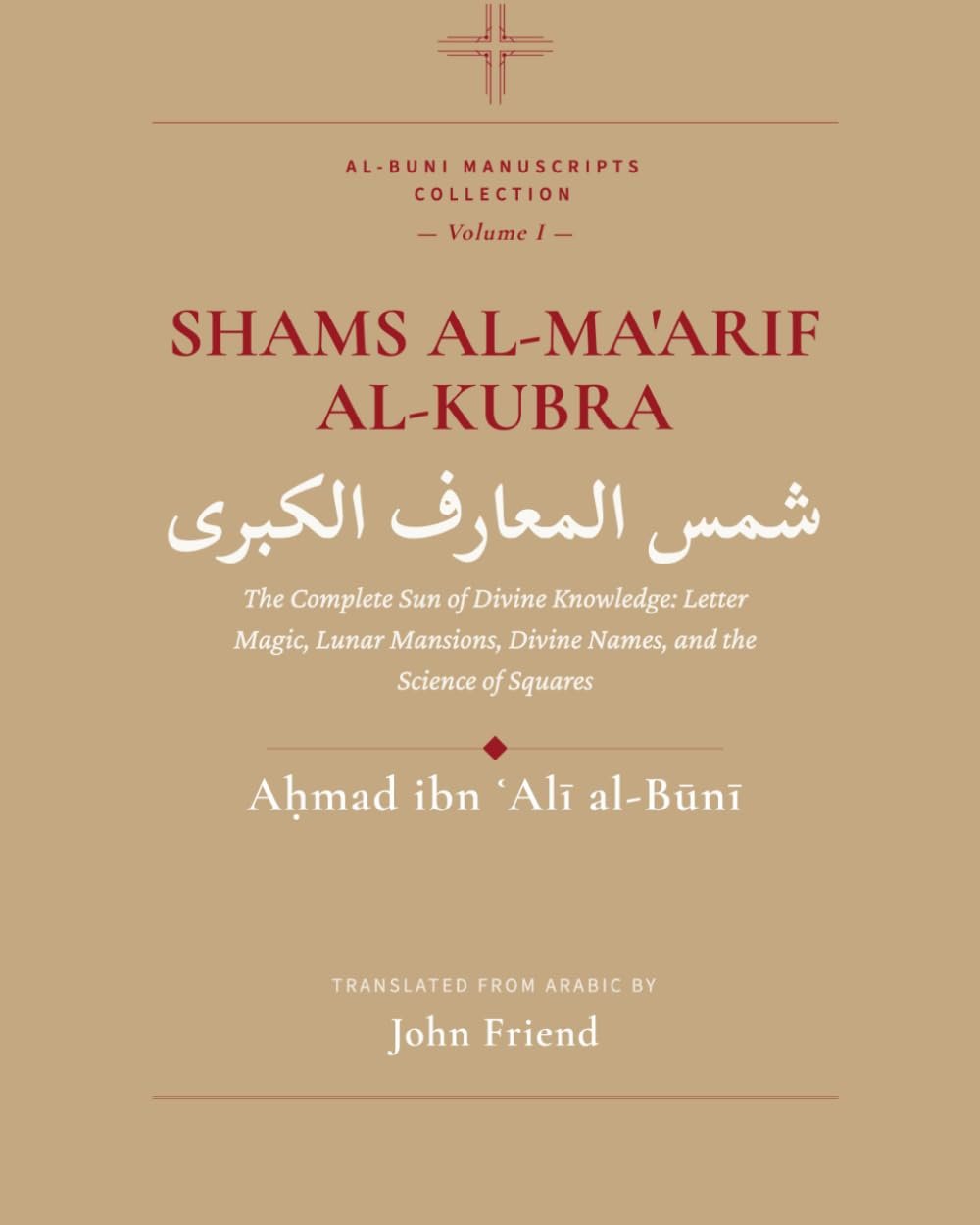
The most famous text in the entire Arabic occult tradition — 40 chapters covering letter science, magic squares, divine names, lunar mansions, planetary correspondences, and talismanic construction. John Friend Publishing's translation (818 pages) is the first complete English rendering of the standard 40-chapter text. No other complete English translation exists. Status: Complete translation available, on Amazon.
Suns of Lights and the Great Treasures of Secrets (Shams al-Anwar, Ibn al-Hajj al-Tilmsani, 1327 CE)
Written in 1327 CE by Ibn al-Hajj al-Tilmsani, a scholar working directly within the al-Buni lineage, the Shams al-Anwar is the closest complete successor text to the Shams al-Ma'arif. Its very title signals the relationship. It covers the 99 Beautiful Names of God, magic squares from the 3×3 to the 7×7 planetary forms, the seven planetary spirits with their timing and incenses, and the operative letter science. John Friend Publishing's translation is the first English rendering. Status: Complete translation available, on Amazon.
Kitab al-Ajnas: The Book of the Races (attr. Asif ibn Barkhiya)
One of the foundational Solomonic grimoires of the Arabic tradition, attributed to Asif ibn Barkhiya — the legendary vizier of Prophet Sulayman (Solomon) who moved the throne of Bilqis in the blink of an eye. The text catalogues the races of jinn, their hierarchies, and the operative procedures for working with them, with voces magicae preserved exactly from the manuscript and talismanic seals reproduced from the source. John Friend Publishing's translation (362 pages) is the first complete English version. Status: Complete translation available, on Amazon.
The Book of the Prophet Daniel (Kitab Danyal al-Nabi)
Islamic folk astronomy, zodiacal astrology, Abjad calendrical calculations, celestial prognostication, and traditional medicine — all attributed to the Prophet Daniel. A different order of text than the operative grimoires, but important for understanding how celestial science and prophetic attribution functioned together in the Arabic manuscript tradition. Part One of the book gives the zodiac signs in Arabic and English, from al-Ḥamal (Aries) to al-Ḥūt (Pisces), each with its ruling planet and month. Includes reproduced woodcut illustrations of the twelve zodiac signs. John Friend Publishing's translation (113 pages) is the first complete English version. Status: Complete translation available, on Amazon.
The Tested Remedies of the Monks (Mujarrabat al-Ruhban)
A remarkable syncretic text — spiritual remedies, protective amulets, spirit invocations, and talismanic constructions attributed to Christian monks versed in the esoteric sciences. The Mujarrabat al-Ruhban represents the cross-confessional current in Arabic occultism, where knowledge flowed between Christian and Islamic practitioners without the rigid boundaries later imposed by both traditions. John Friend Publishing's translation (308 pages) is the first complete English version. Status: Complete translation available, on Amazon.
The Radiant Jewels for Summoning the Kings of Jinn (al-Jawahir al-Lamma'a)
A focused manual of planetary hours and jinn-king conjuration — the timing science that underlies every operative working in the tradition. Which hour belongs to which planet, which king of the jinn governs which domain, and what the precise protocols are for approach at the correct moment. John Friend Publishing's translation (211 pages) is the first complete English version. Status: Complete translation available, on Amazon.
Tumtum al-Hindi: The Book of Tumtum the Indian
One of the most celebrated texts in the Arabic occult corpus, attributed to a legendary Indian sage whose knowledge of stellar magic and talismanic operations entered the Islamic magical corpus through the great translation movements of the 8th–10th centuries. Covers stellar magic, attraction (jalb), excitation (tahyij), and love operations (tahbib) — the full operative spectrum of influence magic. John Friend Publishing's translation (298 pages) is the first complete English version. Status: Complete translation available, on Amazon.
The Complete Magic of the Jinn Kings (Sihr Muluk al-Jann)
The complete operative system for working with the seven kings of the jinn. Conjuration protocols, planetary correspondences, and magic squares. John Friend Publishing's translation (241 pages) is the first complete English version. Status: Complete translation available, on Amazon.
Wisdom of the Ages and Secret of the Sages ('Uyun al-Haqa'iq wa-Idah al-Tara'iq, attr. Abu al-Qasim al-'Iraqi, 13th c.)
A thirteenth-century Arabic handbook of natural magic and marvels attributed to Abu al-Qasim al-'Iraqi, the Egyptian alchemist and occultist known as al-Simawi. Its thirty chapters move from the nawamis, the talismans behind every marvel, through incenses and fumigations, soporifics, niranjat and the illusionist's stratagems, to the stage marvels of the medieval Islamic world, the methods of the deceivers of the author's age, and the properties of plants, animals, stones and minerals. Recipes that hide their key ingredients in cipher signs keep those signs where the author placed them. John Friend Publishing's translation (327 pages) is the complete English version. Status: Complete translation available, on Amazon.
The Al-Buni Manuscripts Collection
Ahmad al-Buni (d. 1225 CE) is the central figure of the Arabic occult tradition. The texts directly attributed to him — the corpus Bunianum — form the most extensive and systematically translated body of Arabic occult material in English. John Friend Publishing has produced eight volumes of direct translations from al-Buni's manuscripts.
al-Asrar al-Rabbaniyyah (The Divine Secrets) — Vol. II
The foundational text on the spiritual properties of the Arabic letters. Each of the 28 letters is treated as a living entity with its own spirit, elemental correspondence, and celestial affiliation. The inner architecture of the Arabic alphabet as al-Buni understood it. 135 pages. On Amazon.
Manba' Usul al-Hikma (The Source of the Foundations of Wisdom) — Vol. III
Contains the Barhatiyyah oath — considered the most powerful conjuration in the entire Arabic magical tradition — alongside systematic magic square construction methods and divine name operations. A massive and consequential text. 485 pages. On Amazon.
Hijab 'Azim al-Sha'n — Vol. IV
A concentrated manual of protective talismans and spiritual veils (hijab). Contains the seven protective veils and the talisman construction methods that later authorities considered too dangerous to print. 49 pages. On Amazon.
Majmu'at al-Awrad (Collection of Litanies) — Vol. V
Prayers, litanies, and invocations for specific emergencies: plague, childbirth, the evil eye, spiritual distress. Practical spiritual remedies drawn from the prophetic and Sufi traditions within al-Buni's operative framework. 84 pages. On Amazon.
Majmu'at Thalath Rasa'il (Collection of Three Treatises) — Vol. VI
Three treatises attributed to al-Buni and his spiritual lineage, including the Sufi path of 60 gates from the Shadhili tradition — the forbidden treatises that circulated together in manuscript form, covering operative spirituality, mystical progression, and esoteric practice. 278 pages. On Amazon.
Mudih al-Tariq — Vol. VII
The most comprehensive treatment of divine name practice in the al-Buni corpus: the divine names, single or paired, across 80 chapters, each treated with its properties, invocation methods, and operative applications. 571 pages. On Amazon.
Usul 'Ilm al-Huruf — Vol. VIII
The theoretical foundations of letter science ('ilm al-huruf): the classification of letters into luminous and dark categories, the system for taking possession of intellects, souls, and hearts, and the advanced knowledge al-Buni reserved for practitioners who had already mastered the foundations. 161 pages. On Amazon.
From Manuscript to English: How a Medieval Arabic Manuscript Translation Is Made
Arabic grimoires — manuscripts copied by hand over centuries — carry two kinds of material that resist ordinary book translation: sacred formulas that must be recited exactly, and diagrams that must be reproduced exactly. The John Friend Publishing editions handle both the same way in every volume, a method set out in full on the Arabic to English translation page.
Prayers, invocations, divine names, and Quranic passages appear in three layers: English translation, romanized transliteration following IJMES conventions with full diacritical marks, and the original Arabic script, so the reader can set the English beside the Arabic. Barbarous names — the sequences of letters meant to be pronounced exactly as written — are transliterated letter for letter and printed beside the Arabic, never translated. Talismanic seals and magic squares are reproduced as images from the source manuscript, and where a source is illegible the gap is noted as a lacuna rather than filled with invented text. That is the standard worth holding any Arabic grimoire English translation to, and the clearest difference between a careful translation of Arabic manuscripts and a paraphrase.
What Is Not Yet Available
Honesty requires noting what is still missing. The Ghayat al-Hakim has been translated (as described above), but the full Arabic manuscript tradition behind it remains underexplored in English. The Ikhwan al-Safa' encyclopedias — the Brethren of Purity texts that form the Neoplatonic philosophical substrate of the entire tradition — exist in expensive multi-volume academic editions from Oxford University Press, not accessible translations. The Kitab al-Istamatis, the texts attributed to Hermes Trismegistus in Arabic, and the great Ottoman commentaries on al-Buni remain untranslated. There is decades of work still to be done.
Two questions deserve a direct answer here. Readers looking for a Ghayat al-Hakim English translation, or for the Picatrix Arabic original behind the Latin, should know that the two are not the same book: the Latin Picatrix reworked its Arabic source rather than reproducing it, so it is worth checking which version any edition follows. Our study of how the Arabic Ghayat al-Hakim became the Latin Picatrix sets out what changed. And readers hoping for an Islamic dream interpretation manuscript will not find a dream dictionary on this list. What these grimoires contain instead are dream operations: The Complete Magic of the Jinn Kings gives an operation for prophetic dreams and visions, with a magic square written and placed beneath the head in sleep; the Kitab al-Ajnas gives a seal for dream revelation and a dream consultation by istikhara; and the Mujarrabat al-Ruhban includes a short chapter on a woman knowing through her dreams.
What exists today represents a watershed moment: more of the Arabic occult tradition is available to English readers than at any previous point in history. The sixteen titles from John Friend Publishing alone constitute a body of material that would have been unimaginable to an English reader even five years ago.
A Quick-Reference Table
| Text | Publisher | Status | Access |
|---|---|---|---|
| Shams al-Ma'arif al-Kubra | John Friend Publishing | Complete | Amazon (KU, PB, Kindle) |
| Shams al-Anwar (Ibn Tilmsani) | John Friend Publishing | Complete | Amazon (KU, PB, HC, Kindle) |
| Kitab al-Ajnas | John Friend Publishing | Complete | Amazon (KU, PB, HC, Kindle) |
| Tumtum al-Hindi | John Friend Publishing | Complete | Amazon (KU, PB, HC, Kindle) |
| al-Jawahir al-Lamma'a | John Friend Publishing | Complete | Amazon (KU, PB, HC, Kindle) |
| Sihr Muluk al-Jann | John Friend Publishing | Complete | Amazon (KU, PB, HC, Kindle) |
| 'Uyun al-Haqa'iq (Wisdom of the Ages) | John Friend Publishing | Complete | Amazon (KU, PB, HC, Kindle) |
| Mujarrabat al-Ruhban | John Friend Publishing | Complete | Amazon (KU, PB, HC, Kindle) |
| Kitab Danyal al-Nabi | John Friend Publishing | Complete | Amazon (KU, PB, HC, Kindle) |
| al-Asrar al-Rabbaniyyah (al-Buni) | John Friend Publishing | Complete | Amazon (KU, PB, Kindle) |
| Manba' Usul al-Hikma (al-Buni) | John Friend Publishing | Complete | Amazon (KU, PB, Kindle) |
| Hijab 'Azim al-Sha'n (al-Buni) | John Friend Publishing | Complete | Amazon (KU, PB, Kindle) |
| Majmu'at al-Awrad (al-Buni) | John Friend Publishing | Complete | Amazon (KU, PB, Kindle) |
| Majmu'at Thalath Rasa'il (al-Buni) | John Friend Publishing | Complete | Amazon (KU, PB, Kindle) |
| Mudih al-Tariq (al-Buni) | John Friend Publishing | Complete | Amazon (KU, PB, Kindle) |
| Usul 'Ilm al-Huruf (al-Buni) | John Friend Publishing | Complete | Amazon (KU, PB, Kindle) |
| Picatrix (Latin-based) | Llewellyn (Greer/Warnock) | Complete | Print, widely available |
| Picatrix / Ghayat al-Hakim (Arabic) | Inner Traditions (Attrell/Porreca) | Complete | |
| Shams al-Ma'arif (selected translation) | Revelore Press | Selected | Print (limited) |
| Al-Buni scholarship (monographs) | Brill Academic | Academic only | Institutional pricing |
Where to Start
If you are new to the Arabic occult tradition, the question of where to begin is not obvious. The Shams al-Ma'arif is the most famous text, but its 818 pages assume familiarity with the operative framework — the letter science, the magic square construction, the planetary correspondences — that is better learned from shorter, more focused texts first.
Three entry points into the Islamic grimoire tradition, depending on what draws you:
If you want the operative system: Begin with Suns of Lights and the Great Treasures of Secrets. It is organized as a practitioner's manual, moving from foundational principles through the Names of God to magic squares to planetary timing — a complete working introduction in 264 pages.
If you want the al-Buni corpus specifically: Begin with al-Asrar al-Rabbaniyyah. At 135 pages, it is al-Buni's concentrated treatment of the spiritual properties of each Arabic letter — the conceptual foundation on which everything else in the corpus rests.
If you want the jinn tradition: Begin with The Radiant Jewels for Summoning the Kings of Jinn. It covers the planetary hours system and jinn-king conjuration protocols in a focused, operationally clear format before moving to the larger texts.
All sixteen titles are available through John Friend Publishing on Amazon. All titles are free with Kindle Unlimited.
Before choosing among these Arabic occult books, it can help to read around them: our articles on Islamic occultism take the manuscripts one at a time, from al-Buni’s letter science to the conjuration of the jinn kings.